
Gear & Home is reader-supported. As an Amazon Associate I earn from qualifying purchases. When you buy through links on our site, we may earn an affiliate commission, at no extra cost to you. Learn more.
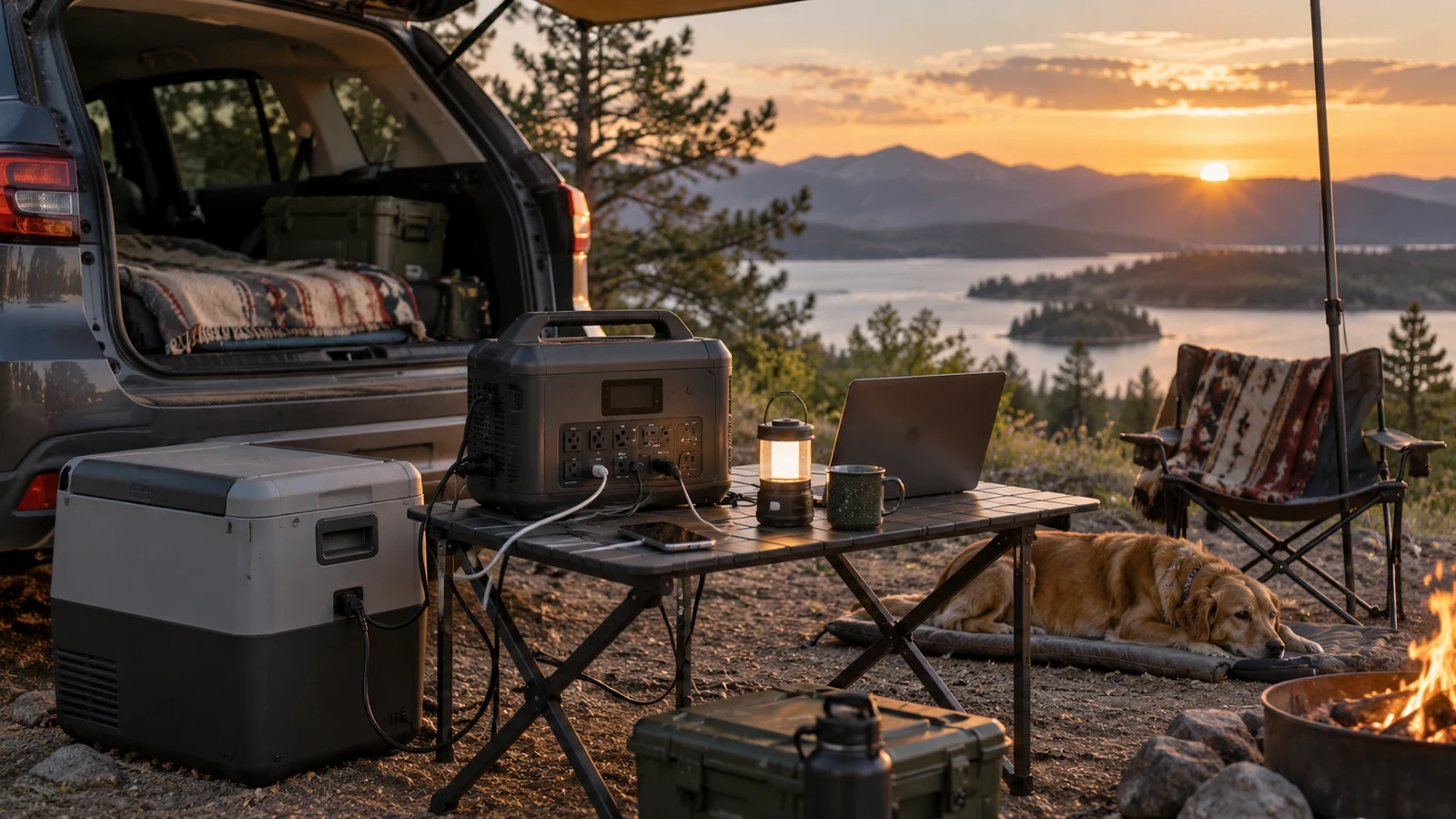
For most two-night car-camping trips, a portable power station in the 600 to 1,000Wh class is the practical starting point. Go smaller if you are only charging electronics. Move above 1,000Wh when a 12V fridge, CPAP, heavy laptop use or other overnight loads become part of the plan.
The important part is not choosing a battery by trip length alone. Car camping gives you room to carry more power than backpacking, but the right size still comes from your daily energy use, the number of days between recharges and the highest load you need to run at once.
What size portable power station do you need for car camping?
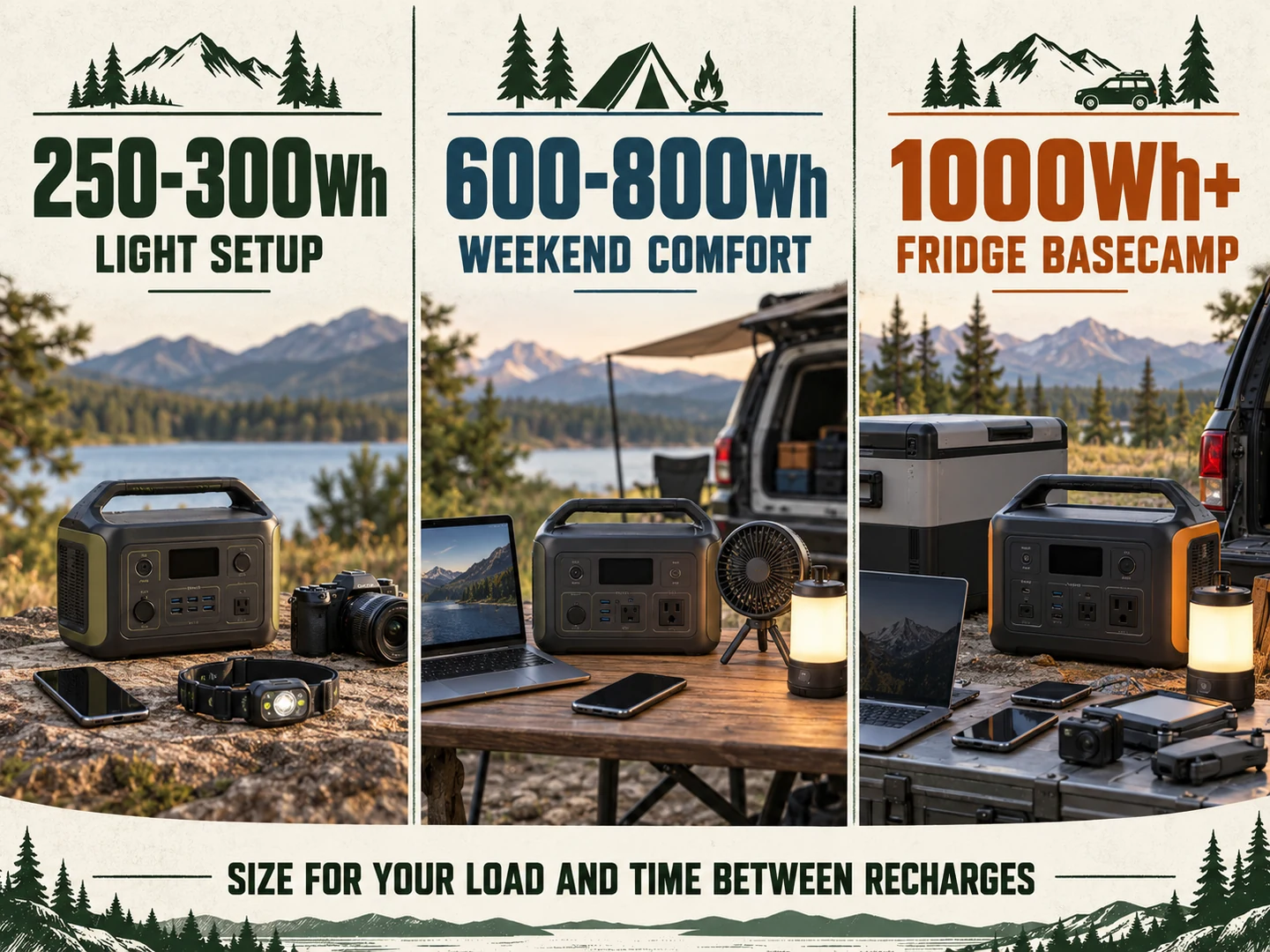
Start around 250 to 300Wh for phones, lights and camera batteries only. A 600 to 800Wh station is a better fit for a comfortable weekend that adds a laptop, fan and more device charging. If a 12V compressor fridge is a core load, a roughly 1,000Wh class station is a more useful starting point for a two-night trip before you account for reliable recharging.
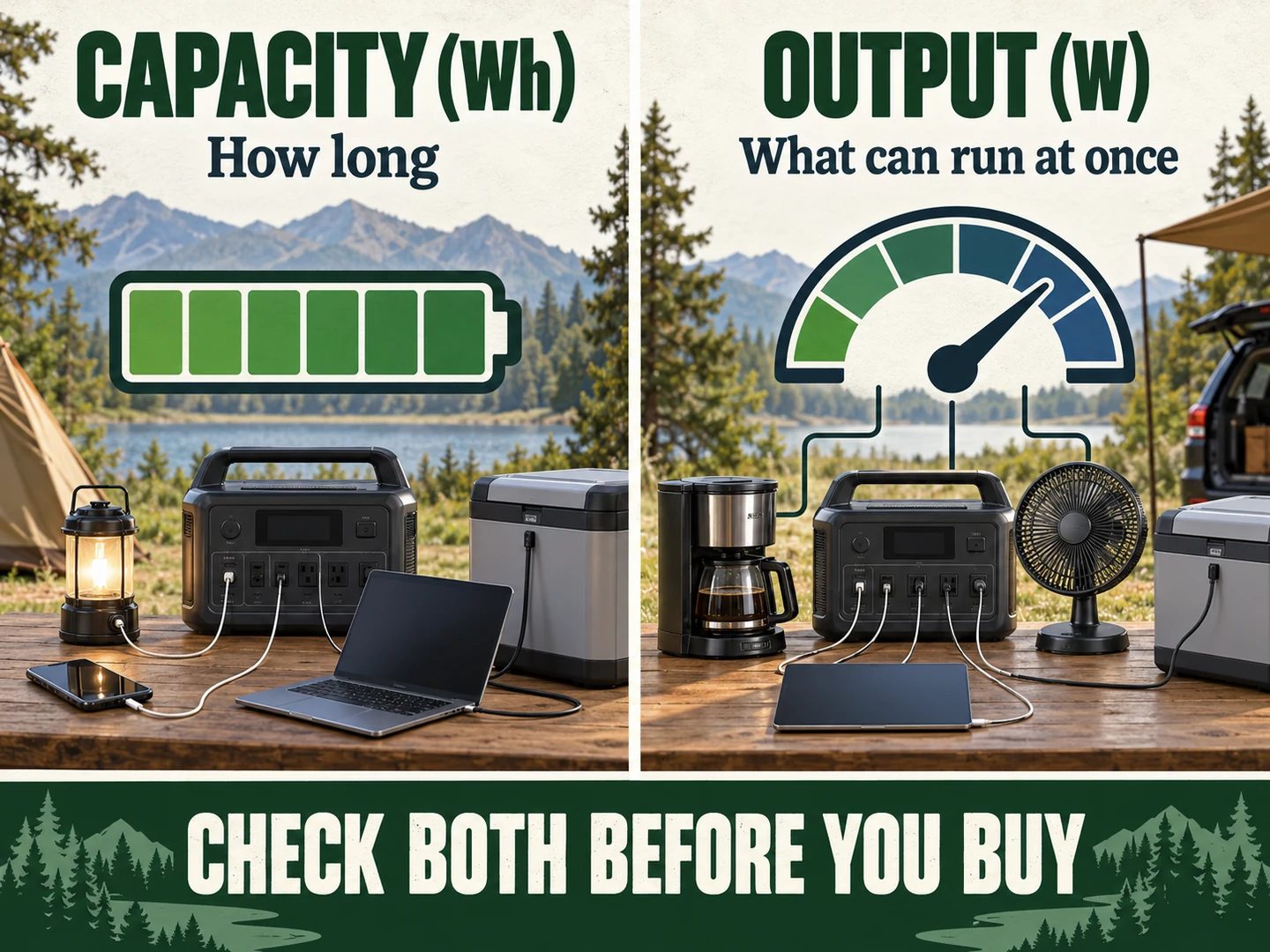
Capacity is only half the decision. Also check the station’s continuous output in watts. A large battery with a low-output inverter can still refuse a coffee maker, kettle or other high-draw appliance.
Car camping power station size table
| Starting class | Best fit | Typical loads to plan for | Main reason to move up |
|---|---|---|---|
| 250 to 300Wh | Light overnight or electronics-only trips | Phones, headlamps, camera batteries, small lights | Laptop use, overnight fan, powered cooler or fridge |
| 600 to 800Wh | Comfortable weekend car camping | Phones, lights, laptop, fan, cameras, air-mattress pump | Fridge duty cycle, CPAP, longer stays, high-draw AC appliances |
| Around 1,000Wh | Fridge-centered weekend basecamp | 12V compressor fridge plus ordinary electronics | Multiple nights without recharge, heavier work setup or cooking loads |
| 1,500 to 2,000Wh+ | Extended or power-heavy basecamp | Fridge, laptop, communications, several people, larger AC loads | Longer off-grid intervals or multiple high-energy devices |
250 to 300Wh
Small electronics
Laptop, fan, cooling
600 to 800Wh
Two-night mixed loads
Fridge or CPAP
Around 1,000Wh
12V fridge plus electronics
More days, heavier loads
1,500 to 2,000Wh+
Power-heavy camps
Weight and recharge time
These are starting classes, not guaranteed runtime bands. A hot campsite can make a fridge cycle more often, a laptop can draw very differently under light and heavy use, and AC conversion adds losses that do not show up in the nameplate capacity.
Calculate your car-camping capacity in four steps
Write down everything you will charge or run: phone, lights, laptop, fan, camera, fridge, CPAP, pump, projector or cooking appliance.
For a device that runs continuously, multiply watts by hours used. For rechargeable electronics, use the battery energy or the energy reported by a USB meter when possible.
A three-night trip does not require three days of stored energy if you can reliably replace a large part of the battery while driving or from campsite power.
Do not size to the exact arithmetic minimum. A roughly 20 percent planning buffer is a useful starting point when you do not have model-specific usable-capacity test data.
Actual usable energy depends on the station, load, battery state, temperature and whether you use AC, USB or 12V DC. The buffer simply keeps the shopping decision from depending on perfect conditions.
A simple formula
Daily energy (Wh) = device watts x hours used per day.
Starting battery target = total daily Wh x days between reliable recharges x 1.2.
If the result is 610Wh, do not obsess over finding a station labeled exactly 610Wh. Shop the next sensible capacity class and then check output, ports, weight and recharge options.
Three example weekend calculations
The numbers below are intentionally hypothetical. They show how the method works, not what your exact devices consume.
Example 1: electronics-only weekend
Add 20 percent planning headroom and the target becomes about 168Wh. A 250 to 300Wh station leaves useful reserve without forcing you into a much heavier box. This is the class where portability can still matter even though the car is doing the carrying.
Example 2: comfortable two-night camp
With headroom, the target is about 576Wh. That is why the 600 to 800Wh class is a strong weekend starting point when the campsite includes more than phone charging but does not depend on a fridge.
If a fan is one of your main loads, see our camping fan guide before using the example wattage above. Your actual fan may use substantially more or less power depending on speed and design.
Example 3: two nights with a 12V compressor fridge
With 20 percent headroom, this hypothetical setup lands just above 1,000Wh. The critical word is hypothetical: compressor-fridge energy use changes with ambient temperature, ventilation, thermostat setting, food temperature, door openings and the exact model. Use the fridge’s real energy data if available rather than copying 300Wh/day into your shopping list.
For the cooling side of the decision, our 12V fridge guide explains why battery sizing should be based on energy over time rather than simply multiplying a compressor’s rated watts by 24 hours.
Capacity and output are two different sizing decisions
Watt-hours answer how long. Watts answer what can run. You need both numbers to fit the trip.
A 1,000Wh battery does not automatically mean a 1,000W appliance is a good match. Likewise, a station with a high-output inverter can still have a small battery that drains quickly under a heavy load.
For car camping, this matters most when you add heat-producing appliances. Coffee makers, kettles, hot plates and induction cooktops can demand far more instantaneous power than lights, phones, laptops or a compressor fridge. If electric cooking is not a real requirement, do not buy a much larger inverter and battery just because the product page shows a kettle.
A 12V fridge changes the sizing problem more than phones do
Phones and cameras are easy to count because their batteries are relatively small and the charging event is finite. A fridge runs all day, but its compressor cycles on and off. That makes average daily energy much more important than the running wattage printed on a spec sheet.
- Start with measured or manufacturer energy use if you have it. That is more useful than assuming the compressor runs continuously.
- Use the 12V DC output when the fridge and station are designed for it. This can avoid unnecessary DC-to-AC conversion, though exact efficiency still depends on the equipment.
- Pre-chill the fridge and food at home. Pulling a warm box down to temperature at camp increases the early energy load.
- Plan for heat. Hot weather, poor ventilation and frequent opening can increase compressor runtime.
If reliable refrigeration is non-negotiable and you cannot recharge during the trip, treat the fridge as the anchor load and size everything else around it.
Your recharge plan can reduce the battery you need
Car camping has one advantage that generic off-grid sizing guides often underplay: the vehicle can move with the battery. That gives you more ways to replace energy between nights.
Campground AC power
If you can recharge fully at a powered site every day, you only need enough stored energy to bridge the periods when you are away from the outlet. A 1,500Wh station may be unnecessary if your actual overnight load is 400Wh and you recharge each morning.
Charging while driving
Many current stations can recharge from a vehicle, but the available input varies widely by model and charging method. Standard car-port charging is often much slower than wall charging. Dedicated alternator chargers can be faster, but compatibility, wiring and installation matter. Count only the energy you can reasonably replace during the driving you already plan to do.
Solar
Solar can extend a trip, but panel wattage is not the same as guaranteed daily energy. Shade, sun angle, clouds, heat and the station’s solar-input limit all matter. Do not downsize the battery on the assumption that a panel will deliver its label wattage all day.
If your energy budget only works when the engine must run at camp for long periods, either reduce the loads, improve the recharge method or move to a larger storage class.
Three current power stations that show the size classes
These are reference points, not a second roundup. The goal is to show what the capacity classes look like in current products. For a complete shortlist by buyer type, use our best portable power stations for camping guide.
Anker SOLIX C300
288Wh capacity, 300W AC output. Best aligned with electronics-first trips where compact size matters more than running large AC appliances.
BLUETTI AC70
768Wh capacity, 1,000W AC output. A useful example of the 600 to 800Wh weekend class with a regulated 12V/10A car outlet.
Anker SOLIX C1000 Gen 2
1,024Wh capacity, 2,000W output. Shows how a roughly 1kWh battery can also provide much more inverter headroom for a power-heavy car camp.
Exact output, charging limits and ports still matter after you choose the capacity class. If your budget is the main constraint, compare the current options in our portable power stations under $500 guide rather than buying the largest Wh number you see on sale.
Five car-camping sizing mistakes to avoid
Buying by watts alone
- A 1,000W or 2,000W label can describe inverter output, not battery capacity.
- It tells you very little about runtime without the Wh number.
Buying by Wh alone
- A large battery can still have insufficient continuous output for a high-draw appliance.
- Check simultaneous loads, not only the single largest device.
Assuming the fridge runs at rated watts 24/7
- Compressor refrigerators cycle.
- Use energy over time or a measured average when possible.
Counting solar at nameplate output all day
- Real solar input changes through the day.
- Panel and station limits can both reduce recovery.
Car camping reduces the penalty for weight, but it does not eliminate it. Bigger stations cost more, occupy more cargo space and can become awkward to move around camp. If your two-night load is 180Wh, a 2kWh unit solves a problem you do not have.
The simplest decision rule
Choose the smallest station that covers your energy budget between reliable recharges and still has enough continuous output for the devices you will run together.
For many car campers that means:
- 250 to 300Wh for electronics-only trips.
- 600 to 800Wh for a comfortable two-night weekend without a fridge as the anchor load.
- Around 1,000Wh when a compressor fridge plus ordinary electronics needs to run through the weekend.
- 1,500Wh and above when the trip is longer, the campsite is shared by several people, or high-energy devices are genuinely part of the setup.
Do the arithmetic first. Product shopping becomes much easier once you know which capacity class you actually need.
FAQ
Is a 300Wh power station enough for car camping?
It can be enough for a short electronics-only trip with phones, lights and camera batteries. It is usually too small to be a comfortable default once you add an overnight fan, substantial laptop use, CPAP or a 12V fridge.
Is a 500Wh power station enough for a weekend camping trip?
Sometimes. If your calculated two-day energy budget stays comfortably below the usable energy of the station, 500Wh can work well. A 600 to 800Wh class gives more margin for mixed comfort loads without jumping straight to a 1kWh box.
Is 1,000Wh enough for car camping?
For many two-night setups, yes. A roughly 1,000Wh station is a useful starting class when a 12V compressor fridge and normal electronics are involved. It is not a guarantee: the exact fridge, weather, trip length and recharge plan determine the real requirement.
How do I calculate how many watt-hours I need?
Multiply each device’s watts by the hours you use it per day, add the devices together, then multiply by the number of days between reliable recharges. Add reasonable planning headroom rather than sizing to the exact arithmetic minimum.
Do I need a 1,000W or 2,000W power station for camping?
That number usually refers to output, not capacity. Choose continuous output from the devices you need to run at the same time. Phones, laptops, lights and fridges generally need far less output than kettles, coffee makers or electric cooking appliances.
Can I charge a portable power station from my car while driving?
Many models support vehicle charging, but input power and required accessories vary by model. Standard car-port charging can be slow, while dedicated alternator chargers may be faster. Check the exact station and vehicle-charging instructions before counting that energy in your trip plan.