
Gear & Home is reader-supported. As an Amazon Associate I earn from qualifying purchases. When you buy through links on our site, we may earn an affiliate commission, at no extra cost to you. Learn more.
The best portable power station under $500 for camping is not necessarily the model with the biggest battery. At this budget, the useful choice is the station that gives you enough watt-hours for your trip, enough continuous output for the gear you actually run, and a weight you will still want to move around camp.
For most car campers shopping below $500, the sweet spot is now roughly 500–800Wh. Smaller 280–300Wh stations are excellent for phones, cameras, laptops, lights and short trips; larger models near the top of this budget make more sense once a 12V fridge or a more demanding shared campsite enters the plan.
BLUETTI AC70 is the best portable power station under $500 for most campers
Pick the BLUETTI AC70 if you want the most capable all-around camping station inside this budget. Its 768Wh LFP battery and 1,000W continuous AC output give it enough reserve and inverter headroom for a 12V fridge, lights, device charging and many normal campsite loads without jumping into a much larger 1kWh-class box.
Pick the Jackery Explorer 600 v2 if carrying weight matters more. At 640Wh and about 14.1 lb, it stores substantially more energy than the mini stations while staying unusually easy to move. If your trip is mostly electronics, the EcoFlow RIVER 3 Plus or Anker SOLIX C300 can save even more weight.
Quick Picks
Jackery Explorer 600 v2
Useful weekend reserve without 20+ lb bulk · 640Wh · 14.1 lb
EcoFlow RIVER 3 Plus
Short trips where inverter headroom matters · 286Wh · 600W
Best Portable Power Stations Under $500 Compared
| Pick | Capacity | AC output | Weight | Solar input | Best for | Buy |
|---|---|---|---|---|---|---|
| BLUETTI AC70 Best Overall |
768Wh | 1,000W | 22.5 lb | 500W max | 12V fridge + weekend camp loads | Check availability on Amazon |
| Jackery Explorer 600 v2 Best Capacity-to-Weight |
640Wh | 500W | 14.11 lb | 200W max | Campers who carry the station often | Check availability at Jackery |
| EcoFlow RIVER 2 Max Best Value Mid-Size |
512Wh | 500W | 13.3 lb | 220W max | Typical weekend camping | Check availability on Amazon |
| EcoFlow RIVER 3 Plus Best Compact High-Output |
286Wh | 600W | 10.4 lb | 220W max | Short trips and higher-draw small gear | Check availability on Amazon |
| Anker SOLIX C300 Best for Electronics |
288Wh | 300W | 9.1 lb | 100W max | USB-C-heavy electronics kits | Check availability on Amazon |
BLUETTI AC70
768Wh
1,000W
22.5 lb
500W
Jackery Explorer 600 v2
640Wh
500W
14.11 lb
200W
EcoFlow RIVER 2 Max
512Wh
500W
13.3 lb
220W
EcoFlow RIVER 3 Plus
286Wh
600W
10.4 lb
220W
Anker SOLIX C300
288Wh
300W
9.1 lb
100W
Capacity and output are manufacturer ratings. Real usable energy is lower after inverter and system losses. Solar figures are maximum accepted input, not guaranteed field production.
Watt-hours (Wh) tell you how much energy is stored. Continuous watts (W) tell you what the station can run at one time. A 700Wh battery with a 500W inverter can run longer than a 300Wh unit, but it can still refuse an appliance that needs more than 500W continuously.
The 5 Best Portable Power Stations Under $500 for Camping
BLUETTI AC70
The strongest all-around camping pick below $500 when a fridge and normal campsite loads matter more than minimum carry weight.
#1
The AC70 is our default recommendation because it gives you enough battery to stop treating every watt as precious. A compressor fridge, lights, phones and camera batteries are a much more natural fit here than on a 286Wh or 288Wh station. The 1,000W inverter also gives you useful headroom for short appliance loads that simply exceed the 300W and 500W limits of the smaller picks.
Its strongest camping feature may be the solar ceiling. Up to 500W of accepted PV input gives the AC70 a realistic recovery path during a sunny day, especially compared with mini stations that accept 100–220W. That does not mean a 500W panel will deliver 500W all day, but it gives you room to use a larger array without the station immediately becoming the bottleneck.
Pros
- Useful 768Wh middle-ground capacity
- 1,000W continuous AC output
- Up to 500W solar input
- LFP battery and app control
- Regulated 12V car output suits fridge-led camps
Limitations
- 22.5 lb is heavy compared with the 500–640Wh picks
- 1,000W is still not appliance-anything-you-want territory
- Power-lifting modes should not be treated as a replacement for continuous inverter headroom
Jackery Explorer 600 v2
The pick for campers who want genuinely useful weekend capacity without jumping into a 20-plus-pound station.
#2
This is the station we would choose when the AC70 sounds right on capacity but wrong on weight. A 640Wh battery is large enough to move beyond pure phone-and-laptop duty, yet 14.11 lb is still reasonable to carry from the vehicle to a campsite or move between a tent, picnic table and car.
The trade-off is inverter output. The 500W continuous limit is fine for lights, laptops, fans, camera gear, many pumps and modest 12V loads, but it is not a general-purpose cooking inverter. The station can store plenty of energy and still reject a device that asks for more than 500W continuously.
Pros
- 640Wh at only about 14.1 lb
- 200W solar input
- LFP battery rated for long cycle life
- Fast AC charging and 10ms UPS switching
- Simple physical controls
Limitations
- 500W continuous AC ceiling
- No app control on the 600 v2
- Newer model with less mature long-term owner evidence
EcoFlow RIVER 2 Max
A mature 500Wh-class option with fast charging, low weight and enough capacity for a typical weekend electronics-and-comfort setup.
#3
The RIVER 2 Max is less ambitious than the AC70, and that is exactly why it is good value. For many campers, 512Wh is enough to cover phones, lights, a laptop, a fan and other low-to-moderate loads without hauling a larger station. It also recharges very quickly from AC, which matters when your refill opportunity is a short stop instead of a full afternoon.
EcoFlow’s 220W solar input is also a better match for the battery than a tiny 100W ceiling would be. You can pair it with a practical folding panel and recover a meaningful part of the pack during good sun, while the station remains light enough to move easily.
Pros
- 512Wh capacity in a roughly 13-pound body
- One-hour AC recharge
- 220W solar input
- App control via Wi-Fi and Bluetooth
- Mature model with broad owner history
Limitations
- 500W rated AC output limits appliance use
- Older RIVER generation than the RIVER 3 Plus
- Not enough reserve for carefree multi-day fridge use without recharging
EcoFlow RIVER 3 Plus
A small battery with unusually strong 600W AC output, fast charging and optional expansion for buyers who value flexibility over raw runtime.
#4
The RIVER 3 Plus flips the usual mini-station compromise. Most 280–300Wh models pair a small battery with a 300W inverter. EcoFlow doubles the rated AC ceiling to 600W, which means more of your small appliances can actually start and run even though the battery will not run them for very long.
It also accepts up to 220W solar and can expand to 858Wh with compatible EcoFlow extra batteries. That expansion option is unusual in this class. For a camper who wants to start small but might later add more runtime, it gives the RIVER 3 Plus a path that the C300 does not have.
Pros
- 600W rated output from a compact 286Wh station
- One-hour AC charging
- Up to 220W solar input
- Expandable to 858Wh
- Quiet low-load operation and app control
Limitations
- 286Wh capacity is still limited for overnight fridge duty
- Extra batteries can erase the simplicity advantage of buying small
- X-Boost is not the same as 1,200W continuous rated output
Anker SOLIX C300
The compact AC station to buy when the campsite is mostly laptops, cameras, phones, lights and USB-C gear rather than appliances.
#5
The C300 is the easiest station here to justify for an electronics-heavy camp. It is about 9.1 lb, has multiple USB-C outputs including high-power ports for laptops, and still gives you AC outlets when a charger or accessory has no USB-C option. An integrated light is a useful bonus around a tent or table.
What it does not do is pretend to be a base-camp battery. At 288Wh, you should buy it because it is easy to carry and easy to recharge, not because you expect it to power refrigeration through a long weekend. If you are mainly charging phones and cameras, that restraint can be a feature rather than a weakness.
Pros
- Only about 9.1 lb
- Strong USB-C port mix
- Built-in light
- Fast AC and USB-C charging options
- LFP battery and app control
Limitations
- 300W continuous AC output
- 288Wh is small for fridge-led or multi-day use
- 100W solar input is modest
- Not a replacement for a full-size UPS or appliance station
How to Choose a Portable Power Station Under $500
The under-$500 market is wide enough that shopping by price alone is not useful. Start with the devices you actually use at camp, then work backward to continuous watts, daily watt-hours and recharge opportunities.
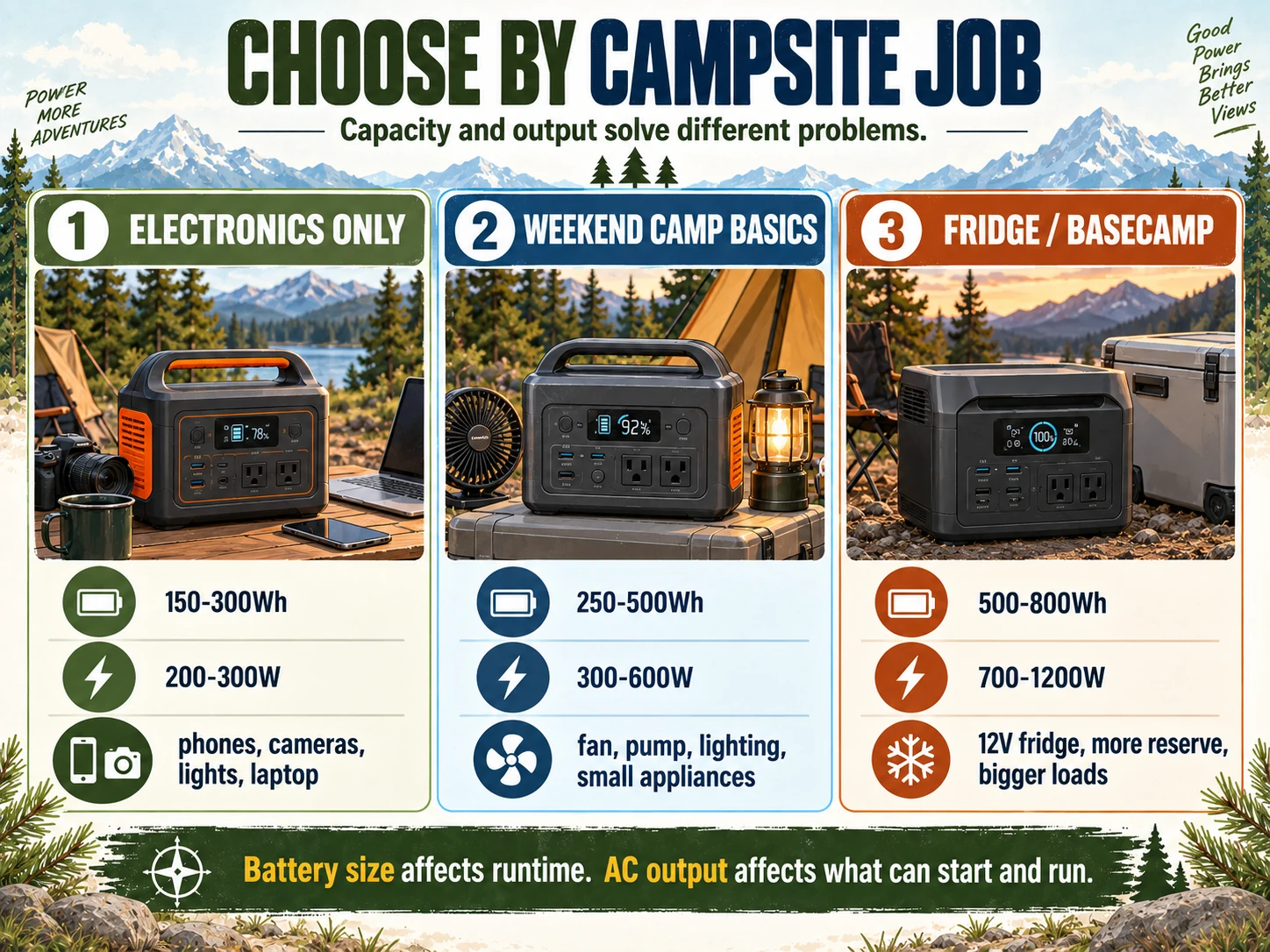
1. Choose the job before the battery size
About 250–300Wh
Phones, cameras, lights, tablets and laptops. Prioritize low weight and USB-C.
About 500–650Wh
Electronics plus fans, pumps and more reserve. This is the best balance for many buyers.
About 700–800Wh
More useful reserve for refrigeration and shared campsite loads without crossing into 1kWh pricing.
2. Continuous watts decide what can run
Do not buy from the surge number. A station advertised with a 1,000W or 1,200W boost mode may still be a 500W or 600W continuous inverter. For planning, use the rated continuous AC output and compare it with the actual running wattage of your appliance.
This is why the BLUETTI AC70 and EcoFlow RIVER 3 Plus stand out for different reasons. The AC70 combines more battery with 1,000W rated output. The RIVER 3 Plus keeps the battery small but gives you 600W rated output, so it can start more small appliances than many same-size stations.
3. Estimate runtime from watt-hours, then subtract losses
A simple first estimate is battery Wh ÷ device watts. Then reduce the result to allow for inverter losses, station overhead and the fact that the battery is not used with perfect efficiency. For AC loads, using roughly 80–90% of the nameplate capacity as a planning range is more realistic than assuming every rated watt-hour reaches your device.
For a compressor fridge, average energy use matters more than the compressor’s peak draw because the compressor cycles. If a fridge is the main reason you are buying a station, our 12V fridge guide is the better place to size the appliance side of the system.
4. Solar input matters only if you will actually carry panels
A high solar-input ceiling is useful when you camp off-grid for multiple days, but it is wasted specification if you never bring panels. The AC70 accepts up to 500W, while the compact stations here accept roughly 100–220W. That difference can matter enormously on a multi-day trip with good sun and very little on a two-night campground stay with wall power available.
If your priority is tiny-device charging rather than a full power station, a portable power bank may be cheaper and easier to carry.
5. Treat weight as part of the specification
There is a major usability difference between 9 lb and 22.5 lb even though both products are technically portable. If you move camp frequently, walk gear a meaningful distance from the car or simply dislike rearranging heavy batteries, the Jackery 600 v2, RIVER 2 Max, RIVER 3 Plus and C300 deserve extra weight in the decision.
6. Do not buy a deal that has moved above the budget
This category is unusually promotion-heavy. A model can spend weeks below $500 and then move back above it without changing in any technical way. We therefore do not hard-code live prices. If one of these picks is currently above $500 when you shop, compare the next option in the same size class instead of stretching the budget automatically.
What Does $500 Buy in a Portable Power Station in 2026?
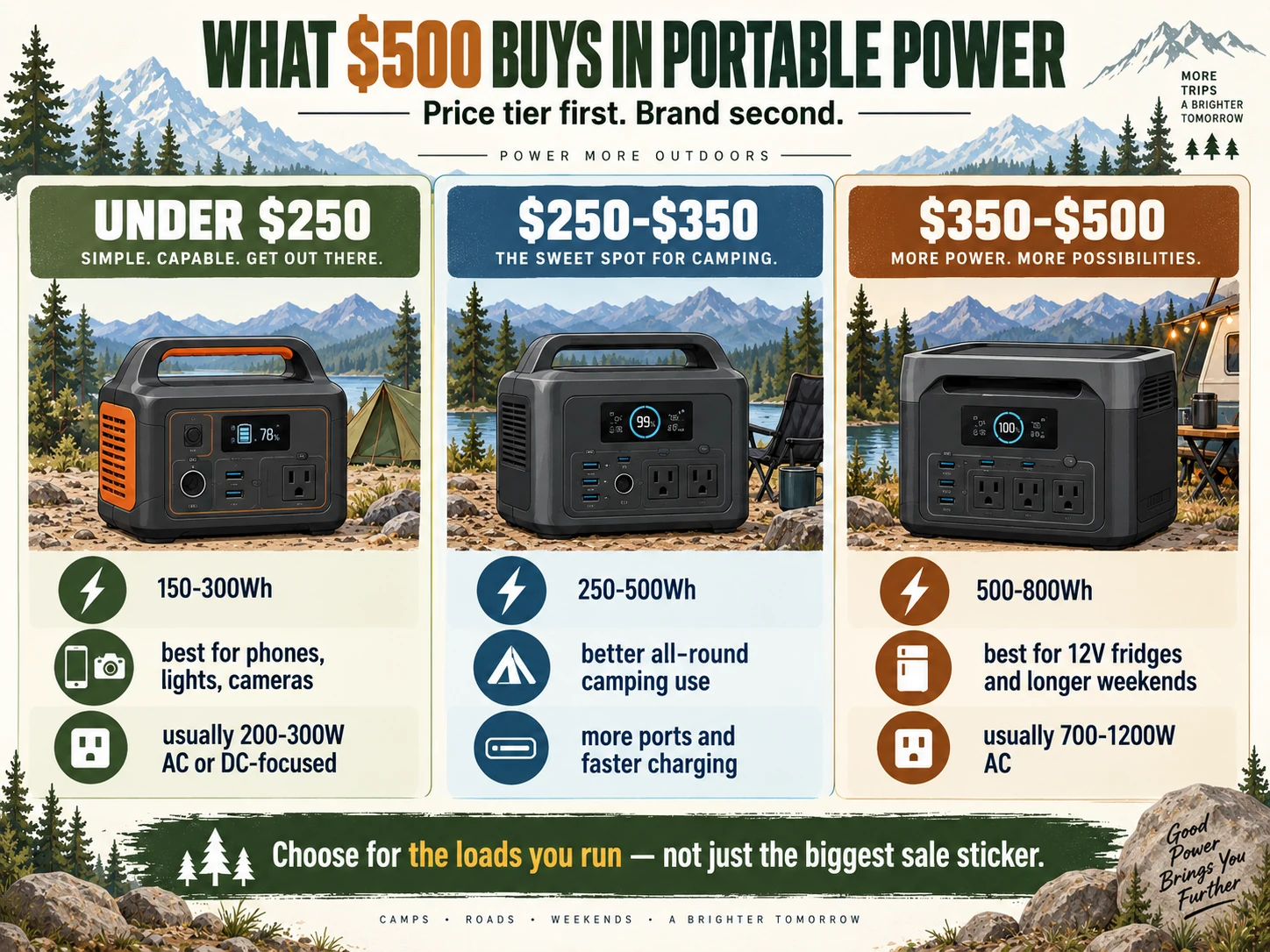
For camping, $500 now reaches much farther than it did a few years ago. LFP batteries, one-hour-class wall charging and useful USB-C output have moved downmarket. The main trade-off is no longer “cheap battery versus good battery”; it is how much capacity, inverter output and solar input you can get without buying more station than you need.
What About a Solar Generator Under $500?
A “solar generator” is usually a portable power station sold with one or more solar panels. The important buying decision is still the power station. A cheap bundle can look attractive while pairing a capable battery with a small panel that is too slow for your trip.
If your total budget is $500 including the panel, you will usually get a better-balanced system by buying a smaller station plus a useful panel than by spending nearly the whole budget on the largest battery and leaving no room for solar. For short campground trips, skip the panel entirely if you can recharge from a wall before leaving.
How We Chose the Best Power Stations Under $500
This is an editorial research roundup, not a Gear & Home laboratory test. We used current manufacturer specifications for capacity, output, weight, charging and solar limits; exact Amazon.com US listings for affiliate products; independent professional reviews for performance context; and owner discussions to identify recurring fit and complaint patterns.
FAQ: Portable Power Stations Under $500
What is the best portable power station under $500 for camping?
The BLUETTI AC70 is our best overall pick because its 768Wh battery, 1,000W continuous AC output and 500W solar-input ceiling give it the broadest camping usefulness without exceeding this budget during our latest check.
Is a 300Wh power station enough for camping?
Yes for electronics-first trips. Around 300Wh is a good class for phones, cameras, laptops, lights and small fans. It is less comfortable for a 12V fridge or multi-day camp unless you recharge frequently.
Is 500Wh enough for a weekend camping trip?
For many campers, yes. A 500Wh-class station is a strong middle ground for device charging, lights, fans and modest 12V loads. Whether it is enough for a fridge depends on the fridge’s average consumption, ambient temperature and your ability to recharge.
Can a portable power station under $500 run a 12V fridge?
Yes, if the station has enough battery capacity and a suitable 12V output. The BLUETTI AC70 is the strongest fridge-first pick here. Smaller 286–300Wh models can run a fridge, but they offer much less overnight reserve and depend more heavily on daily recharging.
Can a power station under $500 run a coffee maker or electric kettle?
Sometimes. Check the appliance’s running wattage against the station’s continuous AC rating. The 1,000W BLUETTI AC70 can run more campsite appliances than the 300W–600W compact models, but many kettles and cooking appliances still exceed 1,000W.
What is the difference between watts and watt-hours on a power station?
Watts measure power: how much a device needs at one time. Watt-hours measure stored energy: roughly how long the battery can provide power. You need enough watts to run the device and enough watt-hours to run it for the time you want.
Is LiFePO4 worth it for a camping power station?
Yes for most buyers. All five picks in this guide use LFP/LiFePO4 chemistry, which is now common in this price range and is valued for long cycle life and thermal stability.
Should I buy a solar panel with my power station?
Buy a panel if you regularly camp off-grid long enough to need daytime energy recovery. For short trips where you can leave home with a full battery, putting the same money into the right-size station may be more useful.
What size solar panel should I use with a camping power station?
Stay within the station’s voltage, current and connector limits, then choose panel wattage based on the station’s maximum solar input and how much good sun you realistically get. A larger panel can help in imperfect conditions, but never exceed the station’s electrical input limits.
When should I spend more than $500?
Spend more when you need around 1kWh or more of reserve, 1,500W–2,000W-class continuous output, electric cooking, e-bike charging, larger solar arrays or several days of fridge use with limited access to recharging.