
Gear & Home is reader-supported. As an Amazon Associate I earn from qualifying purchases. When you buy through links on our site, we may earn an affiliate commission, at no extra cost to you. Learn more.
A 12V compressor fridge is one of the biggest quality-of-life upgrades for car camping: no melted ice, no soggy food, and real temperature control. But the right model depends as much on your power system and cargo space as it does on capacity.
This guide focuses on compressor-based portable fridge/freezers that can actively refrigerate or freeze from vehicle or portable power. We did not mix in thermoelectric coolers, which generally have a more limited temperature drop relative to ambient conditions and are a different buying decision.
Dometic CFX5 45 is the best 12V fridge for most frequent campers
Dometic CFX5 45 is our Best Overall pick because its current 45-liter single-zone platform combines strong insulation, a -7°F to 68°F temperature range, 12/24V DC and household AC power, app monitoring, and a three-stage vehicle-battery protection system. It is expensive, but the current model is unusually complete and independent powered-cooler testing continues to place it at the top of the category.
Choose the ICECO VL45 ProS if you want a steel-bodied, SECOP-compressor alternative for overlanding; the BougeRV CRPRO30 for the strongest feature/value balance; the SetPower AJ30 for the lowest-cost sensible entry point; or the Anker SOLIX EverFrost 2 40L if an integrated removable battery matters more than weight.
Quick Picks
Dometic CFX5 45
Premium insulation, wide temperature range, app monitoring, and strong battery-protection controls for frequent camping and road travel.
ICECO VL45 ProS
A heavy steel 45L fridge with a SECOP compressor, multi-direction lid, and a five-year compressor warranty.
BougeRV CRPRO30
A 30-quart single-zone fridge with useful camp-friendly storage features and an optional removable-battery ecosystem.
SetPower AJ30
A simple 30L/32-quart compressor fridge that prioritizes basic cooling and low power demand over premium construction or smart features.
Anker SOLIX EverFrost 2 40L
A 40L cooler with a removable 288Wh LFP battery, wheels, and multiple recharge options for camps where cords are inconvenient.
Best 12V Camping Fridges Compared
| Pick | Capacity | Temperature range | Power | Battery included? | Best for | Amazon |
|---|---|---|---|---|---|---|
| Dometic CFX5 45 Best Overall |
45L / 47 qt | -7°F to 68°F | 12/24V DC + 100–240V AC | No | Frequent camping, road trips, premium builds | Check availability on Amazon |
| ICECO VL45 ProS Best for Overlanding |
45L / 47.5 qt | 0°F to 50°F | 12/24V DC + AC | No | Truck beds, overlanding, rugged-use bias | Check availability on Amazon |
| BougeRV CRPRO30 Best Value |
30 qt | -8°F to 50°F | 12/24V DC + 110–240V AC | No; optional battery slot | Couples, weekend trips, value-focused builds | Check availability on Amazon |
| SetPower AJ30 Best Budget |
30L / 32 qt | 0°F to 50°F | 12V-class vehicle + AC adapter | No | First 12V fridge, occasional camping | Check availability on Amazon |
| Anker SOLIX EverFrost 2 40L Best Battery-Powered |
40L / 42 qt | -4°F to 68°F | Battery + car + AC + USB-C + solar | Yes, 288Wh LFP | Cordless camp use, grocery runs, tailgating | Check availability on Amazon |
Dometic CFX5 45
45L
-7°F to 68°F
12/24V
External
ICECO VL45 ProS
45L
0°F to 50°F
Steel
SECOP
BougeRV CRPRO30
30 qt
-8°F to 50°F
27.55 lb
Optional
SetPower AJ30
30L / 32 qt
0°F to 50°F
<45W rated
<28W rated
Anker SOLIX EverFrost 2 40L
40L
-4°F to 68°F
288Wh LFP
56.22 lb
The 5 Best 12V Fridges for Camping
1. Dometic CFX5 45
The strongest all-around choice for campers who use a powered fridge often enough to justify premium insulation, sophisticated battery protection, and app-based monitoring.
The CFX5 45 is the least compromised single-zone fridge in this group. Its roughly 45-liter class is large enough for a normal couple or family weekend without moving into the oversized dual-zone category, and the wide set-temperature range means the same box can serve as a refrigerator or freezer.
Dometic’s battery protection is especially relevant in a vehicle. It monitors incoming voltage and can shut the fridge down before the vehicle battery drops too far. That is useful insurance, but it should not be treated as a substitute for a properly sized house battery or portable power station when you plan to camp with the engine off for long periods.
The app is useful when the fridge sits in a cargo area where you cannot see the display. It can monitor temperature and energy use, but we would still put a simple independent refrigerator thermometer inside when carrying food that genuinely matters. Software is convenient; a second temperature reference is cheap.
Pros
- Excellent insulation and current top-tier independent performance signal
- Wide -7°F to 68°F temperature range
- 12/24V DC plus household AC power
- Three-stage vehicle-battery protection and app monitoring
Limitations
- Premium purchase compared with value-focused alternatives
- Single zone: refrigerator or freezer, not both at once
- Lid-latch and wireless-setup complaints appear in owner discussions
2. ICECO VL45 ProS — 45L Single Zone
A steel-bodied alternative for vehicle-based campers who care more about rugged hardware, a SECOP compressor, and long compressor coverage than minimum weight or smart controls.
The VL45 ProS makes sense when the fridge is going to live in a vehicle rather than being carried across a campground every day. The steel shell, corner protection, removable basket, and lid that can open from either side are practical when the box is strapped into a truck bed, drawer system, or crowded cargo area.
It is also intentionally simple. You get physical controls, battery-protection settings, and MAX/ECO compressor modes rather than paying primarily for an app ecosystem. That is appealing for people who want the fridge to behave like an appliance instead of another connected gadget.
The weight is the reason it does not win overall. At about 50.5 pounds empty, moving the VL45 ProS becomes a two-hand job before food and drinks go inside. If you expect to unload the fridge at every camp, the lighter BougeRV is easier to live with.
Pros
- SECOP compressor with five-year compressor warranty
- Steel body and vehicle-oriented hardware
- Multi-direction lid helps in tight cargo layouts
- 12/24V DC and AC operation with MAX/ECO modes
Limitations
- Heavy at roughly 50.5 pounds empty
- Single-zone design
- Some owner reports focus on lid/latch play or rattle
3. BougeRV CRPRO30 — 30 Quart
The best value-focused choice for couples and weekend campers because it combines real compressor cooling, manageable size, camp-friendly storage details, and an optional battery ecosystem without premium-fridge bulk.
Thirty quarts is a useful size when a 45-liter fridge would simply become an excuse to carry more food. It is much easier to fit behind a seat or into a compact SUV, and the official current model weighs 27.55 pounds before loading—dramatically less than the ICECO and Anker picks.
The CRPRO30’s optional battery slot is the feature that separates it from many budget fridges. You do not have to buy the battery to use the fridge; normal 12/24V DC and household AC are supported. But if you later want short cordless operation away from the vehicle, the platform gives you that path without replacing the fridge.
BougeRV publishes different power figures across some current CRPRO30 pages and bundles, so we do not use a single wattage number to promise runtime. That is the right way to evaluate any compressor fridge anyway: actual energy use depends on ambient heat, set temperature, insulation, how often you open the lid, and how much warm food you load.
Pros
- Good 30-quart size for couples and shorter trips
- Much easier to move than the heavy 40–45L rugged picks
- Optional battery slot without requiring a proprietary battery to operate
- Useful camp details: storage box, light, tie-down points and cup holder
Limitations
- Less substantial shell than steel/premium overland fridges
- Single-zone layout
- Manufacturer power figures vary across current product/bundle pages, so runtime should be measured in your own setup
4. SetPower AJ30 — 30L / 32 Quart
A sensible first compressor fridge when the priority is keeping food cold for the least complication and cost, not buying premium materials, app control, or an integrated battery.
The AJ30 is the pick for the camper who is still deciding whether a powered fridge belongs in the kit at all. It gives you the core benefit—controlled compressor refrigeration without ice—without charging you for a battery, wheels, app, or steel overland enclosure.
SetPower’s own energy report shows why nameplate watts cannot be multiplied by 24 hours to predict your trip. The compressor cycles. How often it cycles depends heavily on temperature, setpoint, airflow around the compressor compartment, food load, and lid openings. Use the published power modes to size the outlet and wiring, but use real watt-hour consumption from your setup to plan battery capacity.
There is also some spec inconsistency between current SetPower product-family pages and older Amazon metadata for physical dimensions and weight. We therefore verify the exact AJ30 identity and capacity here without pretending that every historical listing field describes the same production revision.
Pros
- Low barrier to entering the compressor-fridge category
- 30L/32-quart size works well for short trips
- Simple MAX/ECO power modes
- Several long-term owners report multi-year service
Limitations
- Plastic hardware and connector durability receive more mixed owner feedback than premium picks
- No integrated battery
- Less refined fit, finish and control ecosystem than Dometic or Anker
5. Anker SOLIX EverFrost 2 40L — A17A4
The best choice when you want the fridge and short-term off-grid power in one rolling package instead of pairing a conventional 12V fridge with a separate power station.
The EverFrost 2 solves a different problem from the other four picks. A Dometic or ICECO assumes you already have a power system. Anker puts the battery in the fridge ecosystem itself, so you can roll the cooler away from the vehicle, run it during a stop, and recharge through several sources without moving food into another box.
Anker claims up to 52 hours from one battery under controlled lab conditions and up to 104 hours with two. Those numbers are useful for comparing the platform, not for planning your food safety around an exact deadline. The company itself notes that runtime varies with conditions. Hot weather, freezer setpoints, repeated openings, warm groceries, and battery age can all shorten it.
The obvious cost of the integrated system is mass. At about 56 pounds before food, this is the heaviest pick here. The wheels and telescoping handle help on smooth ground, but they do not make it a lightweight cooler for stairs, soft campsites, or lifting into a tall vehicle.
Pros
- 288Wh removable LFP battery included with this exact kit
- AC, vehicle, USB-C, and solar recharge options
- -4°F to 68°F temperature range
- Wheels and handle make the heavy system easier to move on firm ground
Limitations
- Very heavy at 56.22 pounds before food
- Single-zone 40L model
- If you already own a large power station, the integrated-battery premium may duplicate hardware you have
- Newer battery ecosystem has less long-term replacement history than generic 12V power
For perishable food, the FDA recommends keeping cold food at 40°F or below. If perishable food has been above 40°F for more than two hours—or more than one hour when outdoor temperatures exceed 90°F—it may no longer be safe. A fridge alarm or low-voltage cutoff therefore protects hardware, not the food by itself. Use an appliance thermometer and plan enough battery reserve for stationary camp time. See the FDA’s outdoor food-safety guidance.
How to Choose a 12V Fridge for Camping
Choose compressor cooling, not just a box with a 12V plug
For camping refrigeration, a compressor fridge behaves much more like a household refrigerator: you set a target temperature and the compressor cycles to maintain it. Thermoelectric coolers are usually lighter and cheaper, but their cooling ability is tied more closely to ambient temperature and many cannot freeze. If your goal is safe food storage through hot road trips, compressor cooling is the more predictable category.
30L is compact; 40–45L is the practical sweet spot for many vehicle campers
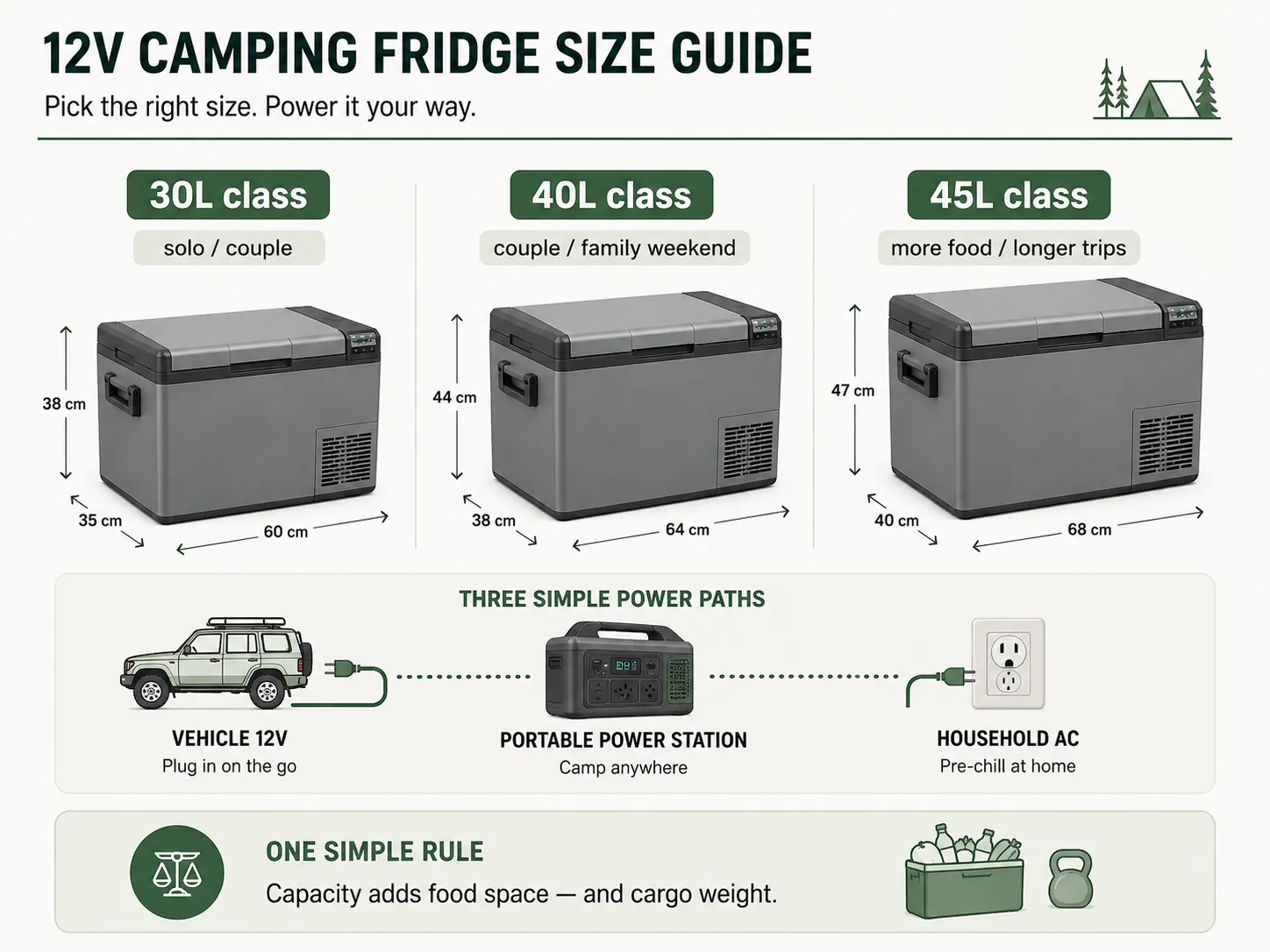
A roughly 30L fridge works well for one or two people on shorter trips if you pack deliberately. The 40–45L class gives more room for fresh food and drinks without consuming an entire SUV cargo area. Large dual-zone units make more sense when you need several days of groceries or simultaneous fridge and freezer temperatures.
Single-zone and dual-zone are different decisions
Every main pick in this roundup is optimized around one controlled temperature zone. That is efficient and simple, but it means the whole main compartment is either refrigerator-cold or freezer-cold. If you need frozen meat and chilled produce at the same time, start your search with a true dual-zone model rather than trying to force one zone to do both jobs.
Size your battery in watt-hours, not by guessing from the fridge’s rated watts
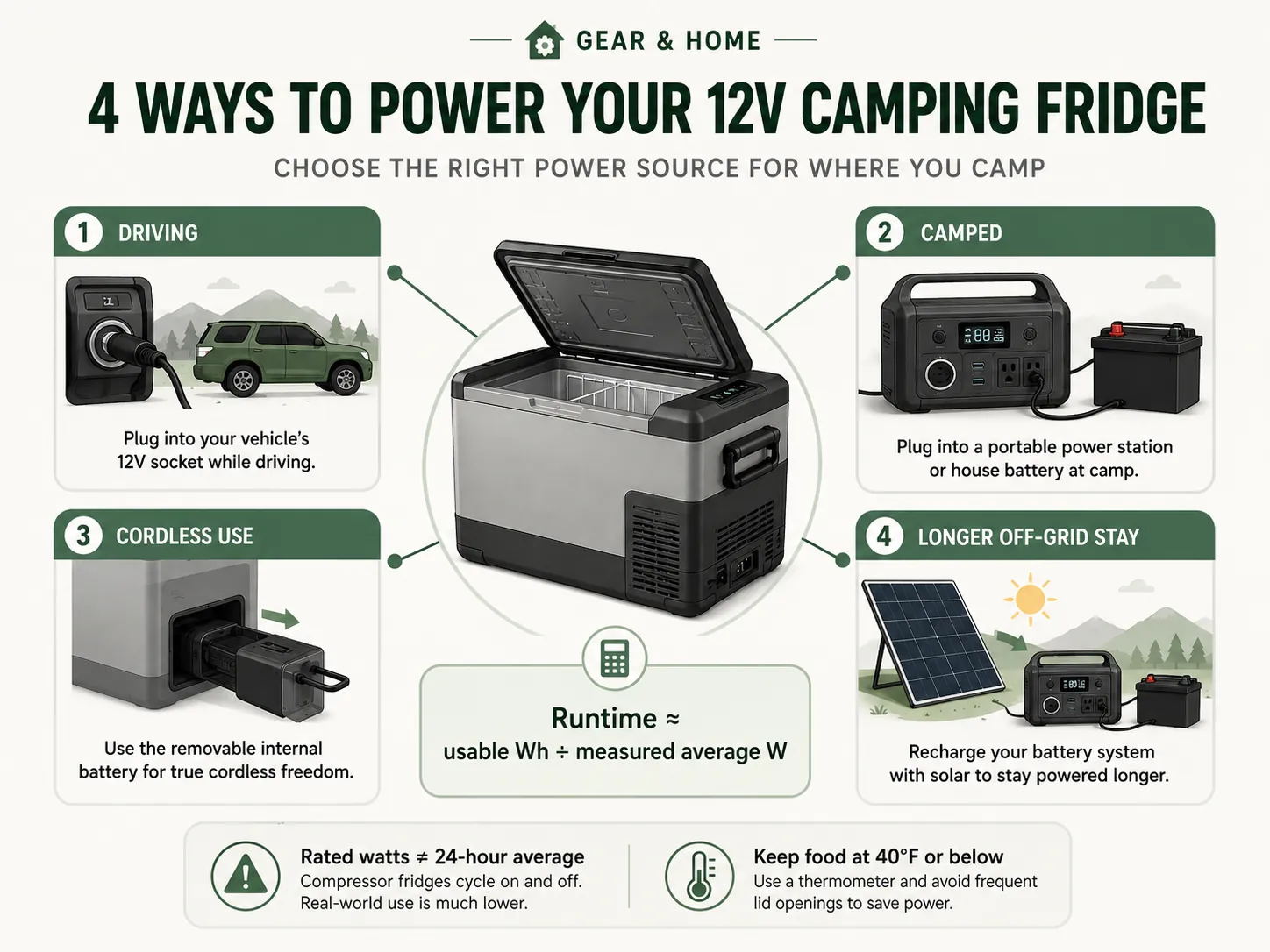
A compressor does not normally pull its maximum rated power continuously. It cycles. A simple planning formula is:
Estimated runtime ≈ usable battery watt-hours ÷ average fridge watts.
For example, a battery with 500 usable watt-hours divided by a measured 20-watt average load would equal about 25 hours before adding a safety reserve. The important word is measured. Ambient temperature, setpoint, insulation, pre-chilling, ventilation, food load, and lid openings can change the duty cycle dramatically.
Use 12V DC directly when your power source supports it
If a portable power station has a suitable regulated 12V outlet, running the fridge directly from DC avoids converting battery DC to household AC and then back inside the fridge. Confirm that the outlet’s continuous current rating is high enough for compressor startup and keep the plug secure. Loose vehicle-style sockets are a recurring real-world failure point across brands.
Do not plan an unattended weekend around your starter battery
Low-voltage protection is useful, but the better stationary-camping setup is a dedicated house battery, portable power station, or fridge with its own battery. A vehicle starting battery is designed primarily to start the vehicle. Whether a socket stays powered with the ignition off also varies by vehicle, so test your exact outlet before the trip.
Pre-chill at home before loading the vehicle
Pulling a fridge and warm groceries down to temperature is one of the most energy-intensive parts of the cycle. If household AC is available, cool the empty fridge first and load already-cold food. Then the battery system mainly has to maintain temperature rather than remove a large amount of stored heat.
Leave ventilation around the compressor end
Compressor fridges reject heat through their cooling hardware. Packing pillows, bins, or soft luggage tightly against the vents makes the system work harder. When planning the cargo layout, reserve space for airflow and access to the power connector, drain, and lid.
Think about campsite organization after the fridge arrives
A powered cooler changes the kitchen layout: food can stay in the vehicle or a shaded kitchen zone instead of occupying an ice chest beside the table. For a cleaner car-camping setup, pair it with our guides to collapsible camping trash cans and camping fans for tents and car camping.
How We Chose These 12V Camping Fridges
This is a research-based Gear & Home comparison. We did not claim to run every fridge through our own temperature chamber or multi-day vehicle test. Awards were assigned after checking the current product landscape, exact model specifications, current Amazon US variants, independent powered-cooler testing, and recurring owner feedback.
Capacity, model number, temperature range, power inputs, battery configuration, and shopping link had to match the specific product or variant discussed.
We limited the shortlist to compressor fridge/freezers capable of real controlled refrigeration rather than mixing in thermoelectric coolers.
Battery protection, DC input, optional or integrated batteries, and charging choices matter because a camping fridge is a system purchase, not only an appliance purchase.
We looked for repeated themes around lid hardware, noise, portability, power connections, construction, app behavior, and multi-year ownership instead of using isolated reviews as universal evidence.
Current professional powered-cooler testing was used as one performance input. Gear & Home does not copy another publisher’s winner automatically.
Each winner solves a different problem: premium all-around use, overlanding, value, budget entry, or cordless battery operation.
12V Camping Fridge FAQ
What size 12V fridge is best for camping?
For one or two people on shorter trips, roughly 25–35 liters is compact and easier to move. Around 40–45 liters is a useful all-around size for many couples and family weekends. Larger or dual-zone fridges make more sense for long trips, bigger groups, or anyone who needs refrigerator and freezer temperatures at the same time.
How much power does a 12V camping fridge use?
There is no single reliable daily number because a compressor cycles rather than drawing its rated maximum continuously. Actual watt-hours depend on ambient temperature, setpoint, insulation, ventilation, food load, lid openings, and whether the food was pre-chilled. Measure average consumption in your own setup before relying on a battery-runtime estimate.
Will a 12V fridge drain my car battery?
It can if the outlet remains powered with the engine off and the fridge runs long enough. Many fridges include low-voltage battery protection, but a dedicated house battery, portable power station, or integrated cooler battery is a safer plan for stationary camping. Also confirm whether your vehicle’s 12V socket stays live after the ignition is switched off.
Can I run a 12V fridge overnight?
Yes, if the fridge has adequate ventilation and the power source has enough usable energy plus a safety reserve. Overnight runtime depends on the fridge’s actual duty cycle, not simply its maximum watt rating. A battery monitor or power station that reports watt-hours used can help you estimate future nights more accurately.
Is a compressor fridge better than a thermoelectric cooler for camping?
For reliable food refrigeration in hot weather, usually yes. A compressor fridge can target refrigerator or freezer temperatures, while thermoelectric coolers generally cool by a limited amount below ambient temperature and may struggle more as the weather gets hotter. Thermoelectric designs can still make sense for drinks or short drives where lower cost and simplicity matter more.
Do I need a dual-zone camping fridge?
Only if you genuinely need two different temperatures at the same time, such as frozen food in one compartment and refrigerated food in another. A single-zone fridge is simpler, usually more space-efficient for its exterior size, and adequate when everything can stay at refrigerator temperature or when the entire unit is used as a freezer.
Can a 12V camping fridge be used as a freezer?
Many compressor models can. Check the exact model’s minimum set temperature: the Dometic CFX5 45, BougeRV CRPRO30, and Anker EverFrost 2 40L all publish sub-freezing minimums. Remember that a single-zone unit cannot normally keep part of the same main compartment at refrigerator temperature while the rest is frozen.
What temperature should I set a camping fridge to?
For perishable refrigerated food, the FDA recommends keeping cold food at 40°F or below. A small appliance thermometer inside the fridge gives you an independent check, especially when outside temperatures are high or the power source has been interrupted.