
Gear & Home is reader-supported. As an Amazon Associate I earn from qualifying purchases. When you buy through links on our site, we may earn an affiliate commission, at no extra cost to you. Learn more.
The best camping fan is not automatically the one with the biggest battery. For hot tents and car-camping setups, the more useful question is how you will power, position, and aim the fan through the night. Our best overall pick is the NESTOUT FAN-1 because it combines strong reach for its size with a tent-friendly hook, tripod, oscillation, and no aging built-in battery—but it makes the most sense if you already carry a USB-C power bank.
We compared current manufacturer specifications, exact Amazon.com US variants, recurring owner feedback, and current independent test data. The six picks below cover distinct camping roles rather than six near-identical rechargeable fans.
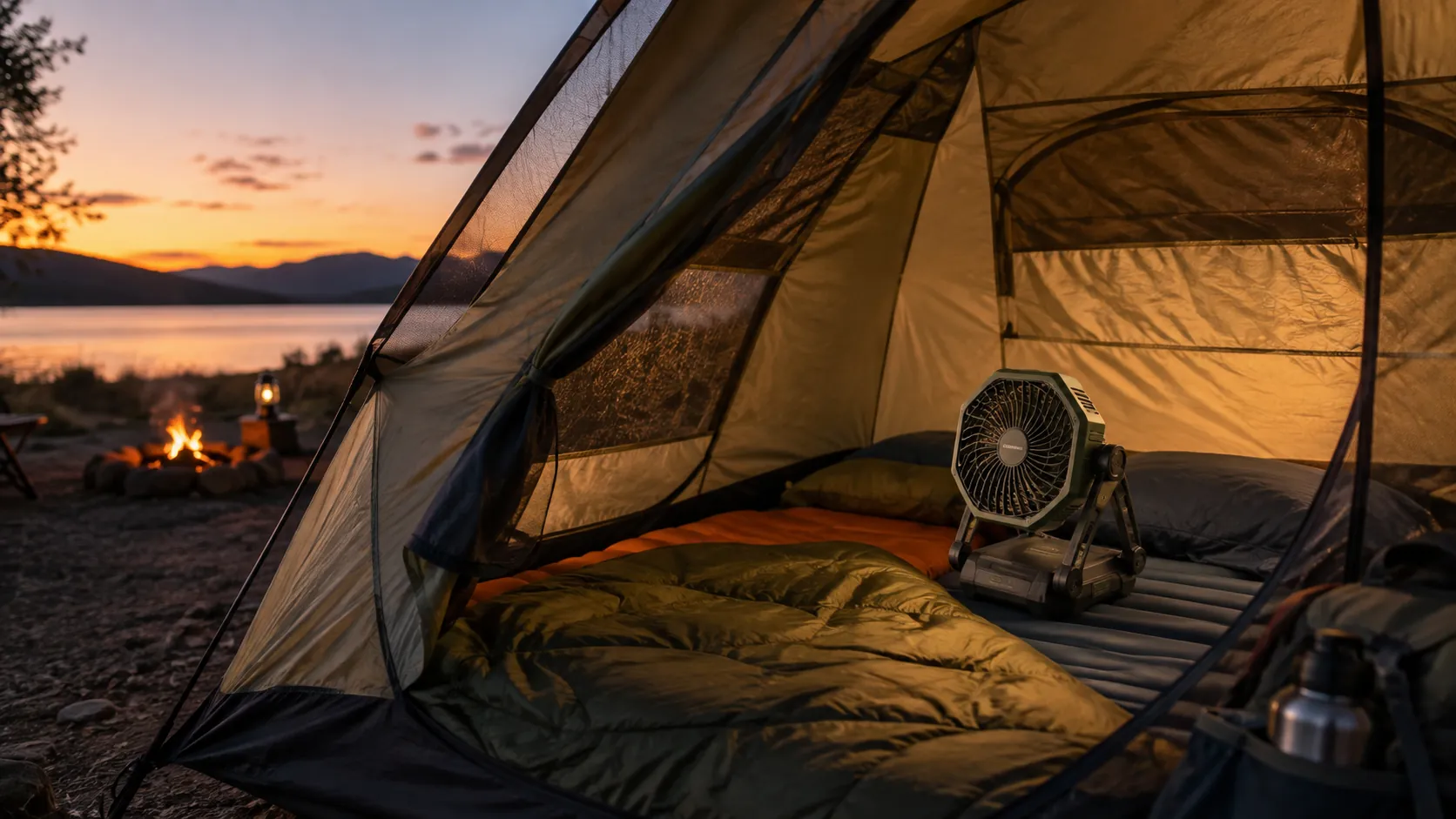
A camping fan helps most when tent vents are open and the airflow can reach the sleeper. If you need eight hours of overnight airflow, compare runtime at the speed you will actually use—not an “up to” number measured on the lowest setting. And do not hang a heavy base-camp fan over your sleeping area just because it technically has a handle.
Best camping fan for most campers
Choose the NESTOUT FAN-1 if you want a compact fan that works equally well on a tent loop, picnic table, or campsite surface and you already carry a USB-C power bank. The fan itself weighs 20.1 ounces with its tripod, has four airflow settings, 40°/70°/100° oscillation, and a 90° tilt. In Outdoor Life’s current camping-fan comparison, it produced noticeable airflow from 10.5 feet away.
If you want a built-in battery that can cover long overnight sessions without a separate power bank, the BougeRV F01 is the better fit. The Odoland lantern fan is the simple D-cell ceiling option, the Honeywell HTF090B is the tiny backup, the Geek Aire XF12 is the large rechargeable floor-fan choice, and the Shark FlexBreeze FA222 is the premium base-camp upgrade with pedestal, oscillation, and a hose-powered misting attachment.
Quick Picks
NESTOUT FAN-1
Compact, versatile mounting and independently measured reach—best if a USB-C power bank is already in your kit.
BougeRV F01
A 20,000mAh built-in battery, hook, warm light, and long low-speed runtime for hot nights.
Odoland Lantern Fan
Two D batteries power a simple ceiling-hung fan and lantern with no charging infrastructure required.
Honeywell HTF090B
A tiny personal fan that runs from USB or four AA batteries and packs easily into a camp bin.
Geek Aire XF12 12-Inch
A 12-inch rechargeable metal floor fan with 360° tilt and IPX4 water resistance for vehicle-supported camps.
Shark FlexBreeze FA222
Pedestal-to-tabletop conversion, oscillation, cordless operation, and a hose-connected misting attachment.
Camping Fans Compared
The table below focuses on the differences that change how a fan works at camp: power architecture, mounting, size or carry burden, airflow scale, and the main compromise you accept.
| Pick | Power setup | Mounting / form | Size / carry burden | Best for | Main trade-off | Amazon |
|---|---|---|---|---|---|---|
| NESTOUT FAN-1 Best Overall |
External USB-C power source | Tripod + hanging hooks | 20.1 oz with tripod | Most tent and car-camp setups | Battery / power bank sold separately | Check availability on Amazon |
| BougeRV F01 Best for Overnight Tent Use |
Built-in 20,000mAh rechargeable | Tabletop + hook; 270° head | 3.29 lb | All-night tent airflow | Heavier and slower to recharge | Check availability on Amazon |
| Odoland Lantern Fan Best Budget Ceiling Fan |
2 D batteries | Tent ceiling hook / tabletop | 1 lb 7.4 oz with batteries in independent test | Simple tent ceiling use | D batteries are bulky and less common | Check availability on Amazon |
| Honeywell HTF090B Best Compact Backup |
USB or 4 AA batteries | Stand / carry / hanging handle | 0.49 lb | Personal airflow close to one sleeper | One speed and very short reach | Check availability on Amazon |
| Geek Aire XF12 12-Inch Best Large Rechargeable |
Built-in rechargeable battery | Free-standing floor fan; 360° tilt | 12 in; 8 × 22 × 22 in | Car camping and larger airflow zones | Large floor-fan footprint; only two speeds | Check availability on Amazon |
| Shark FlexBreeze FA222 Best Premium Base-Camp Fan |
Rechargeable + corded | Pedestal converts to tabletop | Full-size pedestal / tabletop fan | Large base camps, patios, RV sites | Large, expensive, short high-speed cordless runtime | Check availability on Amazon |
NESTOUT FAN-1
External USB-C source
20.1 oz with tripod
Tripod + hooks
Most camp setups
BougeRV F01
20,000mAh built in
3.29 lb
Tabletop + hook
Long overnight use
Odoland Lantern Fan
2 D batteries
2
Ceiling hook
Simple tent airflow
Honeywell HTF090B
USB or 4 AA
0.49 lb
1
Close personal airflow
Geek Aire XF12 12-Inch
Built-in rechargeable
12 in
2
Vehicle-supported camps
Shark FlexBreeze FA222
Corded / cordless
Pedestal / tabletop
5 + boost
Large base camps
NESTOUT FAN-1
The most balanced camping fan if you already carry a power bank: light enough for tent use, strong enough to matter, and flexible enough to hang or stand.
NESTOUT’s design solves a problem that shows up with many rechargeable camp fans: the battery is usually the least serviceable part. The FAN-1 leaves the battery outside the fan. That is excellent if your camping setup already includes a USB-C power bank because you can size the power source to the trip, replace it later, and use the same bank for other electronics.
The hardware is unusually campsite-friendly for a fan this light. The included tripod works on a table, cooler, or tent floor, while the metal hook and additional mounting points make overhead positioning practical when the tent has a secure loop. The head tilts up to 90 degrees and can oscillate across 40, 70, or 100 degrees, so one fan can cover a sleeper, two adjacent pads, or a small seating zone more effectively than a fixed personal fan.
The trade-off is straightforward: this is not a self-contained purchase. NESTOUT sells its own batteries separately, although the manufacturer also supports compatible USB-C power sources. It is also explicitly not weather-resistant, so “outdoor fan” should not be read as permission to leave it in rain.
Pros
- Strong independently measured reach for a roughly 1.25-pound setup
- Tripod, hanging options, tilt, oscillation, and timer in one compact fan
- No sealed built-in battery to age inside the fan
Cons
- Requires a separate power bank or USB-C power source
- Controls are less readable than they could be
- Not weather-resistant
BougeRV F01 Portable Outdoor Fan
The best fit when all-night runtime matters more than minimum carried weight and you want the battery built into the fan.
The F01 makes sense for campers who want to set a fan near or above the sleeping area and stop thinking about power until morning. Its 20,000mAh internal battery is much larger than the cells inside most little clip-on fans, and BougeRV pairs that capacity with an eight-hour timer, battery display, warm light, USB outputs, and app control.
Those extras are more useful in a tent than they may sound. A display tells you whether the remaining battery is realistic for another night. The hook lets you aim airflow down from a secure tent point when the structure can safely support the fan. Remote app control means you can change speed or shut it down after getting into a sleeping bag instead of reaching overhead.
There is no free lunch: the F01 weighs 3.29 pounds, so it is firmly car-camping gear rather than backpacking gear. A large internal battery also takes time to refill. Notebookcheck’s recent review measured a little over three hours to recharge its sample and specifically listed weight and slow charging among the compromises. For an overnight tent fan, however, carrying one heavier self-contained unit may be simpler than pairing a lighter fan with a separate high-capacity bank.
Pros
- Large built-in battery suited to overnight use
- Hook, 270° adjustment, light, display, timer, and app control
- Can provide USB power to other small devices in a pinch
Cons
- Heavy for a tent fan at 3.29 pounds
- Large battery takes longer to recharge than small fan packs
- More electronics and app features than minimalist campers need
Odoland Portable LED Camping Lantern with Ceiling Fan
A simple tent fan and light for camps where replaceable batteries are easier to manage than USB charging.
Odoland’s lantern fan looks old-school next to app-controlled rechargeable models, and that is exactly why it still earns a place. Two replaceable D batteries mean the fan does not care whether your campsite has USB charging, a solar panel, or a running vehicle. Bring a spare pair and the power plan is obvious.
The integrated hook is the real camping feature. Hang the unit from a strong interior tent loop and it can move air down over sleeping pads while doubling as a lantern. Outdoor Life found a 5-foot reach in its current comparison, which is modest outdoors but appropriate for a small or medium tent when the fan is positioned close to the sleepers.
The limitation is the same thing that makes it dependable: D batteries are bulky, heavy, and less convenient to buy than AA cells or recharge over USB. The lantern is also more functional than refined, and independent testing described the light as harsh. This is a utility pick, not the fan to buy for the quietest controls or sleekest campsite setup.
Pros
- Runs from replaceable batteries with no charging requirement
- Hangs directly from a tent ceiling loop
- Combines airflow and campsite lighting in one inexpensive unit
Cons
- Requires two bulky D batteries
- Only two fan speeds
- Limited reach outside a tent-sized space
Honeywell HTF090B Turbo on the Go
A genuinely small personal fan for one sleeper or picnic-table seat—not a substitute for a tent-wide fan.
The HTF090B is useful because it does not pretend to be bigger than it is. At roughly half a pound, it can sit on a small camp table, hang by its handle, or ride in a gear tote without creating another major packing decision. If your goal is simply to keep air moving across your face and upper body while you sleep, that can be enough.
Dual power is the strongest feature. Four AA batteries make it independent of a charger for short trips, while the included USB cable lets you run it from a power bank or powered campsite. Unlike a built-in rechargeable fan, you are not forced to throw away the whole power strategy when the internal cell ages.
Do not buy it for a family tent. Honeywell lists airflow up to 3 feet, and Outdoor Life measured only 2 feet in its reach test. It also has one speed. Think of it as a personal comfort tool or backup fan rather than the device that will circulate a six-person cabin tent.
Pros
- Very small and light
- Runs from either USB power or common AA batteries
- Handle works for carrying, standing, or hanging
Cons
- Very limited reach
- Only one speed
- Four AA cells add recurring battery cost if you use it cordless often
Geek Aire XF12 12-Inch Rechargeable Fan
A 12-inch rechargeable metal floor fan for vehicle-supported camps where a compact tent fan feels too small but a full pedestal fan is unnecessary.
The XF12 fills the gap between little tent fans and a full pedestal setup. Its 12-inch frame and free-standing metal construction suit car camps, vans, picnic shelters, and larger tents where the fan can stay on the floor or a stable surface and aim across a wider zone.
The head tilts through 360 degrees, which makes floor-level positioning easier, and the listing gives you two speed settings rather than the stepless control used on some older Geek Aire models. Geek Aire also lists a large carrying handle and non-slip feet, so this version is easier to move around camp than a handle-free floor fan.
The trade-off is size and evidence maturity. Amazon lists the XF12 at 8 × 22 × 22 inches overall, so it is vehicle-camp gear rather than something you hang from a tent ceiling or squeeze into a small backpack. The exact XF12 listing is also relatively new, which means there is not yet the same depth of long-term owner feedback available for older fan platforms.
Pros
- 12-inch metal floor-fan format for larger campsite airflow zones
- Rechargeable with up to 24 hours listed on the lowest setting
- 360° tilt, carrying handle, non-slip feet, and IPX4 water resistance
Cons
- Only two speed settings
- Too large for overhead tent mounting or lightweight packing
- Limited long-term owner history for this exact XF12 listing
How to Choose a Camping Fan
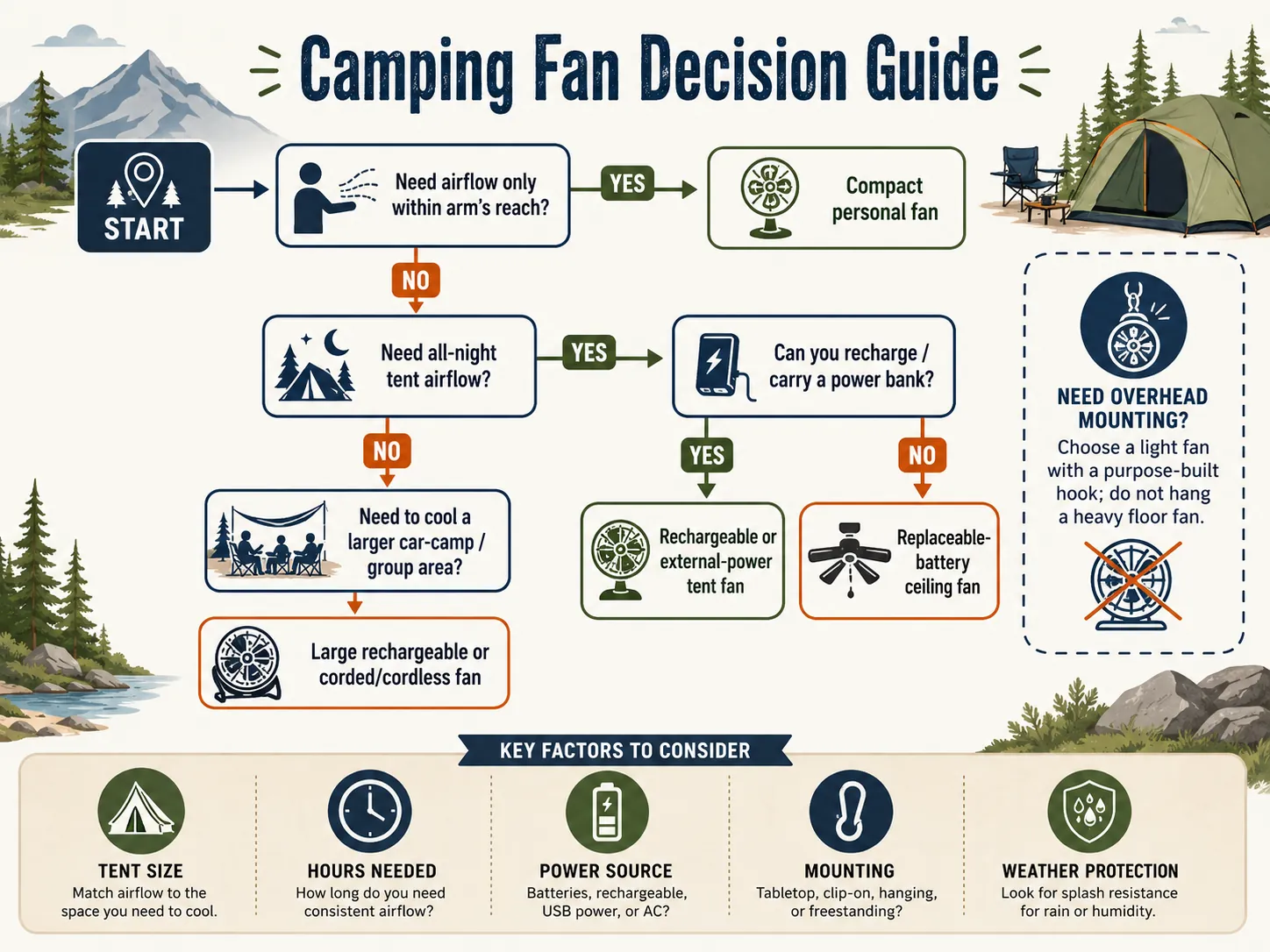
1. Start with where the fan will sit
A fan can only help if the airflow reaches you. In a low backpacking-style tent, a small fan placed near the head end may be enough. In a tall family tent, a ceiling-hung fan can distribute air downward, but only if the tent has a secure loop and the fan is light enough to hang safely. For a picnic shelter, van, or group seating area, a large floor or pedestal fan makes more sense because the fan has to throw air farther.
2. Match the power system to the trip
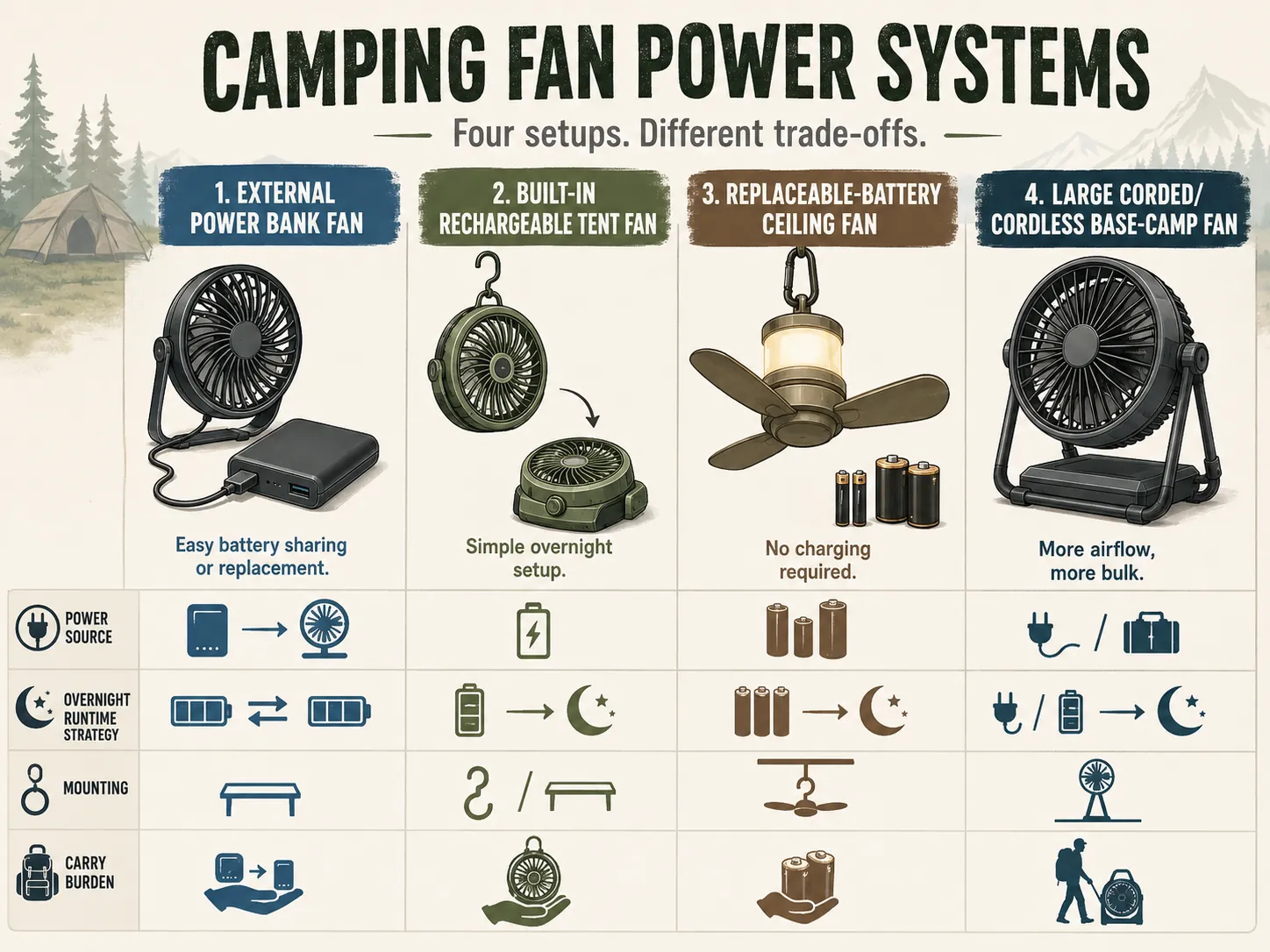
External power-bank fans are efficient when USB-C power is already part of your camp system. The battery can be replaced independently and shared with other gear. Built-in rechargeable fans are simpler to deploy but make you responsible for charging another large battery. Replaceable-cell fans are useful when you cannot recharge at all, although D and AA batteries add ongoing weight and cost. Larger corded/cordless fans make the most sense when vehicle or campsite power is nearby.
3. Treat overnight runtime as a speed-specific requirement
If you want the fan from 10 p.m. to 6 a.m., your real target is about eight hours at the speed that keeps you comfortable. Manufacturer “up to” figures are commonly based on the lowest setting. High-speed testing can produce dramatically shorter results: the Shark FlexBreeze, for example, is marketed for all-day low-speed use but lasted two hours in Outdoor Life’s high-output battery test. Before buying, decide whether you need a gentle overnight breeze or maximum daytime airflow.
4. Do not buy by battery capacity alone
Battery capacity matters, but fan efficiency, blade size, motor power, oscillation, lights, and USB output all affect real runtime. A 20,000mAh fan is not automatically “twice as good” as a 10,000mAh system. The better comparison is whether the fan can deliver the airflow you need for the required number of hours without forcing you to carry unnecessary battery mass.
5. Separate personal airflow from tent-wide airflow
The Honeywell is useful within a couple of feet. The Odoland works across the interior of a tent. NESTOUT reaches farther while staying relatively compact. Geek Aire XF12 and Shark make sense when you are cooling a bigger zone. Buying a large fan for a tiny tent wastes space and battery; buying a personal fan for a six-person cabin tent often leads to disappointment because the breeze never reaches the other sleepers.
6. Use tent ventilation with the fan, not against it
A fan does not create refrigerated air. In hot weather, open the tent vents and mesh panels allowed by the weather so the fan can exchange stagnant interior air and move airflow across your skin. When the outside air cools after sunset, positioning a fan to pull cooler air through the tent is often more useful than simply blasting the same trapped warm air around a closed shelter.
7. Keep rain resistance in perspective
Camping products are not automatically waterproof. NESTOUT explicitly says the FAN-1 is not weather-resistant, and Honeywell’s manual says to keep water from dripping into the motor or electrical components. The current Geek Aire XF12 listing carries an IPX4 water-resistance claim, while Shark markets the FA222 as rain-resistant for outdoor use. Even then, water resistance is not permission to submerge a fan or ignore the manufacturer’s operating guidance.
8. Build the rest of the hot-weather comfort setup
Airflow solves only one part of a hot camp. A rinse can make a humid evening much easier, especially after hiking or beach days; our portable camping shower guide compares pressurized, rechargeable, solar, ultralight, and heated systems. If you are building a small car-camping kit, see our compact camping gadgets and lightweight camping chair guide for other comfort gear that does not need to dominate the trunk.
How We Chose These Camping Fans
We started with the camping use case rather than generic portable-fan popularity. The shortlist had to cover meaningfully different power systems and campsite roles, then survive exact-model, spec, owner-pattern, and Amazon-variant checks.
We prioritized tent mounting, overnight use, vehicle-supported portability, airflow scale, and realistic campsite power options.
Manufacturer pages and manuals were used for model numbers, battery architecture, dimensions, controls, mounting, and other stable specifications.
Where current comparative tests were available, we used measured reach and battery behavior as one signal rather than turning another publisher’s winner into ours.
We looked for repeated practical themes such as overnight runtime, battery consumption, charging friction, and long-term noise rather than publishing isolated praise as fact.
Every CTA maps to the exact Amazon.com US ASIN listed in our source log. No current price, star rating, or review count is hard-coded into the article.
Each pick has a reason to exist: compact modular, long-runtime tent, replaceable-battery ceiling, tiny backup, large rechargeable, or premium base camp.
Camping Fan FAQ
What is the best camping fan for a tent?
For most tent campers who already carry a USB-C power bank, the NESTOUT FAN-1 is the best-balanced choice because it can hang or stand, oscillates, and has more reach than most tiny personal fans. If you want the battery built into the fan for long overnight use, the BougeRV F01 is the better fit. For a simple ceiling fan that runs on replaceable batteries, choose the Odoland.
Do camping fans actually cool a tent?
A fan does not lower a tent below the temperature of the air it is moving, but airflow can make occupants feel cooler by increasing evaporation and can help exchange hot stagnant tent air when vents are open. Position the fan so it moves air across the sleepers or helps pull cooler outside air through the tent after sunset.
How long should a camping fan run overnight?
If you want continuous airflow for a normal night, plan for roughly eight hours at the speed you will actually use. Do not rely on an “up to” runtime without checking the test conditions; low-speed runtime can be many times longer than high-speed runtime on the same fan.
Is a rechargeable camping fan better than a battery-operated fan?
Rechargeable fans are usually more convenient when you have a vehicle, power station, solar setup, or USB-C power bank available. Replaceable-battery fans are useful when you cannot recharge for several days because fresh cells restore full runtime immediately. External-power fans split the difference by letting you choose and replace the power bank separately from the fan.
Can you hang a camping fan from a tent ceiling?
Only if the fan is designed for hanging and the tent has a secure attachment point that can support it. Lightweight models such as the NESTOUT and Odoland are much more appropriate overhead than large floor or pedestal fans. Keep the fan clear of loose fabric, secure it so it cannot fall onto sleepers, and follow the tent and fan manufacturers’ instructions.
What size camping fan do I need for car camping?
For one or two sleepers in a small tent, a compact fan placed close to the sleeping area is usually enough. A 9-inch rechargeable fan is a better fit for longer overnight use or a larger tent, while 12-inch floor fans and full-size pedestal models make more sense for family tents, vans, picnic shelters, or group seating where the air has to travel farther.