
Gear & Home is reader-supported. As an Amazon Associate I earn from qualifying purchases. When you buy through links on our site, we may earn an affiliate commission, at no extra cost to you. Learn more.
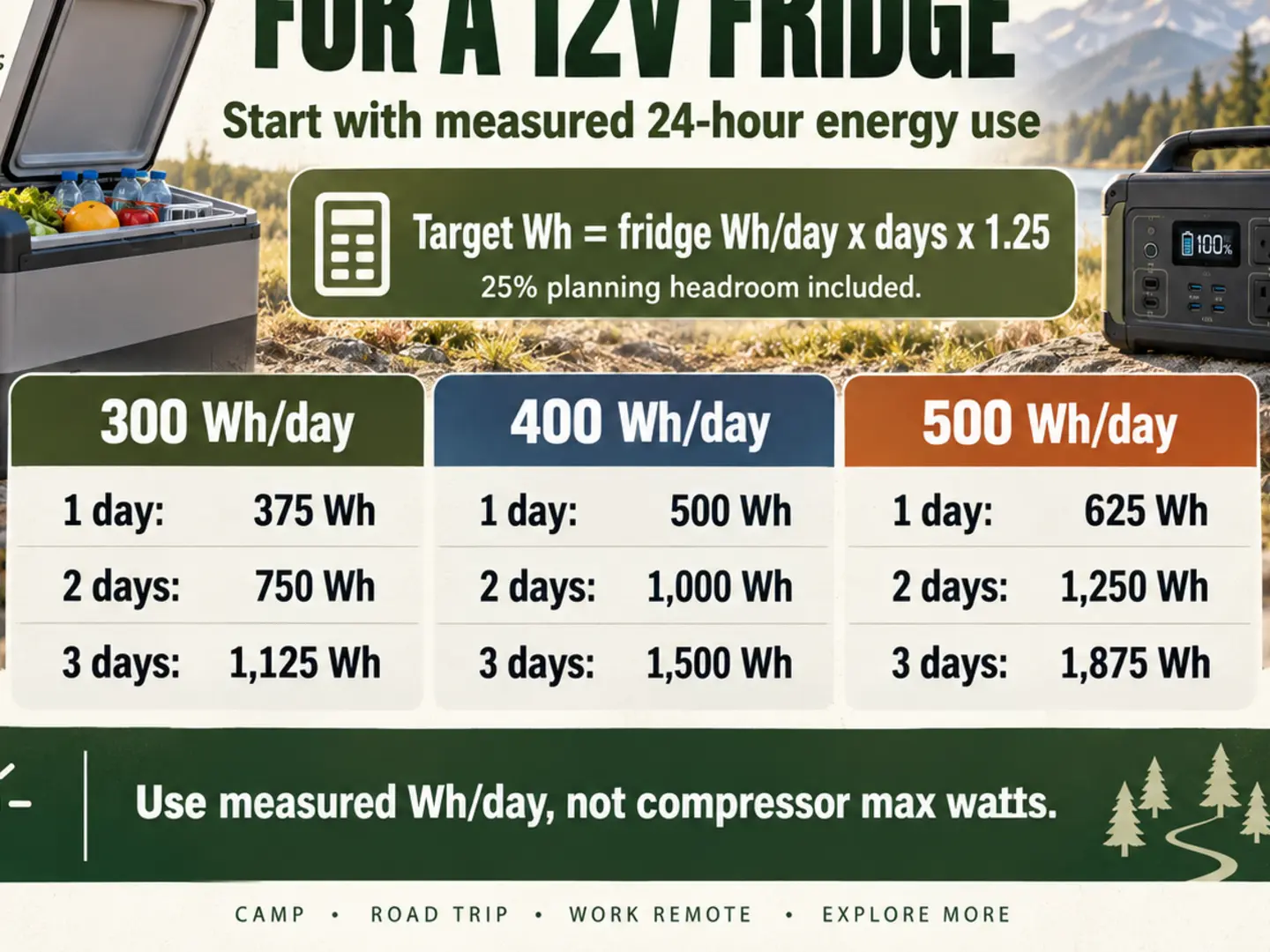
For most 12V compressor fridges, the right power station is determined by how many watt-hours the fridge actually uses in 24 hours, not by the wattage printed next to the compressor or power input. If your fridge uses 300 Wh per day, a practical starting target is about 375 Wh for one day without recharging, 750 Wh for two days, or 1,125 Wh for three days.
That is why a 500 Wh station can be plenty for one setup and frustratingly small for another. Ambient heat, fridge temperature, freezer use, door openings, ventilation and charging opportunities all change the result. If you are still choosing the cooler itself, see our best 12V fridges for camping and road trips. This guide stays focused on sizing the battery that powers one.
Size the station from 24-hour fridge use, then add headroom
Use this planning formula when the fridge is the main load:
Target power-station capacity (Wh) = measured fridge Wh/day × days between dependable recharges × 1.25
The 1.25 multiplier adds 25% planning headroom for conversion losses, battery reserve and real-world variation. It is deliberately simple rather than pretending every station has the same usable efficiency.
If you can recharge every day from the vehicle, shore power or reliable solar, size for the longest realistic gap between recharges, not the total length of the trip.
12V Fridge Power Station Sizing Table
Start with your fridge’s measured or manufacturer-specified daily energy use. The table already includes the same 25% planning headroom used in the formula above.
| Fridge use | 1 day | 2 days | 3 days | Practical station class |
|---|---|---|---|---|
| 200 Wh/day | 250 Wh | 500 Wh | 750 Wh | Compact to mid-size |
| 300 Wh/day | 375 Wh | 750 Wh | 1,125 Wh | 500 Wh to 1 kWh+ |
| 400 Wh/day | 500 Wh | 1,000 Wh | 1,500 Wh | 500 Wh to 1.5 kWh |
| 500 Wh/day | 625 Wh | 1,250 Wh | 1,875 Wh | 768 Wh to 2 kWh |
| 600 Wh/day | 750 Wh | 1,500 Wh | 2,250 Wh | 1 kWh to 2 kWh+ |
A useful real-world reference is the ICECO VL45. ICECO lists laboratory consumption of 0.347 kWh per 24 hours, or 347 Wh/day. That does not mean every 45-quart fridge uses 347 Wh/day, but it shows why a fridge labeled around 55 W should not be treated as a continuous 55 W load for 24 hours.
Why the Fridge’s Watt Rating Is the Wrong Number to Multiply by 24
A compressor fridge cycles. It may pull close to its rated current while the compressor is running, then draw far less while the compressor is off. Dometic explicitly distinguishes these two numbers: its energy-consumption specification is an average for a defined ambient and internal temperature, while rated input current is the maximum current the fridge is designed to draw.
That distinction matters. A 60 W label multiplied by 24 hours gives 1,440 Wh/day, which can wildly overstate the daily use of an efficient compressor cooler because the compressor is not running continuously. The opposite mistake is also possible: a mild-weather energy figure can understate consumption on a hot campsite where the compressor runs much more often.
Use watts for outlet compatibility, watt-hours for battery size
Watts and amps tell you whether a power station’s output can safely run the fridge when the compressor is on. Watt-hours per day tell you how large the battery needs to be for the runtime you want.
How to Find Your Fridge’s Real 24-Hour Energy Use
The best number is the one from your own fridge in conditions close to the trip you are planning. You have three useful options, in order of confidence.
1. Measure a full day from the power station
Charge the station, run only the fridge from the 12V output for 24 hours, and record the battery energy used if the station app or display reports it. Pre-cool the fridge first if you want to model normal campsite operation rather than the one-time pull-down from room temperature.
2. Use a manufacturer 24-hour or Ah/h consumption figure
If the manufacturer provides kWh/24h, convert it directly: 0.35 kWh/24h = 350 Wh/day. If it provides average Ah/h at 12V, estimate daily energy with:
Wh/day = average amps × 12 V × 24 hours
For example, 1.2 A average at 12V works out to about 346 Wh/day. Use the manufacturer’s stated test temperature and setpoint to judge whether that condition resembles your trip.
3. If all you have is maximum watts, treat the result as incomplete
Do not assume maximum compressor watts run continuously. Look for the manual, an energy guide, a manufacturer FAQ or a measured owner log for the exact model. If none exists, do a 24-hour test before relying on the fridge for food storage away from power.
Why We Add 25% Headroom
A station’s advertised capacity is a useful comparison number, but it is not a promise that every last watt-hour reaches the appliance. Battery management, DC conversion, wiring, low-voltage cutoff, temperature and the station’s own electronics all consume or reserve some energy. AC operation adds inverter losses as well.
Instead of claiming a universal efficiency percentage, this guide uses a 25% planning margin. It is enough to stop the calculation from being unrealistically tight while remaining easy to use. If food safety depends on the fridge and you have no reliable recharge option, round up to the next capacity class rather than buying to the exact mathematical minimum.
For a station that will also charge phones, cameras, lights, a laptop or a camping fan, add those loads before applying your reserve:
Target Wh = (fridge Wh/day + other daily Wh) × days × 1.25
Hot Weather Can Matter More Than Fridge Size
Two fridges with similar capacity can have very different energy needs, and the same fridge can behave very differently in April and August. Compressor duty cycle rises when the fridge has to reject more heat. A lower setpoint, freezer mode, frequent lid openings, warm groceries and restricted ventilation can all keep the compressor running longer.
Dometic’s own specifications illustrate the temperature effect. Its refrigerator documentation publishes energy figures at defined ambient temperatures rather than treating consumption as a single fixed number. Its CFX3 support guidance also recommends keeping the cooler packed, minimizing lid openings and leaving ventilation space to conserve energy.
Hot ambient air
A fridge sitting in sun or a hot vehicle has to dump heat into hotter surroundings.
Freezer or colder setpoint
The larger the temperature difference, the harder the cooling system works.
Frequent opening
Warm air and warm food entering the box create additional cooling work.
Poor ventilation
Blocked compressor vents make it harder for the fridge to reject heat efficiently.
If your home test was done in a 70°F garage but your trip is in a 95°F desert campground, do not size the battery to the home number with zero reserve. Test in warmer conditions if possible, or move up a capacity class.
Use the 12V DC Output When the Fridge and Station Are Compatible
A 12V compressor fridge is already designed for DC power, so a regulated 12V car-style output usually makes more sense than converting battery DC to 120V AC and then back through the fridge’s AC adapter. EcoFlow’s own runtime guidance notes that DC output can extend runtime because the AC inverter can remain off.
Compatibility still matters. Check the station’s 12V output voltage, current limit and connector against the fridge’s maximum input requirement. A common power-station car outlet is limited to about 10 A. That is enough for many mid-size compressor fridges, but not every large dual-zone model.
For example, Dometic lists the CFX3 95DZ at 10.4 A rated input current at 12V. A station with a 10 A car-socket limit should not be assumed compatible just because both products say “12V.”
Do Not Size for the Whole Trip If You Can Reliably Recharge
A five-day road trip does not automatically require five days of battery. What matters is the longest stretch between dependable energy inputs.
Dometic’s CFX3 support guidance recommends a 100 W or larger solar panel with a battery for its cooler systems, but that is a starting system recommendation, not a guarantee that 100 W of panel will replace every fridge’s daily consumption in every climate. Size solar from your expected daily Wh load and realistic sun conditions.
What Power Station Size Makes Sense by Scenario?
These are practical capacity classes, not product rankings. For model-specific comparisons, use our portable power station guide for camping.
One mild-weather day for many efficient fridges
Best when measured fridge use is roughly 200 to 350 Wh/day and you can recharge daily. It becomes tight quickly if the fridge is also a freezer or the station powers other gear.
A useful middle ground for a single 12V fridge
Works well when daily use is around 300 to 500 Wh and you want more than a minimal one-day buffer. Check the 12V output current limit before buying.
Better for two-day gaps or extra electronics
A strong general camping class when a fridge shares the battery with lights, phones, cameras or a laptop, or when hot-weather draw is uncertain.
Multi-day, freezer-heavy or low-recharge trips
More appropriate when daily demand is high, you are running dual-zone cooling, or several days can pass without dependable vehicle, AC or solar charging.
If you are trying to keep the station inexpensive, our portable power stations under $500 guide is the better place to compare current models. This sizing page tells you whether that lower-cost capacity class is enough before you start shopping.
Current Power Station Examples for These Capacity Classes
These are capacity examples, not a separate ranking. Use the sizing math above first, then treat the models below as concrete reference points for what roughly 500 Wh, 750 Wh and 1 kWh look like in current camping power stations.
EcoFlow RIVER 2 Max
Its 512 Wh battery and regulated 12.6V/10A car output make it a reasonable match when your fridge is efficient and you expect dependable daily recharging. It is much less comfortable for two-day fridge duty or a fridge plus several other loads.
BLUETTI AC70
This is the most natural middle-ground example for a fridge-led camp: 768 Wh of storage plus a regulated 12V/10A car outlet. It gives noticeably more reserve than a 500 Wh-class station without forcing you into a 1 kWh-plus battery.
Anker SOLIX C1000 Gen 2
A 1,024 Wh station makes more sense when the fridge shares power with laptops, lights or other camp electronics, or when you want a larger buffer between recharges. The extra inverter output is useful for mixed campsite loads, but fridge runtime still depends on daily Wh consumption.
For a full model-by-model comparison, including larger 1.5 to 2 kWh options, see our best portable power stations for camping roundup.
Common Sizing Mistakes
Buying from fridge quart size alone
A 45-quart fridge does not have a universal daily Wh figure. Insulation, compressor control, setpoint, ambient temperature and how it is used matter too much.
Multiplying maximum watts by 24 hours
That assumes the compressor never cycles off. Use average energy consumption or a measured day instead.
Ignoring the power station’s DC current limit
Capacity can be large enough while the 12V outlet is still undersized for the fridge’s maximum current requirement.
Counting perfect solar as guaranteed
Solar is a recharge source, not a reason to remove battery reserve. Plan for poor sun if the fridge contains food that must stay cold.
Forgetting every other load
A laptop, fan, camera batteries and camp lights can consume a meaningful share of a 500 to 1,000 Wh station. Add them to the daily energy budget.
A Simple 5-Step Decision Checklist
- Measure or verify fridge Wh/day. Prefer a 24-hour figure in conditions similar to your trip.
- Choose the longest no-recharge interval. Count days between dependable vehicle, AC or solar charging, not total trip length.
- Add other loads. Include lights, fans, phones, laptops and anything else sharing the station.
- Multiply by 1.25. This provides planning headroom instead of sizing to a perfect laboratory minimum.
- Verify 12V output compatibility. Check voltage, current limit, connector and whether the output is regulated.
Once you know the required capacity class, compare current models in our best portable power stations for camping roundup rather than buying a station first and hoping the numbers work afterward.
FAQ
How many watt-hours does a 12V fridge use per day?
There is no single number for all 12V fridges. Efficient compressor models may use only a few hundred watt-hours per day in mild conditions, while hot weather, freezer settings, larger dual-zone boxes and frequent opening can increase consumption substantially. Use the exact model’s 24-hour energy figure or measure it yourself.
Is a 500 Wh power station enough for a 12V fridge?
It can be if the fridge uses roughly 200 to 350 Wh/day and you only need about one day between recharges. A 500 Wh station is much less comfortable for a fridge using 400 to 500 Wh/day, especially once reserve and other devices are included.
How long will a 1,000 Wh power station run a 12V fridge?
Using the planning method in this guide, a fridge consuming 300 Wh/day points to about 2.7 days from a 1,000 Wh station, while a 500 Wh/day fridge points to about 1.6 days. Those are planning estimates after allowing 25% headroom, not guaranteed runtimes.
Should I run a 12V fridge from AC or DC on a power station?
Use the 12V DC output when the voltage, current limit and connector are compatible. That avoids keeping the AC inverter active. If the fridge’s maximum current exceeds the station’s DC output limit, use only a manufacturer-approved alternative connection.
Does a fridge use more power in hot weather?
Usually yes. The compressor has to run longer when the surrounding air is hotter, especially if the fridge is in sun, ventilation is restricted, the setpoint is very cold or the lid is opened frequently. Measure in conditions close to your trip when possible.
What size solar panel do I need for a 12V fridge?
Size solar from the fridge’s daily Wh use plus other loads, then account for realistic peak-sun hours and charging losses. A 100 W panel may help or even cover an efficient fridge in favorable conditions, but it is not a universal daily-energy guarantee.