
Gear & Home is reader-supported. As an Amazon Associate I earn from qualifying purchases. When you buy through links on our site, we may earn an affiliate commission, at no extra cost to you. Learn more.
The best power bank for backpacking is not the one with the biggest mAh number. It is the one that gives you enough usable energy for your phone, GPS, watch and headlamp without carrying unnecessary battery weight for every mile.
This guide is deliberately narrower than a general camping power-bank roundup. For backpacking, weight, usable capacity, recharge speed and weather tolerance matter more than extra ports or laptop-class output. A 10,000mAh bank is the sweet spot for many one-to-three-night trips, while 20,000mAh starts to make sense when resupply gaps are longer or several devices share one battery.
The best power bank for most backpackers
The Nitecore NB10000 Gen4 is the strongest all-around backpacking benchmark. It combines a 10,000mAh-equivalent 39Wh battery with a manufacturer-listed 5.0-ounce weight, dual USB-C ports, 22.5W input/output and IPX7 water resistance. The catch is price, and the current exact Gen4 model is not one we could resolve to a clean Amazon US listing.
If Amazon availability matters, FLEXTAIL Zero Power 10000 is the closest fit in this shortlist. It weighs 5.1 ounces, has 22.5W output, an 18W input, IPX4 splash resistance and an efficient low-power mode intended to trade charging speed for more usable energy.
Quick Picks
FLEXTAIL Zero Power 10000
Very low weight with 10,000mAh capacity – 5.1 oz
INIU P41 10000
More ports and 45W output at a budget-friendly price – 6.4 oz
INIU P512 20000
20,000mAh capacity without jumping to power-station bulk – 11.1 oz
ELECOM NESTOUT 15000
IP67 protection and a shock-focused outdoor shell – about 12.8 oz
Best Power Banks for Backpacking Compared
| Pick | Capacity | Weight | Max output | Weather rating | Best for | Where to check |
|---|---|---|---|---|---|---|
| Nitecore NB10000 Gen4 Best Overall |
10,000mAh equivalent / 39Wh | 5.0 oz | 22.5W | IPX7 | Most backpackers prioritizing energy per ounce | Check at Nitecore |
| FLEXTAIL Zero Power 10000 Best Amazon-Available Ultralight |
10,000mAh / 38.7Wh | 5.1 oz | 22.5W | IPX4 | Low-weight backpacking with Amazon availability | Check availability on Amazon |
| INIU P41 10000 Best Value and Fast Output |
10,000mAh | 6.4 oz | 45W | Not listed | Value buyers, fast device charging and multiple ports | Check availability on Amazon |
| INIU P512 20000 Best for Longer Trips |
20,000mAh | 11.1 oz | 22.5W | Not listed | Long resupply gaps or multiple small devices | Check availability on Amazon |
| ELECOM NESTOUT 15000 Best Rugged Pick |
15,000mAh | About 12.8 oz | 32W total | IP67 | Wet, dusty or rough trips where protection matters | Check availability on Amazon |
Nitecore NB10000 Gen4
10,000mAh eq.
5.0 oz
22.5W
IPX7
FLEXTAIL Zero Power 10000
10,000mAh
5.1 oz
22.5W
IPX4
INIU P41 10000
10,000mAh
6.4 oz
45W
3
INIU P512 20000
20,000mAh
11.1 oz
22.5W
3
ELECOM NESTOUT 15000
15,000mAh
About 12.8 oz
32W total
IP67
Capacity is nominal cell capacity, not the exact amount that reaches your phone. Conversion losses, cable losses, charging voltage, temperature and the device being charged all reduce usable energy. Manufacturer-listed weights are used where available; the NESTOUT figure is the current independent comparison weight.
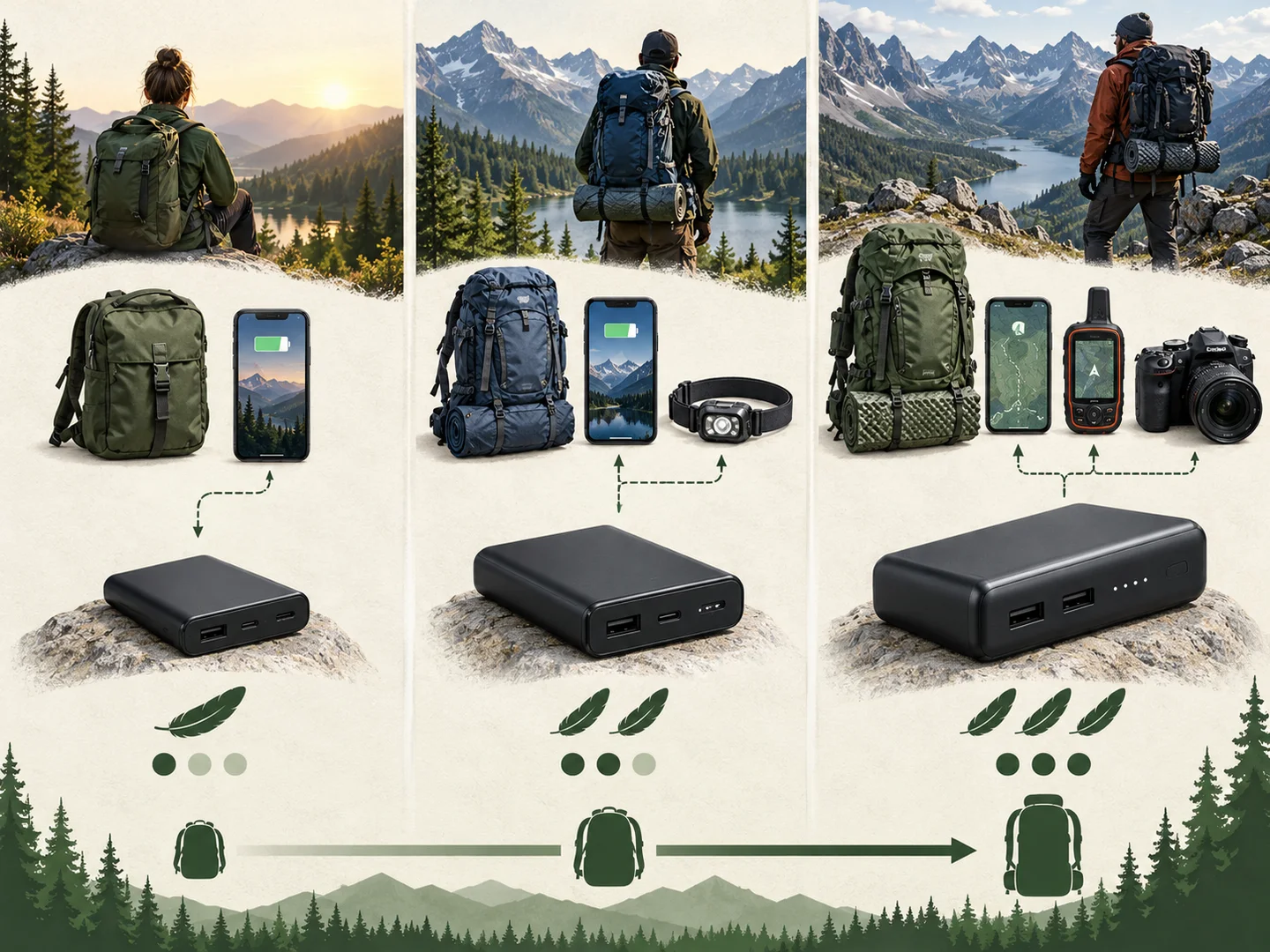
For many backpackers, the extra capacity is dead weight unless the trip is long enough to use it. Start with your actual charging load, then add a modest reserve. A phone in airplane mode, a GPS watch and a headlamp can need far less energy than a phone running navigation all day plus a camera, satellite communicator and earbuds.
The 5 Best Power Banks for Backpacking
Nitecore NB10000 Gen4
The current 10,000mAh backpacking benchmark when minimum carried weight matters more than price or Amazon availability.
#1
The Gen4 is what a backpacking power bank looks like when the design is optimized around carried weight instead of desk features. At 5.0 ounces, it gives you the capacity class many hikers want without drifting into the 7-to-9-ounce range common among mainstream 10,000mAh banks.
Two USB-C ports are more useful on a modern trail electronics kit than a mix built around legacy USB-A. Either port can handle up to 22.5W input or output, and the bank includes a short lanyard charging cable. Nitecore also gives the current revision an IPX7 rating, which is a meaningful advantage in a pack that may see rain, condensation or a leaking bottle.
The main reason not to buy it is value. It is expensive for 10,000mAh, and independent cold-condition comparisons indicate that its excellent warm-weather efficiency does not fully carry over into low temperatures. Keep any lithium-ion bank warm in freezing conditions, and use our dedicated cold-weather power bank guide if winter performance is the primary decision.
Pros
- Exceptional 5.0 oz weight for the capacity class
- Two USB-C ports with 22.5W input/output
- IPX7 water resistance
- Strong efficiency and packability in current independent comparisons
Limitations
- Premium price
- No USB-A port
- Cold-condition efficiency is not its strongest trait
- No clean exact Amazon US Gen4 listing was resolved for this unit
FLEXTAIL Zero Power 10000
The closest Amazon-available alternative to the Nitecore for hikers who want a 10,000mAh bank around five ounces.
#2
Zero Power earns its place by staying genuinely small. The 0.39-inch-thick body and 5.1-ounce weight put it in a class where carrying two 10,000mAh banks can sometimes make more sense than one bulky high-capacity brick, especially when redundancy matters.
Its unusual feature is a low-power efficiency mode. FLEXTAIL rates that mode at 7,000mAh at 5V/1A, while its faster 12V mode has a lower rated output capacity. That is a useful reminder that fast charging and maximum usable energy are not always the same goal. On a long day with time to charge in camp, slower output can be a rational trade.
The lanyard-style USB-C cable is convenient, but it is still another exposed component to manage. IPX4 handles splashes rather than immersion, so this is not the choice for people who want to toss a battery into a wet outer pocket and forget about it.
Pros
- Only 5.1 oz at 10,000mAh nominal capacity
- 22.5W fast output plus efficiency-focused mode
- Very thin forged-carbon-fiber body
- Exact current Amazon US ASIN resolved
Limitations
- Only IPX4 splash resistance
- 18W input is slower than the fastest current 10K banks
- Mode switching adds complexity
- Still priced above mainstream budget 10K options
INIU P41 10000
A better value than the ultralight specialists if you can carry roughly another ounce for 45W output and three charging ports.
#3
The P41 makes the most sense when the difference between 5.1 and 6.4 ounces is less important than what happens at the wall outlet. A 27W maximum input can shorten a town-stop recharge compared with slower ultralight banks, and 45W single-port output is useful if your phone or small tablet can take advantage of it.
It also handles mixed electronics better than the minimalist picks. Two USB-C ports plus one USB-A port let you plug in modern and legacy trail devices without carrying an extra adapter. Multi-device total output is lower than the single-port peak, so the 45W number should not be interpreted as 45W to every device at once.
Current P41 variants have changed over time, which is exactly why the Amazon link here is tied to one resolved ASIN rather than a broad search page. The exact listing used for this unit identifies the P41 10,000mAh 45W variant.
Pros
- Strong value for a current 10,000mAh bank
- 45W single-port output and 27W input
- Two USB-C plus one USB-A port
- Only modestly heavier than the ultralight leaders
Limitations
- No published outdoor IP rating
- Built-in flashlight can add accidental button presses
- Three-port charging reduces total output
- Variant names have changed, so exact listing verification matters
INIU P512 20000
The capacity step-up for hikers who genuinely need more than 10,000mAh but still want a compact phone-focused bank rather than a power station.
#4
The P512 is not a better choice just because 20,000 is a bigger number. It is a better choice when you can explain where the second 10,000mAh goes: long navigation days, a satellite communicator, watch, camera, multiple phones, or a route with several nights between reliable outlets.
At 11.1 ounces manufacturer-listed, it weighs more than two Nitecore Gen4 banks and a little more than two FLEXTAIL Zero Power banks. In exchange, you get one unit, one state-of-charge display and three output ports. That can simplify a shared charging kit, but it concentrates all your stored power in one device.
The 20W maximum input is adequate rather than exceptional. If your trip includes very short resupply stops, recharge time matters almost as much as capacity. A huge bank that cannot be refilled before you leave town can be less useful than two smaller banks charged in parallel.
Pros
- 20,000mAh for longer gaps between outlets
- Strong capacity-to-price value
- Two USB-C ports plus USB-A
- Battery display is easier to read than four tiny LEDs
Limitations
- 11.1 oz is a major weight jump from 10K ultralight banks
- 20W input means a full refill takes time
- No published outdoor IP rating
- High capacity is unnecessary weight on short trips
ELECOM NESTOUT 15000
A heavier power bank that earns the penalty with IP67 sealing and an outdoor-focused shock-protected shell.
#5
NESTOUT is the outlier in this list because it optimizes for abuse rather than grams. Its sealed design is rated IP67, and the outer structure uses a hard shell with internal cushioning intended to reduce shock and vibration. For wet packrafting approaches, sandy desert routes or gear that gets handled roughly, that protection can be worth more than saving several ounces.
The penalty is substantial. At about 12.8 ounces in a current independent comparison, the NESTOUT weighs more than the 20,000mAh INIU P512 despite holding less nominal energy. That is the price of the rugged shell and sealed construction.
Do not choose it merely because the forecast includes rain. A lightweight bank inside a proper dry bag is usually the more efficient backpacking system. Choose NESTOUT when the power bank itself needs to survive repeated exposure or rough handling.
Pros
- IP67 waterproof and dustproof rating
- Shock-focused outdoor construction
- 15,000mAh offers more reserve than standard 10K banks
- 32W combined output supports multiple devices
Limitations
- Very heavy for 15,000mAh
- Bulkier than backpacking-first carbon-fiber banks
- Poor choice for ultralight packs
- Rugged shell is unnecessary if the bank lives in a dry bag
How to Choose a Power Bank for Backpacking
Start with trip energy, not mAh
List what actually needs charging and how often. A modern phone used mostly for photos and occasional offline navigation can consume very different energy from the same phone running bright-screen navigation for hours. Add a watch, headlamp, camera, satellite communicator or earbuds only if those devices will really need a refill during the trip.
10,000mAh is the default for many backpackers
A 10,000mAh bank is popular because it can provide meaningful reserve while still fitting near the five-to-seven-ounce range. For a weekend trip, that balance is often better than carrying a 20,000mAh bank that returns home half full.
Move to 20,000mAh when the route justifies it
High capacity makes sense for longer resupply gaps, two people sharing a bank, camera-heavy trips or routes where electronics are safety-critical. It is also reasonable if you would otherwise carry two separate 10K banks and prefer one larger unit. Remember that two smaller banks add redundancy and can sometimes recharge in parallel.
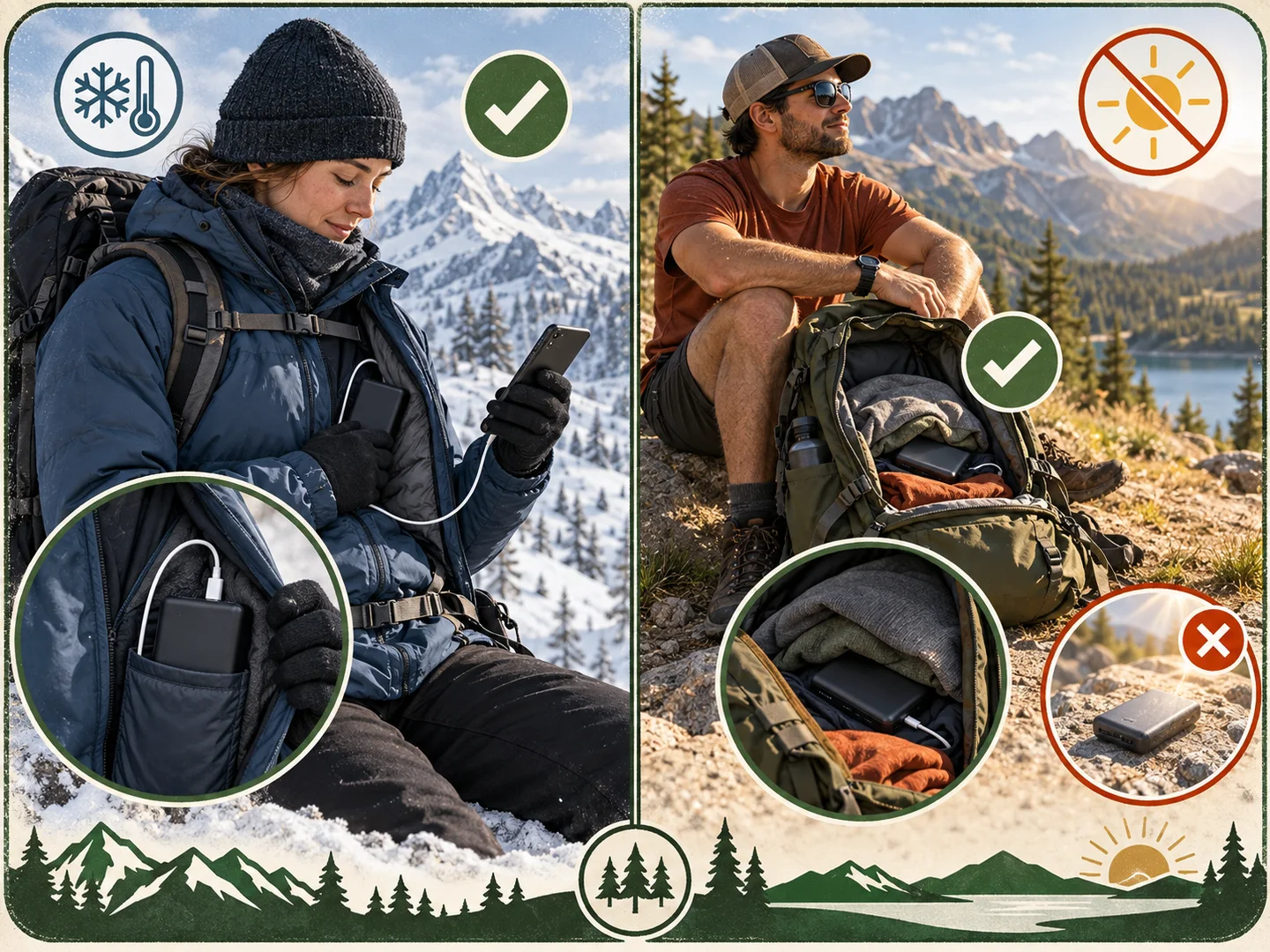
Cold changes the battery equation
Lithium-ion batteries temporarily deliver less usable energy when cold. Keep the bank close to your body during the day, insulate it at night and avoid leaving it exposed on snow or a frozen tent floor. For true winter use, compare models designed specifically around low-temperature behavior in our best power banks for cold weather guide.
Do not charge a hot battery in direct sun
Heat is also hard on lithium-ion cells. Do not leave a black power bank baking on a rock, vehicle dashboard or exposed backpack pocket while it is charging. Shade and airflow are simple ways to reduce heat buildup.
Input speed matters at resupply stops
Output wattage tells you how fast the bank can charge a compatible device. Input wattage tells you how quickly the bank itself can be refilled. Backpackers with short cafe, hostel or visitor-center stops should pay close attention to input speed and carry a wall charger that can actually supply it.
Water resistance is not a substitute for a dry bag
An IP rating adds useful protection, but it should not make your battery the sacrificial item in a wet pack. Even an IPX7 power bank has open cables and connected devices to think about. Keep electronics dry first, then treat the rating as backup protection.
Backpacking power banks are not portable power stations
If you need AC outlets, laptop charging for several people, or hundreds of watt-hours, you are leaving the backpacking power-bank category. Our portable power stations for camping guide covers that heavier car-camping class.
How We Chose These Backpacking Power Banks
We started with current US search results and kept the page focused on backpacking rather than broad camping electronics. The shortlist favors products that make sense in a carried pack: useful energy per ounce, current charging standards, realistic recharge speed and a clear reason to choose each capacity class.
We checked current manufacturer specification pages because power-bank model names and output ratings change frequently.
Weight and usable capacity were prioritized over laptop-class wattage, wireless charging, kickstands and other desk-oriented features.
Current comparison reviews and recurring owner feedback were used to identify trade-offs such as cold behavior, recharge time, accidental buttons and durability.
Amazon buttons are used only where one exact current US ASIN was resolved. The Nitecore Gen4 stays on the manufacturer link rather than using a guessed marketplace variant.
FAQ
What size power bank is best for backpacking?
For many one-to-three-night trips, 10,000mAh is the best starting point because current lightweight models can weigh around five to seven ounces. Move to 20,000mAh when you have longer gaps between outlets, multiple devices or more than one person sharing the bank.
Is 10,000mAh enough for a three-day backpacking trip?
Often, but not always. It depends on phone battery size, screen time, navigation use, signal hunting, temperature and other electronics. Use airplane mode and offline maps when practical, then estimate your real charging needs rather than assuming a fixed number of phone recharges.
Is a 20,000mAh power bank too heavy for backpacking?
Not if the route needs the energy. The INIU P512 in this guide is 11.1 ounces manufacturer-listed, which is a meaningful penalty compared with five-ounce 10K banks. For short trips it is usually unnecessary; for long resupply gaps it can be efficient system weight.
Can I use a power bank in freezing weather?
Yes, but lithium-ion batteries provide less usable energy when cold. Keep the bank warm in an inside pocket or insulated pouch, and avoid charging it when the cell itself is extremely cold. Winter-focused users should prioritize low-temperature designs over the lightest warm-weather option.
Do I need a waterproof power bank for backpacking?
No. A dry bag or waterproof electronics pouch is still the primary protection. An IP rating is valuable backup protection for rain, splashes and accidents, especially if the bank is frequently used outside the pack.
What is more important, charging output or power-bank recharge speed?
Both matter, but backpackers often overlook input speed. Fast device output is useful on trail, while fast input is critical when you have a short resupply stop. Make sure the wall charger and cable support the bank’s maximum input rate.
Why does a 10,000mAh power bank not deliver 10,000mAh to my phone?
The advertised number is nominal cell capacity. Voltage conversion, heat, cable resistance and charging electronics consume part of that energy before it reaches the phone. Compare rated output capacity or independent energy measurements when available instead of treating nominal mAh as directly transferable.