
Gear & Home is reader-supported. As an Amazon Associate I earn from qualifying purchases. When you buy through links on our site, we may earn an affiliate commission, at no extra cost to you. Learn more.
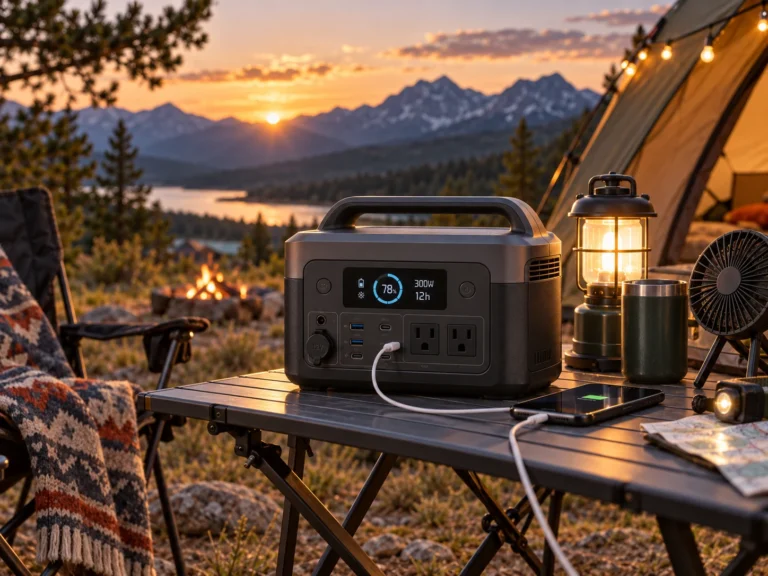
The EcoFlow RIVER 3 is a genuinely small portable power station, not a shrunken home-backup battery. The exact 245Wh US model reviewed here weighs 7.8 lb, supplies 300W of continuous AC power, charges from the wall in about an hour, and gives you a 100W USB-C output. That combination makes it easy to recommend for light-duty camping, travel, routers, laptops, cameras, and short outages, but its limits matter just as much as its strengths.
The EcoFlow RIVER 3 is best for people who need portable power, not big power
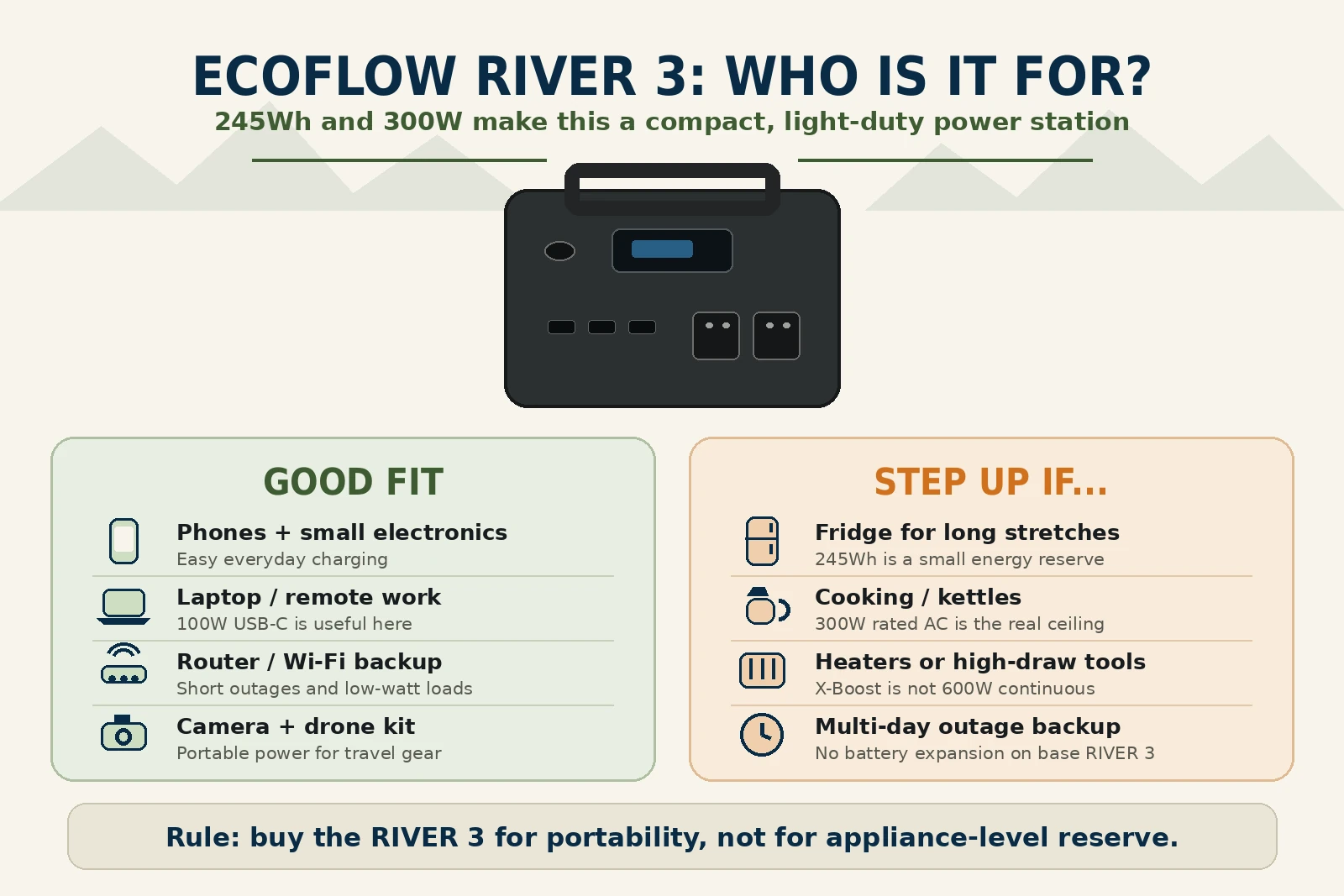
Buy the RIVER 3 if you want a compact LiFePO4 station for phones, laptops, camera gear, lights, a router, and other low-watt loads. Its 7.8 lb body, one-hour AC recharge, quiet operation, app control, and 100W USB-C output are the reasons to choose it.
Skip it if your plan includes long fridge runtime, cooking appliances, heaters, high-draw tools, or multi-day outage backup. The 245Wh battery and 300W rated inverter are real limits, and the base RIVER 3 does not accept EcoFlow’s RIVER 3 Plus expansion batteries.
First, make sure you are looking at the right RIVER 3
This review covers the US EcoFlow RIVER 3 model EFR705 with 245Wh capacity and 300W rated AC output. The exact Amazon US listing we verified is ASIN B0DB1S36YP.
That distinction now matters because EcoFlow also lists a RIVER 3 (230) variant with a 230Wh battery. The name is almost identical, but the capacity is not. The RIVER 3 Plus is another different product again: 286Wh, 600W rated output, faster UPS switching, higher solar input, and an expansion-battery path.
If a retailer page does not clearly identify 245Wh or model EFR705, do not assume the specifications in this review apply to that exact unit.
EcoFlow RIVER 3
A strong small power station for light loads and frequent carrying, with fast charging and useful smart controls. Its 245Wh battery and 300W inverter make it a poor substitute for a larger camping or backup station.
Strengths
- Only 7.8 lb and easy to carry
- One-hour AC recharge
- 100W USB-C output for laptops and modern electronics
- Two AC outlets plus USB-A and 12V car output
- Useful Bluetooth/Wi-Fi app control
- Quiet low-load operation
- LiFePO4 cells rated for 3,000 cycles to 80%
Limitations
- 245Wh is a small battery reserve
- 300W continuous AC ceiling
- No base-model battery expansion
- 110W solar input is modest
- USB-C is output, not a USB-C charging input
- Only one USB-C port
- US warranty is 2 years, shorter than RIVER 3 Plus
What the EcoFlow RIVER 3 does well
It is small enough that portability is not just a marketing word
At 7.8 lb and roughly 10 x 8.3 x 4.4 inches, the RIVER 3 is much closer to a grab-and-go electronics station than to the 20 to 30 lb boxes common around 1kWh. Independent hands-on reviewers repeatedly focus on the same point: it is easy to move, easy to fit into a vehicle, and small enough to live on a desk, equipment cart, or camping table without taking over the space.
That matters because a portable power station only helps on trips where you actually bring it. If your loads are light, carrying extra battery capacity can be a worse trade than recharging a smaller unit more often.
One-hour AC charging changes how a small battery feels
The 245Wh capacity is modest, but EcoFlow rates the RIVER 3 for a full AC recharge in about one hour. That is useful before a last-minute trip and during short access to grid power. It also makes the small battery easier to live with if you can top up regularly rather than needing several days of stored energy at once.
Solar recovery is slower. EcoFlow lists a 110W solar ceiling and a best-case full solar charge in about 2.6 hours. Real outdoor charging will vary with sun angle, temperature, clouds, panel output, and conversion losses. A tiny 45W panel can be convenient, but owner discussions repeatedly point out that small panels recover energy slowly outside ideal sun.
The 100W USB-C port is genuinely useful
A 100W USB-C output lets the RIVER 3 charge many laptops directly without turning on the AC inverter. It also suits tablets, camera chargers, and other modern USB-C gear. That is one reason the station makes sense for remote work, photography, and short travel.
The caveat is that there is only one USB-C port, and the base RIVER 3 does not use that port as a USB-C charging input. Owners who want to recharge the station itself from a high-output USB-C car charger or another USB-C source may prefer a competitor with bidirectional USB-C.
The app and backup features are better than the battery size suggests
Bluetooth and Wi-Fi app control let you monitor state of charge, adjust settings, manage output behavior, and configure features such as port memory. The base model also has a published UPS switchover time under 20 ms.
That makes it useful for a router, modem, network hardware, or other small loads during short interruptions. But it should not be treated as equivalent to a line-interactive UPS that provides power conditioning and surge protection. Owner discussions about using RIVER models as UPS devices are mixed largely because these are power stations with standby backup behavior, not replacements for every function of a dedicated UPS.
Where the RIVER 3 is easy to oversell
245Wh is enough for electronics, not a lot of appliance runtime
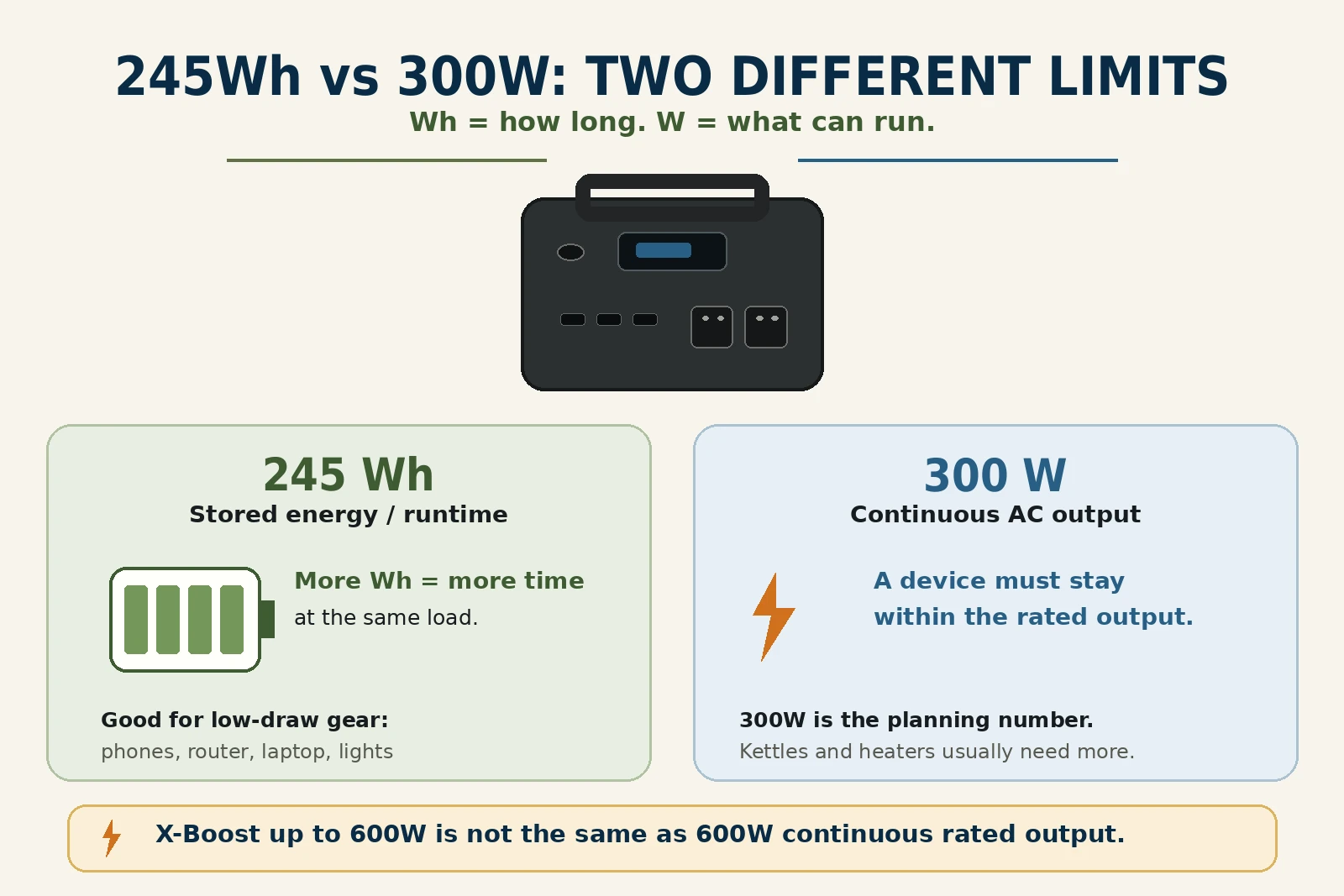
Watt-hours tell you how much energy is stored. A 245Wh label does not mean 245Wh will arrive at every device after conversion losses, and actual runtime depends on the output type and the load. What it does tell you is that the RIVER 3 is fundamentally a small station.
That is fine for charging phones, running a router, topping up a laptop, or powering lights. It becomes restrictive when one load runs continuously for hours. If your main purpose is refrigeration, start by checking the fridge’s real average draw and duty cycle. Our camping 12V fridge guide is a better place to size that load before choosing the battery behind it.
300W continuous output is the planning number
EcoFlow advertises X-Boost up to 600W, but that does not turn the RIVER 3 into a 600W continuous inverter. X-Boost is designed to help with some higher-rated resistive loads by reducing output voltage. It is not a reason to plan a camp kitchen around a kettle, heater, or other device that normally exceeds the 300W rated output.
For purchasing decisions, use 300W as the dependable ceiling unless EcoFlow specifically confirms compatibility with your exact load.
The base model is not expandable
This is one of the most important differences between the RIVER 3 and RIVER 3 Plus. The Plus can accept compatible extra batteries and scale to 858Wh. The base 245Wh RIVER 3 cannot. If you already suspect 245Wh may be too small, buying the Plus is usually cleaner than buying the base model and wishing it could grow later.
IP54 does not mean the whole station is weatherproof
EcoFlow’s own footnote is more specific than many summaries online: the IP54 water-resistance claim applies to the battery pack, not the entire power station. It does not make the unit safe to leave in rain or immerse in water. Treat the RIVER 3 like powered electronics and keep the station itself protected from weather.
The current US warranty is two years
This is another area where current review pages can be misleading. EcoFlow’s US warranty policy lists the base RIVER 3 at 24 months. RIVER 3 Plus is listed at five years. If warranty length is a major buying criterion, that difference belongs in the comparison.
What owners and independent reviewers consistently say
Across professional hands-on reviews and owner discussions, the strongest consensus is straightforward: people like the RIVER 3 because it is small, light, fast to recharge, quiet at light loads, and useful for electronics. Real-world use cases repeatedly center on laptops, routers, camera gear, small workstations, travel, and short outages.
The recurring disappointment is usually a mismatch between the buyer’s load and the station’s size. Owners looking at kettles, extended outage backup, heavier refrigeration, or larger desktop setups quickly run into either the 300W inverter or the 245Wh battery.
There are also isolated reports of firmware, overload, and hardware failures in EcoFlow owner communities. We found those reports, but they are not enough to establish a RIVER 3 failure rate or a model-wide defect. Public forum reports are useful for identifying failure modes to watch for, not for calculating reliability.
A smaller but useful owner theme is UPS configuration. Port-memory behavior can restore outputs after recharge, and many owners use RIVER models successfully for network gear. At the same time, technically experienced users repeatedly warn that a portable power station’s UPS mode is not identical to a dedicated surge-protecting, line-interactive UPS.
EcoFlow RIVER 3 vs RIVER 3 Plus: when is the Plus worth it?
| Spec / decision | RIVER 3 | RIVER 3 Plus |
|---|---|---|
| Capacity | 245Wh | 286Wh |
| Rated AC output | 300W | 600W |
| Weight | 7.8 lb | 10.4 lb |
| Solar input | 110W | 220W |
| UPS switchover | <20 ms | <10 ms |
| AC outlets | 2 | 3 |
| Expansion batteries | No | Yes, up to 858Wh total |
| US warranty | 2 years | 5 years |
| Best reason to choose | Lower weight and smaller footprint | Much more capability and room to grow |
Portability-first
Capability-first
Our decision rule: choose the base RIVER 3 when compact size and 7.8 lb carry weight are the point of the purchase. Choose RIVER 3 Plus when the price gap is acceptable and you care about 600W output, more solar, a longer warranty, or any chance of adding battery capacity later.
Three alternatives worth considering
EcoFlow RIVER 3 Plus
The most logical alternative if you like EcoFlow but need more power. It is heavier, but the jump from 300W to 600W rated output, 110W to 220W solar input, and no expansion to up to 858Wh makes it a much more flexible small station.
Anker SOLIX C300
Anker’s C300 is close in battery size at 288Wh and keeps a 300W rated AC output, but it adds three AC outlets and high-power bidirectional USB-C. It is about 9.1 lb. Choose it if port selection and USB-C charging flexibility matter more than the RIVER 3’s lower weight.
Jackery Explorer 300 v2
Jackery’s current 300 v2 is another portability-first competitor: 288Wh, 300W rated output, and about 8.16 lb. It also carries a longer 3+2-year warranty under Jackery’s current terms. It makes sense if you want a little more stored energy without moving into the heavier RIVER 3 Plus class.
If you only need to charge phones, small electronics, or one laptop, you may not need a power station at all. A high-capacity power bank is smaller and easier to fly or hike with; see our cold-weather power bank guide for that lighter class of device.
Should you buy the EcoFlow RIVER 3?
Yes, if you already understand that you are buying a small station. The RIVER 3’s value is the combination of 7.8 lb weight, 245Wh of LiFePO4 storage, 300W AC output, 100W USB-C, one-hour wall charging, useful app controls, and a compact shape that is easy to take along.
It is not the right choice for buyers who want to grow into larger loads. The base model has no expansion path, only 110W solar input, a 300W continuous AC ceiling, and a two-year US warranty. If those compromises already sound uncomfortable, the RIVER 3 Plus is the better buy even before you outgrow the smaller unit.
How we researched this review
This review synthesizes the current EcoFlow US product family pages and warranty policy, the exact Amazon US listing for model EFR705, professional hands-on reviews, and owner discussions about real use, UPS behavior, solar expectations, app settings, and failures.
Manufacturer specifications were used for exact electrical limits and dimensions. Independent testers were used as performance and usability signals. Owner reports were aggregated for recurring patterns, while isolated failures were treated as individual reports rather than proof of a defect rate.
FAQ
Is the EcoFlow RIVER 3 worth it?
It is worth considering if you need a compact station for electronics, travel, camping, or short backup use and your continuous AC loads stay below 300W. It is less compelling if the RIVER 3 Plus is only slightly more expensive, because the Plus doubles rated output and adds battery expansion.
What can the EcoFlow RIVER 3 power?
It is well suited to phones, laptops, cameras, lights, routers, small fans, and other low-watt electronics. The rated AC output is 300W. X-Boost can help with some higher-rated resistive devices, but it should not be treated as 600W of normal continuous AC power.
How long does the EcoFlow RIVER 3 battery last?
Runtime depends on the device load and conversion losses. The battery itself is rated at 245Wh, and EcoFlow rates the LiFePO4 cells for 3,000 cycles before capacity falls to about 80%.
How fast does the EcoFlow RIVER 3 charge?
EcoFlow rates AC charging from 0 to 100% at about one hour. Maximum solar input is 110W, with a best-case full solar recharge around 2.6 hours under EcoFlow’s test conditions.
Can the EcoFlow RIVER 3 be expanded with an extra battery?
No. The base 245Wh RIVER 3 does not support the RIVER 3 Plus extra-battery system. If expansion matters, choose the RIVER 3 Plus instead.
Is the EcoFlow RIVER 3 waterproof?
No. EcoFlow’s IP54 statement applies to the battery pack, not the entire power station. Keep the unit itself protected from rain, immersion, and wet operating conditions.
Does the EcoFlow RIVER 3 work as a UPS?
It has a published switchover time under 20 ms and can be useful for routers and other small devices. It is still a portable power station with standby backup behavior, not a full replacement for every surge-protection and power-conditioning function of a dedicated UPS.
What is the difference between RIVER 3 and RIVER 3 (230)?
The exact model reviewed here is the 245Wh RIVER 3, model EFR705. EcoFlow also lists a RIVER 3 (230) with 230Wh capacity. Check the exact capacity and model on the retailer page before assuming specifications are identical.