
Gear & Home is reader-supported. As an Amazon Associate I earn from qualifying purchases. When you buy through links on our site, we may earn an affiliate commission, at no extra cost to you. Learn more.
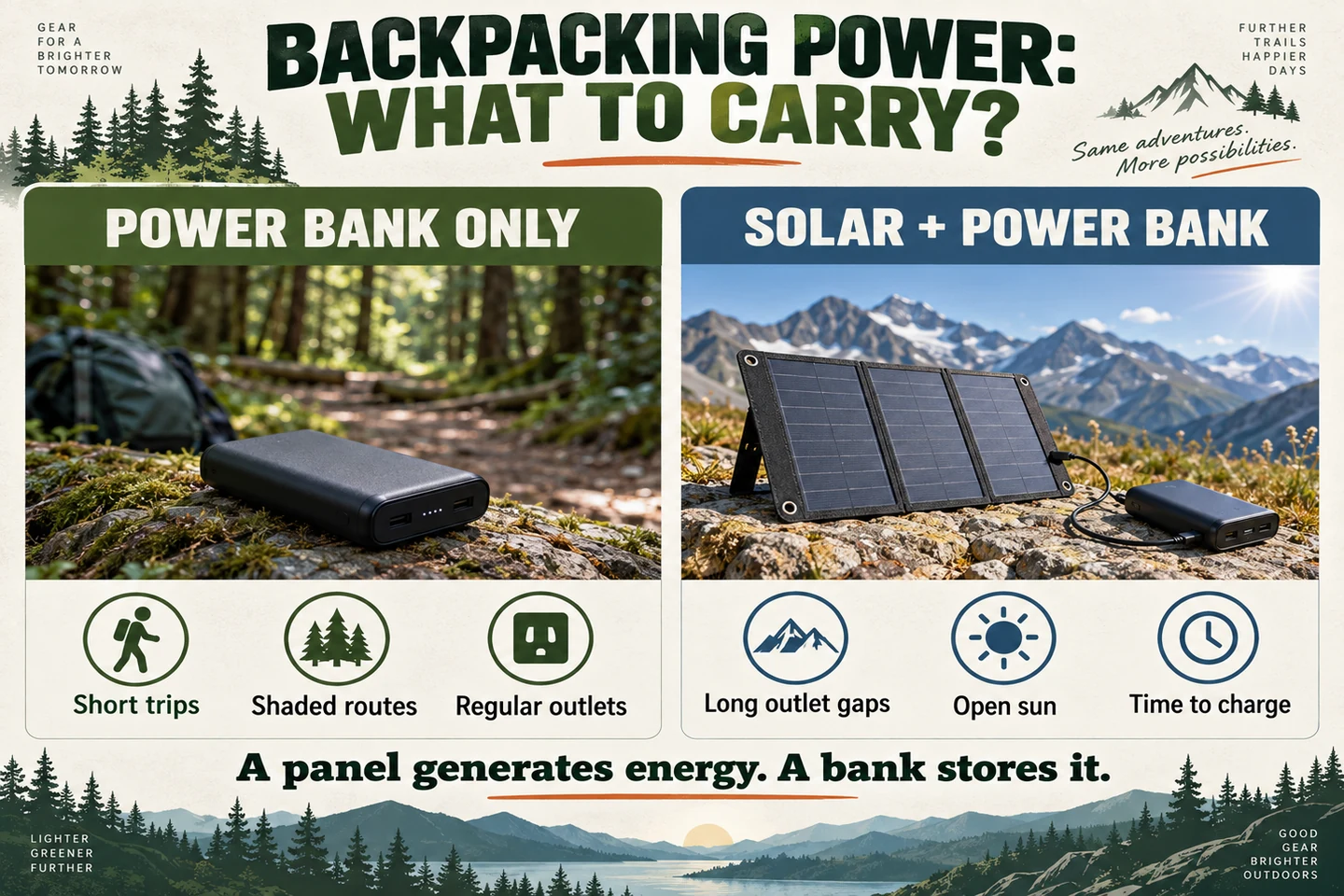
A power bank is the better default for most backpacking trips. A solar panel starts to earn its weight only when your route keeps you away from outlets long enough, gives you dependable open sun, and leaves enough time to collect that energy. In practice, the real choice is usually power bank only versus solar panel plus a small buffer power bank.
Carry a power bank unless the route gives solar a real job to do
Choose a power bank for weekends, shaded trails, hut or town resupply, and any trip where the battery can cover your expected use with a sensible reserve. Consider adding a solar panel when you have long gaps between outlets, regular direct sun, and enough stationary charging time that generating energy can replace the weight of carrying still more stored energy.
Solar Panel vs Power Bank for Backpacking at a Glance
| Decision factor | Power bank only | Solar + power bank |
|---|---|---|
| What it gives you | Energy stored before the trip | On-trail generation plus stored buffer energy |
| Best conditions | No sun required; protect the battery according to its weather rating | Open sun with time to orient the panel well |
| Best route pattern | Short to medium outlet gaps, frequent resupply, forested routes | Long outlet gaps on exposed or sunny routes |
| Pack complexity | Low: bank plus cable | Higher: panel, bank, cable, placement and weather management |
| Predictability | High if your energy budget is realistic | Variable because sunlight and setup change output |
| Main weight question | How much stored energy do you need? | Does the panel save more battery weight than it adds? |
| Our default | Best for most backpackers | Specialized tool for the right route |
Power bank only
Yes
Minimal
Shorter outlet gaps
High
Solar + power bank
Yes
More involved
Long sunny outlet gaps
Variable
A Solar Panel and a Power Bank Are Not True Substitutes
A power bank stores energy. A solar panel generates energy only while useful light is reaching it. That distinction matters more on trail than the marketing labels on either product.
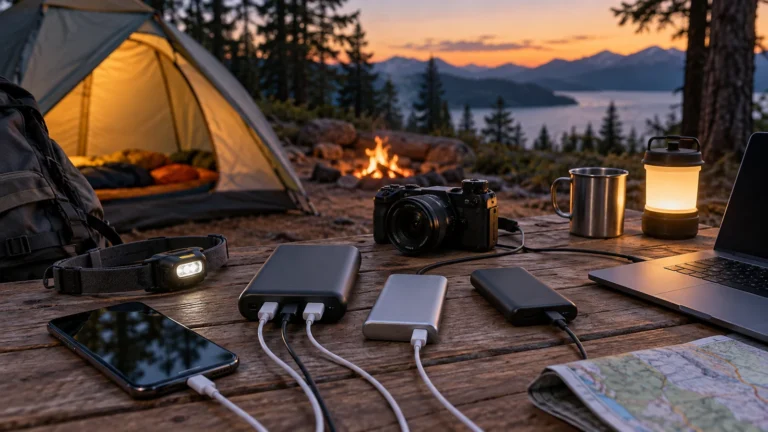
If your bank starts the trip charged, it can refill a phone at night, inside a tent, under tree cover, or during bad weather. A panel cannot do that by itself. Even on a solar-first trip, a small bank is usually the practical buffer: the panel charges the bank when conditions are good, and the bank charges your phone, GPS, headlamp, camera battery or satellite communicator when you actually need power.
That is why the useful comparison is not “panel or battery.” It is whether you should carry stored energy only or accept the extra complexity of generation plus storage.
The 5 Differences That Actually Change the Decision
1. Stored energy is predictable; solar input is conditional
A charged power bank begins the trip with a known energy reserve. Solar output changes with cloud, tree cover, panel angle, season, time of day and how often you can stop to reposition the panel. Current manufacturer guidance reflects this: Goal Zero notes that solar charge times vary with factors including elevation, temperature, season, angle and position to the sun, while BigBlue warns that shade and weather can cause output fluctuations.
That does not make solar unreliable in every setting. It means your route has to supply the conditions that a panel needs.
2. The real weight comparison is system weight, not panel weight
A solar setup still needs cables and, for most backpacking use, a buffer bank. Compare that complete system with the extra battery capacity you would otherwise carry.
For scale, the current NITECORE NB10000 Gen4 publishes 39Wh of cell capacity at 5 oz. At the other end of the equation, the Goal Zero Nomad 10 is a 10W panel listed at 1.12 lb. Larger folding panels can add even more mass: BigBlue lists its 28W SolarPowa 28 at 1.5 lb.
Those are examples, not a recommendation to buy any one of them. They show why there is no universal “solar wins after X days” rule. Panel efficiency, panel weight, bank weight and your own energy use all change the break-even point.
3. Rated panel watts are not guaranteed device charging watts
A panel’s headline wattage is a peak rating under defined conditions, not a promise of constant USB output on trail. The current Goal Zero Nomad 10 is rated at 10W, for example, while its USB port is specified at up to 7.5W. BigBlue similarly distinguishes rated power from actual working output and explains that environmental conditions reduce what reaches connected devices.
For backpacking, this means a larger number printed on the panel is not enough. You also need the right output port, cable, compatible charging input on the bank, and enough real sunlight to keep the system useful.
4. Moving panels are harder to optimize than stationary panels
Clipping a panel to a pack sounds effortless, but the panel changes direction as you walk and repeatedly passes through shade. A stationary lunch break, exposed campsite or basecamp makes it easier to face the panel toward the sun and leave it there long enough to collect meaningful energy.
Community reports are mixed for exactly this reason. Some long-distance hikers make small panels work well on exposed western routes, while others find that the same idea adds hassle and produces little on forested trails. Route geometry matters.
5. Your devices matter more than your trip length
Two hikers can spend five nights on the same route and need completely different power systems. A phone used mostly in airplane mode for navigation may consume little. Add frequent photography, video, satellite messaging, a smartwatch, camera batteries or a high-drain medical device and the energy budget changes fast.
Trip length is only a proxy. The better question is: how much energy must you replace before the next reliable outlet?
Choose a Power Bank Only If These Conditions Fit
- You can cover the outlet gap with one sensible battery reserve. If the bank already does the job, a panel is extra system weight.
- You spend much of the day under tree cover. Stored power does not care whether the trail is shaded.
- You move from dawn to late afternoon. A bank does not need a charging window or careful orientation.
- Your resupply stops have outlets. Fast wall charging often removes the need to generate power on trail.
- You value simplicity. Fewer components mean fewer cables, connections and weather-sensitive steps to manage.
For winter trips, battery behavior adds another layer. Our cold-weather power bank guide covers that narrower use case.
Choose Solar Plus a Power Bank If These Conditions Fit
- You have genuinely long gaps between outlets. Solar has more opportunity to repay its weight when there is no easy wall recharge.
- The route is exposed. Desert, alpine and above-tree-line terrain can make panel placement much easier than a dense forest corridor.
- You can stop during useful sun. Lunch breaks, basecamp time or an early camp can matter more than total daylight hours.
- Your energy demand is repetitive. A panel is most useful when it can replenish a buffer bank day after day instead of simply sitting unused.
- You have tested compatibility before leaving home. Confirm that the panel can reliably restart charging after shade, that the bank accepts the panel’s output, and that your cables work together.
A buffer bank makes the system more forgiving when sunlight changes. It lets the panel collect energy when conditions are favorable and lets you charge devices later, instead of tying your phone to a panel every time the sun appears.
Use Route Math, Not a Fixed Day Count
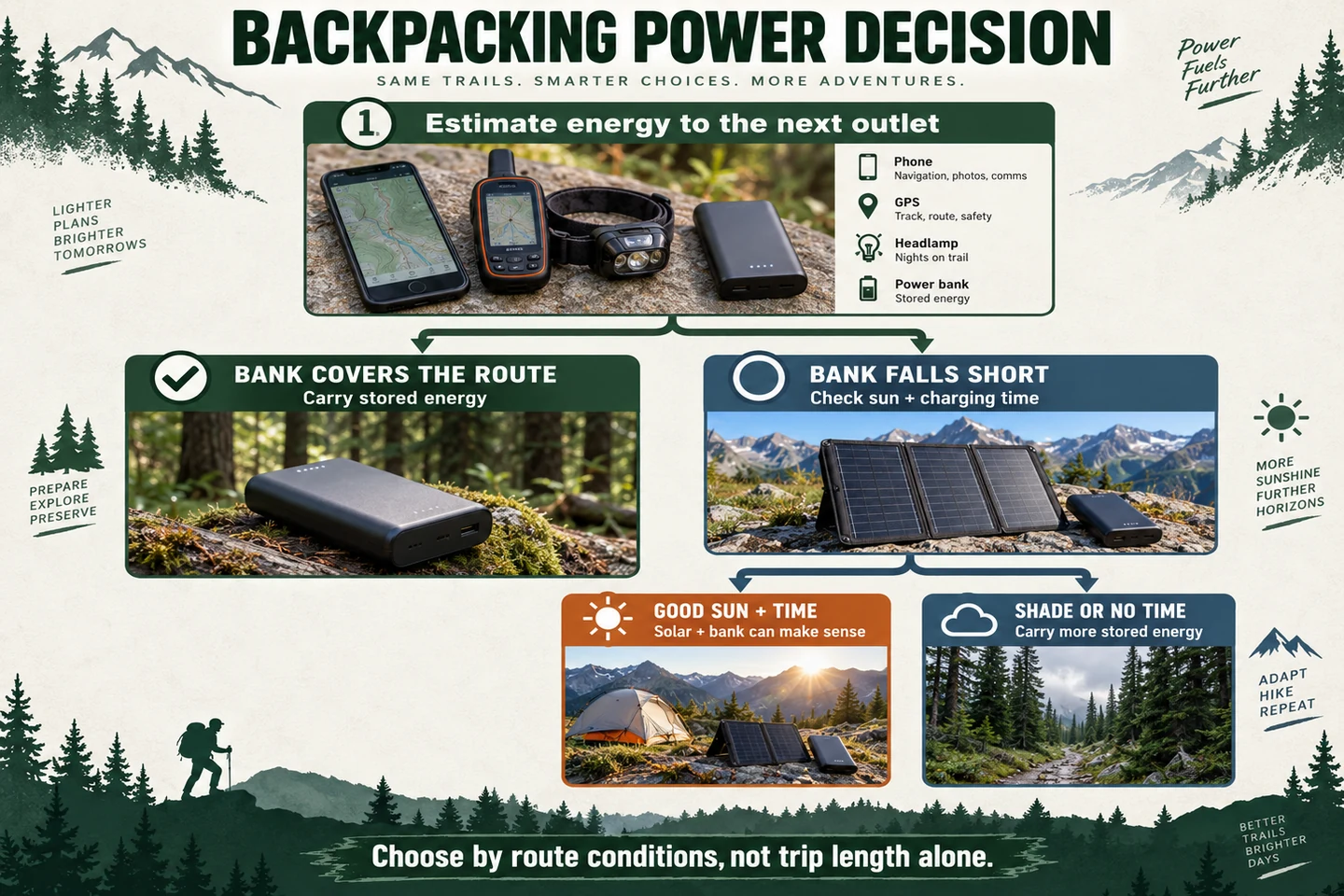
You do not need a spreadsheet to make the first decision. Start by observing one realistic day of device use at home or on a shakedown trip. Note how much charge your phone, GPS, headlamp, camera and other electronics actually consume. Then ask how many similar days you must cover before the next reliable outlet.
- Estimate the energy you need to the next outlet. Use your normal navigation, photography and communication habits, not an idealized low-use day.
- See whether your existing bank covers it with reserve. If yes, stop. Solar has no required job.
- If the bank falls short, compare two ways to close the gap. More stored energy, or a panel plus the buffer bank you still need.
- Apply the sun test. If the route is shaded, storm-prone or gives you little stationary time, more stored energy is usually the safer answer.
- Run a shakedown. A solar system that works on paper can still fail because of cable behavior, charging thresholds, pack orientation or your actual daily routine.
This article intentionally stops at the decision framework. A detailed watt-hour calculator belongs in a separate capacity-planning guide because it answers a different question.
Four Backpacking Scenarios
Two nights on a forested trail
Pick: power bank only. The outlet gap is short and the canopy works against solar collection. If one charged bank covers your phone, navigation and headlamp, a panel adds complexity without solving a real problem.
Five days above tree line with long lunch stops
Pick: solar may make sense, but compare total weight first. This is the kind of route where a small panel can actually see the sun and remain oriented for meaningful periods. The decision still depends on whether the panel plus buffer bank is lighter or more useful than carrying enough stored energy for all five days.
A week with a town or hut outlet every second or third day
Pick: power bank only for most hikers. Regular outlets reset the energy problem. Prioritize a bank and wall charger that can refill efficiently during the stop instead of carrying generation hardware every mile.
Remote photography trip with camera batteries and multiple devices
Pick: calculate before buying anything. High device demand can make solar attractive on a sunny route, but it can also push you beyond the practical limits of a lightweight USB panel. If the trip is camp-based rather than backpacking-first, a larger battery system may be the better category. Our portable power stations for camping guide covers that heavier class.
If You Want a Concrete Product to Start From
This page is meant to decide the power system first, not rank individual products. Once that route-level decision is clear, these two current examples give you a practical starting point without turning the comparison into another roundup.
NITECORE NB Plus 10,000mAh
NITECORE lists the NB Plus at 10,000mAh / 38.5Wh and 5.47 oz, with USB-C input plus USB-C and USB-A outputs. It fits the power-bank-only side of the decision when you want a compact stored-energy reserve without panel hardware.
FlexSolar E10 Mini 10W
FlexSolar lists the E10 Mini at 10W with 5V USB-A output and a 9.12 oz listed weight. It is a reasonable example of the solar side only when your route gives it sustained sun and you still use a buffer bank for dependable charging.
Why only two examples? They are representative products for the two decisions above, not Best Overall awards. Product ranking belongs on the separate solar-charger and backpacking power-bank roundups, so this page can stay focused on the solar-versus-storage decision.
Common Mistakes to Avoid
- Buying a panel because the trip is “long.” Long and shaded can still favor batteries.
- Comparing panel watts directly with bank mAh. One describes generation rate and the other describes stored charge at a stated voltage. They are different measurements.
- Assuming rated solar output is what you will see all day. Real output varies with conditions and port limits.
- Forgetting the buffer bank in the weight comparison. A panel-only number understates the practical solar system.
- Relying on a tiny solar panel built into a battery brick. Treat those products primarily as power banks unless the solar surface is large enough and independently useful for your route.
- Skipping a home compatibility test. Check panel, bank, cables and restart behavior before the trip.
Alternatives to Carrying a Solar Panel
Carry a second small power bank
Two smaller banks can add redundancy and may recharge in parallel with a suitable multi-port wall charger when outlet time is limited. Compare their combined weight with one larger bank and with the solar system you are considering.
Reduce device use
Airplane mode, offline maps, lower screen brightness and fewer background radios can stretch stored energy without adding hardware. Keep emergency communication and navigation needs first.
Optimize town charging
A bank with a faster input and a suitable wall charger can matter more than extra capacity when your route includes short resupply stops. Fast recharge is especially useful on thru-hikes where time at an outlet is limited.
Move up to a power station only when the trip stops being backpacking-first
Laptops, CPAP machines, drones, large camera kits and group charging can exceed what a small trail battery system handles comfortably. For basecamp, car camping or supported trips, a portable power station is a different and often more appropriate tool.
Bottom Line
For most backpackers, a power bank is the simpler and more predictable choice. It works in shade, at night and in poor weather, and it does not need a charging routine.
A solar panel becomes compelling only when the route creates a specific problem that stored energy cannot solve efficiently: long outlet gaps, open sun, time to charge, and enough daily device demand to justify generation hardware. When those conditions line up, think of solar as a way to refill a small bank, not as a replacement for storage.
The shortest decision rule is simple: if your bank covers the route, carry the bank. If it does not, check sun and charging time before adding solar.
FAQ
Is a solar panel worth it for backpacking?
Usually only on routes with long gaps between outlets, good sun exposure and enough time to keep the panel well positioned. For weekends, forested routes and trips with regular resupply charging, a power bank is normally simpler and more predictable.
Can a solar panel replace a power bank on trail?
Not in most practical backpacking setups. A panel generates energy only when conditions are suitable, while a power bank stores energy for use at night, in shade or during bad weather. A small buffer bank is usually still useful with solar.
How many days of backpacking make solar worth carrying?
There is no reliable fixed day count. The break-even point depends on your device use, days between outlets, panel and battery weight, sun exposure and the time you can spend charging. A sunny five-day alpine route and a shaded five-day forest route can justify different systems.
Should I charge my phone directly from a backpacking solar panel?
You can when the panel and phone support it, but a buffer power bank is generally more flexible. The bank can collect energy while sunlight is good and charge the phone later, reducing dependence on stable sunlight at the exact moment you need the phone.
Is a 10W solar panel enough for backpacking?
It can be enough for modest device demand when the route offers strong sun and adequate charging time, but the 10W label is a peak panel rating rather than guaranteed trail output. Check the panel’s actual USB output, your bank’s input requirements and your daily energy use.
Are solar power banks with a built-in panel good for backpacking?
Many compact battery bricks have very little solar surface area, so the solar section should be treated as supplemental rather than the main recharge plan unless the manufacturer publishes a credible output and the design has enough panel area for your needs. A separate folding panel plus a small bank is easier to evaluate as a true solar system.
What matters more than battery capacity for a thru-hike?
Days between reliable outlets, recharge speed, your daily device use and the time available at resupply stops all matter. On sunny exposed routes, solar can also reduce dependence on town charging, but it should be compared against the weight and simplicity of carrying more stored energy.