
Gear & Home is reader-supported. As an Amazon Associate I earn from qualifying purchases. When you buy through links on our site, we may earn an affiliate commission, at no extra cost to you. Learn more.
A good camping power station is not simply the biggest battery you can fit in the car. The useful choice is the one that gives your campsite enough watt-hours and AC/DC output without making you haul capacity you will never use.
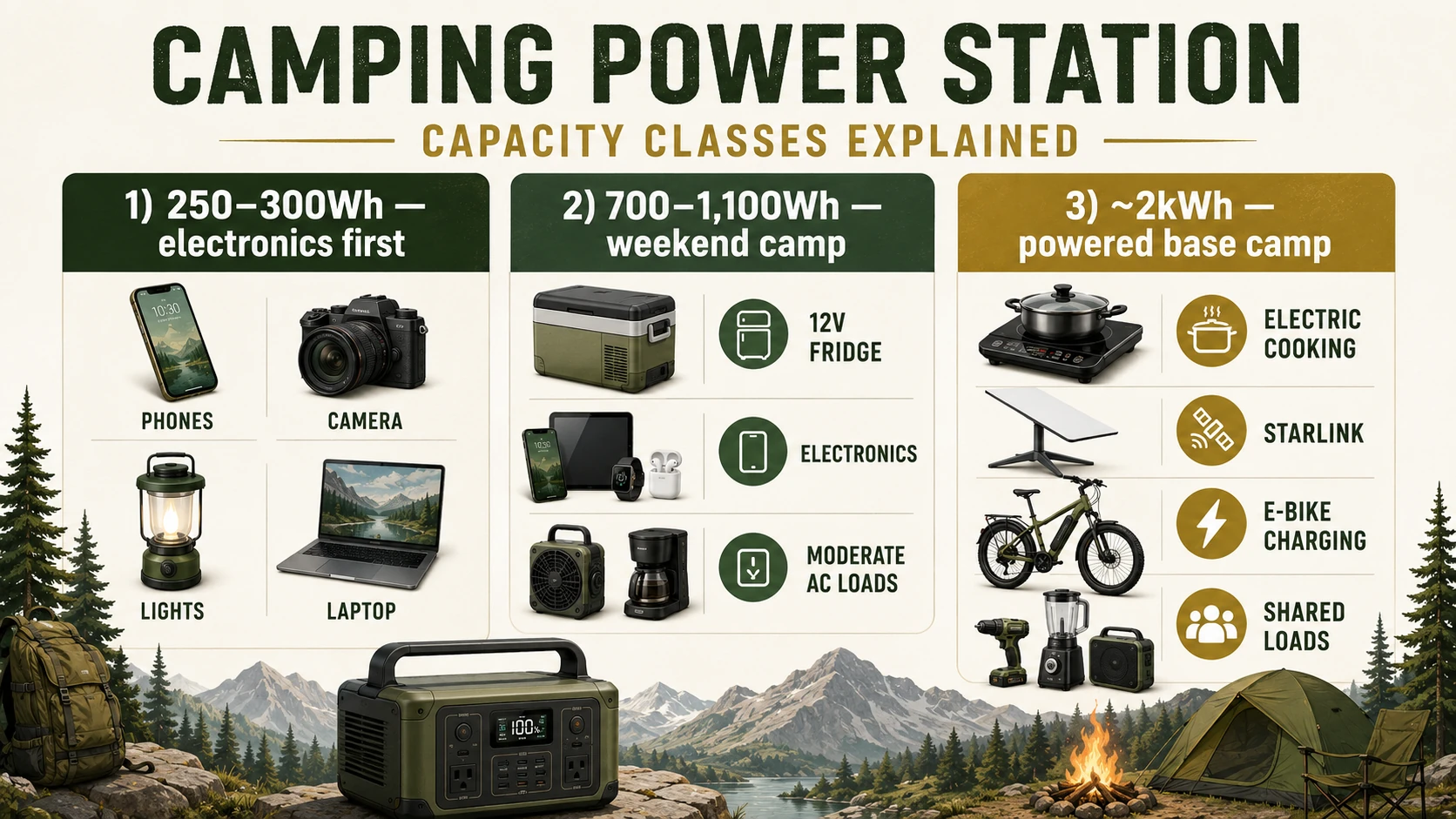
For electronics-first tent camping, a compact 250–300Wh station can be enough. If a compressor fridge or regular AC appliances are part of camp, roughly 700–1,100Wh is the more useful weekend range; 1.5–2kWh starts to earn its extra weight for rough-weather trips, electric cooking, Starlink, e-bikes or longer base-camp stays.
The best portable power station for most campers
The Anker SOLIX C1000 Gen 2 is our Best Overall pick. Its 1,024Wh battery, 2,000W AC output and roughly 25-pound body put unusually strong appliance headroom into a package that is still reasonable to move around a campsite. The main trade-offs are a fan that independent testing found loud under heavier use and the loss of expansion-battery support on Gen 2.
Choose the Anker SOLIX C300 instead if you mostly need electronics power and low carried weight. Move up to the Jackery Explorer 2000 v2 if your camp uses electric cooking, multiple high-draw devices or simply needs much more reserve between recharges.
Quick Picks
Jackery Explorer 1500 Ultra
Wet, dusty, rougher vehicle camps · 1,536Wh · 38.6 lb
EcoFlow DELTA 3 Plus
Solar-heavy and expandable setups · 1,024Wh · 27.6 lb
Best Portable Power Stations for Camping Compared
| Pick | Capacity | AC output | Weight | Solar input | Best for | Amazon |
|---|---|---|---|---|---|---|
| Anker SOLIX C1000 Gen 2 Best Overall |
1,024Wh | 2,000W | 24.9 lb | 600W max | Most weekend car-camping setups | Check availability on Amazon |
| Anker SOLIX C300 Best Compact |
288Wh | 300W | 9.1 lb | 100W max | Phones, laptops, lights, short trips | Check availability on Amazon |
| BLUETTI AC70 Best for a 12V Fridge |
768Wh | 1,000W | 22.5 lb | 500W max | Fridge-led camps without 1kWh bulk | Check availability on Amazon |
| Jackery Explorer 1500 Ultra Best Weather-Resistant |
1,536Wh | 1,800W | 38.6 lb | 800W max | Wet, dusty and rougher vehicle camps | Check availability on Amazon |
| EcoFlow DELTA 3 Plus Best for Solar & Expansion |
1,024Wh | 1,800W | 27.6 lb | 1,000W max | Solar-heavy and expandable setups | Check availability on Amazon |
| Jackery Explorer 2000 v2 Best Base Camp |
2,042Wh | 2,200W | 39.5 lb | 400W max | High-demand, multi-day car camps | Check availability on Amazon |
Anker SOLIX C1000 Gen 2
1,024Wh
2,000W
24.9 lb
600W max
Anker SOLIX C300
288Wh
300W
9.1 lb
100W max
BLUETTI AC70
768Wh
1,000W
22.5 lb
500W max
Jackery Explorer 1500 Ultra
1,536Wh
1,800W
38.6 lb
800W max
EcoFlow DELTA 3 Plus
1,024Wh
1,800W
27.6 lb
1,000W max
Jackery Explorer 2000 v2
2,042Wh
2,200W
39.5 lb
400W max
Capacity and output are manufacturer ratings. Real usable energy is lower than the nameplate Wh once inverter losses and station overhead are included. Solar figures are maximum accepted input, not a promise of real-world panel production.
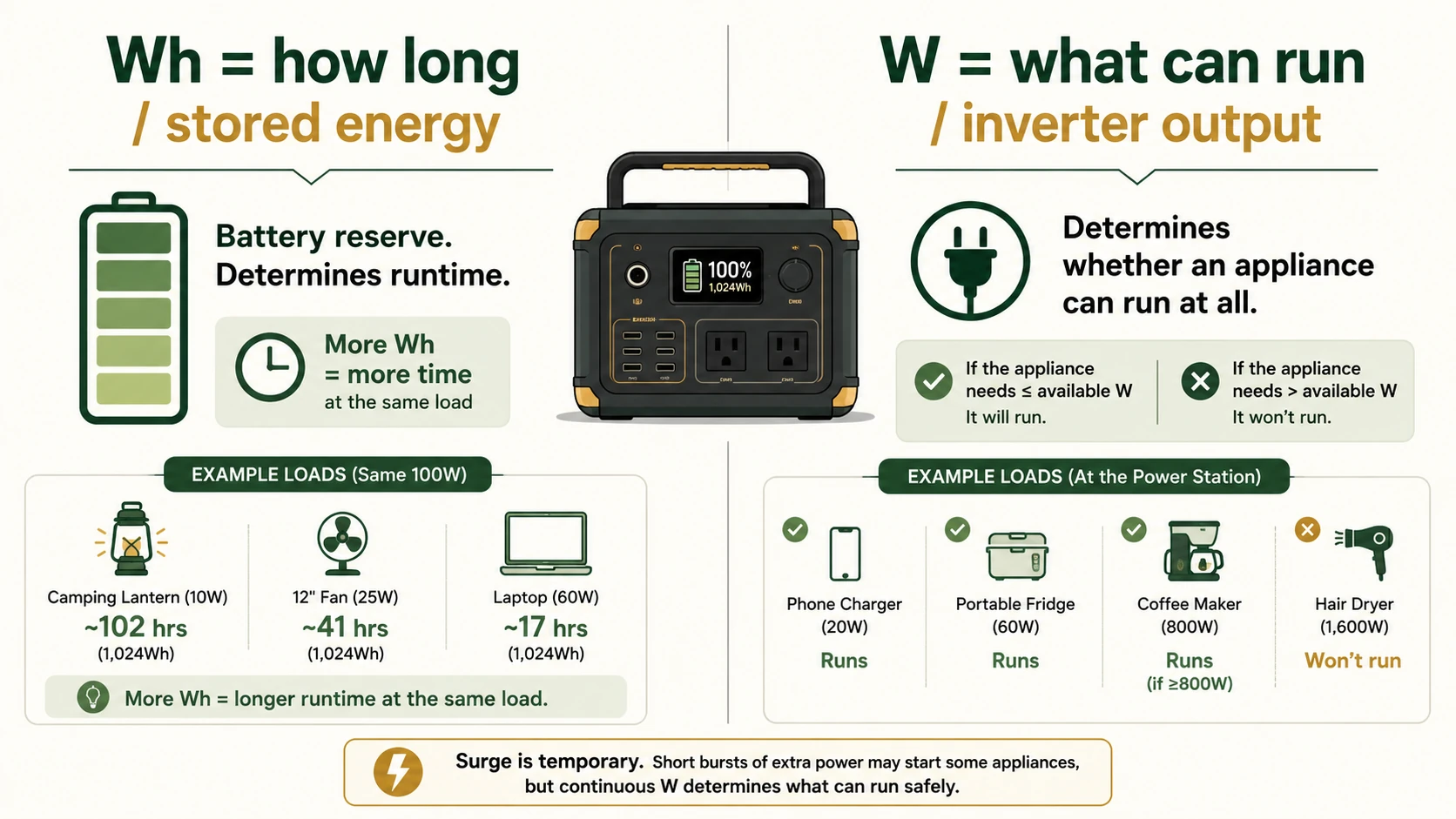
Capacity (Wh) tells you how much energy is stored. Continuous output (W) tells you what the inverter can run at one time. A large battery with a low-output inverter can still refuse a kettle or cooking appliance, while a high-output station with too little capacity can run it only briefly.
The 6 Best Portable Power Stations for Camping
Anker SOLIX C1000 Gen 2
The strongest all-around balance of 1kWh capacity, appliance-ready output and campsite portability.
#1
The C1000 Gen 2 is the easiest recommendation here for a camper who has not already decided on a specialized setup. A 1,024Wh LFP battery is large enough to move beyond phone-and-laptop duty, while the 2,000W inverter gives far more room for coffee makers, cooking gear and other short high-draw loads than most compact stations.
Its 600W solar ceiling is enough to make daytime recovery realistic with a substantial panel array, but this is still a one-battery system. If your plan is to start at 1kWh and add multiple extra batteries later, EcoFlow is the better fit.
Pros
- Very strong 2,000W output for a roughly 25-pound station
- 1,024Wh is a practical weekend-camping class
- 600W maximum solar input
- Fast AC charging and simple controls
Limitations
- Fan can be intrusive during fast charging or heavier loads
- No expansion-battery support
- No built-in campsite light
Anker SOLIX C300
A genuinely portable AC power station for electronics-first camps, not a miniature appliance battery pretending to be more.
#2
At 9.1 pounds, the AC version of the C300 is dramatically easier to move than every 700Wh-plus station in this guide. The 288Wh pack and strong USB-C support are a better match for charging a laptop, phones, cameras, lights and small DC loads than for running an entire powered campsite.
The 300W AC ceiling is the important limit. It is not the pick for electric cooking, a large compressor load or a campsite where several people expect appliance-level power. That constraint is useful: it keeps the C300 small enough that you may actually bring it on trips where a 25- or 40-pound box would stay home.
Pros
- Only 9.1 lb
- 288Wh LFP battery with useful USB-C charging
- Built-in light
- Can recharge from AC, USB-C, vehicle or up to 100W solar
Limitations
- 300W AC output rules out many appliances
- Small battery for multi-day fridge duty
- 100W solar input is modest
BLUETTI AC70
A useful middle class: substantially more reserve than 300Wh minis without jumping all the way to a heavier 1kWh-plus station.
#3
A compressor fridge is usually a capacity-and-recharge problem more than a need for a giant inverter. That makes the AC70’s 768Wh battery, regulated 12V car outlet and 500W solar input a sensible combination for a camp built around cold food plus normal electronics. If you are still choosing the cooler itself, see our best 12V fridges for camping.
It weighs almost as much as some 1kWh stations, so the reason to choose it is not minimum pounds. The reason is a smaller battery class with enough solar input to recover well during the day. If you also expect to run kettles, induction cookers or other high-draw AC loads, move to the C1000 Gen 2 or a larger station.
Pros
- 768Wh is a practical fridge-led middle ground
- Regulated 12V/10A car outlet
- Up to 500W solar input
- LFP battery and app control
Limitations
- 1,000W continuous AC output is modest for appliance-heavy camps
- 22.5 lb is not especially light for the capacity
- Power Lifting mode is not a substitute for continuous inverter headroom on motor/compressor loads
Jackery Explorer 1500 Ultra
The camping-specific pick when dust, splashes and rough transport matter enough to justify a heavier 1.5kWh-class station.
#4
The Explorer 1500 Ultra solves a different problem from the three 1kWh-class stations that dominated the original shortlist. Its 1,536Wh LFP battery and 1,800W inverter are useful, but the reason to buy it is the enclosure: protected ports, dust resistance and one-meter drop-resistance claims give it a much stronger case for rough campsites, truck-bed transport and changing weather.
Do not read IP65 as permission to leave it exposed while every port is open. Jackery says the rating depends on the protective covers being secured; when the solar input cover is open, that port is not waterproof, and the company recommends charging in dry conditions. This is a weather-resistant station, not a substitute for a dry, ventilated shelter.
Pros
- IP65 dust/water resistance with port covers secured
- 1,536Wh capacity and 1,800W continuous AC output
- Up to 800W solar input
- Rugged construction and one-meter drop-resistance claim
Limitations
- 38.6 lb is substantially heavier than a 1kWh station
- Weather protection is conditional when ports are open
- No expansion-battery support
- Limited USB port count for a station this large
EcoFlow DELTA 3 Plus
The most flexible 1kWh platform here if fast solar recovery and adding more storage later matter more than minimum weight.
#5
The DELTA 3 Plus is the solar-first option. Its two 500W MPPT inputs can accept up to 1,000W of solar, which gives a serious panel setup far more recovery headroom than the 100–600W ceilings of the other sub-2kWh picks here.
It also supports compatible EcoFlow extra batteries, making it the cleanest choice if you want to start near 1kWh and grow later. The penalty is a 27.6-pound body and a more involved ecosystem. If you simply want one box for a normal weekend, the Anker C1000 Gen 2 is the cleaner recommendation.
Pros
- Up to 1,000W solar input
- Expandable storage ecosystem
- 1,800W AC output
- Multiple high-power USB-C and DC outputs
Limitations
- Heavier than the lightest 1kWh options
- More complexity than a simple one-box camping station
- Owner experiences with UPS/pass-through behavior are not uniformly positive
Jackery Explorer 2000 v2
A 2kWh station that stays movable enough for car camping while giving appliance-heavy camps a much deeper energy reserve.
#6
The Explorer 2000 v2 makes sense when you stop treating the power station as a charger and start treating it as part of the camp kitchen or base-camp infrastructure. Its 2,042Wh battery and 2,200W continuous inverter give much more breathing room for electric cooking, Starlink, e-bike charging and several people sharing power.
It is still a 39.5-pound box, so this is car-camping equipment, not something to casually carry far from the vehicle. The 400W solar ceiling is also conservative relative to the battery size: if repeated high-draw use and rapid solar recovery are both central to your plan, EcoFlow’s expansion/solar ecosystem is more flexible.
Pros
- 2,042Wh capacity with 2,200W continuous AC
- Relatively compact and movable for a 2kWh station
- Simple controls and flat, packable shape
- Strong fit for appliance-heavy camps
Limitations
- 39.5 lb is still heavy
- No expansion-battery support
- 400W solar input is modest for a 2kWh battery
- Some third-party solar panels require an adapter
Two Current Alternatives Worth Knowing About
Jackery Explorer 1000 v2
The Explorer 1000 v2 is still a good 1,070Wh, 1,500W option, and current professional coverage continues to recommend it for camping. We did not give it a separate award because its buyer job overlaps too closely with the C1000 Gen 2: it is only about a pound lighter while giving up AC-output and solar-input headroom. It remains a sensible alternative when its simpler interface or current retailer offer suits you better.
Jackery HomePower 1000 Plus v2
Jackery launched the HomePower 1000 Plus v2 on August 27, 2026. Its 1,024Wh battery, 1,800W output, 23.8-pound weight and expansion path up to 11kWh make it unusually interesting on paper. We are not ranking it yet because a launch-week spec sheet is not a substitute for mature independent and owner evidence. It is a model to re-check on the next update rather than a reason to reshuffle the list immediately.
How to Choose a Portable Power Station for Camping
Start with the capacity class
About 250–300Wh: best for phones, cameras, lights, a laptop and small fans. This class wins on portability, not on running a powered camp for days.
About 700–1,100Wh: the most useful range for many weekend car campers. It gives a compressor fridge, electronics and moderate AC use far more reserve while keeping weight around the low-to-high 20-pound range in the best current designs.
About 1.5–2kWh: starts to make sense for electric cooking, Starlink, e-bikes, several users, longer base-camp stays or a weather-resistant/rugged-use design that adds weight. You are trading a much heavier box for more reserve or more specialized construction.
Capacity in Wh and output in W are different decisions
A 1,000Wh battery stores roughly twice the nameplate energy of a 500Wh battery, but that does not tell you whether it can start or sustain an appliance. For that, check continuous AC output and the device’s normal and startup draw. Treat manufacturer surge or “power lifting” modes as short-duration assistance, not as permission to ignore the continuous rating.
For a 12V fridge, care about DC power and daily recharge
When the station offers a suitable regulated 12V outlet, running a compatible fridge from DC can avoid the extra inverter conversion involved in AC operation. Fridge energy use changes with ambient heat, thermostat setting, insulation, how often the lid opens and how much warm food is added, so generic “X hours of runtime” claims are poor sizing tools. Use the exact fridge specifications and, if you are choosing the appliance at the same time, compare our 12V camping fridge picks.
Solar input matters only if you will actually carry enough panel
A station that accepts 1,000W of solar does not generate 1,000W from a 200W folding panel. Match the station’s input window to the panels you plan to use, and assume real output will move with sun angle, cloud, temperature and shading. Higher input ceilings become valuable on longer trips where recovery speed matters.
Do not ignore weight and shape
Power stations are car-camping gear, but you still move them,from house to vehicle, vehicle to table, table to shade, and sometimes around a campsite to follow solar panels or a load. A 24-pound 1kWh box is a very different ownership experience from a 40-pound 2kWh station.
LFP is the default chemistry we want for this use
Every pick in this guide uses lithium iron phosphate (LiFePO₄/LFP) cells. Current manufacturers generally rate these packs for thousands of cycles, making them a better long-term fit for frequently used camping and backup power than older short-cycle chemistries. Cycle-life figures are laboratory claims, not a guarantee of identical real-world lifespan.
How We Chose These Camping Power Stations
We started with the current US camping-power-station search landscape, then compared current models by the decisions that actually change a camping purchase: capacity, continuous AC output, weight, DC capability, solar input, charging options, battery chemistry, expandability and the practical job each station is best at.
Capacity, output, weight, charging limits and battery chemistry were checked against current manufacturer documentation.
We used current professional tests to check whether portability, charging behavior and practical output supported the spec-sheet story.
Community reports were used for recurring camping friction such as fan behavior, fridge use, portability, solar recovery, weather protection and app/UPS issues,not as precise lab data.
Retailer buttons were checked against the current exact model rather than a generic category page, bundle guess or older generation.
When a Power Station Is the Wrong Tool
If you only need to keep a phone, headlamp and camera alive, a much smaller power bank is easier to carry and cheaper to replace. For lighting, a dedicated solar camping lantern can remove that load from the station entirely. And if long battery life matters more than maximum brightness, see our camping flashlights with long runtime.
FAQ
What size portable power station is best for camping?
For electronics-first trips, roughly 250–300Wh can be enough. A fridge plus normal electronics often points toward about 700–1,100Wh, while 1.5–2kWh becomes easier to justify for electric cooking, Starlink, e-bikes, several users or longer base-camp stays.
Is a 300W power station enough for camping?
It can be enough if your loads are phones, lights, cameras, a laptop and other small devices. A 300W inverter is not a good match for most electric cooking appliances or an appliance-heavy campsite, regardless of battery capacity.
Is 1,000Wh enough for a camping fridge?
It can be, but fridge runtime cannot be predicted from capacity alone. Ambient temperature, fridge size, set temperature, duty cycle, food loading and whether you run from 12V DC or AC all change energy use. Size from your fridge’s measured or well-supported daily Wh consumption and your recharge plan.
Can I leave a portable power station outside in the rain?
Usually not. Keep a power station sheltered unless the exact model is rated for the conditions. Even the IP65-rated Jackery Explorer 1500 Ultra depends on its port covers being secured; Jackery says an open solar-input port is not waterproof, so charging should be done in dry conditions.
How much solar do I need with a camping power station?
That depends on how much energy you consume each day and how quickly you need to replace it. A larger panel array helps only when the station can accept the panel’s voltage/current and enough solar wattage; shade and weather can reduce real production substantially.
Are LiFePO4 power stations better for camping?
LFP is now a strong default for frequent-use portable stations because current models typically combine long manufacturer-rated cycle life with stable chemistry. All six picks in this guide use LFP batteries.