

Gear & Home is reader-supported. As an Amazon Associate I earn from qualifying purchases. When you buy through links on our site, we may earn an affiliate commission, at no extra cost to you. Learn more.
The EcoFlow RIVER 3 Plus is one of the more convincing small power stations because it puts a 600W continuous AC inverter, fast charging, a useful UPS mode, and battery expansion into a 10.4 lb body. The catch is equally important: its 286Wh battery is still small. This is a compact electronics and short-backup station, not a substitute for a 1kWh-class power system.
Who should buy the EcoFlow RIVER 3 Plus?
Buy the RIVER 3 Plus if you want a small LiFePO4 power station for home-office backup, routers and network gear, laptops, cameras, short camping trips, a car fridge, or other moderate loads that fit inside a 600W continuous AC limit. It is especially compelling if the base RIVER 3 feels too restrictive but a 25 to 30 lb 1kWh station feels excessive.
Skip it if you need multi-day appliance backup, plan to run heaters or cooking appliances for long periods, routinely exceed 600W continuous AC, or already know you need 500Wh to 1kWh or more. If you intend to buy the largest expansion battery immediately, compare complete larger stations before committing to the modular route.
On this page
- Check the exact model first
- EcoFlow RIVER 3 Plus specs and verdict
- What 286Wh and 600W mean
- What the RIVER 3 Plus does well
- Where it is easy to oversell
- Is it a real UPS replacement?
- Owner and reviewer patterns
- RIVER 3 vs RIVER 3 Plus
- Alternatives
- Should you buy it?
- How we researched this review
- FAQ
Check the exact RIVER 3 Plus model before you buy
This review is specifically about the 286Wh EcoFlow RIVER 3 Plus, model EF-RV-H02-1. The exact Amazon US listing verified for this unit is ASIN B0DCCB657J.
The distinction matters because EcoFlow’s current manual also lists a separate RIVER 3 Plus (270), model EF-RV-H03-1. Retail listings and review pages can mix the family name with different capacities, and even current comparison content sometimes shows a lower capacity figure. If a listing does not clearly identify 286Wh and EF-RV-H02-1, do not assume every specification below applies.
There is one more naming trap on Amazon: the current listing title can show 760W. EcoFlow’s manual defines the station’s AC output as 600W total and separately lists 760W total output power across the station’s combined outputs. For appliance planning, 600W is the continuous AC number that matters.
EcoFlow RIVER 3 Plus
A compact, unusually capable 286Wh station that makes the most sense for electronics, short backup jobs, and light camping. Its 600W AC ceiling is strong for the size, but the battery reserve remains firmly in the small-station class.
Strengths
- 600W continuous AC output in a 10.4 lb station
- Fast one-hour wall recharge under EcoFlow’s rated conditions
- 220W solar input is generous for a 286Wh battery
- Three UPS-supported AC outlets
- 100W USB-C output plus two USB-A ports and 12V car output
- Expandable to 572Wh or 858Wh total with one compatible extra battery
- Five-year US warranty
- App control and PC/NAS Power Manager support
Limitations
- 286Wh is still a small energy reserve for appliances
- Only one USB-C port
- 600W remains the continuous AC planning limit
- X-Boost should not be treated as a true 1200W continuous inverter
- Two AC outlets are on the rear, which can make cable routing less tidy
- Owner reports show mixed results for unattended 24/7 UPS use
- Firmware updates can interrupt AC output, according to multiple owner reports
*EcoFlow manufacturer rating. Charging time, switch behavior, noise, and runtime vary with conditions and connected equipment.
What 286Wh and 600W actually mean in daily use
The RIVER 3 Plus has an unusual balance for a small station: its inverter is relatively powerful, while its battery is relatively small. That is why it can start or run devices that many compact 300W stations cannot, yet still run out of stored energy quickly when the load stays high.
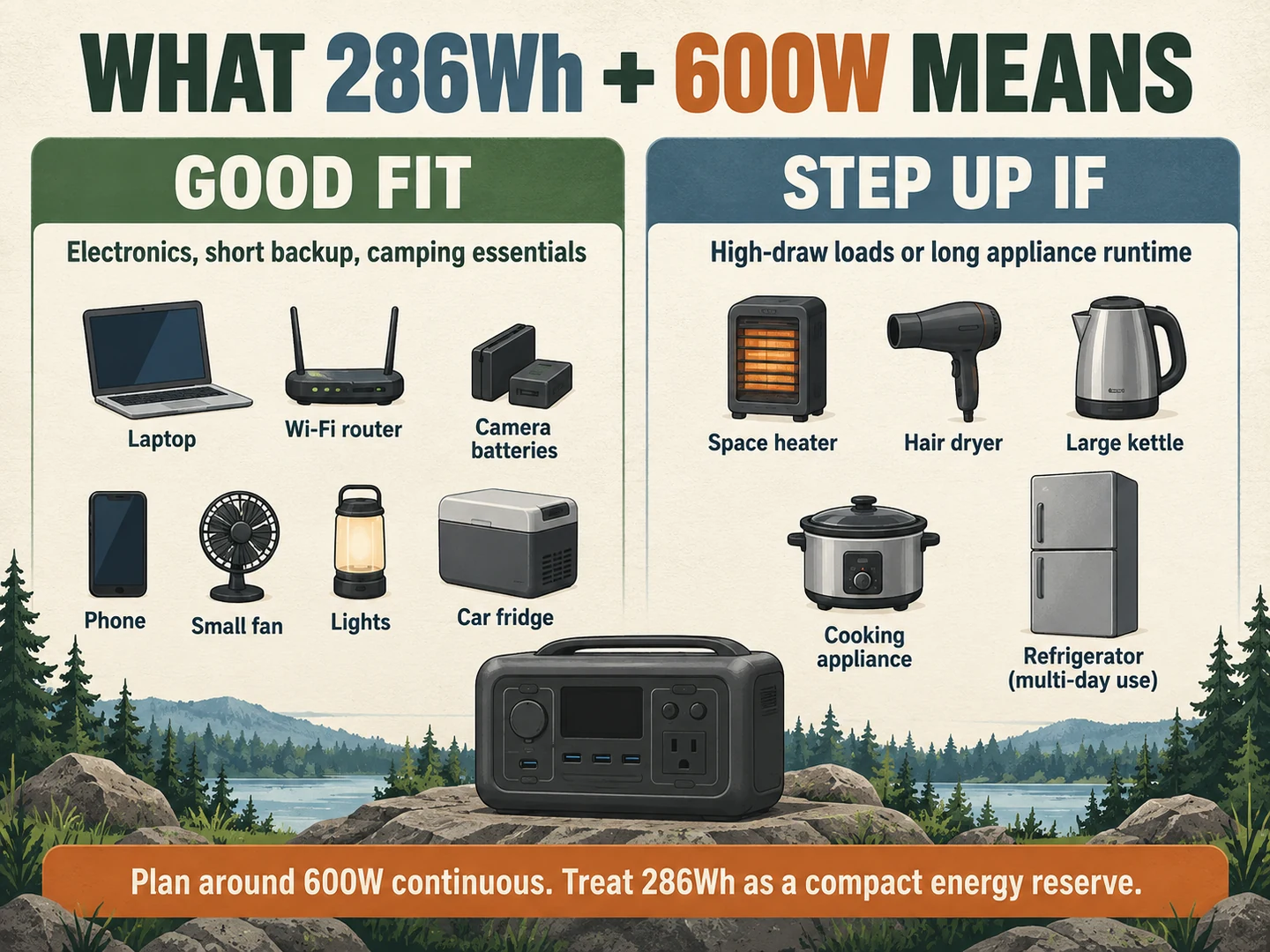
A simple way to estimate idealized runtime is 286Wh divided by device watts. Real AC runtime is lower because the inverter and battery-management system consume energy too. Low-watt devices benefit most from the small battery because their draw is modest. A laptop, router, camera charger, light, or small fan fits the station’s design much better than a heater, kettle, or sustained cooking load.
That distinction also explains why a refrigerator can be a reasonable emergency or camping use without making this a long-duration fridge backup. Refrigerators cycle rather than draw their rated compressor power continuously, so actual runtime depends heavily on the appliance, ambient temperature, duty cycle, and how often the door opens. For multi-day food protection, move up in capacity.
Use 600W as the normal AC ceiling
EcoFlow advertises X-Boost support for some loads up to 1200W, especially resistive heating devices. That feature can make certain appliances run by reducing effective voltage or otherwise managing the load, but it does not turn the RIVER 3 Plus into a conventional 1200W continuous inverter.
For buying decisions, design your setup around the published 600W continuous AC output. Treat X-Boost as a compatibility feature for specific devices, not as permission to build a 1200W load plan.
What the EcoFlow RIVER 3 Plus does well
It delivers unusually high AC output for its weight
Many stations around this physical size live in the 300W class. The RIVER 3 Plus doubles that continuous AC output while staying at 10.4 lb. Popular Mechanics’ current testing singled it out as a compact model precisely because it could run a wider range of electronics and small appliances than its size suggests.
This is the main reason to buy the Plus instead of the base EcoFlow RIVER 3. The capacity increase from 245Wh to 286Wh is modest. The jump from 300W to 600W continuous AC is much more meaningful.
Fast charging makes the small battery easier to live with
EcoFlow rates the US model for a full wall recharge in about one hour and lists 380W AC input. The 220W solar ceiling is also strong relative to the 286Wh battery, with EcoFlow quoting as little as 1.5 hours under its controlled conditions.
Those are manufacturer best-case figures, not a promise for every wall circuit, panel, cloud condition, or temperature. The practical advantage is still clear: this station is designed to refill quickly when you have access to grid power or a well-sized solar panel.
The port mix covers a useful small-station workload
You get three AC outlets, two USB-A ports, one 100W USB-C port, and a 12V car-style output. That is enough to run a laptop, phone, camera chargers, light, and another small device without immediately reaching for a power strip.
The single USB-C port is the weak spot. If your kit is mostly modern USB-C laptops, tablets, cameras, and phones, one high-power port can become the bottleneck before the station itself does.
Expansion is real, but it is best viewed as an option for later
The RIVER 3 Plus accepts one compatible smart extra battery. The EB300 adds 286Wh for 572Wh total. The EB600 adds 572Wh for 858Wh total. The packs stack below the station through EcoFlow’s pogo-pin connection and add a separate high-power USB-C port.
That is useful if your needs grow after purchase. It is less convincing if you know on day one that 286Wh will be too small. Independent reviewers have raised the same value concern: once you price a base station plus a large extra battery, a purpose-built 700Wh to 1kWh station can offer more inverter power, more ports, and a cleaner one-box setup. Compare our best portable power stations for camping before buying the expansion pack immediately.
Where the RIVER 3 Plus is easy to oversell
286Wh is not long-duration home backup
The 600W inverter can make the station feel larger than it is. Capacity tells the other half of the story. A device drawing hundreds of watts can consume a 286Wh battery quickly, even when the inverter handles the load without trouble.
That makes the RIVER 3 Plus better for keeping a desk, network, camera kit, light, fan, or short appliance task running than for carrying a refrigerator, cooking setup, heater, and entertainment system through a long outage. If the goal is extended backup, start in a larger capacity class rather than trying to stretch a small battery.
The Amazon 760W number is not the AC inverter rating
The current Amazon title for ASIN B0DCCB657J can describe the unit as 760W. EcoFlow’s manual resolves the apparent conflict: AC output is 600W total, while total station output power is listed as 760W. The higher number reflects combined outputs, not 760W of continuous AC power.
For a toaster, desktop PC, coffee maker, or any other AC appliance, use the 600W specification when deciding whether the load fits.
IP54 applies to the battery pack, not the whole station
EcoFlow’s own US product-page footnote says the IP54 rating applies only to the battery pack. It does not make the entire power station waterproof and it does not permit immersion. Keep the unit sheltered from rain and treat exposed ports and AC outlets like the electronics they are.
The quiet claim is a manufacturer test condition, not a universal noise ceiling
EcoFlow publishes a noise figure below 30 dB under specified lab conditions, and independent reviewers generally describe the RIVER 3 Plus as quiet. Owner discussions are more mixed once fans ramp up or a particular unit develops fan noise. The safe conclusion is that quiet operation is a strength at suitable loads, not that every unit stays below one exact sound level in every room or temperature.
Is the RIVER 3 Plus a real UPS replacement?
It is a useful UPS-capable power station, but it is not automatically a replacement for every dedicated UPS. EcoFlow publishes a transfer time under 10 ms, all three AC outlets are UPS-supported, and its Power Manager software can connect to a PC or compatible NAS workflow through USB for monitoring and controlled shutdown behavior.
That makes the RIVER 3 Plus attractive for a home office, router, modem, small server, NAS, or entertainment setup when longer battery runtime matters. Current owner discussions include many successful examples of network and computer equipment riding through outages.
The caution is reliability and power conditioning. A traditional line-interactive UPS may provide voltage regulation, surge handling, service expectations, and tested compatibility that are different from a portable power station in bypass mode. Transfer time alone does not describe all UPS behavior.
There is one owner-reported firmware behavior worth planning around
Multiple RIVER 3 Plus owners using the station for network or server backup report that firmware updates can shut off AC output during the update process. That can be inconvenient on any load and especially disruptive when the station itself powers the router needed for the update.
If you use the RIVER 3 Plus as a UPS for important equipment, schedule firmware work intentionally and safely shut down or temporarily move critical loads first. For unattended, mission-critical infrastructure where even a maintenance interruption is unacceptable, a conventional UPS remains the safer default.
What owners and independent reviewers consistently say
The strongest consensus is positive and fairly specific. Professional reviewers repeatedly highlight the same combination: the RIVER 3 Plus is small for a 600W station, fast to recharge, quiet in normal use, and versatile enough for laptops, networking, cameras, small appliances, and short camping trips. Bob Vila’s long-term use and Popular Mechanics’ current testing both reinforce the idea that the station’s inverter capability is impressive relative to its size.
The most consistent limitation is also straightforward: the battery is not large enough for sustained high-watt loads. A compact station can run a coffee maker or refrigerator under the right conditions without becoming a long-duration appliance backup.
Owner reports on UPS use are mixed rather than uniformly positive or negative. Several users report months of successful 24/7 use and clean transitions during outages. Other owners describe unexpected AC dropouts, hard resets, or firmware-related interruptions. That is enough to justify caution for unattended servers, but not enough to calculate a defect rate or claim a model-wide reliability problem.
Noise reports show a similar pattern. Reviewers often praise the quiet design, while some owners report noticeable fan noise. We did not find enough consistent evidence to label fan noise a universal flaw. Placement, charging mode, ambient temperature, load, firmware, and individual hardware can all change fan behavior.
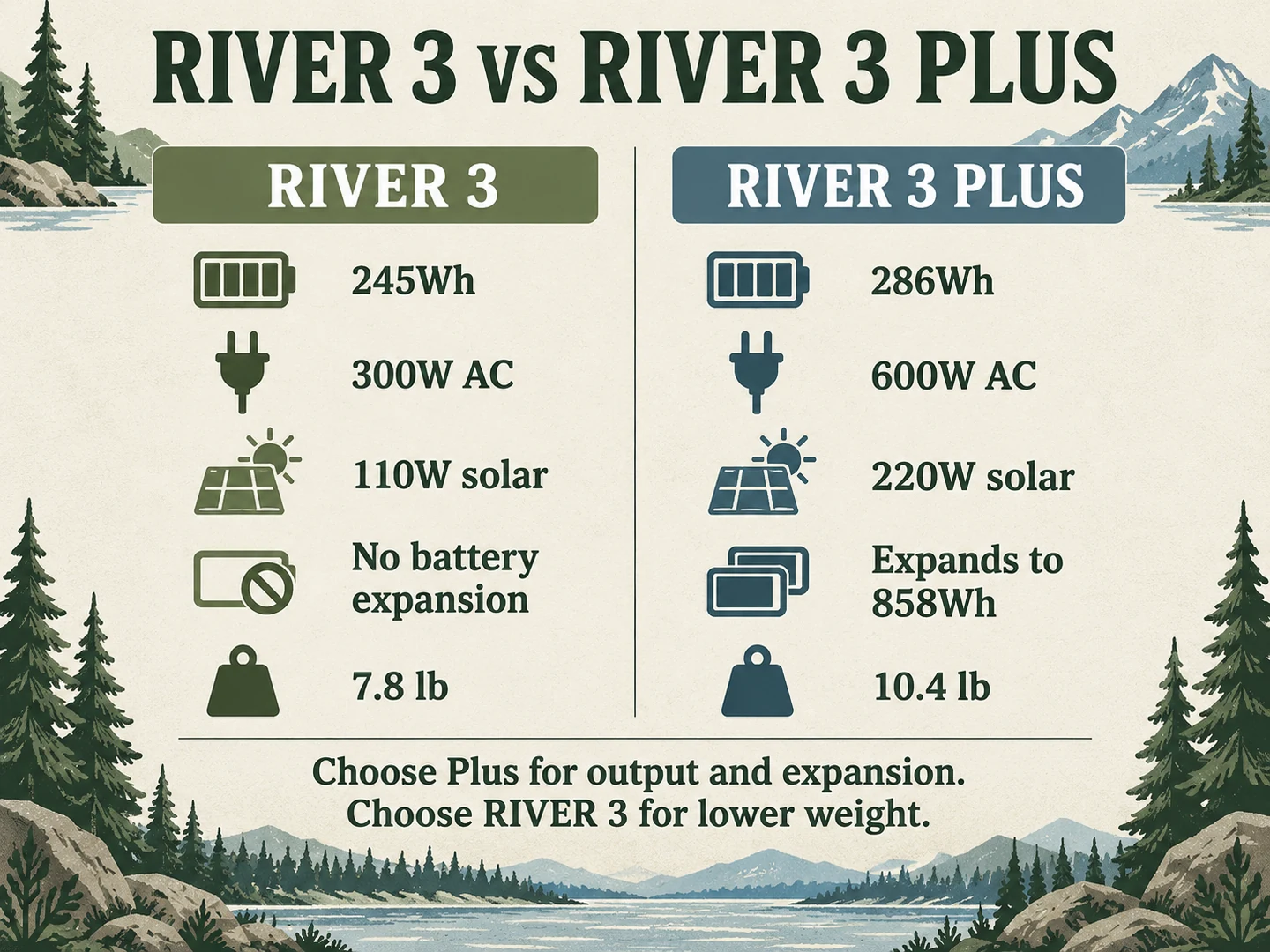
EcoFlow RIVER 3 vs RIVER 3 Plus: the Plus is mainly about capability
| Spec / decision | RIVER 3 | RIVER 3 Plus |
|---|---|---|
| Capacity | 245Wh | 286Wh |
| Rated AC output | 300W | 600W |
| Weight | 7.8 lb | 10.4 lb |
| Solar input | 110W max | 220W max |
| UPS switchover | <20 ms | <10 ms |
| AC outlets | 2 | 3 |
| Battery expansion | No | Up to 858Wh total |
| US warranty | 2 years | 5 years |
| Best reason to choose | Lower weight and smaller footprint | Higher output, faster solar, expansion |
Portability first
Capability first
Decision rule: choose the RIVER 3 when carrying less weight is the priority and your AC loads clearly stay under 300W. Choose the RIVER 3 Plus when you want a much less restrictive 600W inverter, more solar input, faster UPS switching, a five-year warranty, or the option to add capacity later.
The battery-capacity difference alone is not enough reason to upgrade. The Plus earns its name through output and system flexibility.
Alternatives worth considering before you buy
EcoFlow RIVER 3: better if every pound matters
The base RIVER 3 is 7.8 lb with 245Wh capacity and 300W rated AC output. It is a better fit when your real workload is phones, laptops, cameras, lights, and other low-watt electronics and you value the smallest carry weight more than appliance flexibility. Read our full EcoFlow RIVER 3 review.
EcoFlow DELTA 3 Plus: better if runtime is already the problem
If 286Wh sounds small before you have even bought the station, moving directly to a larger class is usually cleaner than relying on an add-on battery. The DELTA 3 Plus moves to 1024Wh and 1800W AC output, but also jumps to about 27.6 lb. It is a different portability class and a much more credible choice for extended home backup or heavier camp loads.
Jackery and other 1kWh stations: compare the whole system, not the logo
If you are considering the RIVER 3 Plus with an expansion battery, compare total capacity, inverter output, solar input, weight, port selection, warranty, and complete system cost against a larger one-box station. Our Jackery vs EcoFlow guide explains the brand-level trade-offs, while our portable power stations under $500 guide covers the value-focused category without hard-coding a marketplace price here.
If your real need is only phones and a laptop, a smaller power bank may be enough. See our cold-weather power bank guide for the lighter device class.
Should you buy the EcoFlow RIVER 3 Plus?
Yes, if 600W of AC capability in a small 10.4 lb body is the reason you are shopping. The RIVER 3 Plus has a well-judged feature mix for home offices, electronics, short outages, road trips, and light camping: 286Wh of LiFePO4 storage, 600W continuous AC, three AC outlets, 100W USB-C, 220W solar input, fast wall charging, useful app controls, UPS support, and an expansion path.
The station becomes a worse fit when you ask its battery to behave like a much larger one. High-watt appliances can burn through 286Wh quickly, and X-Boost does not change that energy math. Buyers who already want a large expansion pack, multi-day refrigerator reserve, sustained cooking, or heavier home backup should compare larger stations first.
For the right buyer, the Plus is not simply a RIVER 3 with 41Wh more battery. It is the model that removes the base unit’s 300W ceiling and gives the small RIVER platform enough output headroom to be genuinely versatile.
How we researched this review
We started with the current EcoFlow US product pages, warranty policy, and RIVER 3 Plus manual for exact model identity, capacity, electrical limits, charging inputs, port ratings, dimensions, expansion compatibility, UPS specification, battery chemistry, and warranty. We then verified the exact Amazon US listing mapped to this article: ASIN B0DCCB657J, model EF-RV-H02-1, 286Wh.
Independent reviewer evaluations were used as outside signals for portability, charging behavior, appliance fit, noise, and practical layout. Owner discussions were reviewed for repeated patterns around home-office use, network backup, firmware behavior, fan noise, and long-running UPS setups. Isolated failures were not treated as proof of a model-wide defect rate.
Gear & Home’s verdict is an editorial synthesis of those sources. We did not invent field use, runtime tests, or a proprietary score.
FAQ
Is the EcoFlow RIVER 3 Plus worth it?
It is worth considering if you want a compact 10.4 lb station with 600W continuous AC output, fast charging, 220W solar input, UPS support, and optional battery expansion. It is less compelling if you already need much more than 286Wh of stored energy.
How much power can the EcoFlow RIVER 3 Plus actually deliver?
The exact 286Wh EF-RV-H02-1 model is rated for 600W total continuous AC output. EcoFlow also advertises X-Boost support for certain loads up to 1200W. Plan normal AC use around the 600W rating rather than treating X-Boost as 1200W of conventional continuous inverter power.
Why does Amazon call the RIVER 3 Plus a 760W power station?
EcoFlow’s manual lists 600W total AC output and separately lists 760W as the station’s total output power across combined ports. The 760W figure is not a 760W continuous AC inverter rating.
How long will a 286Wh RIVER 3 Plus run my devices?
Runtime depends on the device load and conversion losses. As a rough upper-bound calculation, divide 286Wh by the device wattage, then expect less real AC runtime because the inverter and battery-management system consume energy. Low-watt electronics are a much better fit than sustained high-watt appliances.
Can the EcoFlow RIVER 3 Plus be used as a UPS?
Yes. EcoFlow rates the unit for a switchover under 10 ms, and all three AC outlets support UPS use. It can work well for home-office and network equipment, but it does not automatically replace every surge-protection, voltage-regulation, maintenance, and reliability feature of a dedicated UPS.
Can the EcoFlow RIVER 3 Plus use an extra battery?
Yes. It can connect to one compatible smart extra battery. The EB300 brings total capacity to 572Wh, while the EB600 brings it to 858Wh.
What is the difference between RIVER 3 and RIVER 3 Plus?
The base RIVER 3 has 245Wh capacity, 300W rated AC output, 110W solar input, no extra-battery support, and a two-year US warranty. The RIVER 3 Plus has 286Wh, 600W AC, 220W solar, expansion up to 858Wh, faster UPS switching, and a five-year US warranty.
Is the EcoFlow RIVER 3 Plus waterproof?
No. EcoFlow says the IP54 rating applies to the battery pack, not the entire power station. Keep the unit and its exposed ports protected from rain, standing water, and immersion.