
Gear & Home is reader-supported. As an Amazon Associate I earn from qualifying purchases. When you buy through links on our site, we may earn an affiliate commission, at no extra cost to you. Learn more.
The Anker SOLIX C300 DC is a better camping power bank only if your camp setup is already built around USB-C, USB-A and 12V gear. Its 288Wh battery, two 140W USB-C ports and 120W car socket give it far more useful energy than a normal laptop power bank, while the DC-only design keeps it smaller and lighter than a comparable power station with an AC inverter.
The catch is just as important: there is no household AC outlet. If your essential gear needs a wall plug, the C300 DC is the wrong version. At 6.17 lb and 288Wh, it is also much closer to a micro power station than something most backpackers would carry all day.
The C300 DC is excellent for USB-C camping, but it is not a universal power station
Best for: car campers, photographers, remote workers, Starlink Mini users, and USB-C-heavy camping kits that need more energy than a conventional power bank but do not need AC outlets.
Skip it if: you need to plug in an AC-only charger or appliance, you want an airline-friendly battery, or 288Wh is too small for your refrigerator, CPAP or multi-day base-camp plan.
Anker SOLIX C300 DC (A1726)
A compact 288Wh DC power hub that makes the most sense when your camping electronics can run directly from USB-C, USB-A or 12V.
DC
Strengths
- 288Wh in a narrow 6.17 lb body
- Two 140W bidirectional USB-C ports
- Separate 100W USB-C output plus 15W USB-C
- 120W 12V car socket for compatible DC gear
- Up to 100W solar input
- Built-in retractable camp light
Limitations
- No AC receptacle
- No wall charging brick in the standard box
- Fastest recharge needs two high-power USB-C chargers
- Very low USB loads can auto-shut after two hours
- Port output changes when several connections are used at once
- 288Wh battery is not permitted on passenger aircraft under current FAA rules
What the C300 DC actually is
Anker calls the A1726 a portable power station, and that description is more useful than treating it like an oversized phone battery. It stores 288Wh of energy and can deliver up to 300W across its DC outputs, but it deliberately removes the AC inverter and household outlets found on the standard SOLIX C300.
That design decision is the whole point. If your laptop, camera batteries, phone, tablet, lighting, networking gear and other essentials already accept USB-C or 12V power, converting battery DC to household AC and then back to device DC adds hardware that you may never use. The C300 DC avoids that path and gives the space to more DC ports instead.
It is still not a small power bank. At 6.17 lb, it is reasonable to move from the car to a campsite, picnic table, photo location or cabin. It is difficult to justify as a normal backpacking battery unless the trip has a very specific power requirement.
The port layout is the main reason to buy it
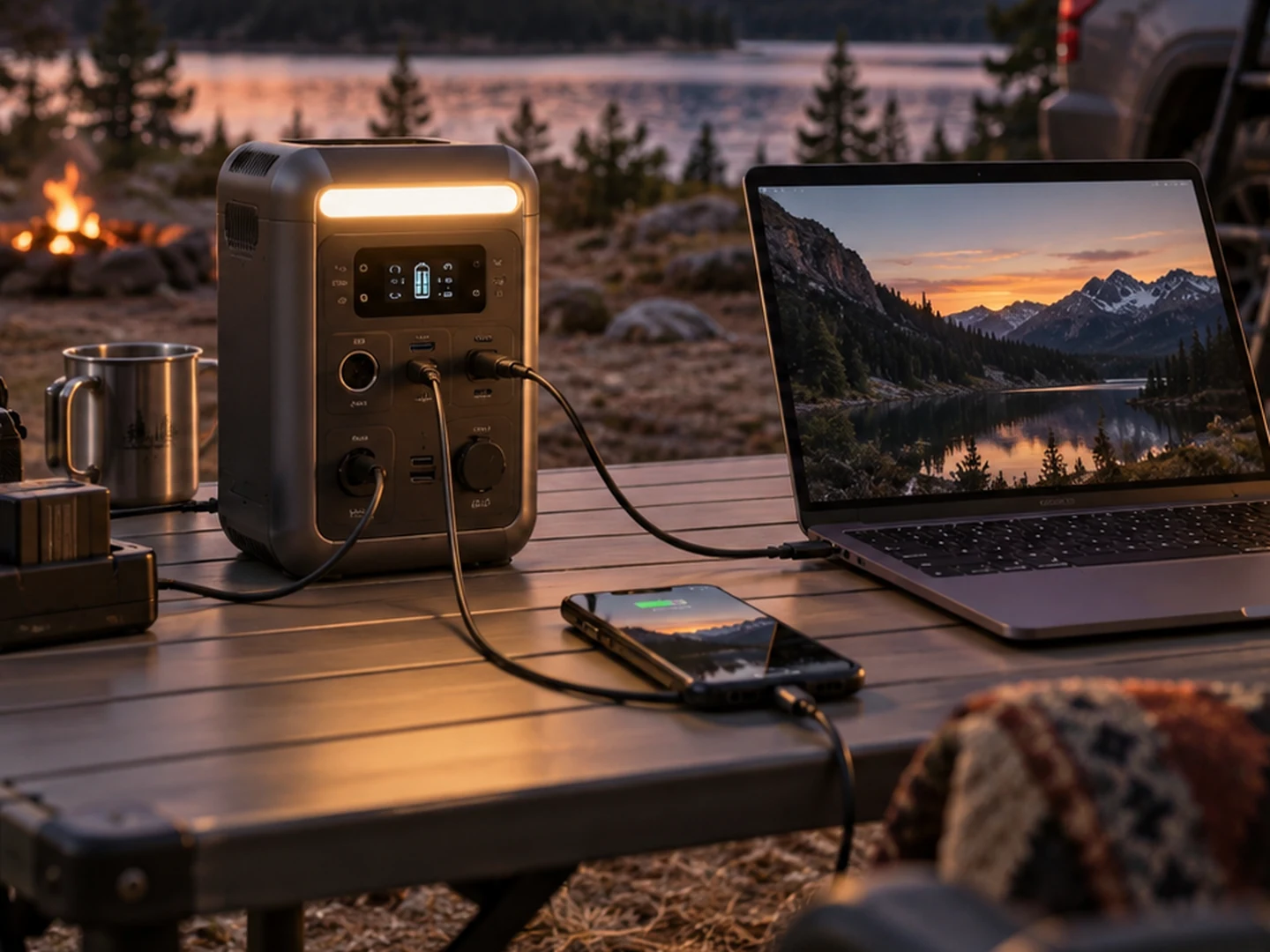
The C300 DC has seven device outputs: two 140W bidirectional USB-C ports, one 100W USB-C port, one 15W USB-C port, two 12W USB-A ports, and a 12V car socket rated to 120W. The two 140W USB-C ports can also accept charging input.
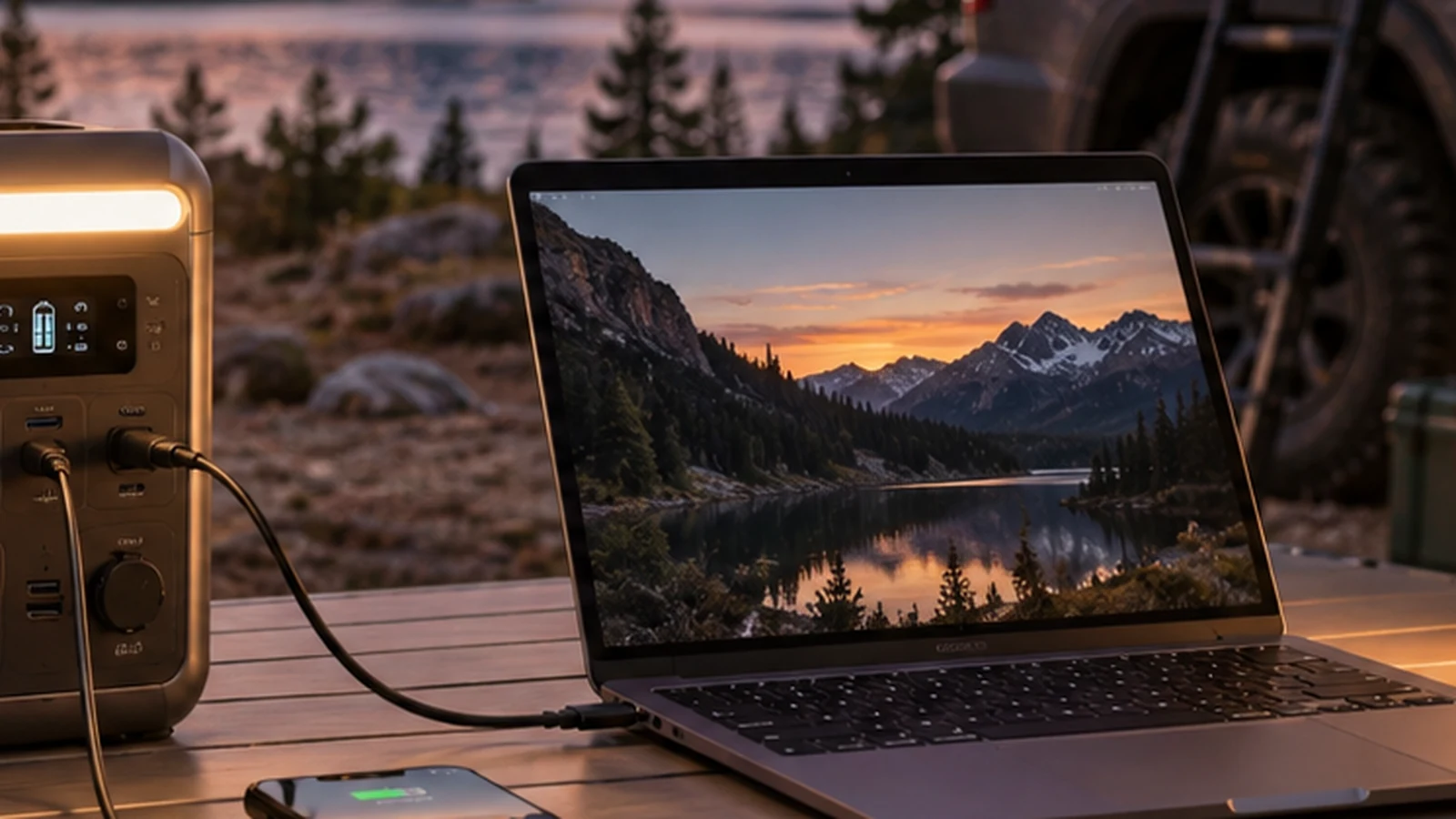
That is unusually useful for modern camp electronics. A high-power USB-C laptop can use one of the 140W ports while a phone, camera battery charger and smaller accessory use the remaining outputs. The 12V socket also keeps the unit relevant for compatible coolers, routers and other vehicle-style DC gear.
The 300W figure is the station’s total output ceiling. The manual publishes separate limits for each port, and power allocation changes when multiple outputs are active. Check both the device’s individual port requirement and your combined load.
Important shared-output behavior
The two USB-A ports and the 15W USB-C port share a 20W combined group. With heavier multi-port use, the higher-power USB-C ports can also step down. This is normal power allocation, but it matters if you expect several laptops or other high-draw devices to run at maximum charging speed at the same time.
Charging is flexible, but the box is more minimal than the headline suggests
Anker supports three main recharge paths: USB-C, solar and a vehicle connection. The fastest published method uses both 140W bidirectional USB-C ports at once for up to 280W input. Anker currently advertises roughly 80% in one hour and a full charge in about 90 minutes under the right charging setup.
The important ownership detail is that the standard package includes a USB-C cable but does not include the high-power wall charger or chargers needed for maximum recharge speed. If you already own a strong USB-C PD charger, that may be fine. If not, include the cost and bulk of the charger in your decision.
Solar charging
The dedicated solar input accepts up to 100W from an 11V to 28V source. Anker recommends its 60W or 100W panels and warns that some other Anker SOLIX panels are not compatible. A solar panel also needs the correct cable, which is not part of the basic power-station box.
For camping, 100W solar is useful for extending a modest electronics load over multiple days. It is not magic: weather, panel angle, shade and actual device consumption can all change whether the station gains or loses battery during the day.
The low-current auto-off rule deserves attention
The A1726 manual confirms a two-hour low-current shutdown rule for the USB outputs. With no input connected, USB-A and the 15W USB-C group can shut down when total load falls below 60mA for two hours. The higher-power USB-C ports can shut down below 100mA after two hours. Anker says this timer cannot be changed for those port conditions.
Most phones, laptops and active chargers are not affected because their draw is well above those thresholds while charging. The risk is with tiny always-on loads, idle sensors, certain low-power lights or networking setups that may drop below the trigger. Reddit owner discussions also include complaints about unattended input and low-load behavior, while other long-term users report normal operation in typical camping setups.
Our practical rule is simple: do not assume the C300 DC is an unattended mini-UPS for a critical low-draw device. Configure it and reproduce your exact load at home before relying on it overnight or remotely.
USB-C compatibility is broad, not universal
Two 140W PD 3.1 ports are a major strength, but high-power USB-C still depends on the charger, cable and device negotiating a compatible profile. Owner reports include cases where some third-party or older multi-port chargers worked slowly or behaved inconsistently until firmware updates or different chargers were used.
That does not make the C300 DC unusually incompatible with USB-C as a category, but it does mean that a random “140W” label on a cable or charger is not enough. For the fastest input or output, use properly rated USB-C PD equipment and verify the negotiated wattage before your trip.
Anker SOLIX C300 DC vs C300: the plug decides the winner
The DC and standard C300 share the same 288Wh battery class, but they solve different jobs. The standard C300 adds household AC outlets and a 300W AC inverter. The C300 DC removes those outlets, is smaller and lighter, and puts more emphasis on USB-C.
| Decision | C300 DC (A1726) | Standard C300 | Conventional laptop power bank |
|---|---|---|---|
| Battery class | 288Wh | 288Wh | Usually far smaller |
| Household AC outlets | No | Yes, 300W AC | No |
| High-power USB-C | Two 140W plus one 100W port | Available, but fewer DC ports | Depends on model |
| 12V car socket | 120W | 120W | Usually no |
| Carry role | Car camp or base-camp micro station | More flexible small power station | Travel and backpack-friendly charging |
| Passenger aircraft | No, 288Wh exceeds 160Wh | No, 288Wh exceeds 160Wh | Many models under 100Wh can qualify, subject to airline rules |
| Best reason to choose | You want 288Wh without carrying an AC inverter you will not use | One essential device still needs a wall plug | You need much less capacity and much less weight |
C300 DC
288Wh
No
2 x 140W + 100W
USB-C and 12V camps
Standard C300
288Wh
Yes, 300W
Larger and heavier
Mixed AC and DC gear
Laptop power bank
Much smaller
No
Much lower
Travel and backpacking
If you want a broader look at the AC-capable C300 and similar compact stations, see our portable power stations under $500 for camping.
How well does the C300 DC fit real camping scenarios?
Phones, cameras and USB-C laptops: strong fit
This is the clearest use case. A 288Wh battery is several times larger than common laptop power banks, and the port mix can support multiple electronics without a separate AC charger for every device. Photographers and remote workers are especially likely to use the two 140W ports well.
Starlink Mini: promising fit, but test your exact cable and load
Long-term independent users report the C300 DC as a good match for Starlink Mini because it can power DC-native networking gear without converting through AC. Runtime still depends on the Starlink system’s actual draw, weather, network use and any other devices sharing the battery.
12V cooler: possible, not automatic
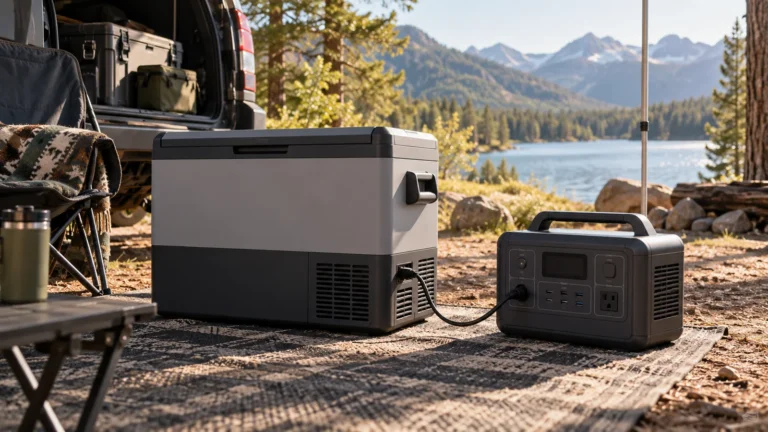
The car socket is rated to 120W. A cooler can be a valid load only when its startup and continuous draw stay within that output and the trip’s energy budget. A 288Wh battery can disappear quickly if the cooler averages a high duty-cycle load. If refrigeration is central to the trip, our best portable power stations for camping guide covers larger capacity classes.
CPAP: size the night, not the marketing number
Some owners report good CPAP runtime, especially with efficient DC setups and humidification reduced or disabled, but sleep equipment is too important for a generic runtime promise. Check your exact CPAP power draw, required voltage and cable, then calculate the expected watt-hours with margin. If CPAP is the primary reason for buying a station, a dedicated runtime plan matters more than the C300 DC’s compact size.
Backpacking: usually the wrong category
Six-plus pounds is a large penalty for normal backpacking. If you only need phones, satellite communicators or a laptop occasionally, a lighter power bank is the more logical starting point. Our cold-weather power bank guide shows the smaller battery class that makes more sense when every ounce matters.
Do not buy the C300 DC as an airline travel power bank
The 288Wh battery exceeds the current FAA 160Wh maximum for passenger aircraft. The FAA specifically states that lithium battery power stations above 160Wh are forbidden in both carry-on and checked baggage.
This is an easy detail to miss because the C300 DC looks more like a large power bank than a traditional generator-style station. For flights, start with a battery at or below the relevant airline watt-hour limit and check the carrier’s current rules before travel. See the FAA airline battery guidance for the current U.S. rules.
What owner and reviewer feedback consistently gets right
Across professional reviews and owner discussions, the same core story keeps repeating. People who already understand the DC-only concept often like the form factor, strong USB-C selection and built-in light. The station works best as a dense electronics hub, not as a miniature version of a home-backup system.
The negative patterns also make sense together. The standard box does not include a fast wall charger. Some users run into USB-C PD handshake quirks with particular chargers or multi-port adapters. Very low current loads can trigger fixed two-hour port shutdown behavior. A smaller number of owners report more serious unattended charging or firmware frustration, while other long-term users report stable operation over many trips.
That mixed evidence changes our recommendation in one way: the C300 DC is a good product to configure and prove before the trip, not a product to unbox at camp and trust with an unusual always-on load. Update firmware, test your actual chargers and cables, and reproduce overnight loads at home.
Better alternatives for three common buyers
Choose the standard Anker SOLIX C300 if one wall plug matters
If even one essential device has no practical USB-C or 12V path, the AC-capable C300 is the safer choice. You accept more size and weight, but you gain the flexibility the DC model intentionally removes.
Choose EcoFlow RIVER 3 if you want a compact AC station with a different feature balance
EcoFlow’s RIVER 3 occupies a similar small-station role but includes household AC output. Our EcoFlow RIVER 3 review explains where that model fits and where its smaller capacity becomes the constraint.
Choose a conventional power bank if you need flights or real backpacking
If your devices are mostly phone, tablet, camera and occasional laptop charging, a sub-100Wh USB-C power bank can save several pounds and avoid the passenger-aircraft problem that comes with a 288Wh station.
How we evaluated the Anker SOLIX C300 DC
This is a research-based editorial review, not a Gear & Home physical product evaluation. We first checked the current US search results to confirm that exact-model review intent is distinct from our existing camping power-station roundups and from the standard C300 AC version. We then matched the product to model A1726 and the current Amazon US listing before evaluating fit.
Capacity, port limits, charging input, size, weight, temperature range and low-current shutdown behavior were checked against Anker’s current product page and the A1726 user manual.
Amazon-linked owner reviews and Reddit discussions were used to identify repeated ownership friction, especially USB-C charger compatibility and low-load behavior.
Several professional and long-term reviews were compared for recurring strengths, practical use cases and disagreements rather than copying any single verdict.
The exact Amazon US product is matched to A1726 and ASIN B0D62PMB3R. The importer will still require explicit listing approval before the WordPress draft is prepared.
FAQ
Does the Anker SOLIX C300 DC have AC outlets?
No. The A1726 C300 DC is a DC-only model with USB-C, USB-A and a 12V car socket. The separate standard SOLIX C300 adds household AC outlets.
Can the C300 DC charge a USB-C laptop?
Yes, when the laptop and cable support a compatible USB-C Power Delivery profile. The C300 DC has two USB-C ports rated up to 140W each and another USB-C port rated up to 100W. Multi-port use can reduce the power available to an individual connection.
Can the Anker SOLIX C300 DC run a 12V refrigerator?
Potentially. The 12V car socket is rated to 120W, so the refrigerator’s startup and continuous draw must stay within that limit. Battery runtime then depends on the refrigerator’s average consumption, duty cycle, temperature and other loads on the station.
How fast can the C300 DC recharge?
Anker supports up to 280W of USB-C input by using both 140W bidirectional ports and currently advertises about 80% charge in one hour with the proper setup. Solar input is limited to 100W. The standard box does not include the wall charger required for maximum USB-C recharge speed.
Can I take the C300 DC on an airplane?
No on passenger aircraft under current FAA rules. Its 288Wh battery exceeds the 160Wh maximum. The FAA states that lithium battery power stations above 160Wh are forbidden in both carry-on and checked baggage.
Why do very small USB loads sometimes shut off?
The manual specifies a fixed low-current shutdown rule. With no input connected, some USB groups shut down after two hours when the load remains below the published current threshold. This can matter for tiny always-on devices even when normal phone or laptop charging works as expected.
Is the C300 DC better than the regular C300 for camping?
It is better when every important device can run from USB-C, USB-A or 12V and you want to avoid carrying an AC inverter you will not use. The regular C300 is better when even one essential device requires a household wall plug.