

Gear & Home is reader-supported. As an Amazon Associate I earn from qualifying purchases. When you buy through links on our site, we may earn an affiliate commission, at no extra cost to you. Learn more.
The Arc’teryx Beta SL is a premium 12-ounce Gore-Tex shell for hikers who want serious storm protection, pit-zipped ventilation, and a relatively compact package without dropping all the way into fragile ultralight territory. Its biggest compromises are equally clear: the fitted torso can complicate layering, the helmet hood is more jacket than some hikers need, and the lighter Beta construction gives up abrasion margin compared with burlier shells.
Who should buy the Arc’teryx Beta SL?
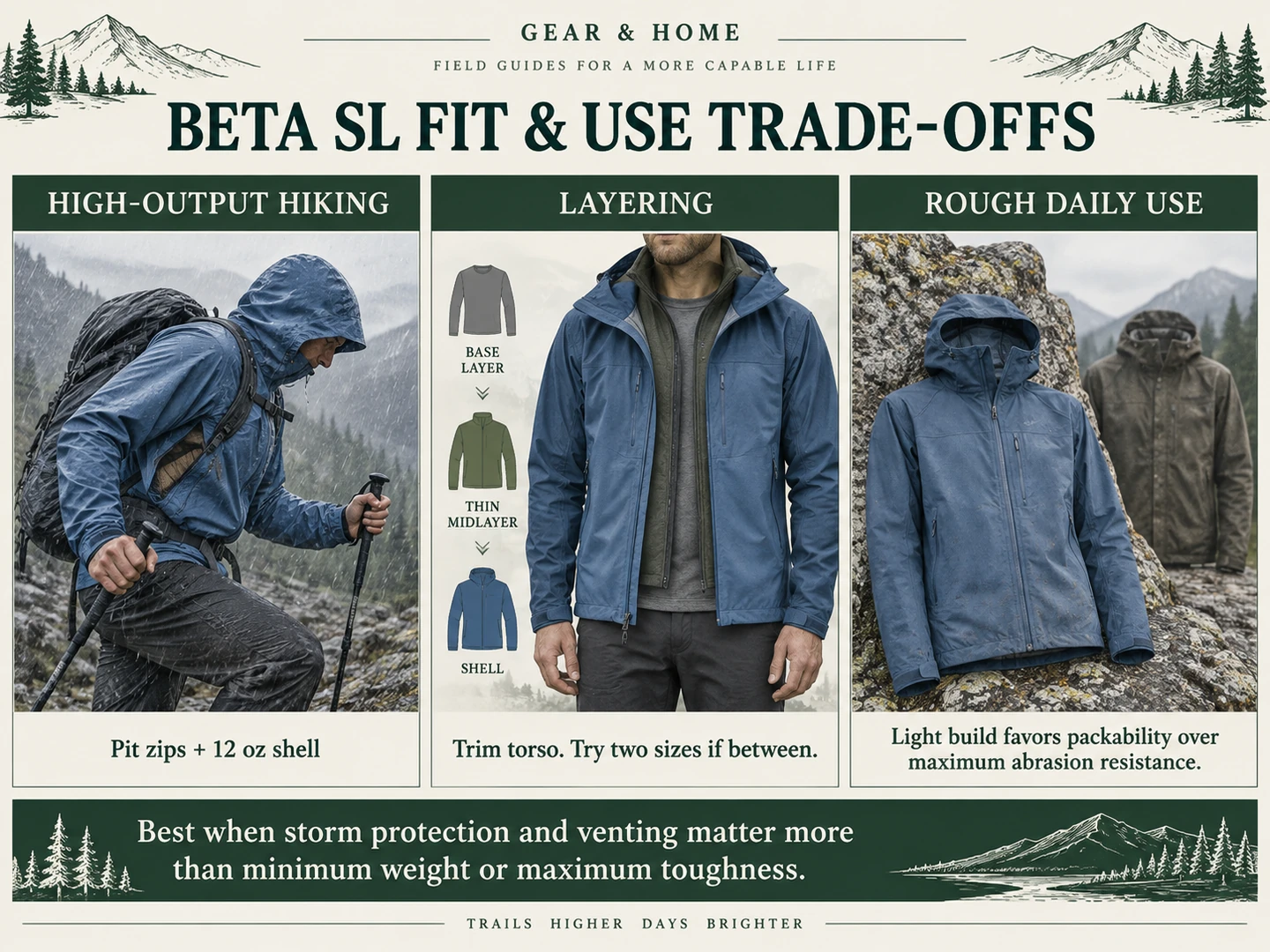
Buy the Beta SL if you hike in genuinely wet, windy terrain and want a protective 3-layer shell with pit zips at 12 ounces. It makes the most sense for backpacking, mountain hiking, climbing approaches, and travel where one shell needs to cover both bad weather and high-output movement.
Skip it if your priority is the lowest possible weight, roomy cold-weather layering, maximum abrasion resistance, or value. The regular Beta is a better durability-first Arc’teryx choice, while the Patagonia Torrentshell 3L gives you a simpler 3-layer hiking shell with pit zips for much less money.
First, make sure you are looking at the current Beta SL
Arc’teryx has reused and reshuffled Beta names over the years, so old reviews can easily contaminate a current buying decision. This review is anchored to the men’s Beta SL model X000010854, which Arc’teryx currently lists as a 340 g / 12 oz fitted shell made with 40D x 70D 3-layer Gore-Tex ePE fabric. The body uses a C-KNIT backer, and the jacket includes pit zips, a helmet-compatible StormHood, two zippered hand pockets, an internal chest pocket, adjustable cuffs, and a RECCO reflector.
Arc’teryx also states that this product was previously the Beta Lightweight Jacket. A previous Beta SL listing, X000010553, is still visible through Arc’teryx outlet channels and uses the same modern ePE-era design language. Far older Paclite Beta SL and Beta SL Hybrid products are different jackets and should not be used to judge the current model’s construction or durability.
Best for and skip if
The Beta SL is easy to misunderstand because “SL” suggests a minimalist ultralight jacket. It is lighter than the burlier Beta models, but it still carries a full feature set. A 12-ounce shell with three pockets, pit zips, a helmet hood, adjustable cuffs, hem adjustment, and a 3-layer construction is better thought of as a light technical hardshell than a gram-counter emergency rain jacket.
Weather protection is the main reason to pay for it
The current Beta SL uses a 3-layer Gore-Tex ePE membrane with an FC0 DWR finish. Across recent independent reviews, weather protection is the most consistent strength. Reviewers at OutdoorGearLab, CleverHiker, Treeline Review, Gripped, and Outside all converge on the same broad pattern: this is a shell intended for sustained bad weather rather than a just-in-case drizzle layer.
That consensus matters more than any single laboratory number because Arc’teryx does not publish a consumer-facing hydrostatic-head figure on the current product page. The useful buying point is simpler: the membrane is a full 3-layer waterproof construction, the hood and cuffs are highly adjustable, the center front and pockets use weather-resistant zipper construction, and the 30-inch center-back length in men’s medium gives more coverage than cropped ultralight shells.
Wet-out complaints need context
One of the most important owner-feedback patterns is also one of the easiest to misread. Some current owners report that the face fabric develops dark wet patches or stops beading water sooner than expected. Arc’teryx explicitly warns that newer ePE products can show face-fabric wet-out faster than older treatments.
Wet-out is not automatically the same thing as the waterproof membrane leaking. The DWR treatment helps water bead and roll off the outer fabric. When that treatment is contaminated or depleted, the face can absorb water and feel colder or less breathable even while the membrane underneath is still blocking liquid water.
This does not mean every wet-looking jacket is fine. A shell that is actually passing water to the inside, has damaged seam tape, or shows abnormal localized failure should be inspected. But a darkened outer face alone is not enough evidence to declare the current Gore-Tex membrane defective.
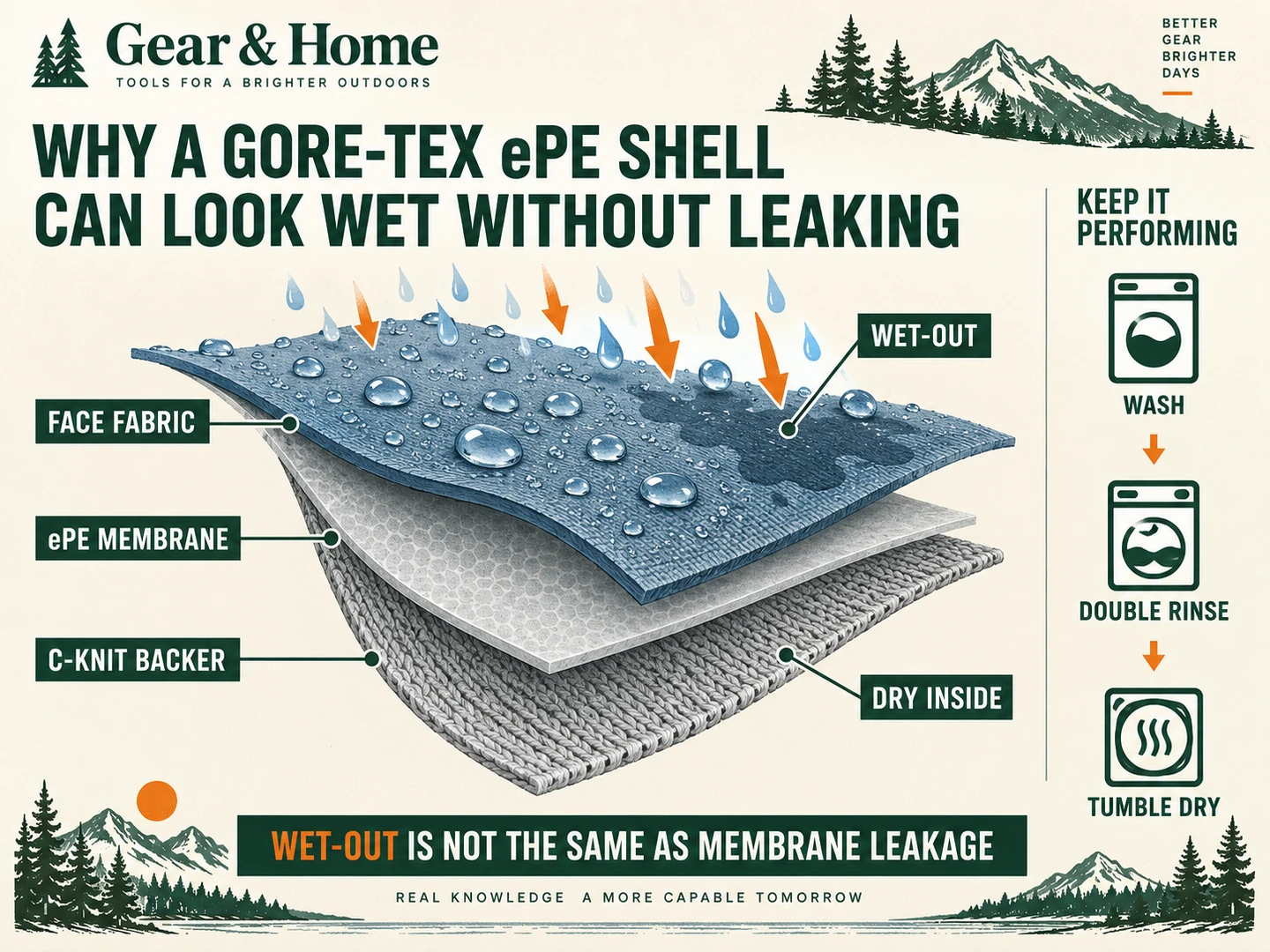
Arc’teryx’s current care instructions call for machine washing, double rinsing, and tumble drying, with no fabric softener. That maintenance matters more with FC0 DWR than many buyers expect. If you want a shell that can live dirty in the bottom of a pack for months with no care, this is not the ideal ownership profile.
Breathability is good, but the pit zips are the bigger advantage
No waterproof hardshell becomes magically cool on a steep climb. The Beta SL’s useful advantage is that it combines a breathable 3-layer laminate with real pit zips. Independent reviewers repeatedly call out the vents as a meaningful reason the jacket works for hiking and climbing rather than only standing around in rain.
Owner feedback points in the same direction. People who like the jacket often describe opening the pit zips during summer rain, uphill hiking, or other high-output use. That is a more practical benefit than arguing over small laboratory breathability differences between membranes.
If you rarely open pit zips, the Beta SL loses part of its value proposition. The regular Beta uses a tougher 80D face and a roomier regular fit, and may be the more rational Arc’teryx shell for everyday wear and lower-output hiking.
Fit is the biggest buying risk
Arc’teryx labels the current Beta SL Fitted, with a trimmer cut through the chest, waist, hip, and thigh. That lines up with part of the owner and reviewer feedback, but not all of it. Some users find the torso close enough that adding a thicker midlayer pushes them toward a larger size. Others report generous sleeves and shoulders, or feel that their usual Arc’teryx size already gives enough room.
The recurring pattern is not simply “runs small” or “runs large.” It is torso-to-arm balance. The body can feel trim while the sleeves and helmet hood feel comparatively roomy. That is why buying one size up by habit can solve the torso problem and create a baggier upper-body fit.
For warm-weather hiking over a base layer, your normal size may give the cleanest fit. For cold rain over fleece or light insulation, the next size can make more sense. Judge the jacket with a backpack on and with both arms raised, not only while standing in front of a mirror.
Long sleeves are generally an advantage in rain and when reaching overhead, but short-armed buyers may notice extra fabric. The helmet-compatible hood also has more volume than a casual rain-jacket hood, although its adjustments let many users cinch it down effectively without a helmet.
Comfort and mobility are stronger than the trim silhouette suggests
The C-KNIT backer is a small specification with a noticeable practical role. It gives the inside a less plasticky feel than many stripped-down rain shells and helps make the Beta SL reasonable over a short-sleeve shirt during travel or mild-weather hiking.
Articulated patterning and roomy shoulder movement also explain why reviewers can describe the torso as trim while still praising climbing and hiking mobility. The shell is cut to stay close rather than to restrict movement. If the correct size leaves room for your intended layer stack, the mobility story is one of the product’s strengths.
Durability: lighter than the Beta, not disposable ultralight
Arc’teryx itself describes the SL designation as prioritizing weight and packability over durability. That is the right frame. The Beta SL uses a 40D x 70D construction, while the current regular Beta uses an 80D face and the current Beta AR steps up to 80D and 100D Gore-Tex Pro ePE panels.
That does not make the current Beta SL equivalent to old Paclite emergency shells. Some retailer review pages mix feedback from older Beta SL generations into the same product family. An old Paclite owner complaint about membrane abrasion is not valid evidence for the current 3-layer ePE jacket.
For normal backpack contact, hiking, travel, and technical movement, multiple recent professional reviewers treat the modern Beta SL as a real mountain shell. For regular chimney climbing, bushwhacking, work use, or constant scraping against rock, the heavier Beta or Beta AR provides a larger durability margin.
The feature set is what separates it from minimalist shells
- Pit zips: the standout feature for high-output hiking and climbing.
- Helmet-compatible StormHood: strong coverage and adjustment, but more hood volume than casual users need.
- Two hand pockets: useful storage positioned for outdoor use rather than minimalist weight savings.
- Internal chest pocket: adds secure storage that many lighter shells omit.
- Adjustable cuffs and hem: useful for sealing wind-driven rain and adapting around gloves or layers.
- RECCO reflector: a passive search aid, not a substitute for a satellite communicator, beacon, navigation skills, or trip planning.
There is no single feature here that justifies the premium. The value comes from keeping most of them in a 12-ounce package without turning the jacket into a stripped emergency shell.
Arc’teryx Beta SL pros and cons
Pros
- Strong 3-layer storm protection
- Pit zips add useful mechanical ventilation
- 12-ounce listed weight is low for the feature set
- C-KNIT backer improves next-to-skin comfort
- Good mobility and technical hood coverage
- Three-pocket layout is more practical than many ultralight shells
Limitations
- Premium price tier
- Fitted torso can complicate cold-weather layering
- Helmet hood can feel oversized without a helmet
- Lighter face fabric gives up abrasion margin to Beta and Beta AR
- FC0 DWR can need more attention to maintain beading
- Not especially light compared with true ultralight rain shells
Arc’teryx Beta SL alternatives
The Beta SL makes the most sense when you specifically value its blend of weather protection, ventilation, low-ish weight, and technical features. If one of those priorities changes, another shell can be easier to justify.
| Shell | Listed weight | Construction | Fit | Ventilation | Choose it when |
|---|---|---|---|---|---|
| Arc’teryx Beta SL | 340 g / 12 oz | 40D x 70D 3L Gore-Tex ePE | Fitted | Pit zips | You want the lightest current Beta with a full technical feature set |
| Arc’teryx Beta | 375 g / 13.2 oz | 80D 3L Gore-Tex ePE | Regular | No pit zips listed | You value abrasion margin and easier layering more than vents |
| Arc’teryx Beta AR | 460 g / 1 lb 0.2 oz | 80D / 100D 3L Gore-Tex Pro ePE | Regular | Pit zips | You need a burlier alpine shell for hard weather and rougher use |
| Patagonia Torrentshell 3L | 400 g / 14.1 oz | 3L H2No Performance Standard | Regular | Pit zips | You want a straightforward 3-layer hiking shell and better value |
Arc’teryx Beta SL
12 oz
Fitted
40D x 70D 3L ePE
Pit zips
Arc’teryx Beta
13.2 oz
Regular
80D 3L ePE
Durability + layering
Arc’teryx Beta AR
1 lb 0.2 oz
Regular
80D / 100D Pro ePE
Pit zips
Patagonia Torrentshell 3L
14.1 oz
Regular
3L H2No
Pit zips
Beta SL vs Beta
Choose the Beta SL for pit zips, lower listed weight, and a closer technical fit. Choose the regular Beta if you prefer an 80D face fabric, a regular fit with easier layering, and do not care about pit zips. The weight difference is modest, so this is mainly a feature and durability decision rather than a pure ounce-counting decision.
Beta SL vs Beta AR
The Beta AR is for rougher alpine use and harsher ownership. Its Gore-Tex Pro ePE build uses 80D and 100D fabrics and it weighs substantially more. The SL is the better hiking and travel crossover when packability matters; the AR is easier to justify when abrasion and severe mountain use dominate the decision.
Beta SL vs Patagonia Torrentshell 3L
The Torrentshell 3L is heavier at 14.1 ounces but gives hikers a regular fit, pit zips, a 3-layer waterproof shell, and self-stowing pocket design. It is the better value decision for many hikers. The Beta SL earns its premium when you specifically want the lighter Arc’teryx package, refined technical patterning, C-KNIT backer, helmet hood, and mountain-focused feature integration.
Is the Arc’teryx Beta SL worth it?
It is worth the premium for a narrow but legitimate buyer: someone who spends enough time in sustained bad weather to value a premium 3-layer shell, wants pit zips, carries the jacket often enough to appreciate a 12-ounce package, and prefers a trim technical fit.
It is much harder to justify for occasional campground rain, commuting, or fair-weather day hiking. In those use cases, cheaper 3-layer shells can solve the core waterproofing problem without making you pay for a helmet hood, RECCO, technical patterning, and Arc’teryx’s lighter Beta construction.
How Gear & Home evaluated the Beta SL
Gear & Home does not present this as a first-person product test. The verdict is based on source aggregation and model-specific verification.
Frequently asked questions
Is the current Arc’teryx Beta SL fully waterproof?
Yes. The current men’s X000010854 uses a 3-layer Gore-Tex ePE waterproof shell. The outer face can wet out when the DWR loses effectiveness, but surface wet-out does not automatically mean the waterproof membrane is leaking.
Is the Arc’teryx Beta SL good for backpacking?
Yes, especially for wet or exposed trips where storm protection and pit-zipped ventilation matter. At 12 ounces it is light for a fully featured 3-layer technical shell, but it is not a true ultralight emergency jacket.
Does the Arc’teryx Beta SL run small?
Arc’teryx labels it Fitted, and the torso can feel trim, especially over thicker layers. Owner feedback is mixed because sleeves and shoulders can feel roomier. If you are between sizes or plan to layer insulation, compare your normal size with the next size up while wearing the intended layers.
What is the difference between the Beta SL and regular Beta?
The current men’s Beta SL is 12 ounces, uses a lighter 40D x 70D 3-layer Gore-Tex ePE construction, has a fitted cut, and includes pit zips. The current regular Beta is 13.2 ounces, uses an 80D face fabric, has a regular fit, and prioritizes versatility and durability over the SL’s lighter, vented design.
How often does the Beta SL need washing?
There is no universal mileage interval. Wash it when dirt, body oils, or poor beading indicate the shell needs care. Arc’teryx’s current instructions call for machine washing, double rinsing, tumble drying, and avoiding fabric softener. Proper cleaning and drying help restore DWR performance.