
Gear & Home is reader-supported. As an Amazon Associate I earn from qualifying purchases. When you buy through links on our site, we may earn an affiliate commission, at no extra cost to you. Learn more.
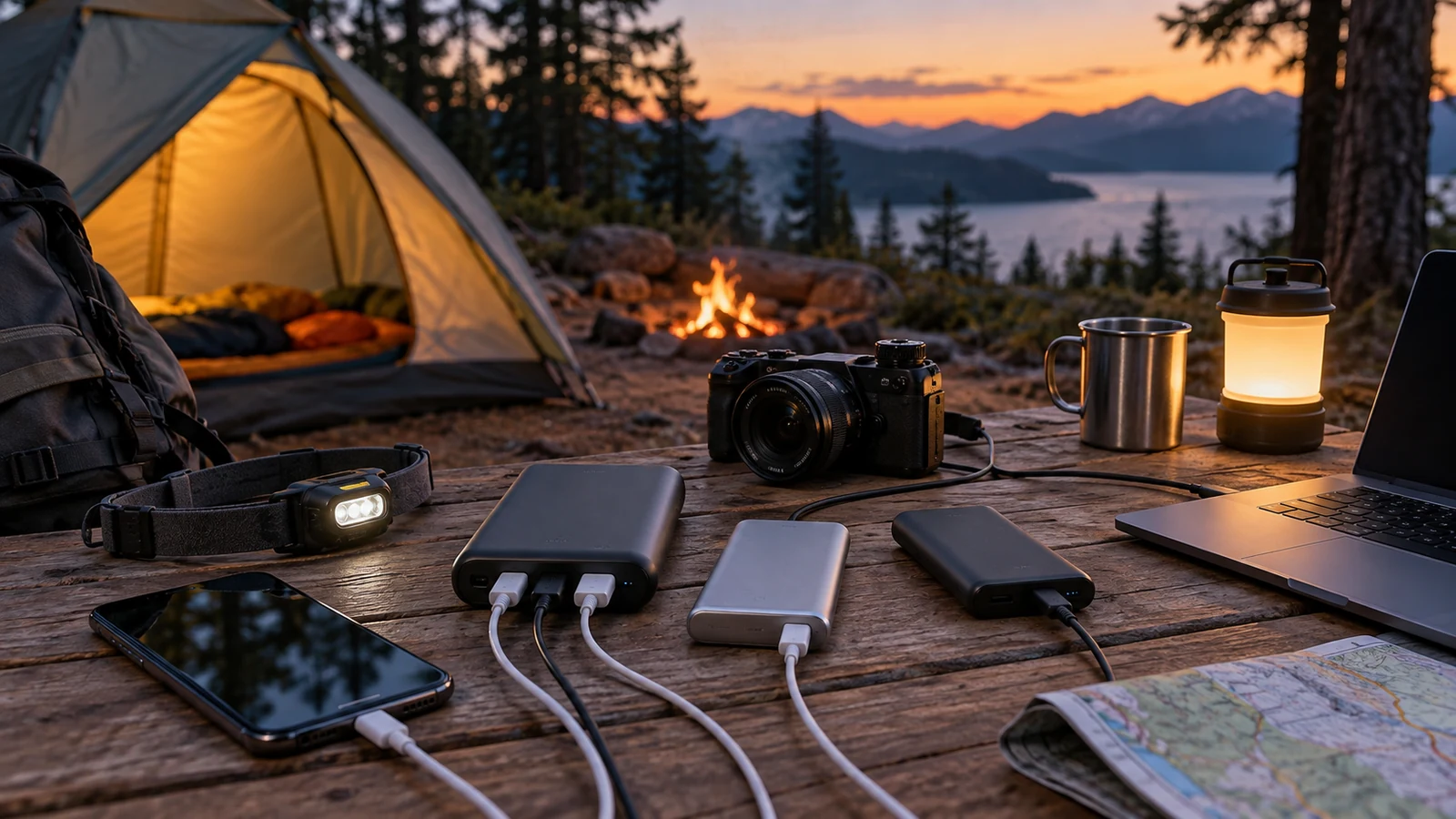
The best power bank for camping is not automatically the biggest battery you can carry. For most camps, the useful sweet spot is enough capacity for phones, headlamps, cameras and other USB gear, paired with enough USB-C output to refill those devices quickly without dragging a small power station to the tent.
We kept this roundup deliberately separate from portable power stations and backpacking-first ultralight banks. The five picks below sit mainly in the 15,000 to 25,000 mAh range: large enough for weekend or multi-device camping, but still carry-on-sized battery packs with no AC inverter.
The best power bank for camping for most people
The Anker Power Bank 20K, 87W (A1383) is our Best Overall pick. Its 20,000 mAh capacity is large enough to make sense for a weekend camp, while 65W single-device USB-C output can handle far more than a phone. The built-in USB-C cable also removes one easy-to-forget item from the charging kit.
Choose the NESTOUT 15000 instead if weather protection matters most. Its IP67 construction and shock-resistant design are much more camp-specific than a typical smooth plastic battery. If you regularly bring a laptop, camera kit or several USB-C devices, the Anker Laptop Power Bank 25K, 165W offers more capacity, more ports and two built-in USB-C cables.
Quick Picks
Anker Power Bank 20K, 87W
Best balance of capacity, USB-C output and pack size for typical weekend camping.
INIU P512 20000
High capacity for phone and accessory charging without paying for laptop-class output.
NESTOUT 15000
Wet, dusty camps and hard-use kits where sealed construction matters more than weight.
Anker Laptop Power Bank 25K, 165W
Group camps, camera kits and laptop users who want four-device charging and built-in cables.
UGREEN Nexode 25K, 145W
High-output USB-C charging for a laptop plus other camp electronics.
Best Power Banks for Camping Compared
| Pick | Capacity | Max USB-C output | Weight | Outdoor edge | Best for | Where to check |
|---|---|---|---|---|---|---|
| Anker Power Bank 20K, 87W Best Overall |
20,000 mAh | 65W single device | About 15.2 oz | Built-in USB-C cable | Weekend camping and mixed USB gear | Check availability on Amazon |
| INIU P512 20000 Best Budget |
20,000 mAh | 22.5W class | About 12 oz | Digital display + flashlight | Phones, headlamps and accessories | Check availability on Amazon |
| NESTOUT 15000 Best Rugged |
15,000 mAh | 32W total platform | 12.8 oz | IP67 + shock-resistant shell | Wet, dusty and rough camps | Check availability on Amazon |
| Anker Laptop Power Bank 25K, 165W Best Multi-Device |
25,000 mAh | 100W per USB-C path | 21.0 oz | Two built-in USB-C cables | Groups, laptops, cameras and drones | Check availability on Amazon |
| UGREEN Nexode 25K, 145W Best for Laptop Power |
25,000 mAh / 90Wh | 140W USB-C1 | About 18.1 oz | High-output PD 3.1 | Power-hungry USB-C laptops and camera gear | Check availability on Amazon |
Anker Power Bank 20K, 87W
20,000 mAh
65W max
About 15.2 oz
Built-in USB-C cable
INIU P512 20000
20,000 mAh
22.5W class
About 12 oz
Display + flashlight
NESTOUT 15000
15,000 mAh
32W
12.8 oz
IP67
Anker Laptop Power Bank 25K, 165W
25,000 mAh
100W max each
21.0 oz
Up to four
UGREEN Nexode 25K, 145W
25,000 mAh / 90Wh
140W max
About 18.1 oz
2 USB-C + 1 USB-A
Capacity and output are manufacturer or current listing specifications for the exact models shown. Weight can vary slightly by listing revision or measurement method. For trip planning, watt-hours and your real device batteries matter more than a headline mAh number.
Power bank or power station for camping?
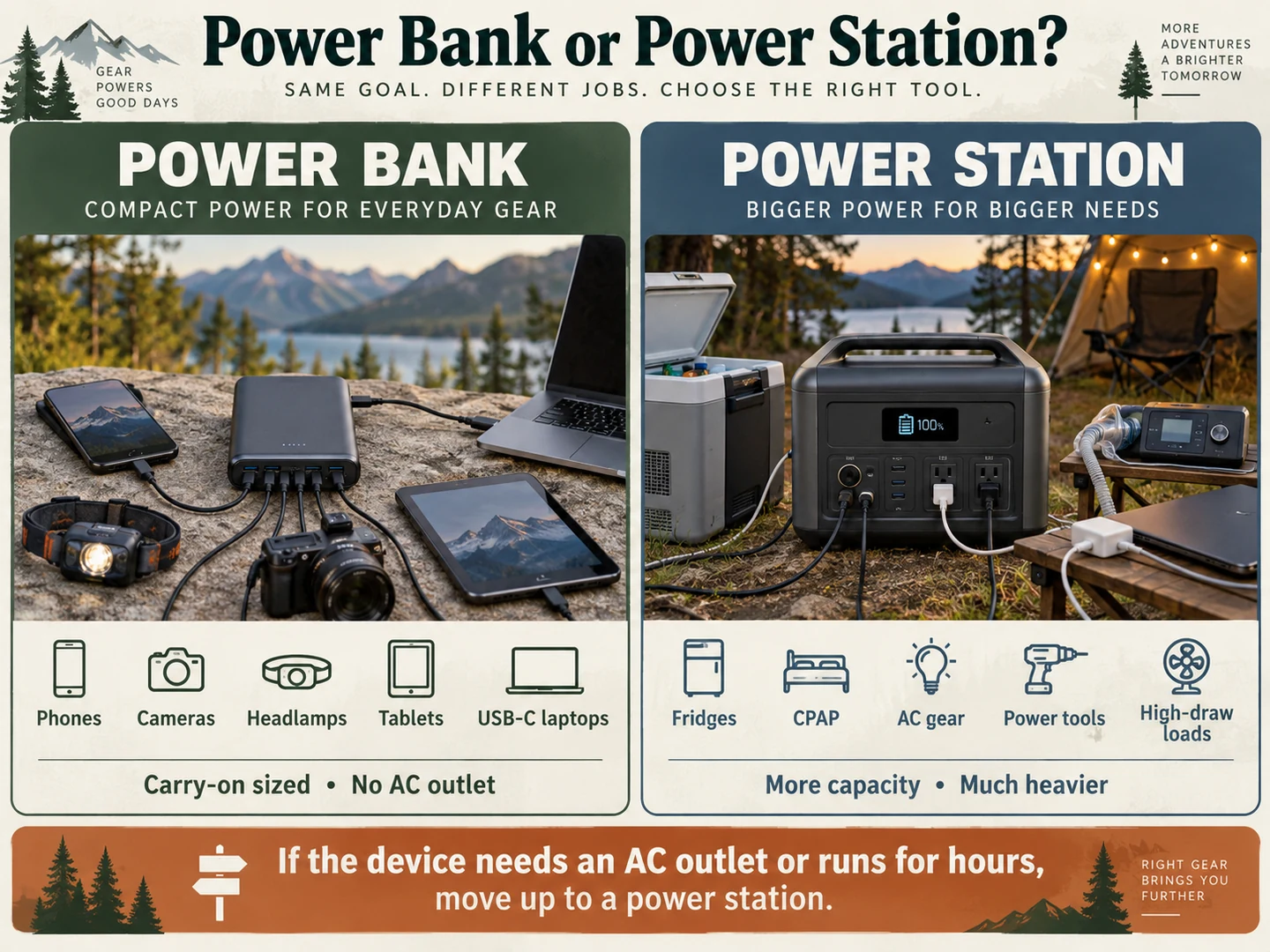
A power bank is the right tool when the things you need to charge already run from USB or USB-C: phones, watches, headlamps, cameras, satellite communicators, tablets and many modern laptops. It is small enough to live in a day bag, easy to move around camp and usually below the airline limit for ordinary carry-on power banks.
A power station is a different category. If you need an AC outlet, a 12V accessory socket or enough stored energy to run equipment continuously for hours, move up rather than buying an absurdly large pocket battery. A fridge, CPAP setup, heated blanket or other sustained load is exactly where our portable power stations for camping guide becomes the better starting point. If budget is the constraint, see our portable power stations under $500.
If the device needs a wall outlet or must run continuously instead of simply recharging a battery, a USB power bank is probably the wrong tool.
The 5 Best Power Banks for Camping
Anker Power Bank 20K, 87W (A1383)
The strongest all-around camping balance for people who want serious USB-C output without jumping to a 25,000 mAh one-pound-plus brick.
#1
Most camping power-bank buyers do not need the highest wattage in the category. They need enough capacity to get through a weekend, enough output that charging does not become an all-night chore and a format that is still easy to move between the tent, picnic table and day bag. The A1383 hits that middle ground unusually well.
The built-in USB-C cable is more useful at camp than it sounds. It gives you one complete charging path even if a loose cable is buried in another bag, and that cable supports the same 65W ceiling as the separate USB-C port. A USB-A port remains available for older headlamps, fans or accessories, so you are not forced into an all-USB-C kit immediately.
The compromise is size. At around 15 ounces, this is not a backpacking-first battery and it is much heavier than a 10,000 mAh ultralight bank. It also lacks the weather sealing of the NESTOUT. That is exactly why it fits this page: car campers, tent campers and short-walk campsite users get a better capacity-output balance without paying the weight penalty of a larger power station.
Pros
- Useful 20,000 mAh middle ground for weekend camping
- 65W single-device USB-C output can handle many laptops
- Built-in USB-C cable reduces cable clutter
- USB-A remains available for older camp electronics
Limitations
- About 15 oz, so not an ultralight carry
- No published outdoor IP rating
- Built-in cable is convenient but not user-replaceable
- No pass-through charging according to current independent testing
INIU P512 20000
A capacity-first value pick for campers mainly charging phones and accessories, with a useful digital display but much less output headroom than the laptop-focused options.
#2
The P512 is the pick for campers whose charging list is mostly phones, watches, headlamps, earbuds and other small USB devices. Its advantage is not raw speed. It is getting a full 20,000 mAh capacity class without paying for 65W, 100W or 140W laptop output you may never use.
The digital percentage display is especially useful on a two- or three-night trip because it gives a more actionable estimate than four generic LEDs. The built-in flashlight is not a reason to buy the battery by itself, but it is handy for finding a cable in a dark tent or checking the picnic table without digging out a headlamp.
The limitation is clear: 22.5W is phone-class output, not a serious laptop-charging specification. It also performed worse in cold-condition efficiency testing than several alternatives. If shoulder-season or winter camping is the priority, keep the bank insulated and warm, or use our separate cold-weather power bank guide as the more specific decision page.
Pros
- 20,000 mAh capacity without laptop-class hardware cost
- Independent 2026 testing found strong usable-energy efficiency for the class
- Digital percentage display is easy to budget over a weekend
- Built-in flashlight is a practical small camp extra
Limitations
- 22.5W output is not the pick for power-hungry laptops
- Bulky compared with 10,000 mAh backpacking banks
- Cold-weather efficiency was a weak point in independent testing
- No rugged outdoor IP rating
ELECOM NESTOUT 15000
The camp-specific choice when rain, dust and drops matter more than efficiency per ounce.
#3
Most power banks are indoor electronics that happen to travel well. The NESTOUT is different because the case and port protection are part of the product’s purpose. If your battery will sit on a damp picnic table, ride in a dusty truck bed or get handled with wet hands around camp, that protection can be more valuable than shaving a few ounces.
The 15,000 mAh capacity is also a useful compromise for outdoor use. It is meaningfully larger than a 10,000 mAh pocket bank but smaller than the 25,000 mAh laptop bricks in this roundup. For a phone, headlamp, satellite communicator and small camera, that can be enough stored energy without carrying a one-and-a-quarter-pound battery.
You pay for the armor. Independent testing found lower efficiency per gram than more conventional designs, and the sealed port covers make access slightly less convenient. It is also not the fastest charger in this lineup. The NESTOUT wins because it can tolerate conditions the others are better kept away from.
Pros
- IP67 water and dust protection
- Shock-resistant construction aimed at outdoor use
- Independent testing found excellent durability
- Good fit for cold, wet or dusty campsite conditions
Limitations
- Heavy for 15,000 mAh
- Lower efficiency per gram than lighter conventional banks
- Protective port covers add friction to everyday use
- 32W platform is not a high-output laptop solution
Anker Laptop Power Bank 25K, 165W (A1695)
A heavy but unusually convenient 25,000 mAh camp battery for laptops, cameras, phones and groups that charge several devices at once.
#4
Group camping creates a different charging problem from solo use. One person has a phone, another brings a tablet, the camera battery adapter wants USB-C and someone eventually asks to top up a laptop. The A1695 is built for that mess. Two USB-C cables are integrated into the pack, and the remaining ports let you connect more gear without turning the camp table into a pile of loose cables.
The smart display is useful when several devices are pulling power because it shows more detail than simple charge dots. More importantly, the 25,000 mAh capacity sits under 100Wh and is large enough to justify the weight when you are sharing the bank across several devices.
That weight is the reason it is not Best Overall. At 21 ounces, the A1695 is a bag item, not something you forget is in a pocket. If you only need to recharge one phone and a headlamp, it is unnecessary. If your campsite has a laptop, drone, camera kit or several people, the extra capacity and port flexibility are much easier to justify.
Pros
- 25,000 mAh capacity for multi-device weekends
- Up to 165W total output
- Three USB-C charging paths can each reach 100W under the right load
- Two built-in USB-C cables reduce cable packing
Limitations
- 21 oz is heavy for a power bank
- No outdoor IP rating
- Built-in cables add moving parts that are not user-replaceable
- Overkill for phone-only or minimalist camping
UGREEN Nexode 25K, 145W
The high-output pick when your campsite charging plan includes a demanding USB-C laptop rather than just phones and accessories.
#5
The UGREEN makes sense when the laptop is not an occasional emergency device but part of the trip. A 140W-capable primary USB-C output gives far more headroom than mainstream phone-focused banks, while the second USB-C and USB-A ports cover a camera, tablet or accessory at the same time.
Its 90Wh rating is also useful for travel because it sits below the FAA’s 100Wh threshold for ordinary carry-on spare lithium batteries. That does not mean every airline has identical rules, but it keeps the pack in the same general travel class as the other high-capacity picks here.
For camping, the trade-off is that the UGREEN behaves like a premium electronics battery, not rugged outdoor gear. Keep it dry and protected. It is also heavy, and the large output only matters if your devices can actually use it. A phone-only camper gets no meaningful benefit from 140W USB-C.
Pros
- 140W USB-C1 output for high-power USB-C laptops
- 25,000 mAh / 90Wh capacity
- Three ports support mixed modern and legacy accessories
- Digital display gives a clear remaining-capacity readout
Limitations
- About 18 oz, so it is not backpacking-light
- No rugged outdoor IP rating
- 65W recharge ceiling is slower than the fastest premium competitors
- High output is wasted on phone-only kits
How to choose a camping power bank
List what must be recharged and how often. A phone plus headlamp is a different problem from two phones, a camera and a laptop.
A 20W to 30W bank is fine for many phones. Laptop users should check the laptop’s USB-C input requirement and choose a bank with enough single-port output.
mAh is useful for shopping within a similar battery class, but Wh is the cleaner energy number and the one airline rules use.
If the bank will sit outside a dry bag or tent, a published IP rating and covered ports can matter more than a small efficiency advantage.
How much capacity do you need?
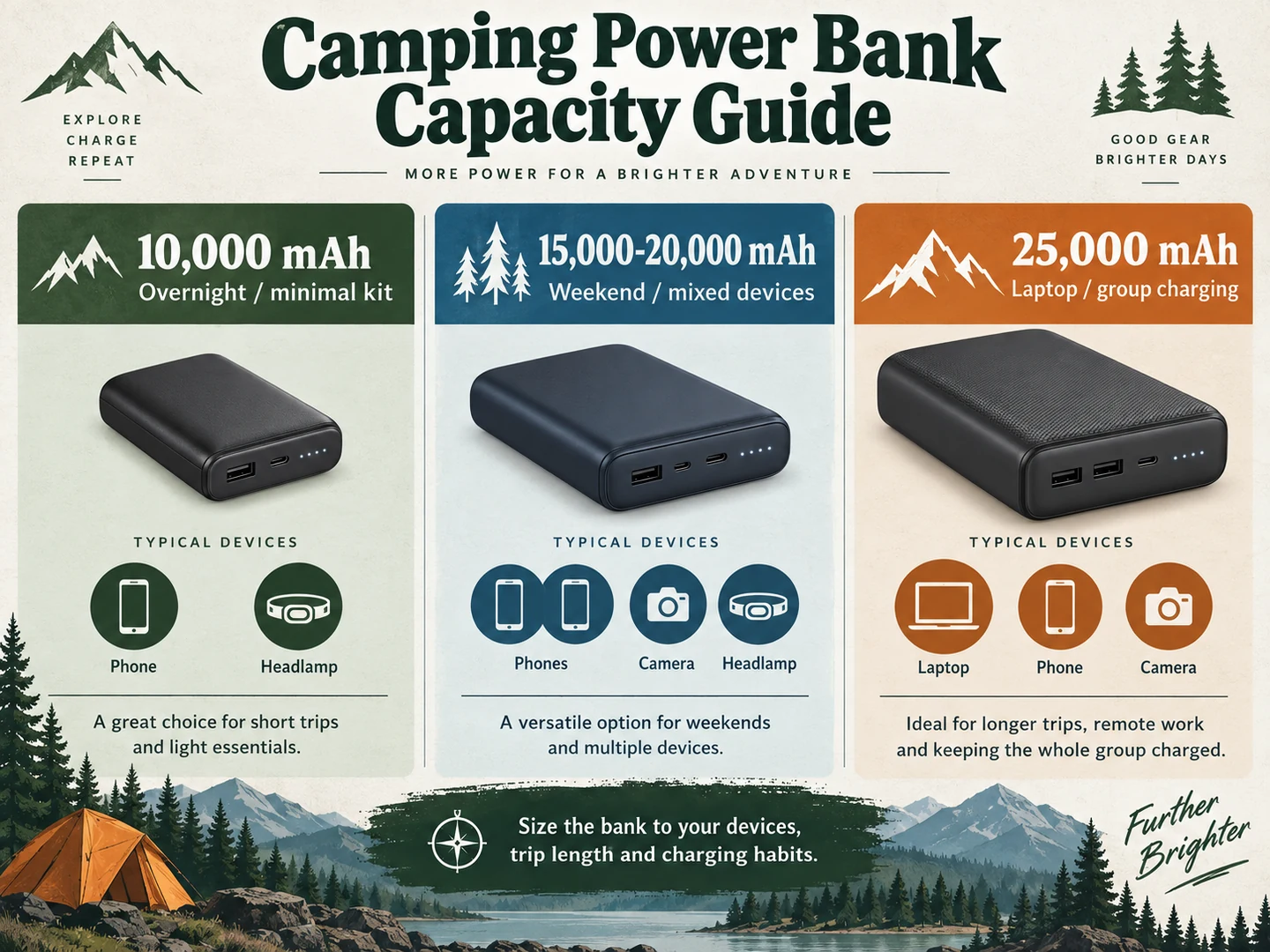
For a short overnight with one modern phone, a 10,000 mAh bank can be enough. For two- to three-night camping where you also recharge a watch, headlamp or camera, 15,000 to 20,000 mAh is a more comfortable starting point. A 25,000 mAh bank makes the most sense when several people share it or when a laptop, tablet or camera system is part of the load.
Do not convert a bank’s headline mAh directly into an exact number of phone charges. Conversion losses, cable losses, charging voltage and the phone battery itself all change the result. Plan with margin rather than assuming every listed milliamp-hour reaches the device.
How much USB-C output matters at camp?
For phones and small accessories, more wattage does not automatically make a bank better. Once the bank can meet the device’s useful charging rate, extra output is mostly unused. High output becomes important when you bring a tablet, Steam Deck, drone charger or USB-C laptop.
Also check the difference between single-port output and total output. A bank advertised at 165W total does not necessarily send 165W to one device. The Anker A1695, for example, caps each USB-C charging path at 100W even though two-device total output can be higher.
What features are actually useful outdoors?
- Built-in cable: genuinely convenient if you tend to forget loose cables, but it becomes one more integrated part that can wear.
- Digital display: useful for rationing charge over several nights, especially on 20,000 to 25,000 mAh banks.
- IP rating: worth prioritizing for paddling, rainy camps, dusty roads and exposed base camps.
- USB-A: still useful for older lanterns, fans and headlamps even if your phone has moved to USB-C.
- Pass-through charging: helpful in a hotel, car or solar setup, but support varies by model and should not be assumed.
What about solar power banks?
Small solar panels built into a power-bank shell are usually too small to be the main charging plan for a camping trip. Treat an integrated panel as emergency trickle input, not a substitute for starting with a fully charged battery. If you expect to replenish meaningful energy from the sun, use a separate foldable solar panel with a bank or step up to a power station designed for solar input.
Can you fly with a 20,000 or 25,000 mAh power bank?
Under current FAA guidance, spare lithium-ion batteries and power banks up to 100Wh are allowed in carry-on baggage, not checked baggage. Batteries from 101Wh to 160Wh need airline approval, and airlines can impose stricter rules. The 90Wh UGREEN listed here is below the 100Wh threshold, while the exact Wh marking on your own unit remains the number that matters. Check the current FAA battery guidance and your airline before flying.
Cold weather changes the decision
Lithium-ion batteries lose useful performance as they get cold, and different designs can behave very differently. Keep a power bank insulated, avoid leaving it on frozen ground and do not assume a large capacity rating guarantees winter performance. If sub-freezing use is the main job, use the more specific cold-weather power bank comparison rather than choosing from this general camping list.
How we picked these camping power banks
We started with the current US search intent for camping power banks and deliberately excluded portable power stations from the shortlist. That matters because many search results mix pocket batteries with 300Wh to 1,000Wh power stations even though they solve different jobs.
For each finalist we checked the current exact model, manufacturer specifications where available, current Amazon.com US listing identity and independent evidence on practical performance. The shortlist favors five different buyer scenarios rather than five versions of the same 20,000 mAh brick: balanced everyday camping, budget capacity, rugged weather resistance, multi-device charging and high-output laptop use.
We also checked the September 2025 CPSC Anker power-bank recall before keeping current Anker models in the list. The recall names A1647, A1652, A1257, A1681 and A1689. Neither A1383 nor A1695 is among the model numbers listed in that recall. Buyers should still check manufacturer and CPSC recall pages for any battery product they already own.
FAQ
What size power bank is best for camping?
For most two- to three-night camping trips, 15,000 to 20,000 mAh is a useful starting range if you are charging one or two phones plus small accessories. Move toward 25,000 mAh when several people share the bank or when laptops and camera gear are part of the load.
Is 20,000 mAh enough for a weekend camping trip?
Often, yes, especially for one or two phones plus a headlamp or watch. The exact number of recharges depends on your device batteries, charging losses, temperature and how heavily you use the devices, so plan with margin rather than relying on a fixed phone-charge count.
Can a camping power bank charge a laptop?
Yes, if both the laptop and the bank support USB-C charging at a compatible wattage. For many laptops, 65W is a useful baseline. Higher-demand models may benefit from 100W or more. Check the laptop’s charging requirement rather than choosing by capacity alone.
Do I need a waterproof power bank for camping?
Not for every campsite. If the battery stays inside a tent, dry bag or vehicle, ordinary construction can be fine. A published IP rating becomes much more valuable around rain, paddling, dust, beach camps or gear that lives outside shelter.
Should I buy a power bank or a portable power station for camping?
Choose a power bank for USB-powered devices that need recharging. Choose a power station when you need AC outlets, 12V output or enough stored energy to run equipment continuously for hours, such as a fridge or some CPAP setups.
Are solar power banks good for camping?
Integrated solar panels on small power banks are usually too small for fast, dependable recharging. They can provide emergency trickle input, but a separate folding panel or a solar-capable power station is a better plan when solar replenishment is important.
Can I put a power bank in checked luggage?
No. Current FAA guidance says spare lithium-ion batteries, including power banks and portable chargers, must be carried in carry-on baggage. Check your airline as well because carriers may have stricter rules.