
Gear & Home is reader-supported. As an Amazon Associate I earn from qualifying purchases. When you buy through links on our site, we may earn an affiliate commission, at no extra cost to you. Learn more.
Portable power station capacity is easier to size when you stop asking how many days a battery lasts and start asking how many watt-hours your campsite uses between reliable recharges. Phones and lights may need only a small station. Add a 12V fridge, overnight fan, CPAP, laptop or heated gear and the answer can jump by hundreds of watt-hours.
Most campers should calculate the load first, then choose the capacity class
A useful starting formula is required rated capacity (Wh) = energy you expect to use between recharges (Wh) / 0.8. The 0.8 factor is a conservative planning allowance for conversion losses and other real-world overhead. It is not a promise that every power station will deliver exactly 80 percent of its label capacity.
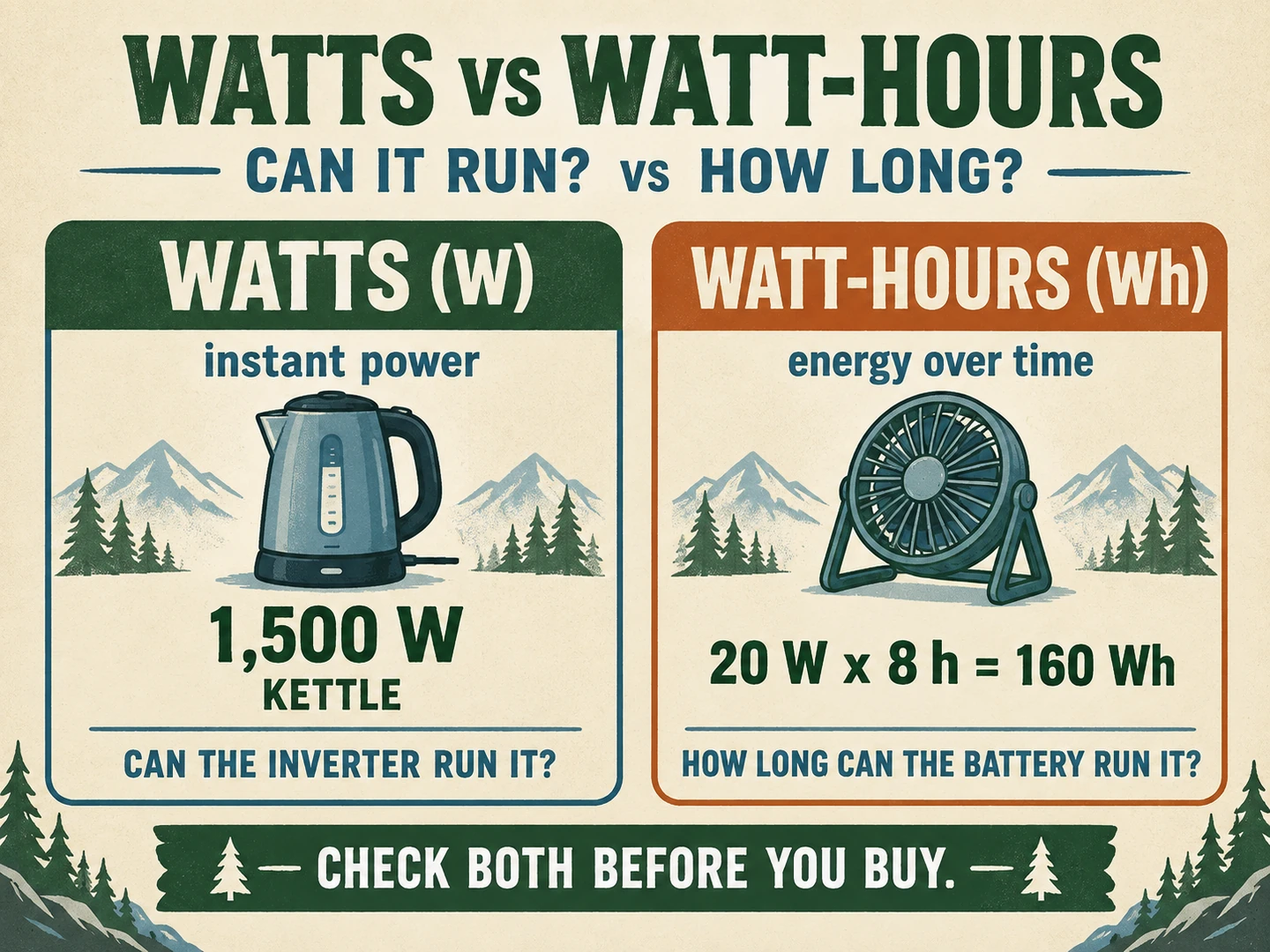
For light electronics, roughly 200 to 300Wh can be enough. A campsite with a compressor fridge, fan and regular device charging often moves toward the 1,000Wh class. If that same load must run for two days with no dependable recharge, 1,500 to 2,000Wh can become reasonable. The right number depends on your measured load and recharge window, not the trip length alone.
Size a camping power station in 60 seconds
Watts vs watt-hours: the mistake that causes most bad sizing decisions
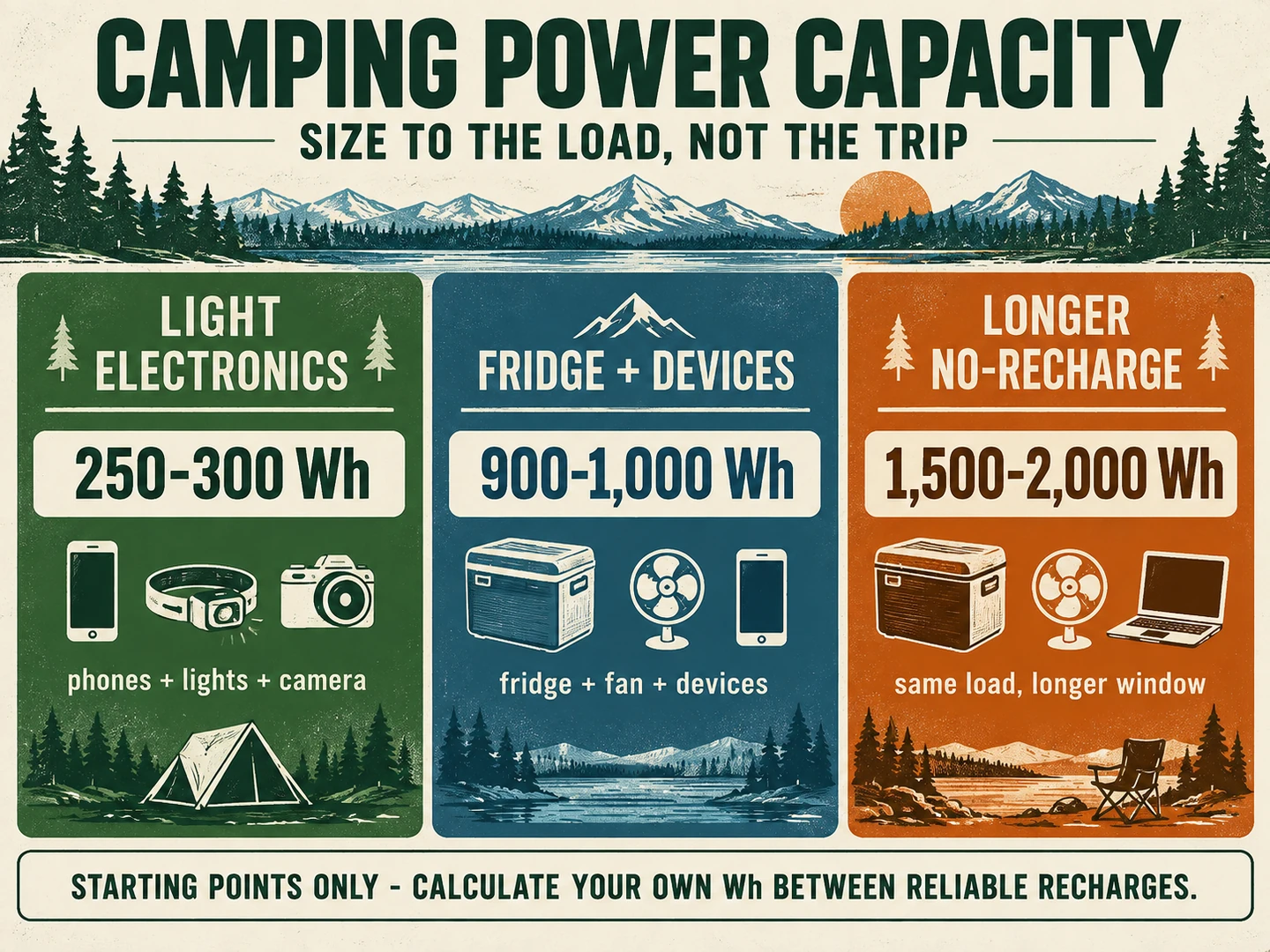
Watts (W) tell you how much power a device needs at a moment in time. Watt-hours (Wh) tell you how much energy it uses over time. A power station has to pass both tests.
A 1,500W kettle illustrates the difference. If it runs for five minutes, the ideal energy use is only 125Wh. But a 300W inverter still cannot run it, because the instantaneous load is far above 300W. A low-watt fan is the opposite problem: a 20W fan is easy for almost any inverter, but eight hours of use consumes 160Wh before losses.
How to calculate the portable power station capacity you need
Build the calculation around the period between dependable recharges. For each item with reasonably stable consumption, use:
Add the Wh for every device, then divide the total by 0.8 for a conservative first-pass capacity target. If your loads are mostly DC or USB-C, real efficiency can be better because you may avoid AC inverter losses. If your load varies heavily, measure it instead of trusting a nameplate wattage.
For example, suppose your campsite uses 240Wh before you can recharge. Dividing 240Wh by 0.8 gives a 300Wh planning target. If it uses 800Wh between recharges, the same method points to about 1,000Wh rated capacity.
| Camping load | Example energy between recharges | First-pass rated capacity | Typical fit |
|---|---|---|---|
| Minimal electronics | About 200 to 240Wh | About 250 to 300Wh | Phones, headlamps, camera batteries, small USB devices |
| Moderate camp setup | About 400 to 550Wh | About 500 to 700Wh | More device charging, laptop use, fan, short fridge window |
| Fridge plus devices | About 700 to 800Wh | About 900 to 1,000Wh | Car camping with a measured fridge load, fan and electronics |
| Heavy or long no-recharge window | About 1,200 to 1,600Wh | About 1,500 to 2,000Wh | Longer fridge runtime, multiple devices, heavier basecamp loads |
200 to 240Wh
250 to 300Wh
Phones, headlamps, camera batteries and small USB devices.
400 to 550Wh
500 to 700Wh
More device charging, laptop use, fan or a short fridge window.
700 to 800Wh
900 to 1,000Wh
Car camping with a measured fridge load, fan and electronics.
1,200 to 1,600Wh
1,500 to 2,000Wh
Longer no-recharge windows, multiple devices and heavier basecamp loads.
These are sizing examples, not universal camping averages. Your own device measurements should override the table.
A worked example: why the recharge window matters more than trip length
Imagine a car-camping setup where a measured 12V fridge averages 20W across the day, an overnight fan averages 20W for eight hours, and phones, lights and camera charging add another 60Wh per day. The fridge figure is deliberately hypothetical. Real compressor consumption changes with ambient temperature, thermostat setting, insulation, loading and how often you open the lid.
- Fridge: 20W average x 24 hours = 480Wh per day.
- Fan: 20W x 8 hours = 160Wh per day.
- Phones, lights and camera batteries: 60Wh per day.
- Total: 700Wh per day.
If you have a dependable recharge every day, 700Wh / 0.8 = 875Wh, so a roughly 1,000Wh station is a sensible class to investigate. If you need the battery to cover two full days with no reliable recharge, the same load becomes 1,400Wh / 0.8 = 1,750Wh. That pushes you toward the 2,000Wh class.
This is why buying by trip length alone fails. A seven-day road trip with daily driving can need less battery than a two-night stationary campsite under trees with no practical solar input.
A 12V camping fridge changes the calculation
Compressor fridges cycle on and off. Dometic, for example, tells owners to use average energy consumption for runtime calculations rather than the rated input current, which represents the maximum draw. Ambient temperature and internal temperature also affect consumption.
The best input is a measured 24-hour energy figure from your own fridge under realistic conditions. If the manufacturer publishes average Wh/day or Ah/hour for a stated ambient temperature, that is more useful than the maximum nameplate current. If neither is available, a plug-in or inline power meter can turn guesswork into a usable number.
Fridge owners also need to check startup behavior and port limits. A station can have enough battery capacity but still be a poor match if its 12V output limit or AC inverter cannot support the load.
If a fridge is central to your setup, our 12V camping fridge guide is the better place to choose the fridge itself.
Solar, vehicle charging and shore power can shrink the battery you need
Capacity should cover the time between reliable recharges. That word matters. A 200W solar panel does not deliver 200W all day, and shade, panel angle, clouds, heat and charge-controller limits can cut harvest substantially. Treat solar as an energy refill plan, not as extra battery capacity.
Community experience is consistent on one point: fridge-heavy campers often discover that solar access and ambient temperature matter as much as the battery label. A large station under a shaded campsite can still run down if daily consumption exceeds daily recharge.
What 250Wh, 1,000Wh and 2,000Wh look like in real current power stations
These are not ranked recommendations. They are concrete size-class examples so you can see what capacity costs in output and carried weight before jumping to a bigger battery.
| Current example | Capacity | Rated AC output | Weight | What the class suggests | Amazon |
|---|---|---|---|---|---|
| EcoFlow RIVER 3 US model EFR705 |
245Wh | 300W | 7.8 lb | Easy to carry, but intentionally limited for light loads and shorter runtimes. | Check availability on Amazon |
| Jackery Explorer 1000 v2 | 1,070Wh | 1,500W | 23.8 lb | A practical 1kWh reference for fridge-plus-electronics car camping. | Check availability on Amazon |
| Jackery Explorer 2000 v2 | 2,042Wh | 2,200W | About 39.5 lb | Much more energy reserve, but no longer a small battery to casually move around camp. | Check availability on Amazon |
EcoFlow RIVER 3
245Wh
300W
7.8 lb
US model EFR705. Light-load, short-runtime class.
Jackery Explorer 1000 v2
1,070Wh
1,500W
23.8 lb
A practical class for fridge-plus-electronics car camping.
Jackery Explorer 2000 v2
2,042Wh
2,200W
About 39.5 lb
More reserve for long no-recharge windows, with a substantial weight penalty.
That weight progression is the reason we would not buy 2kWh by default for ordinary weekend camping. If your calculation lands near 300Wh, carrying roughly 40 lb of battery solves a problem you may not have. If your measured fridge-plus-device load really needs 1,700Wh between recharges, however, the larger class becomes rational.
For actual product selection within these classes, use our best portable power stations for camping roundup. We also have a detailed EcoFlow RIVER 3 review and a Jackery vs EcoFlow comparison.
Why we use an 80 percent planning factor
The capacity printed on the battery is not identical to the energy every device will receive. Conversion losses, inverter overhead, low-load behavior, temperature and battery-management limits all affect real output.
Jackery’s current support guidance uses an approximate runtime formula of battery Wh x 0.8 / device watts for stable loads. EcoFlow publishes a similar runtime approach using an assumed efficiency factor and gives 0.85 as an AC example. Independent 2026 testing of the Jackery Explorer 1000 v2 measured 910Wh from its claimed 1,070Wh, or about 85 percent in that test.
Using 0.8 for initial planning therefore builds in some breathing room without pretending that every station and every port behaves the same way. If the load is mission-critical, cold-weather sensitive or close to the station’s limits, measure the actual setup before the trip and add more reserve.
Do not forget continuous watts and startup surge
Capacity tells you how much energy is stored. Output tells you what the station can run at all. Check the highest simultaneous continuous load and any startup surge from compressors, pumps or other motor-driven equipment.
- A 245Wh station can theoretically hold enough energy for several small device charges, but a 300W inverter will not run a 1,500W kettle.
- A 1kWh station with a 1,500W rated inverter can run much larger AC loads, but high-watt cooking or heating can drain the battery quickly.
- A fridge may have a modest average energy use yet still need enough instantaneous output to start its compressor.
Do not treat marketing modes that temporarily support unusually high resistive loads as a replacement for the normal rated continuous output when sizing your campsite.
You may not need a portable power station at all
If your entire electrical plan is two phones, a headlamp and a camera battery, a USB power bank can be smaller, cheaper and easier to pack. A power station earns its space when you need AC outlets, a 12V fridge output, much more stored energy, high-power USB-C, or the ability to recharge several devices repeatedly.
This matters for tent campers in particular. Buying a large station just because a roundup calls 1kWh a sweet spot can add 20 to 40 lb of gear to solve a phone-charging problem that a compact battery bank already handles.
Five sizing mistakes to avoid
- Buying by trip length. Size to energy use between reliable recharges, not simply nights away.
- Confusing W with Wh. You need enough output to run the load and enough capacity to run it for the required time.
- Using maximum fridge current as average consumption. Compressor duty cycle makes that estimate misleading.
- Counting perfect solar weather. Shade, clouds, panel angle and input limits can make a theoretical refill plan fail.
- Running the math to exactly zero percent. Real-world loads vary. Build in reserve, especially when you cannot easily recharge.
CPAP, heated gear and other special loads need their own numbers
For CPAP use, check the exact device and settings, including whether a humidifier or heated hose is enabled. Do not size medical-device backup from a generic web estimate. Test the complete setup before depending on it off-grid and follow the device manufacturer’s guidance.
Heated blankets, kettles, coffee makers and induction cooktops can also dominate the power budget. Some use high watts for a short time; others run for hours. Calculate both output and Wh rather than assuming a larger station automatically makes the load practical.
Fans are usually easier to predict. If you are mainly sizing power for hot-weather tent camping, our camping fan guide can help you choose the load before sizing the battery around it.
How Gear & Home built this sizing guide
We do not claim product testing we did not perform. For this guide we separated the problem into battery capacity, inverter output and recharge rate, then cross-checked current manufacturer manuals and support formulas, current US product specifications and Amazon listings, independent measured-output testing and recurring camper reports about fridges, solar access and real trip duration.
FAQ
Is 500Wh enough for camping?
It can be. A 500Wh-class station is often enough for phones, lights, cameras, moderate laptop use and some fan runtime. It may be too small for a compressor fridge plus other loads if you cannot recharge daily. Add your expected Wh between recharges, then divide by about 0.8 as a conservative first-pass target.
Is 1,000Wh enough for a weekend camping trip?
Often, but not automatically. A 1kWh station is a useful car-camping class when the daily load includes a 12V fridge and electronics, especially if you can recharge during the trip. A heavy fridge load with no recharge for two full days can exceed 1kWh quickly.
How many watt-hours does a camping fridge use per day?
There is no reliable universal number. Compressor fridges cycle, and consumption changes with ambient temperature, thermostat setting, insulation and use. Prefer the manufacturer’s average energy consumption for relevant conditions or measure your own fridge over 24 hours.
Should I add 20 percent extra capacity?
A 20 percent buffer is a common rough approach, but it is not identical to dividing by 0.8. Our simple planning formula assumes about 80 percent usable energy, so the nameplate target is 25 percent above the delivered Wh you expect to consume. Difficult conditions or critical loads justify more reserve.
Does a 1,000W power station mean it has 1,000Wh?
No. Watts describe output power and watt-hours describe stored energy. A station can have a 1,000W inverter with substantially less or more than 1,000Wh of battery capacity. Check both specifications.
Can solar let me buy a smaller power station?
Yes if solar recharge is dependable and large enough to replace a meaningful part of your daily consumption. Do not assume panel nameplate watts are available all day. Shade, weather, panel angle, temperature and the station’s solar input limit all affect real harvest.
What size power station do I need for a CPAP while camping?
Use the exact CPAP model, settings and accessories rather than a generic wattage estimate. Measure or verify the actual energy required for a full night, add conversion losses and reserve, and test the setup before relying on it away from grid power.