
Gear & Home is reader-supported. As an Amazon Associate I earn from qualifying purchases. When you buy through links on our site, we may earn an affiliate commission, at no extra cost to you. Learn more.
A backpack rain cover is useful when you want to keep the pack body, outer pockets and strapped-on gear from soaking up water, but the right cover has to fit the loaded pack and stay put in wind. The best models are light enough to carry routinely, secure enough for exposed trails and sized for the pack you actually hike with.
We compared current covers from Osprey, Sea to Summit, REI Co-op, Frelaxy and Mountainsmith. The shortlist stays focused on separate backpack rain covers for hiking and backpacking, not ponchos, pack liners or waterproof dry bags.
The best backpack rain cover for most hikers
Osprey Ultralight Raincover is our Best Overall pick. The current Medium fits 30-50 L packs, uses taped seams and a draw cord, packs into itself and weighs about 4 ounces. That is a strong middle ground between ultralight covers and heavier generic shells, with a fit system that owner feedback repeatedly describes as secure when the size is right.
Choose the Sea to Summit Ultra-Sil Pack Cover if minimum carried weight matters more: the Small fits 30-50 L packs at 3 ounces and adds a keeper strap across the harness. Choose the REI Co-op Duck’s Back if you want the broadest current size ladder, from 18-30 L through 90-100+ L.
Sea to Summit explicitly notes that wind-driven rain can still enter between your back and the pack harness. For a sleeping bag, insulation, electronics and other gear that cannot get wet, a pack liner or individual dry storage is the more reliable interior barrier. A cover can still be worth carrying because it keeps the pack fabric and exposed pockets drier and can reduce wet-out.
Quick Picks
Osprey Ultralight Raincover
Most hikers using mainstream day-hike or backpacking pack sizes
Sea to Summit Ultra-Sil Pack Cover
Backpackers who want low weight plus a harness keeper strap
Frelaxy Waterproof Backpack Rain Cover
Budget buyers who want cross-straps for extra retention
Mountainsmith Backpack Raincover
Hikers who want a light, seam-free cover in high-visibility colors
Best Backpack Rain Covers Compared
| Pick | Representative fit | Listed weight | Construction | Retention | Best for | Where to check |
|---|---|---|---|---|---|---|
| Osprey Ultralight Raincover Best Overall |
Medium: 30-50 L | 0.247 lb, about 4 oz | Recycled 40D high-tenacity nylon, taped seams | Draw cord | Balanced fit, weight and simplicity | Check availability on Amazon |
| Sea to Summit Ultra-Sil Best Lightweight |
Small: 30-50 L | 3 oz | 30D Ultra-Sil CORDURA nylon, no-seam construction | Keeper strap, S-L | Ultralight backpacking | Check at Sea to Summit |
| REI Co-op Duck’s Back Best Size Range |
18-30 L to 90-100+ L | 3-7 oz by size | Silicone-coated ripstop polyester, seam sealed | Cinch closure | Matching unusual small or large pack volumes | Check at REI |
| Frelaxy Waterproof Backpack Rain Cover Best Budget |
Medium: 25-35 L | 2.2-3.6 oz across listed sizes | Tear-resistant nylon with coated layers | Elastic edge plus cross-buckle straps | Low-cost secure fit | Check availability on Amazon |
| Mountainsmith Backpack Raincover Best Simple Seamless Cover |
Medium: 30-45 L | 2.9 oz | 70D Sil-Nylon taffeta with urethane backing | Full-circumference elastic | Simple seam-free coverage | Check at Mountainsmith |
Osprey Ultralight Raincover
30-50 L Medium
About 4 oz
Recycled 40D nylon
Draw cord
Sea to Summit Ultra-Sil
30-50 L Small
3 oz
30D Ultra-Sil nylon
Keeper strap
REI Co-op Duck’s Back
18-30 L to 90-100+ L
3-7 oz by size
Coated ripstop polyester
Cinch fit
Frelaxy Waterproof Backpack Rain Cover
25-35 L Medium
2.2-3.6 oz range
Coated nylon
Cross-buckle straps
Mountainsmith Backpack Raincover
30-45 L Medium
2.9 oz
70D Sil-Nylon
Elastic binding
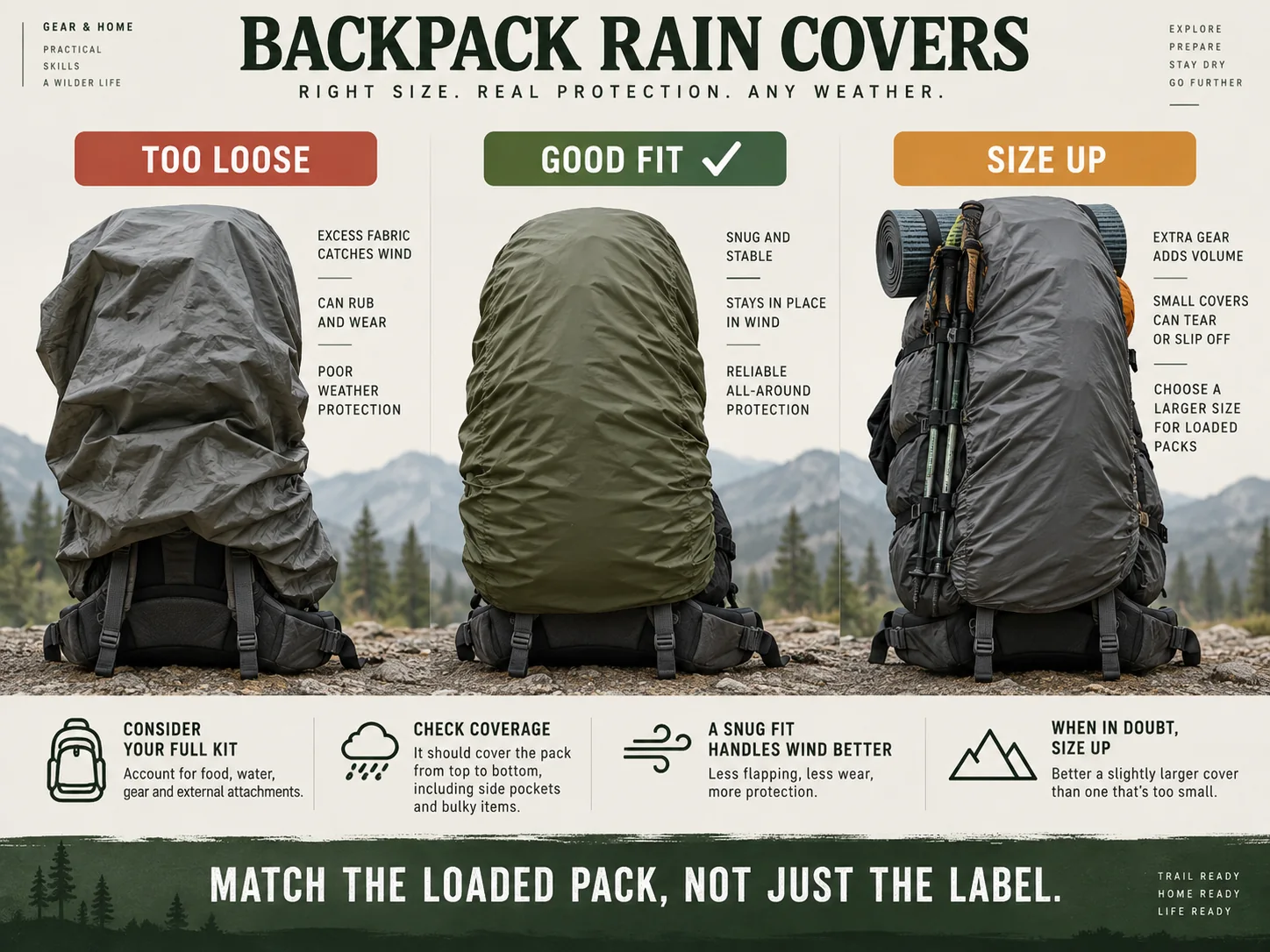
Fit ranges and weights refer to the current variants shown. A loaded backpack can be effectively larger than its nominal internal volume when a sleeping pad, tent, chair or other gear rides outside the pack.
The 5 Best Backpack Rain Covers for Hiking and Backpacking
Osprey Ultralight Raincover
The best all-around choice when you want a current mainstream cover with taped seams, simple adjustment and a proven secure fit.
#1
Osprey earns the top spot because the current design does the important things without turning the cover into a complicated accessory. The taped seams address obvious leak paths, the draw cord lets you tune the perimeter around different pack shapes, and the cover stuffs into itself rather than needing a separate pouch that can disappear in the gear closet.
The Medium is a particularly useful reference size because 30-50 liters spans large daypacks, hut packs and many lightweight overnight setups. Osprey also sells Large and X-Large versions for bigger packs. The current Medium weighs 0.247 pounds, or just under 4 ounces, which is not the lightest number in this guide but is easy to justify when weather is plausible rather than merely theoretical.
The key caveat is fit at the edge of the range. Owner feedback includes both secure, wind-resistant fits and cases where a fully loaded pack made the expected size too small. Treat the liter number as a starting point. If bulky gear sits outside the pack, compare the loaded dimensions and consider sizing up.
Pros
- Taped seams and draw-cord adjustment
- Packs into itself
- Current 30-50 L Medium fits many common hiking packs
- Recent owner feedback supports a secure fit when correctly sized
Limitations
- Not the lightest option here
- Black is less visible than bright lime or orange covers
- Exterior gear can make the stated size range optimistic
- Still leaves the harness side of the pack exposed
Sea to Summit Ultra-Sil Pack Cover
A 3-ounce 30-50 L cover with no-seam construction and a keeper strap, making it the strongest lightweight specialist in this shortlist.
#2
The Ultra-Sil is the more specialized backpacking choice. Its Small covers the same 30-50 L nominal range as the Osprey Medium but saves roughly an ounce, and the keeper strap crosses the harness side to pull the cover tighter against the pack. That matters when a thin, slippery cover would otherwise balloon away from the pack body.
Sea to Summit also removes seams from the cover body and keeps the stuff sack attached. The four current sizes span extra-small through large, with published weights from 2 ounces to 4.6 ounces. For hikers who usually carry a 30-50 L pack, the 3-ounce Small is the sweet spot.
Do not interpret the lightweight construction as a substitute for interior waterproofing. Sea to Summit’s own FAQ says wind-driven rain can enter through the space between your back and the harness. The cover protects the pack exterior very well for its weight, but critical dry gear still deserves a liner or dry storage.
Pros
- 3 oz for the 30-50 L Small
- No-seam construction
- Keeper strap improves harness-side retention
- Attached stuff sack and base drainage hole
Limitations
- Weight-focused 30D fabric is not the first choice for repeated brush and rock abrasion
- Exact fit still depends on loaded pack shape
- Wind-driven rain can reach the harness-side opening
- Bright colors are useful for visibility but not always discreet
REI Co-op Duck’s Back Pack Rain Cover
The easiest current lineup to match across unusually small and unusually large packs, with five clear volume bands and seam-sealed coated fabric.
#3
REI’s advantage is not one magic feature. It is the clarity of the size ladder. A tiny daypack and a 90-liter expedition pack should not be forced into the same generic cover, and Duck’s Back gives you distinct options from extra-small to extra-large.
The Small, for example, fits 35-45 L packs and weighs 4 ounces. The Medium steps up to 50-65 L at 5 ounces, while the extra-large reaches 90-100+ L at 7 ounces. The current Extra-Large specification adds an oxford-nylon bottom panel and a drain hole, a useful detail on a cover designed for 90-100+ L packs.
That size clarity still does not remove the need to check your loaded pack. Current owner feedback ranges from a near-perfect cinch to buyers who found the nominal size larger or smaller than expected. If you can try the cover on your actual backpack, this is one of the easiest products here to fit correctly.
Pros
- Five current size bands from 18 L to 100+ L
- Seam-sealed coated ripstop polyester
- Clear technical specs for each size
- Useful option for very small and very large packs
Limitations
- Heavier than the lightest Ultra-Sil option at comparable volumes
- Fit can still vary with pack shape and exterior gear
- No cross-harness keeper strap like Sea to Summit
- REI availability can vary by size and color
Frelaxy Waterproof Backpack Rain Cover
A low-cost Amazon option that adds cross-buckle straps instead of relying on perimeter elastic alone.
#4
Many inexpensive rain covers are just a coated fabric bowl with elastic around the edge. Frelaxy adds adjustable cross-buckle straps across the back of the pack, which is the feature that earns it a place here. The straps give you another way to keep the cover from walking off the sides when the pack shape is narrow, tall or exposed to gusts.
The current Amazon-derived listing spans five sizes, and the Medium 25-35 L child is tied to ASIN B07D8S65YM. The listing also advertises a coated multi-layer nylon construction and a compact storage pouch. Those details make it a sensible budget comparison, but the evidence base is not as strong as the brand-direct documentation available for Osprey, Sea to Summit, REI or Mountainsmith.
That distinction matters. Buy Frelaxy because the retention design and price fit your needs, not because a marketplace waterproof-rating number looks larger than a competitor’s. Fit, seam construction and keeping critical gear inside a liner remain more important than marketing arithmetic.
Pros
- Cross-buckle straps add retention
- Wide listed size range
- Compact and light for the category
- Low-cost entry point
Limitations
- Marketplace-first documentation is less transparent than major outdoor brands
- Exact weight varies by size
- Fit claims still depend on real loaded pack dimensions
- We would still use a liner for critical dry gear
Mountainsmith Backpack Raincover
A newly revised 2026 cover that removes seams entirely and keeps the hardware simple with full-circumference elastic binding.
#5
Mountainsmith takes the opposite approach from Frelaxy. There are no cross straps or extra adjustment pieces. The 2026 redesign simply removes seams from the cover body and uses elastic around the entire perimeter. For hikers who like fewer moving parts, that is appealing.
The Medium is notably light at 2.9 ounces while using a 70D fabric, and the current lineup adds bright Lemon Chrome with Blaze Orange scheduled for fall 2026. That makes Mountainsmith attractive for hikers who prefer visible wet-weather gear and want a tougher fabric number than 30D ultralight covers.
The compromise is retention. Full-circumference elastic can work well on a conventional pack shape, but there is no separate keeper strap crossing the harness. If you expect strong wind, awkward external loads or lots of off-trail movement, Osprey, Sea to Summit or Frelaxy gives you more adjustment.
Pros
- 2026 no-seam pattern
- 2.9 oz in Medium
- 70D Sil-Nylon taffeta with urethane backing
- High-visibility color options
Limitations
- Only three size bands
- No separate keeper or cross strap
- No current owner-review depth on the brand page
- 60 L upper limit leaves very large expedition packs to other options
How to Choose a Backpack Rain Cover
1. Size for the loaded pack, not the empty pack
A 45-liter backpack is not necessarily a 45-liter shape once a foam pad, tent body, chair or wet sandals are strapped outside. Start with the manufacturer’s liter range, then think about the real outer dimensions you hike with. If you sit at the top of a size range or carry bulky external gear, sizing up is often safer than stretching a small cover over the load.
2. Choose the retention system for your weather
Perimeter elastic is simple and light. A draw cord gives you more adjustment. A keeper strap or cross-buckle system adds another line of defense against flapping and side slip. On sheltered woodland trails, any well-fitted system may be enough. On exposed ridges or windy shoulder-season trips, retention matters more.
3. Look at seam strategy and drainage
There are two sensible approaches: tape the seams or remove them. Osprey tapes its seams; Sea to Summit and Mountainsmith use no-seam cover bodies. Larger covers can also benefit from a drain hole so water that reaches the inside has somewhere to escape instead of pooling at the bottom.
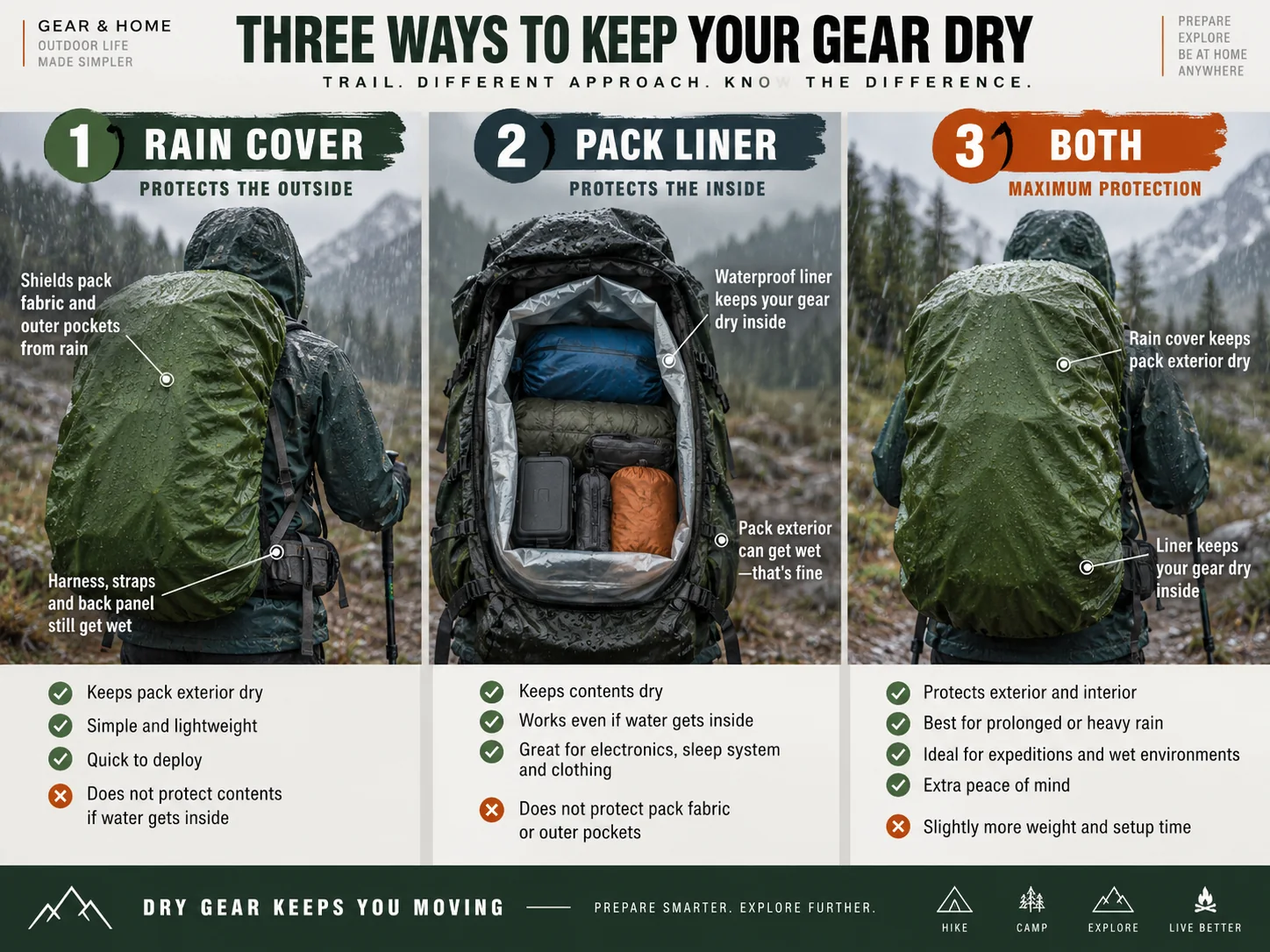
4. Treat the cover and liner as different tools
A cover helps keep the outside of the backpack drier. A liner protects the contents even if the outer pack fabric gets wet. Those are different jobs. For a sleeping bag, dry clothing and electronics on a wet multi-day trip, the interior barrier is the more important one. Add a cover when you also want to reduce pack wet-out, protect outer pockets or keep mud off the pack body.
5. Visibility can be a feature
Bright lime, yellow or orange covers can make a hiker easier to see in poor weather or low light. Black is more discreet but provides less visual contrast. Visibility is not a substitute for a light, reflective gear or route planning, but it can be a useful secondary benefit.
6. Do not overpay for a waterproof-rating number alone
A hydrostatic-head number describes fabric performance under a specific test. It does not tell you whether water can enter around the harness opening, whether a cover fits your loaded pack or whether wind will peel it away. For a pack cover, fit, retention, seam strategy and interior dry storage are often more useful decision points than a single large marketing number.
Rain Cover vs Pack Liner: Which Matters More?
If the only goal is keeping a sleeping bag and spare clothes dry, a properly closed pack liner is the more dependable barrier because it protects the contents from inside the pack. The pack fabric and harness can still get wet, but the insulation stays isolated from that moisture.
A rain cover solves a different nuisance: it reduces how much water reaches the pack body and exposed pockets in the first place. That can keep the backpack from gaining as much water weight, keep muddy spray off the exterior and make camp organization less soggy.
For sustained or wind-driven rain, using both is a defensible system: liner for critical gear, cover for the pack exterior. For short fair-weather trips with only a small chance of rain, many hikers choose one layer instead of carrying both.
How We Chose These Backpack Rain Covers
We started with the current US SERP and Gear & Home content registry. The query is still dominated by commercial roundups, while the planned Gear & Home decision page about pack liners versus covers serves a different intent. That supports a separate money page focused only on which rain cover to buy.
We preferred current 2026 manufacturer pages and current retailer listings, not legacy specs copied from older roundups.
We compared stated pack-volume ranges, adjustment systems, keeper straps and owner fit patterns rather than ranking by waterproof claims alone.
Manufacturer specifications lead the fact stack. Retailer and owner feedback are used to identify practical patterns such as sizing difficulty and wind security.
Amazon CTAs are included only where the exact current US listing and ASIN were resolved. Other picks link to the manufacturer or REI instead of using a guessed marketplace variant.
FAQ
What is the best backpack rain cover for most hikers?
Osprey Ultralight Raincover is our Best Overall pick because the current design combines taped seams, draw-cord adjustment, self-packing storage and a practical 30-50 L Medium size at about 4 ounces. Sea to Summit Ultra-Sil is the better choice when minimum weight matters more.
What size backpack rain cover do I need?
Start with the cover’s stated pack-volume range, then account for the loaded shape. A tent, sleeping pad, chair or other gear strapped outside the pack adds effective volume. If you are at the top of a range or regularly carry bulky exterior gear, sizing up is often the safer choice.
Will a backpack rain cover make my pack completely waterproof?
No. A cover can keep most rain off the pack body, but the harness side remains open around your back and shoulder straps. Sea to Summit specifically warns that wind-driven rain can still enter through that gap. Use a pack liner or dry storage for gear that absolutely must stay dry.
Do I still need a pack liner if I use a rain cover?
For critical gear on sustained wet trips, yes. A liner protects the contents from inside the pack even when the outer fabric or harness gets wet. A cover is most useful as an additional exterior layer that reduces pack wet-out and protects outer pockets.
Can a backpack rain cover blow off in wind?
It can if the fit is loose or the retention system is weak. Look for a draw cord, keeper strap or cross-buckle straps when wind is a concern. A correctly sized cover should sit snugly without large areas of loose fabric that can catch gusts.
Is a rain poncho better than a backpack cover?
Not automatically. A poncho can cover your body and pack with one piece of gear and often ventilates well, but wind and brush can make loose fabric harder to manage. A separate cover works better when you prefer a fitted rain jacket and want independent pack protection.