
Gear & Home is reader-supported. As an Amazon Associate I earn from qualifying purchases. When you buy through links on our site, we may earn an affiliate commission, at no extra cost to you. Learn more.
For camping, a power bank is the better default when your gear charges over USB and you care about weight. A portable power station starts to make sense when you need 120V AC, a 12V outlet, substantially more stored energy, or enough ports and output for several larger loads.
The labels can be misleading. Modern power banks are no longer limited to slow phone charging, and small power stations are not automatically capable of running every appliance. The useful question is not which category is “more powerful” in the abstract. It is whether the battery has the right outputs, enough watt-hours, enough continuous output and an acceptable carry weight for the devices you actually bring.
Power bank or portable power station for camping?
Choose a power bank for phones, headlamps, GPS devices, cameras, small tablets and many USB-C laptops. It is usually the better fit for backpacking, minimalist car camping and trips where every pound matters.
Choose a portable power station when you need AC outlets, a 12V car-style outlet, a camping fridge, a CPAP setup, multiple laptops, shared family charging or a much larger energy reserve. It is usually a car-camping or basecamp tool rather than something you want to carry far.
Power Bank vs Portable Power Station: The Short Version
| Decision factor | Power bank | Portable power station |
|---|---|---|
| Best fit | USB electronics, lightweight travel, backpacking | Car camping, basecamp, larger or mixed loads |
| Common outputs | USB-C and USB-A | USB-C/A plus 120V AC and often 12V DC |
| Stored energy | Usually lower | Usually much higher |
| Continuous output | Can be high over USB-C, but limited to supported USB profiles | Designed to support larger combined loads, within the station’s rated limits |
| Carry burden | Pocket, daypack or backpack friendly | Usually several pounds or more, best near the vehicle or camp |
| Recharge options | Usually USB-C wall charging, sometimes small solar setups | Usually wall, vehicle and dedicated solar input |
| Air travel | Many models fit airline battery limits, but Wh rating matters | Many camping stations exceed passenger-aircraft limits |
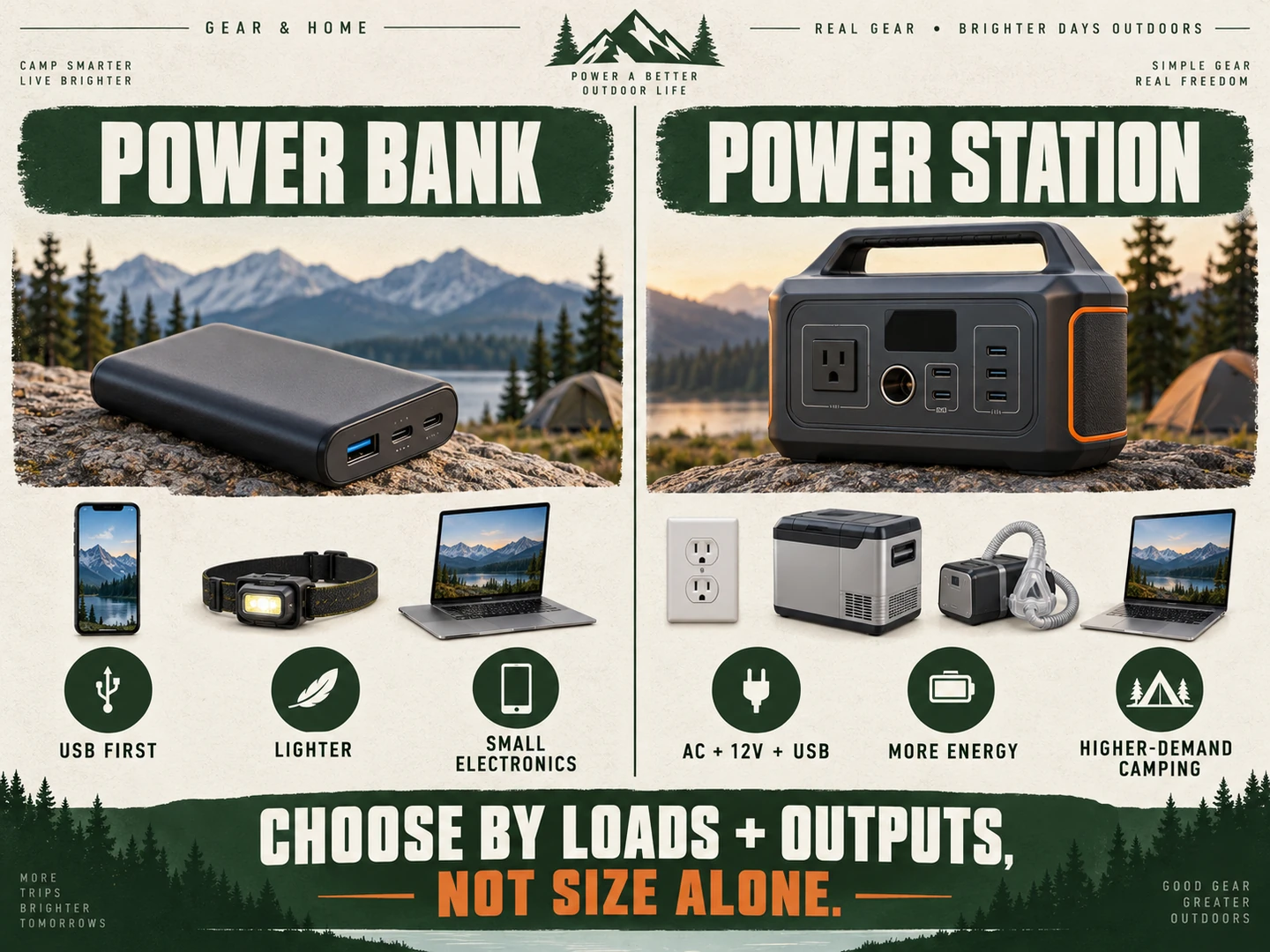
Best for USB-first camping
USB-C / USB-A
Light and compact
Phone, lights, GPS, camera, many laptops
Less energy and fewer output types
Best for mixed or higher-demand loads
USB + AC + often 12V
Heavier basecamp gear
Fridge, CPAP, laptops, shared camp power
More weight, bulk and cost
The Difference That Actually Matters
The easiest way to compare these categories is to separate four things that shoppers often blend together: energy, output power, connector type and portability.
Watt-hours tell you how much energy is stored
Watt-hours (Wh) describe the battery’s energy reserve. A larger Wh figure can generally run the same load longer, but usable runtime also depends on conversion losses, temperature, the device being powered and the battery’s own electronics. This page is about choosing the category; if you need a precise trip-size calculation, treat watt-hours as the starting point rather than a guaranteed runtime promise.
Watts tell you whether the battery can support the load
Output wattage is a separate question. A high-output USB-C power bank can charge a compatible laptop surprisingly quickly, but it still cannot substitute for a 120V AC outlet or a 12V car socket. A power station can provide those outputs, but only up to its published continuous and port limits.
The connector can decide the category before capacity does
If every device you bring charges directly from USB-C or USB-A, adding an inverter and AC outlets may give you features you never use. If one critical device requires AC power or a 12V plug, a conventional power bank may be disqualified even if it has enough stored energy on paper.
List every device, its required input and how long you need it. If the list stays USB-only, start with a power bank. If AC or 12V appears, start with a power station and verify the exact output limit.
Choose a Power Bank If…
- You are backpacking or carrying your own gear far from the vehicle. A battery that disappears into a pack is usually more useful than a station that adds several pounds.
- Your devices are USB-first. Phones, headlamps, GPS units, satellite messengers, cameras and many tablets are natural power-bank loads.
- Your laptop supports USB-C Power Delivery. Some current high-output banks can supply up to 100W from a USB-C port, enough for many compatible laptops. Check the laptop’s required charging profile and cable before relying on it.
- You only need a weekend reserve. Carrying a much larger battery than the trip requires adds dead weight.
- You may fly with your battery. Air-travel rules are based on watt-hours, not the marketing name on the product. Many power banks are designed around this constraint, while many camping power stations are too large for passenger aircraft.
A power bank is not automatically the “weak” option. For a camper whose heaviest device is a USB-C laptop, the right high-output bank can be the cleaner and lighter system.
Choose a Portable Power Station If…
- You need a 120V AC outlet. This is the clearest dividing line for devices that do not accept direct USB or DC charging.
- You need a 12V car-style outlet. Many portable fridges and other camp devices are built around 12V power.
- You are running a CPAP or another important overnight device. A station can provide the larger energy reserve and output flexibility these setups often require. Verify the exact machine, humidifier use, pressure settings, adapter and expected overnight consumption before the trip.
- You are powering a group campsite. Several phones, lights, cameras and laptops can turn a neat single-user power bank into a cable and recharge bottleneck.
- You want dedicated solar or vehicle recharging. Compact stations commonly include inputs designed for these recharge paths.
The trade-off is simple: power stations buy you more energy and more ways to deliver it, but you pay in weight, space and usually price.
Which One Fits Your Camping Style?
Backpacking: power bank
For navigation, a phone, headlamp, satellite messenger and compact camera, a power bank is the natural starting point. It keeps the charging system small and avoids carrying AC hardware that has no job on the trip.
Weekend car camping with phones and lights: usually power bank
Being next to the car does not automatically justify a station. If the load list is still only USB devices, one larger bank or two smaller banks may be simpler and easier to use.
USB-C laptop at camp: power bank can be enough
A laptop does not automatically force you into the power-station category. If it charges over USB-C PD and your bank can provide the required profile, a high-output bank may be the better answer. If the laptop needs a proprietary AC brick, or you need several workdays of reserve, a station becomes more attractive.
12V fridge: portable power station
A compressor fridge is a different job from charging a phone. You need a compatible 12V output and enough stored energy for the fridge’s real duty cycle. That makes a station the practical category for most car-camping fridge setups. See our portable power stations for camping guide when you are ready to compare actual models.
CPAP overnight: usually portable power station
For CPAP use, start with the machine’s own power requirements rather than a generic “number of nights” claim. Heated humidification and heated tubing can materially change consumption. A station gives you more reserve and more output choices, but an efficient DC setup can be preferable when the CPAP manufacturer supports it.
Family basecamp: portable power station
Shared charging is where stations become convenient even when no single device is extreme. More ports, a bigger reserve and multiple recharge options can matter more than pocket portability.
Two Current Products That Show the Category Gap
These are not “winner” picks for this comparison. They are useful reference points because they show how much the categories now overlap in USB output while remaining very different in energy, connectors and carry weight.
| Example | What it shows | Current key specs | Where to check |
|---|---|---|---|
| Anker Prime 20,000mAh Power Bank (200W), A1336 | A modern power bank can be a serious laptop charger without becoming a power station. | 2 USB-C + 1 USB-A; up to 100W from either USB-C port; 200W total; 545g | Check availability on Amazon |
| EcoFlow RIVER 3 | A compact station adds far more stored energy plus AC and 12V outputs. | 245Wh; 300W AC total; 100W USB-C; 12.6V/10A car output; 7.8 lb | Check availability on Amazon |
Anker Prime 20,000mAh (200W)
2 USB-C + 1 USB-A
100W per USB-C port
200W max
545g
EcoFlow RIVER 3
245Wh
300W total
100W max
7.8 lb
Anker’s current support page lists the A1336 at 545g with two USB-C ports, one USB-A port, up to 100W from either USB-C port and 200W total output. EcoFlow lists the U.S. RIVER 3 at 245Wh and 7.8 lb with two 120V AC outlets rated at 300W total, a 100W USB-C port and a 12.6V/10A car output.
If the RIVER 3 class is closer to what you need, our EcoFlow RIVER 3 review goes deeper into where that compact 245Wh format fits. For a broader shopping comparison, see our portable power stations under $500 guide.
What About Solar Charging?
Solar does not change the core category decision. It changes how you plan to refill the battery.
Power stations usually make solar easier because many include a dedicated solar input and publish a supported voltage/current range. For example, EcoFlow rates the RIVER 3 for up to 110W of solar input. Some power banks can also be charged from compact USB solar panels, but the setup is more dependent on the panel’s USB output, charging protocol and conditions.
Do not size a battery around a perfect-sun recharge claim. Shade, panel angle, clouds, heat, cable losses and campsite geography can all reduce harvest. For an important load, bring enough stored energy for the trip plan first and treat solar as a recharge source, not a guarantee.
Can You Fly With a Power Bank or Power Station?
For U.S. passenger air travel, the FAA says spare lithium batteries and power banks must be carried in the cabin, not checked. Rechargeable batteries from 0 to 100Wh are generally allowed; 101 to 160Wh batteries require airline approval and are limited to two spares; batteries above 160Wh are forbidden on passenger aircraft. The FAA also specifically notes that large power banks, power stations and lithium battery generators above 160Wh are not allowed.
That means the word “portable” does not make a camping station flight-friendly. Check the battery’s printed Wh rating and your airline’s current rules before travel. The FAA’s current battery guidance is the right starting point.
The Trade-Offs People Miss
Power bank advantages
- Much easier to carry
- Simple for USB-first electronics
- High-output USB-C models can handle many laptops
- Often easier to fit within air-travel limits
- Less unused hardware when you do not need AC or 12V
Power bank limitations
- No standard 120V AC outlet
- Usually no 12V car-style outlet
- Lower energy reserve than a camping station
- Fewer simultaneous high-demand loads
- USB protocol compatibility still matters
Power station advantages
- AC, USB and often 12V outputs in one box
- Much larger energy reserve
- Better fit for fridges, CPAP and shared camps
- Dedicated wall, car and solar recharge options are common
- Clearer fit for mixed device ecosystems
Power station limitations
- Several pounds of extra gear even in compact models
- Bulkier to pack and store
- More expensive than a simple bank
- AC conversion adds losses when a device could charge directly over USB or DC
- Many models are too large for passenger air travel
Common Buying Mistakes
Buying by wattage alone
A 100W USB-C port does not tell you how long a battery will run a laptop. Wattage tells you whether the port can deliver the required power; watt-hours tell you how much energy is stored.
Buying by capacity alone
A large battery is not useful if it lacks the connector or voltage your device requires. Start with outputs, then size the energy reserve.
Using AC when direct USB or DC is available
If a device can be powered directly from USB-C or an approved DC adapter, that route can avoid an unnecessary DC-to-AC conversion step. Use the device manufacturer’s supported input method and the battery manufacturer’s port limits.
Assuming “600W” marketing means 600W continuous AC
Manufacturers may advertise surge or boost modes separately from continuous output. For example, EcoFlow rates the RIVER 3 at 300W total AC output while also advertising higher X-Boost capability for some loads. Match your device to the continuous rating and the manufacturer’s compatibility guidance.
Ignoring recharge time between camping days
A station with more energy can also take longer to replenish unless it supports a suitable wall, vehicle or solar input. A smaller power bank may be easier to top off during a short drive or restaurant stop. The best system is the one you can realistically recharge on your route.
FAQ
Is a portable power station overkill for camping?
It can be. If your entire load list is phones, headlamps, cameras, GPS devices and other USB electronics, a power bank is usually simpler and lighter. A station becomes more useful when you need AC or 12V outputs, much more stored energy, or shared power for several devices.
Can a power bank run a laptop while camping?
Yes, if the laptop supports USB-C Power Delivery and the power bank can provide the voltage and wattage profile the laptop requires. High-output models can reach 100W from a USB-C port. Check the laptop, cable and power-bank specifications together.
Can a power bank run a 12V camping fridge?
A conventional USB power bank is usually the wrong category because a 12V fridge typically expects a 12V DC source and a larger energy reserve. A portable power station with a compatible 12V output is the more practical starting point.
How many watt-hours do I need for camping?
Add the energy needs of the devices you plan to run, then allow margin for conversion losses, temperature and uncertainty. Do not choose from trip length alone. A phone-only weekend and a fridge-plus-CPAP weekend can have radically different energy requirements even if both last two nights.
Can I bring a portable power station on a plane?
Usually not if it exceeds 160Wh. Under current FAA guidance, rechargeable batteries from 0 to 100Wh are generally allowed, 101 to 160Wh requires airline approval, and batteries above 160Wh are forbidden on passenger aircraft. Power banks and spare lithium batteries must be carried in the cabin. Check your airline before travel.
Bottom Line
Start with a power bank unless your devices give you a reason to step up. USB-only loads, low carry weight and short trips favor the smaller category. AC appliances, 12V gear, overnight medical loads, group charging and a larger reserve favor a portable power station.
The deciding question is not “Which one is better?” It is “What must this battery power, through which connector, for how long, and how far do I have to carry it?” Answer those four questions and the category usually becomes obvious.