
Gear & Home is reader-supported. As an Amazon Associate I earn from qualifying purchases. When you buy through links on our site, we may earn an affiliate commission, at no extra cost to you. Learn more.
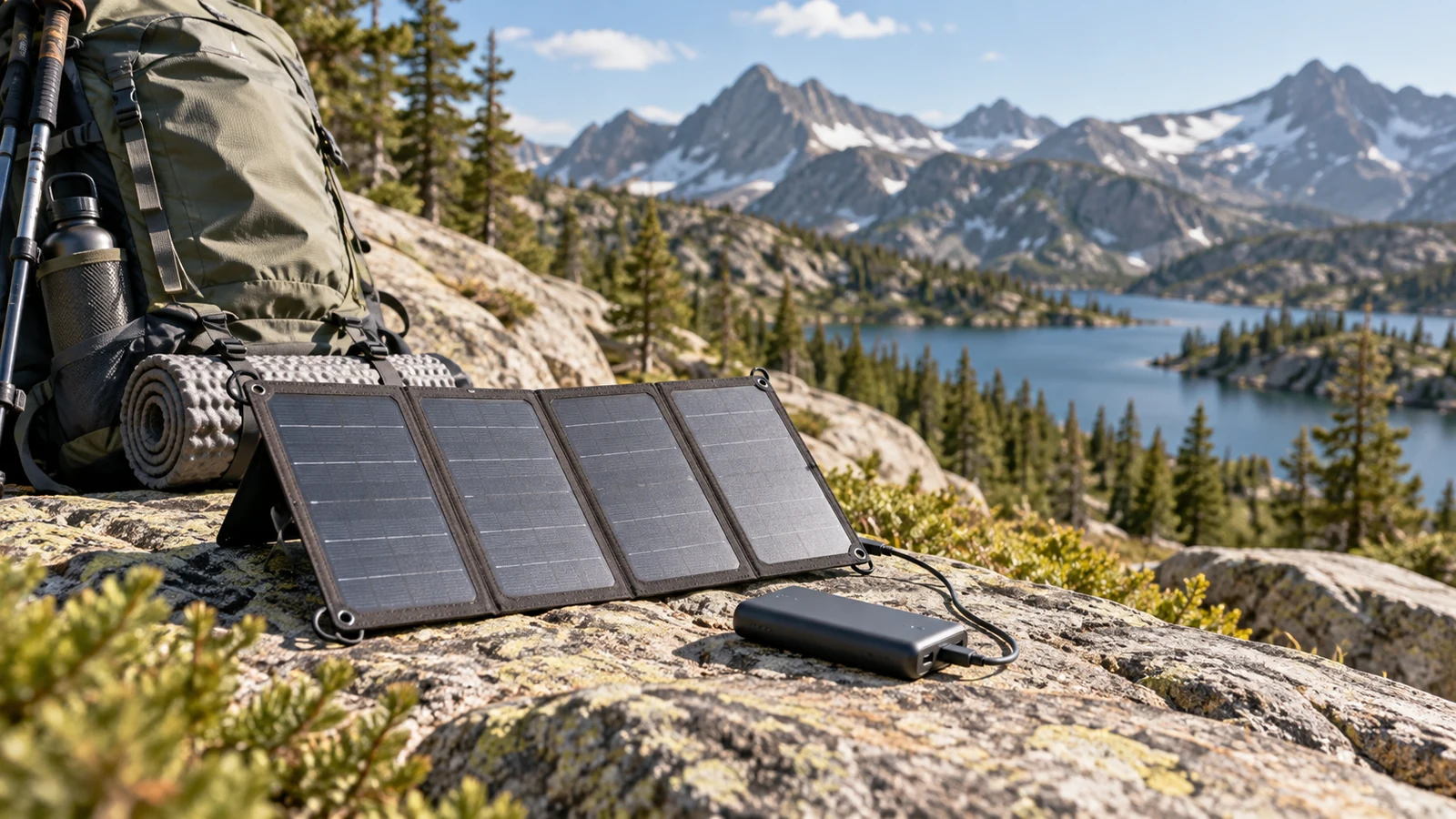
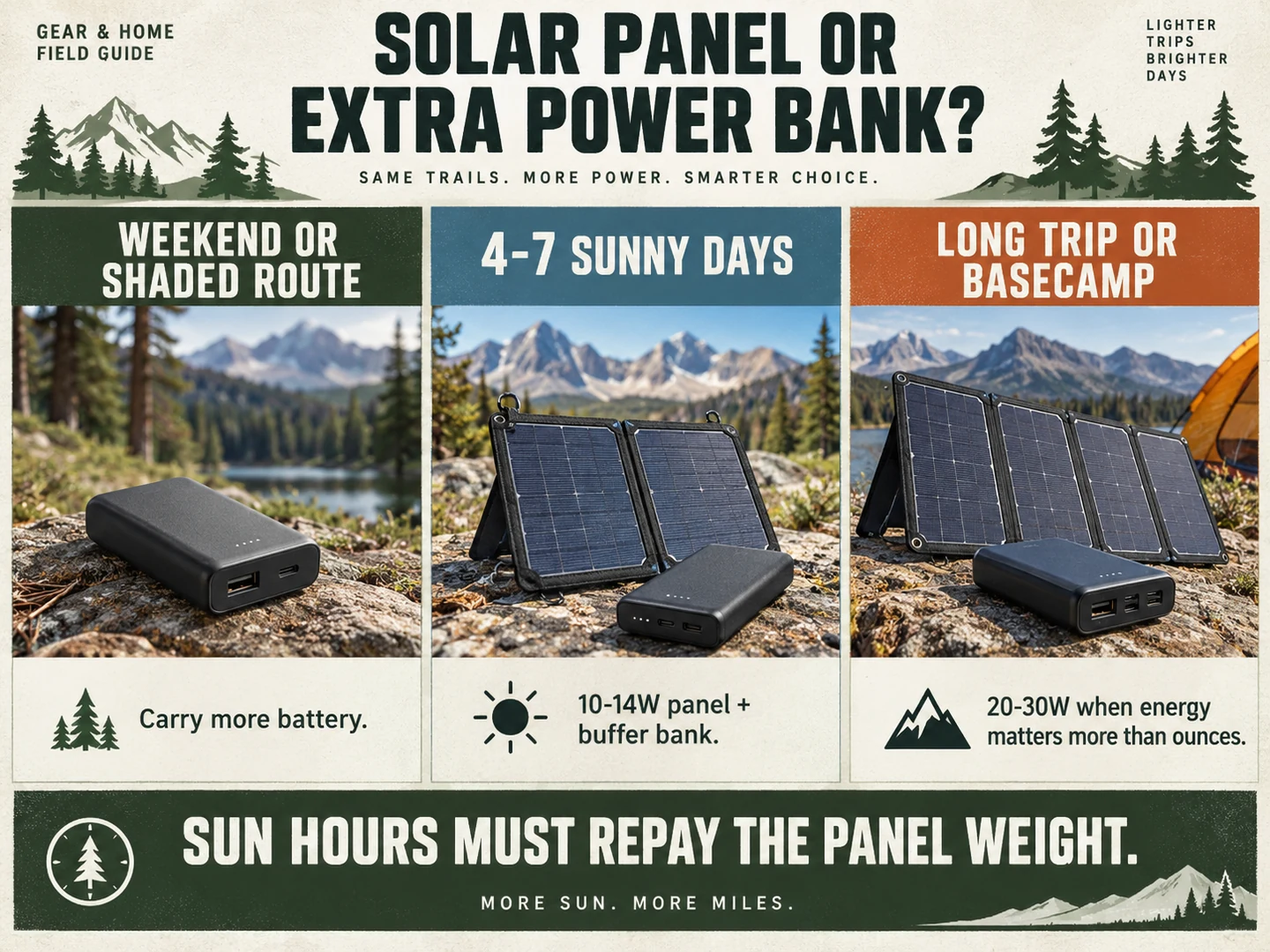
A backpacking solar charger only earns its place when it can replace energy you would otherwise have to carry. For most weekend trips, another charged power bank is simpler. For longer, sunny routes with limited outlet access, a compact panel can keep a buffer battery alive day after day.
If your trip is only a few days, your route is mostly forested, or you reach outlets at regular resupplies, carry a larger precharged power bank instead. Solar starts to make sense when you have many hours of reliable sun, several days between outlets, and enough time to expose or aim the panel.
The best solar charger for most backpackers
The FlexSolar 10W Mini is our Best Overall pick. The current Amazon listing is a 10W FlexSolar panel at about 7.1 ounces, and independent comparison work identifies the same compact model as one of the strongest weight-conscious options for backpacking. Recent long-trip owner reports also support the use case that matters most: feeding a separate power bank across long sunny days rather than expecting wall-charger behavior from the panel.
Choose the BLAVOR 10W if you want USB-A and USB-C in a compact package. Move to the BigBlue 28W with ammeter only when higher daily energy matters enough to justify roughly 1.5 pounds of panel. The Goal Zero Nomad 5 is the easiest small panel to aim thanks to its kickstand, but its 5W output makes it a specialist choice rather than the performance winner.
Quick Picks
FlexSolar 10W Mini
Lowest carried weight among our serious 10W picks, with enough panel area to be useful on long sunny routes.
BLAVOR 10W
A compact 10W panel with both USB-A and USB-C outputs, plus a storage pocket and hanging points.
BigBlue 14W
More rated panel capacity than the 10W class while staying under 13 ounces on the linked BB-14 version.
BigBlue 28W with Ammeter
A larger USB-A and USB-C panel for long trips, groups, and basecamp-style charging where ounces matter less.
Goal Zero Nomad 5
A rugged 5W panel that is easy to aim at camp, best for small loads and slow charging rather than maximum output.
Best Backpacking Solar Chargers Compared
| Pick | Rated power | Listed weight | USB output | Setup | Best for | Where to check |
|---|---|---|---|---|---|---|
| FlexSolar 10W Mini Best Overall |
10W | About 7.1 oz | USB-A | Folding panel, carabiners | Weight-conscious multi-day backpacking in reliable sun | Check availability on Amazon |
| BLAVOR 10W Best with USB-C |
10W | 12.96 oz | USB-A + USB-C, 5V/2A max | Bi-fold panel, pocket, hanging points | Backpackers who want modern cable flexibility | Check availability on Amazon |
| BigBlue 14W Best 14W Middle Ground |
14W | 12.8 oz | USB-A, up to 5V/2.4A | Folding panel, pocket, carabiners | Stationary charging breaks without a 1.5 lb panel | Check availability on Amazon |
| BigBlue 28W with Ammeter Best Higher Output |
28W rated | 1.48 lb | USB-A + USB-C, up to 5V/2.4A per port | Large folding array, built-in current display | Long trips, shared loads, basecamp-style use | Check availability on Amazon |
| Goal Zero Nomad 5 Best Built-In Kickstand |
5W | 12.7 oz | USB-A, up to 5W | Rigid panel with adjustable kickstand | Small USB loads and easy stationary aiming | Check availability on Amazon |
FlexSolar 10W Mini
10W
About 7.1 oz
USB-A
Weight-conscious long trips
BLAVOR 10W
10W
12.96 oz
USB-A + USB-C
Cable flexibility
BigBlue 14W
14W
12.8 oz
USB-A
Stationary charging breaks
BigBlue 28W with Ammeter
28W rated
1.48 lb
USB-A + USB-C
Long trips and larger loads
Goal Zero Nomad 5
5W
12.7 oz
USB-A, up to 5W
Small loads at camp
Rated watts describe panel capacity under favorable conditions, not guaranteed trail output. Shade, clouds, panel angle, heat, cable losses and the device being charged can all reduce useful power. The weight figures above refer to the linked variants and current manufacturer or listing specifications.
The 5 Best Solar Chargers for Backpacking
FlexSolar 10W Mini
The strongest choice here when every ounce matters but you still want enough panel area to replenish a buffer bank over long sunny days.
#1
The FlexSolar wins this roundup because its advantage is directly relevant to backpacking: it gives you a real 10W-class panel without making you carry roughly three-quarters of a pound. The current Amazon listing identifies the product as a FlexSolar 10W Mini and lists a 200 g body with a compact folding format.
That low weight changes the break-even calculation. A solar panel does not have to beat a wall charger. It has to collect enough energy over several days to justify carrying the panel instead of more stored battery capacity. At about seven ounces, the FlexSolar has a much easier case to make on long, exposed routes than 12 to 24 ounce alternatives.
The design is intentionally simple. There is one USB-A output and no integrated battery or kickstand. That is good for weight, but it means you need to manage the setup yourself. Clip or prop the panel where it can see direct sun, protect the exposed USB connection from dust and rain, and use a separate power bank as the buffer.
Pros
- Very low weight for a 10W folding panel
- Small packed footprint
- Enough output to make sense for multi-day solar harvesting
- Simple design with fewer extras to carry
Limitations
- USB-A only
- No built-in kickstand
- Exposed charging port deserves protection in dust and weather
- Small panel still depends heavily on sun exposure and angle
BLAVOR 10W
A practical step up in convenience if you want both USB-A and USB-C without moving into a large, heavy panel.
#2
The BLAVOR is heavier than our top pick, but it is easier to integrate into a modern cable kit. The exact linked 10W version is model PN-30P and provides both USB-A and USB-C outputs. Its USB-C socket is a connector convenience, not high-wattage USB Power Delivery, so do not read the port shape as a promise of laptop-style fast charging.
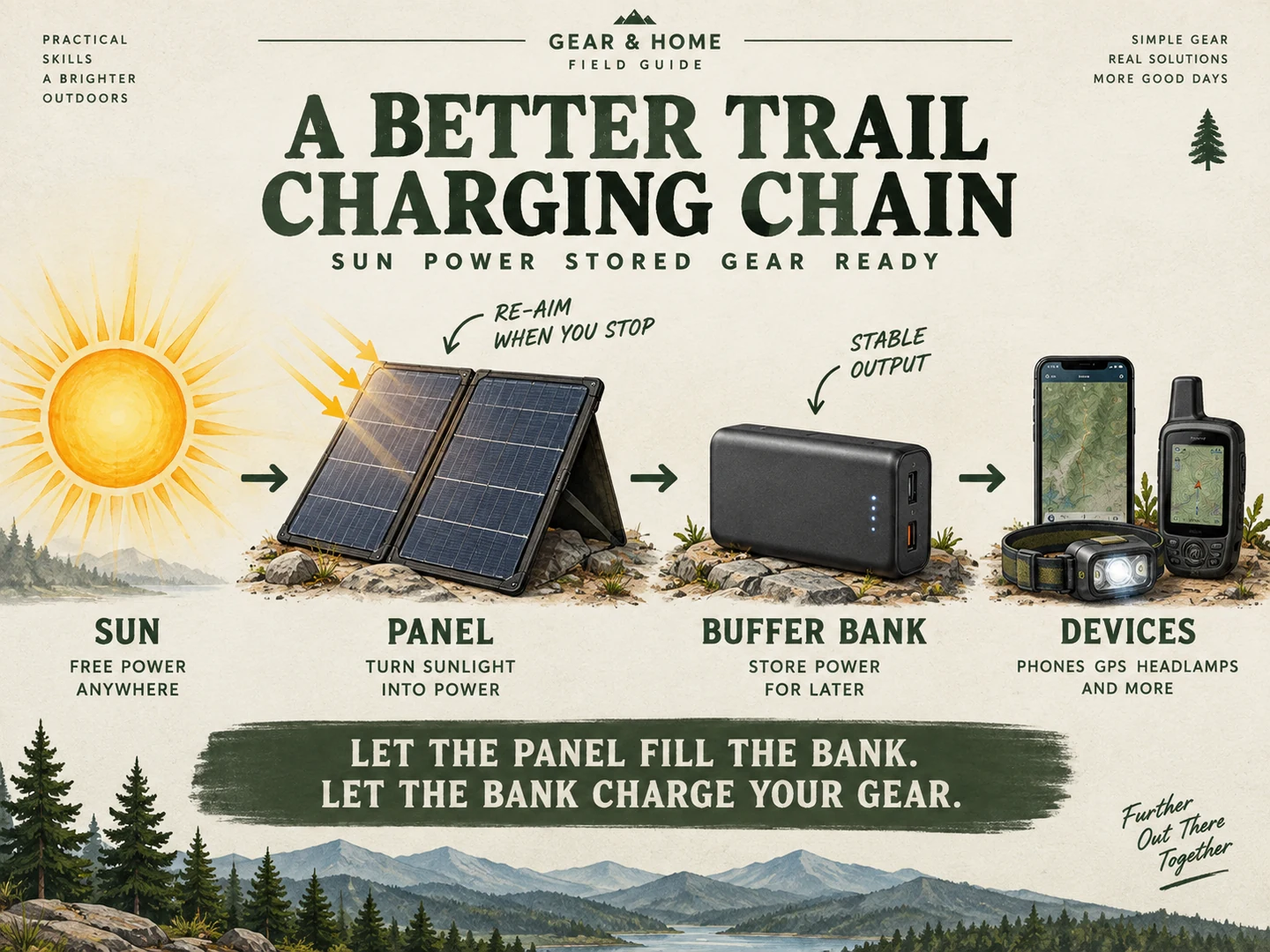
A storage pouch and hanging points make it easy to pair with a buffer bank. That is the setup we prefer for a small panel because a bank can accept variable solar input during the day and then provide stable power to your phone, GPS or headlamp later.
The main reason to choose BLAVOR over FlexSolar is not raw rated wattage. Both are 10W panels. Choose it because the extra connector and storage features matter enough to justify roughly six more ounces.
Pros
- USB-A and USB-C outputs
- Compact two-panel fold
- Storage pocket for cables or a small battery bank
- Good value in the small-panel category
Limitations
- Almost twice the weight of the FlexSolar Mini
- USB-C does not mean USB PD charging
- Ports are exposed to trail dust and weather
- Owner feedback includes connector-fit complaints
BigBlue 14W
A compact 14W option for hikers who want more panel capacity than the 10W class but do not want to jump to a 1.5 lb array.
#3
BigBlue’s 14W panel occupies a useful middle position. The exact Amazon variant here is BB-14 with one USB-A port, a storage pocket and two carabiners. It weighs almost the same as the BLAVOR 10W but adds more rated panel capacity.
That does not mean it will always charge faster. Small solar panels are sensitive to sun angle, partial shading and temperature, and manufacturer wattage is a ceiling rather than a field guarantee. The benefit of 14W is extra headroom when conditions are good, not immunity from clouds.
The single USB-A port is the clearest downside in 2026. If your cable kit is mostly USB-C to USB-C, BLAVOR is easier. If you are comfortable using a short USB-A cable into a power bank, the BigBlue remains a clean, proven setup.
Pros
- 14W rating at under 13 ounces
- Compact folding design
- Pocket works well with a separate buffer bank
- Simple one-port charging setup
Limitations
- USB-A output only on the linked variant
- No kickstand for precise aiming
- Intermittent shade can cut output sharply
- Not meaningfully lighter than BLAVOR 10W
BigBlue 28W with Ammeter
The choice for much higher solar collection when energy needs matter more than ultralight pack weight.
#4
This is where the word “backpacking” needs a qualifier. A 1.48 lb panel is excessive for many solo hikers, especially when a larger battery bank could cover the same short trip for less hassle. The BigBlue 28W earns a place only because there are trips where daily energy demand is high and outlet access is genuinely scarce.
The current ammeter model provides one USB-A and one USB-C port, with up to 5V/2.4A from a single port and 5V/4A total shared output. BigBlue lists 20W total working power for this version. The built-in current display is useful because it gives you immediate feedback while changing panel angle instead of guessing whether your setup is productive.
Think camera batteries, multiple phones, a group power bank, or long basecamp periods. For an ultralight hiker carrying only a phone and satellite messenger, this is usually the wrong direction.
Pros
- Much more panel area than 5W to 14W options
- USB-A and USB-C outputs
- Ammeter helps optimize panel position
- Good match for a larger buffer battery
Limitations
- About 1.5 lb is heavy for backpacking
- USB-C output is not high-voltage laptop PD
- Large unfolded area is awkward while moving
- Overkill for low-energy weekend trips
Goal Zero Nomad 5
A low-output but easy-to-position panel for small USB loads, with a rigid format that makes stationary charging simpler.
#5
The Nomad 5 is not here because 5W is competitive with 10W at the same weight. It is not. It is here because its rigid panel and adjustable kickstand solve one of the most annoying solar problems: getting the panel pointed at the sun when you stop.
Goal Zero lists a single USB output at up to 5W and specifically recommends pairing the panel with a power bank. That makes sense. A headlamp battery, small GPS, or slowly replenished bank is a better workload than trying to recover a large modern phone from near empty during a short lunch break.
At 12.7 ounces, this is a poor choice for hikers who judge solar by watts per ounce. It makes more sense for someone who values simple setup, rugged construction and low-power maintenance charging.
Pros
- Built-in adjustable kickstand
- Simple rigid design
- Well suited to small USB loads
- Current Goal Zero support and exact Amazon listing
Limitations
- Only 5W of rated output
- Heavy for the amount of panel power
- USB-A only
- Slow choice for large modern phones and battery banks
How to Choose a Solar Charger for Backpacking
1. Start with trip length, not wattage
A panel is easiest to justify when you are away from outlets long enough for repeated solar harvest to matter. On a two-night trip, a second battery is usually more reliable. On a ten-day route with long exposed sections, the same panel has many chances to repay its weight.
2. Count usable sun hours
Open desert, alpine terrain and treeless ridges are much friendlier to solar than forest corridors. A panel clipped to a pack also changes angle constantly and can spend much of the day facing away from the sun. If your route is shaded or your hiking direction keeps the panel poorly oriented, plan on less energy than the label suggests.
3. Use a power bank as the buffer
For small backpacking panels, the most robust setup is panel to power bank, then power bank to device. Phones and other electronics can react poorly to rapidly changing current when clouds or shade interrupt direct solar charging. A battery bank stores whatever the panel can collect and gives your electronics a stable source later.
4. Treat USB-C as a connector, not a speed guarantee
Several small panels now include USB-C, but that does not automatically mean USB Power Delivery or high-voltage laptop charging. Check the actual output specification. The BLAVOR 10W and BigBlue 28W models here use USB-C at ordinary 5V output levels.
5. Protect ports and keep batteries shaded
Panels belong in the sun. Lithium battery banks and phones do not benefit from sitting on a hot black panel. Put the panel in direct light while keeping the connected bank in its pocket, under the panel, or otherwise shaded when practical. Also protect exposed USB ports from blowing dust and rain.
Solar Panel or Extra Power Bank?
Choose another power bank for short trips, frequent resupply, mostly shaded routes, or when you value zero setup. Stored energy is predictable and works at night, in rain and under trees.
Choose a 10W to 14W solar panel plus a buffer bank when you have multiple sunny days between outlets and modest electronics such as a phone, satellite messenger, headlamp and watch.
Choose a 20W to 30W panel only when the daily energy load is high enough to justify the weight. If your trip is vehicle-based and your loads are much larger, a backpacking USB panel is the wrong category. See our guide to portable power stations for camping instead.
Cold weather adds another complication because batteries can lose usable performance when chilled. If freezing conditions are part of the route, see our cold-weather power bank guide.
How We Picked
Gear & Home does not claim direct laboratory testing for these products. We built the shortlist by matching the current commercial search intent with current product availability, then comparing exact variant specifications and recurring real-use patterns.
FAQ
Are solar chargers worth it for backpacking?
They are worth it mainly for longer trips with reliable sun and limited access to outlets. For most weekend trips or shaded routes, an extra precharged power bank is lighter, simpler and more predictable.
How many watts do I need for a backpacking solar charger?
For a phone, GPS, headlamp and similar small electronics, 10W to 14W is a practical backpacking range when paired with a power bank. A 20W to 30W panel can collect more energy, but the extra size and weight only make sense when your daily energy demand is high.
Can I charge my phone directly from a backpacking solar panel?
Often yes, but a buffer power bank is usually the more reliable setup. Passing clouds, partial shade and changing panel angle can interrupt current. Let the panel charge a battery bank during the day, then use the bank to charge your phone with stable power.
Is a 10W solar panel enough for backpacking?
It can be enough for modest electronics on sunny, exposed routes if you have several hours to collect energy. It is not a fast substitute for an outlet, and it becomes much less useful when most of the route is shaded or cloudy.
Should I hang a solar panel on my backpack while hiking?
You can, but do not assume moving-panel charging will match a well-aimed stationary setup. Pack direction, shade and panel angle change constantly while walking. Treat on-pack charging as opportunistic and use breaks or camp time to aim the panel more directly at the sun.