

Gear & Home is reader-supported. As an Amazon Associate I earn from qualifying purchases. When you buy through links on our site, we may earn an affiliate commission, at no extra cost to you. Learn more.
Side sleepers put more pressure through the shoulder and hip than back sleepers, so a bargain sleeping pad can look thick enough on paper and still feel miserable after a few hours. For this roundup, we prioritized usable cushion, width and edge stability first, then warmth, packed weight and value.
Every reference variant below was selling below the $100 ceiling when researched on September 11, 2026. Prices and Amazon availability can change, so use the retailer button to confirm the current offer before buying.
Best sleeping pad under $100 for most side sleepers
The Naturehike TuYe R6.5 with reinforced sidewalls is our Best Overall pick. Its 3.9-inch profile, 25.2-inch-wide large size and raised side support address the two problems that matter most for side sleeping: bottoming out at the hip or shoulder and feeling unstable near the edge.
Choose the Hikenture Double Sleeping Pad if side-sleeper space matters more than carried weight, especially for car camping or two-person tents. Choose the Gear Doctors ApolloAir if low carried weight matters more than width, and the Naturehike TuYe R5.8 if you want a lower-cost insulated option with better owner history than the newer R6.5 sidewall model.
Quick Picks
Naturehike TuYe R6.5 Sidewalls
Side sleepers who want maximum cushion, width and edge support without crossing the $100 line
Hikenture Double Sleeping Pad
Side sleepers who want bed-like width and four inches of cushion and do not need a lightweight solo pad
Gear Doctors ApolloAir
Backpackers who need insulation and low weight and can accept a narrower tapered shape
Naturehike TuYe R5.8
Three-season and colder trips where insulation matters but a premium pad is outside budget
Best Sleeping Pads for Side Sleepers Under $100 Compared
| Pick | Thickness | Reference width | Weight | Warmth signal | Best for | Amazon |
|---|---|---|---|---|---|---|
| Naturehike TuYe R6.5 Sidewalls Best Overall |
3.9 in | 25.2 in Large | 1.26 lb Large | Manufacturer R6.5 | Pressure relief plus edge stability | Check availability on Amazon |
| Hikenture Double Sleeping Pad Best for Car Camping |
4 in | 55 in Full XL | 3.6 lb | No published R-value | Maximum room and cushion | Check availability on Amazon |
| Gear Doctors ApolloAir Best Lightweight Insulated Value |
3.2 in | 22 in widest | 17.53 oz Normal | Manufacturer R5.2, not public ASTM | Lightweight insulated backpacking | Check availability on Amazon |
| Naturehike TuYe R5.8 Best Budget Insulated |
3.2 in | 22.8 in Mummy | 1.15 lb Mummy | Manufacturer R5.8 | Lower-cost insulated backpacking | Check availability on Amazon |
Naturehike TuYe R6.5 Sidewalls
3.9 in
25.2 in Large
1.26 lb Large
Manufacturer R6.5
Hikenture Double Sleeping Pad
4 in
55 in Full XL
3.6 lb
No published R-value
Gear Doctors ApolloAir
3.2 in
22 in widest
17.53 oz
Manufacturer R5.2
Naturehike TuYe R5.8
3.2 in
22.8 in Mummy
1.15 lb Mummy
Manufacturer R5.8
Dimensions and weights refer to the reference variant named in the table. Do not assume a different size has the same weight or width. Also remember that R-value describes resistance to heat loss, not cushioning or softness. Our sleeping pad R-value guide explains how to use it when planning for colder nights.
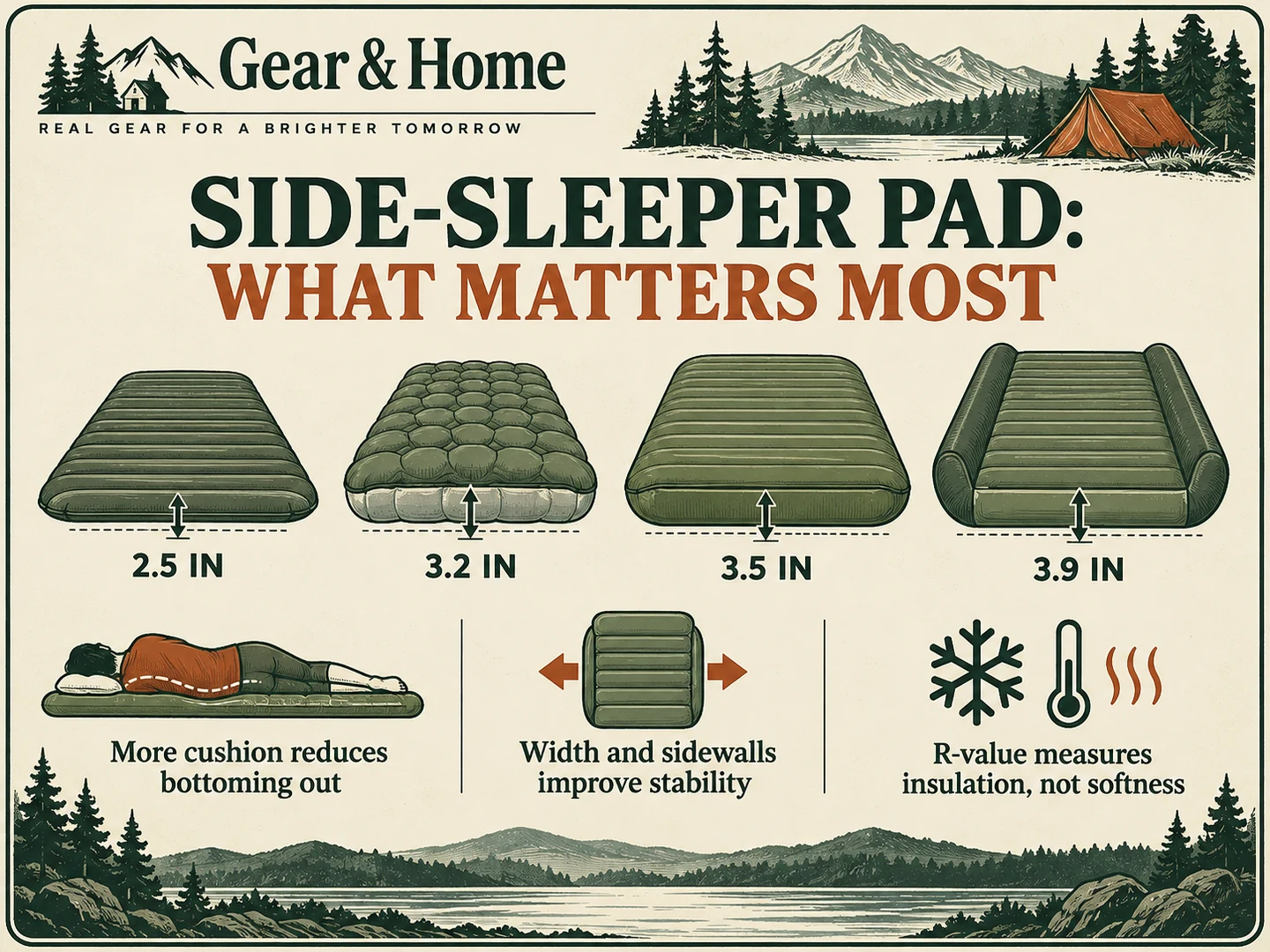
A 3.5-inch pad can still feel unstable if the edges collapse, and a narrow mummy shape can force your hip toward the edge. Start with enough vertical cushion to keep your hip and shoulder off the ground, then look at usable width, sidewalls or rails, and how the baffles distribute pressure.
The 4 Best Sleeping Pads Under $100 for Side Sleepers
Naturehike TuYe R6.5 Ultralight Pad with Reinforced Sidewalls
The strongest side-sleeper geometry in this budget group: nearly four inches of cushion, a wide large size and raised edges that make the usable sleeping surface feel more secure.
#1
This is the pad that best matches the actual biomechanics of side sleeping at this price. The large version gives you 25.2 inches of width, the air chamber is 3.9 inches deep, and the raised edge structure reduces the feeling that your shoulder or hip is sliding toward a soft edge. Those features matter more for side comfort than shaving a few ounces.
Naturehike also builds a multi-layer reflective insulation system into this model and publishes an R-value of 6.5. We treat that as a manufacturer warmth claim, not a guarantee of comfort at a specific temperature. Ground temperature, sleeping bag or quilt, clothing and individual cold tolerance still matter.
The bigger caveat is evidence maturity. This model is relatively new, and the current Amazon listing has a smaller long-term history than older budget pad families. If you prioritize a deeper review history over maximum cushion, the R5.8 or ApolloAir is the more conservative choice.
Pros
- 3.9-inch cushion gives hips and shoulders generous clearance
- Reinforced sidewalls improve edge stability
- Large size is 25.2 inches wide
- Low weight for the published insulation and thickness
Limitations
- Newer model with less long-term owner history
- Published R-value should be treated as a manufacturer claim
- 20D fabric rewards careful campsite selection
- Amazon offer status can vary by variant
Hikenture Double Sleeping Pad
A 4-inch-thick, 55-inch-wide option for side sleepers who care more about sprawling room and pressure relief than backpacking weight.
#2
For side sleepers, extra width can solve a problem that single backpacking pads cannot. The Hikenture gives one sleeper enormous room to change sides, bend knees or move diagonally without balancing near an edge. At four inches thick, it also provides more vertical cushion than the typical budget solo pad.
The Full XL Pumpsack version is 79 by 55 inches and weighs about 3.6 pounds. That is reasonable for a two-person tent or trunk, but not an ultralight choice despite the marketing language around the product. Treat it as a compact air mattress for camping, not as a pad you would happily carry for high-mileage backpacking.
There is also no published R-value for this exact model. For summer and mild-weather car camping, that may be fine. For cold ground, choose an insulated pad with a clearer warmth specification instead of assuming four inches of air automatically equals four-season insulation.
Pros
- 4-inch cushion gives side sleepers generous pressure relief
- 55-inch Full XL width offers exceptional room for one sleeper or space for two
- Large owner base on the exact Amazon variant
- Pump sack version avoids mouth inflation
Limitations
- 3.6 pounds is heavy for solo backpacking
- Double width may not fit narrow backpacking tents
- No published R-value for trip planning
- Air-only construction still needs protection from sharp ground
Gear Doctors ApolloAir
A compact insulated option for backpackers who want more than three inches of cushion without carrying a wide, heavy camp mattress.
#3
The ApolloAir is the best fit here if you are carrying the pad on your back. The Normal version weighs 17.53 ounces, packs to roughly bottle size and still provides 3.2 inches of air cushion. That is a useful amount of clearance for many side sleepers without moving into bulky self-inflating mattress territory.
Gear Doctors publishes an R-value of 5.2 based on its internal evaluation and explicitly notes that a public ASTM F3340 or independent lab report is not attached. That disclosure is important. We would use the number as a relative insulation signal, not as a reason to plan an aggressive winter temperature limit.
The shape is the deciding factor. The Normal is about 22 inches at its widest and narrows lower down, so broad-shouldered side sleepers or people who sprawl may prefer the Naturehike R6.5 or the much wider Hikenture. For a smaller side sleeper or a backpacker who prioritizes carried weight, the ApolloAir has a strong balance of cushion, warmth and packability.
Pros
- 17.53-ounce Normal size is easy to justify for backpacking
- 3.2 inches of cushion is side-sleeper friendly for its weight class
- Pump sack included
- Long-running owner base compared with newer budget pads
Limitations
- Normal size is narrower than the two comfort-first picks
- Published R5.2 is not backed by a public ASTM report
- Large size is not clearly below the article ceiling
- Tapered shape is less forgiving for restless sleepers
Naturehike TuYe R5.8
A more established Naturehike option that combines 3.2 inches of cushion with meaningful insulation at a lower price tier than most premium backpacking pads.
#4
The R5.8 makes sense when you want insulation and reasonable side-sleeper cushion but do not need the reinforced edges or nearly four-inch depth of our top pick. Naturehike lists the pad at 8 cm thick, and the Silver-Mummy Amazon listing corresponds to the slimmer mummy-format family rather than the widest square version.
There is better community history here than with the R6.5 sidewall model. Multiple owners have reported using the R5.8 in cold conditions without feeling ground chill, and Naturehike’s own current review section includes a side sleeper calling it comfortable. At the same time, owner reports also provide useful reasons not to oversell it: one long-distance user reported baffle failure after about 15 nights, and older community measurements found some examples shorter than the advertised length.
That mixed pattern is exactly why this is our value pick rather than Best Overall. It offers a lot of insulation and cushion for the money, but the top R6.5 sidewall model has a better shape for pressure relief and stability.
Pros
- 3.2-inch cushion works for many side sleepers
- Strong warmth-to-cost proposition
- Small packed size for an insulated pad
- More owner history than the new R6.5 sidewall version
Limitations
- Mummy version is not especially wide
- Some owners report noise
- Some field measurements have come in below listed dimensions
- Isolated baffle failures appear in long-term feedback
How to Choose a Sleeping Pad for Side Sleeping Under $100
1. Start around 3 inches of usable cushion
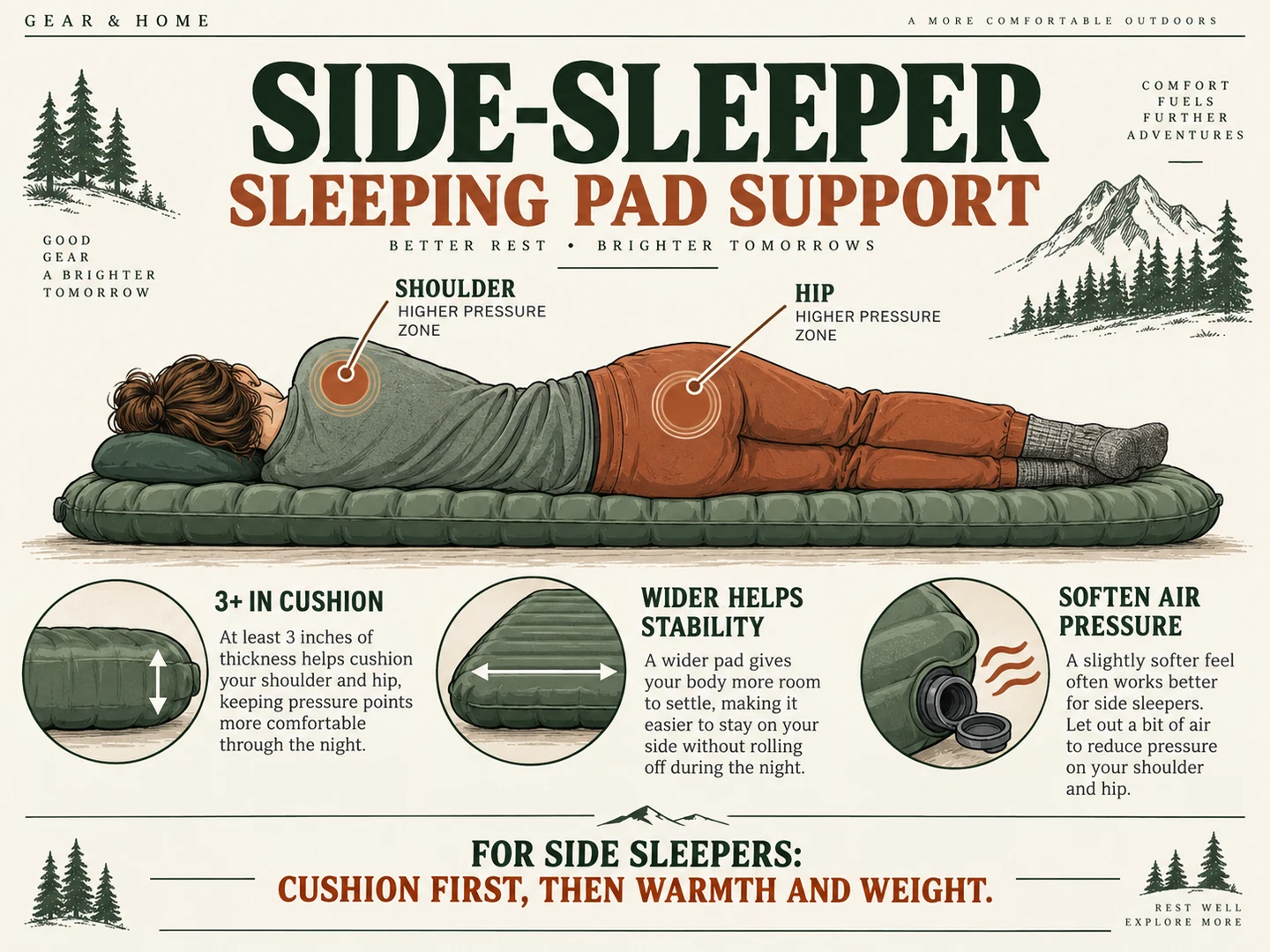
Side sleepers concentrate body weight at the shoulder and hip. A pad around 3 inches thick gives more margin before those points compress the chamber enough to touch the ground. This is why we did not put thin closed-cell foam pads at the top of this roundup even though they are inexpensive and durable.
2. Width and edge support matter almost as much as thickness
A narrow pad can force a side sleeper to balance close to an edge. Look for a 23-inch-plus width if you move at night, or a design with raised side rails or reinforced sidewalls. If you are comparing a 20-inch premium pad against a 25-inch budget pad, the wider option can feel more secure even if both have similar center thickness.
3. Do not use R-value as a comfort score
R-value measures resistance to heat transfer. It does not tell you whether a pad feels soft, stable or deep enough under your hip. Choose cushion and width for pressure relief, then choose enough insulation for the conditions. If you are building the whole setup, our backpacking sleep system guide shows how the pad, sleeping bag or quilt and clothing work together.
4. Slightly softer inflation often works better on your side
An air pad at maximum pressure can feel hard and can push more pressure back into the shoulder. Inflate the pad fully for setup, lie down in your normal sleeping position, then release small amounts of air until the hip and shoulder feel supported without reaching the ground.
5. Know when the $100 ceiling is costing you comfort
If you are a heavier side sleeper, very broad across the shoulders, or especially sensitive to pressure points, premium 3.5-inch-plus pads may be worth the jump. Our NeoAir XLite NXT vs NEMO Tensor comparison covers two more expensive backpacking options and explains why extra thickness can matter.
How We Chose These Pads
We started with current US search results for side-sleeper and budget sleeping-pad queries, then built a candidate list from models that were actually positioned at or below the $100 ceiling. We excluded products that were too thin for a side-sleeper-first recommendation, had unclear model identity, lacked a verifiable Amazon.com listing or were clearly outside the budget in the reference variant.
For each finalist we checked manufacturer specifications, the exact Amazon US listing and ASIN, recurring owner feedback, relevant Reddit discussions and independent review signals where available. We weighted side-sleeper fit most heavily: usable thickness, width, edge behavior and pressure distribution. Warmth, weight, packed size, evidence quality and durability trade-offs came next.
We did not assign numerical scores because the evidence sources do not use one standardized test protocol. The awards are Gear & Home editorial selections based on the combined evidence and intended use case.
FAQ
How thick should a sleeping pad be for a side sleeper?
About 3 inches is a useful starting point for many side sleepers, with 3.5 to 4 inches giving more margin against bottoming out. Thickness is not enough by itself, though. Width, baffle shape, air pressure and edge stability also affect how much support reaches the shoulder and hip.
Is a foam sleeping pad good for side sleepers?
Closed-cell foam pads are durable, inexpensive and reliable, but most are much thinner than inflatable pads. Some side sleepers can use them comfortably, especially with soft ground or a second pad, but people who feel pressure at the hip or shoulder usually get better cushioning from a thicker inflatable.
What R-value should a side sleeper choose?
Choose R-value for ground temperature, not for sleeping position. Side sleepers do not automatically need a higher R-value than back sleepers, but they often need more cushion. For warm weather, lower R-values can be sufficient; colder ground requires more insulation regardless of how you sleep.
Should a side sleeper buy a wide sleeping pad?
A wide pad is often worth it if you switch sides, bend your knees or dislike balancing near the edge. Around 25 inches of width can feel much more stable than a 20-inch pad. Raised side rails can also improve usable width without making the whole pad extremely broad.
Are budget sleeping pads reliable enough for backpacking?
Some are, but the trade-offs are usually clearer than with premium models. Budget pads may use thinner fabrics, have less mature quality-control history or publish insulation claims with less test documentation. Carry the repair kit, clear sharp debris under the tent and choose a model with owner history that matches your trip length and conditions.