
Gear & Home is reader-supported. As an Amazon Associate I earn from qualifying purchases. When you buy through links on our site, we may earn an affiliate commission, at no extra cost to you. Learn more.
Stomach sleepers usually need less pillow height than side sleepers, and that matters even more on a backpacking pad. The best trail pillow for this position is not the tallest or firmest option. It is the one you can keep low, soft and stable without carrying unnecessary bulk.
The best backpacking pillow for most stomach sleepers
The NEMO Fillo Elite is our Best Overall pick. Its 3-inch profile is lower than many common air pillows, the air pressure is easy to fine-tune, and a thin insulated cover softens the direct air-bladder feel. At 3 ounces, it also stays firmly in backpacking territory.
If you dislike inflatable pillows completely, the Therm-a-Rest Compressible Pillow Cinch Small is the softer foam alternative, but it costs you several ounces and more pack volume. The Sea to Summit Aeros Premium Regular is the polished adjustable-air choice, while the Trekology ALUFT 2.0 is the value pick with a useful pad strap.
If your head feels pushed backward even with a lightly inflated pillow, try sleeping flat or use only a folded shirt under your cheek. A dedicated pillow is useful only when it improves comfort without forcing your neck upward. The right answer can also change with pad softness, shoulder width and whether you rotate partly onto your side.
Quick Picks
Therm-a-Rest Compressible Pillow Cinch Small
Soft foam feel for hikers who dislike air pillows · 8 oz
Sea to Summit Aeros Premium
Refined valve, softer top and easy pressure tuning · 3.5 oz
Best Backpacking Pillows for Stomach Sleepers Compared
| Pick | Weight | Size / height | Construction | Why it fits stomach sleepers | Where to check |
|---|---|---|---|---|---|
| NEMO Fillo Elite Best Overall |
3 oz | 15 × 11 × 3 in | Air core + synthetic insulation | Low maximum profile and micro-adjustable pressure | Check availability on Amazon |
| Therm-a-Rest Compressible Pillow Cinch Small Best Non-Inflatable |
8 oz | 15 × 11 × 5 in nominal | Compressible upcycled foam | Soft, yielding fill instead of a springy air chamber | Check availability on Amazon |
| Sea to Summit Aeros Premium Best Adjustable Inflatable |
3.5 oz | 13 × 9 × 4 in | Air core + 5 mm memory-foam layer | Easy fine adjustment and a cushioned top when lightly inflated | Check availability on Amazon |
| Trekology ALUFT 2.0 Best Budget |
3.9 oz | 16 × 12 × 4 in | Inflatable TPU pillow | Air can be released for lower loft and the strap limits sliding | Check availability on Amazon |
NEMO Fillo Elite
3 oz
3 in
Air + insulation
Low profile
Therm-a-Rest Compressible Pillow Cinch Small
8 oz
5 in
Compressible foam
Soft and yielding
Sea to Summit Aeros Premium
3.5 oz
4 in
Air + foam top
Fine pressure control
Trekology ALUFT 2.0
3.9 oz
4 in
Inflatable
Pad strap
Published weights and dimensions are for the reference variants shown. A pillow’s full inflated height is not the height a stomach sleeper should necessarily use. With air pillows, pressure is part of the fit.
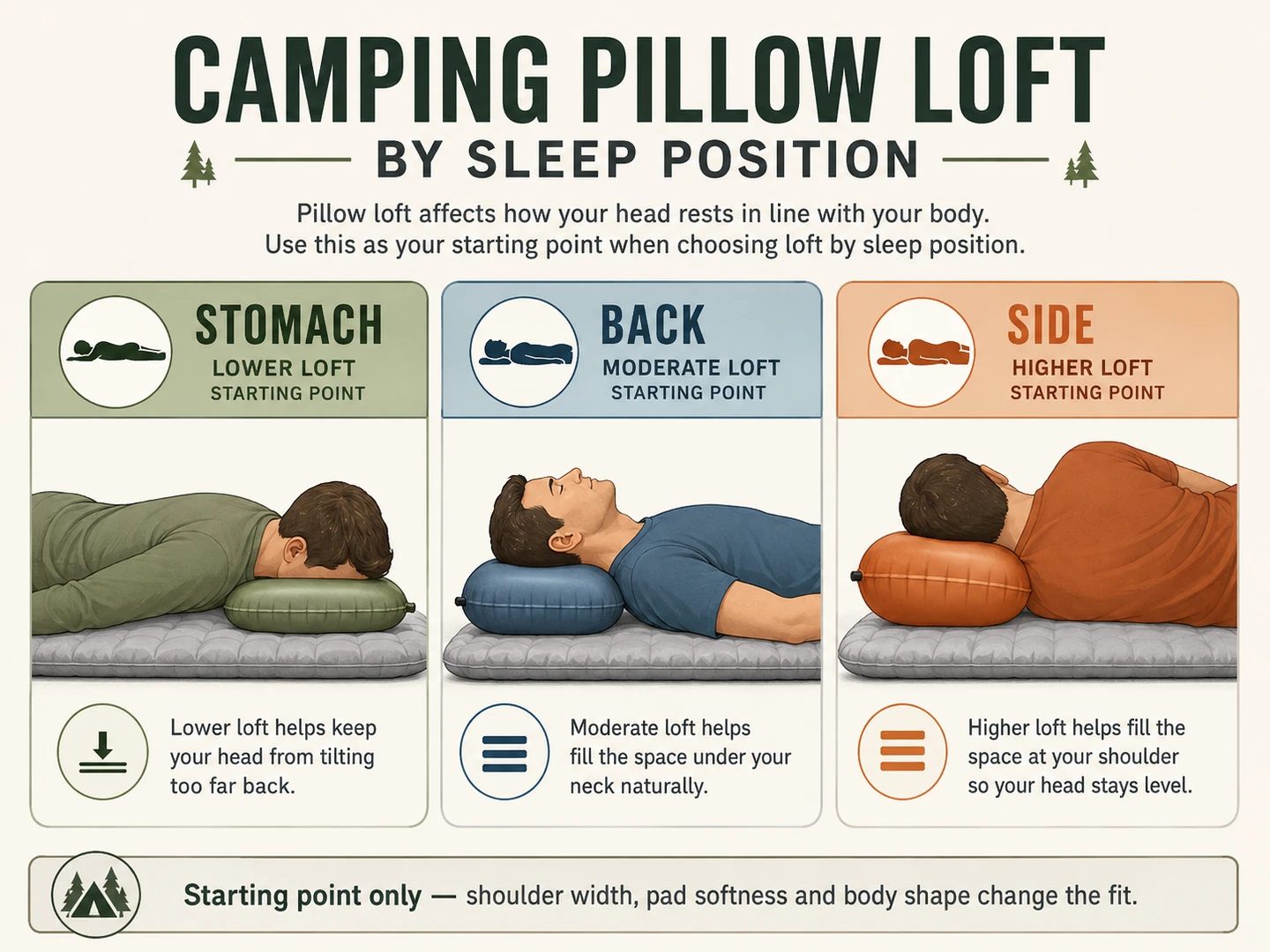
How Low Should a Backpacking Pillow Be for a Stomach Sleeper?
There is no single ideal inch measurement because your sleeping pad compresses under your torso and your body shape changes the head-to-pad gap. The useful rule is simpler: start with the least loft that still feels comfortable. Home-sleep guidance for stomach sleepers consistently favors a low profile because too much pillow height can push the head backward relative to the torso. Outdoor guidance adds one practical advantage: an inflatable lets you tune that height with air pressure.
For many hikers, a 3-inch pillow like the Fillo Elite is easier to keep low than a 5-inch design. A 4-inch air pillow can still work well if the valve lets you release enough air without turning the pillow into an unstable lump. A soft foam pillow behaves differently because its listed loft compresses under your head rather than acting like a fixed block.
If you also sleep on your side for part of the night, do not chase an ultra-flat setup blindly. Mixed-position sleepers often need enough remaining volume to support the head during side-sleeping stretches. That is where adjustable air pillows have an advantage over a fixed low-profile slab.
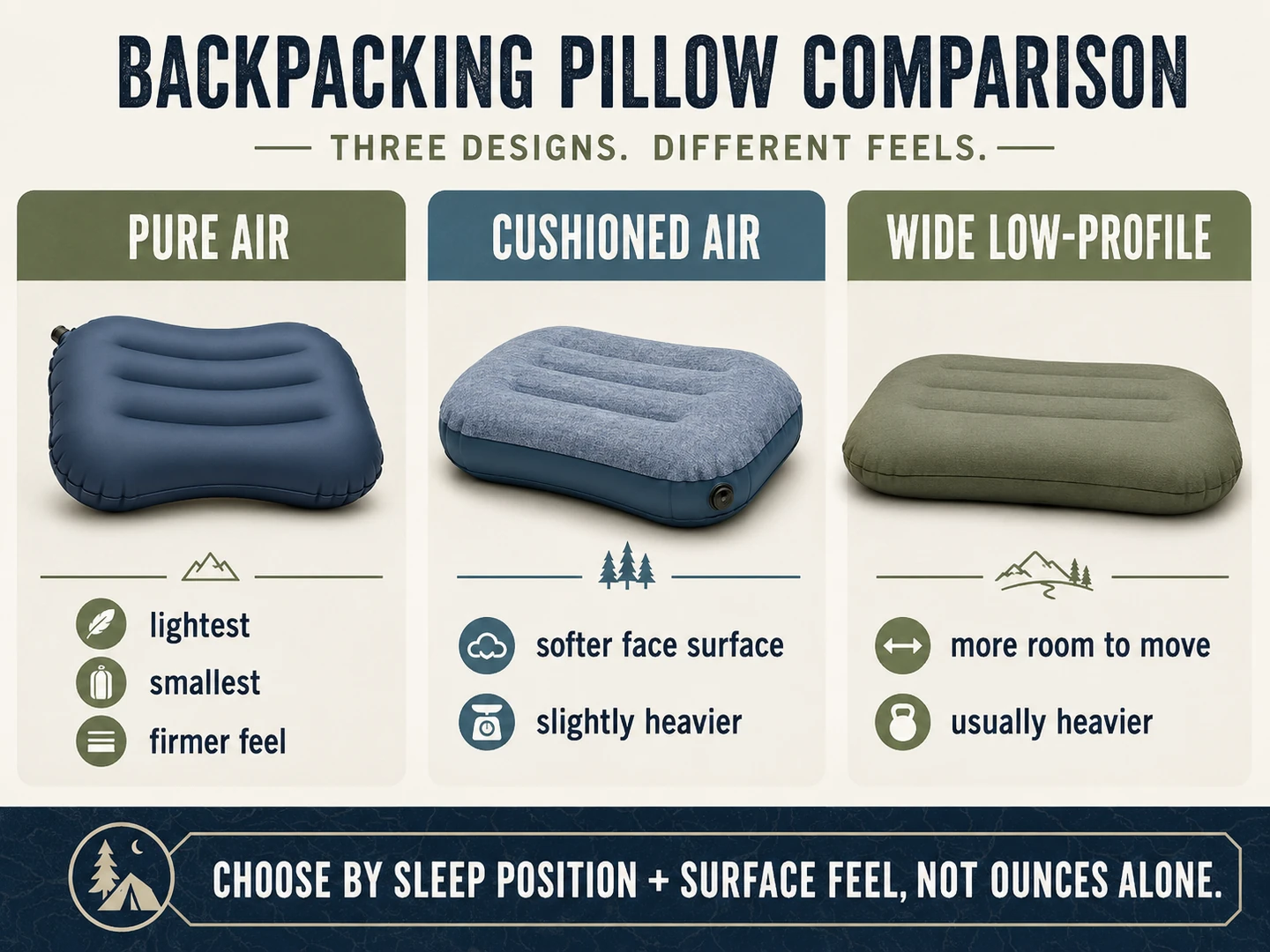
The 4 Best Backpacking Pillows for Stomach Sleepers
NEMO Fillo Elite
The strongest all-around fit for stomach sleepers because it combines a genuinely low 3-inch profile, adjustable air pressure and a soft insulated face at only 3 ounces.
#1
Most backpacking pillows are marketed by maximum loft. The Fillo Elite stands out by going the other direction. Its full height is only 3 inches, so you are starting closer to the low-loft zone before you release any air. NEMO also uses a baffled air cell rather than a simple balloon shape, and the synthetic insulation plus jersey-style cover keeps your face from resting directly on slick TPU.
The practical advantage is not just the number on the spec sheet. A stomach sleeper can begin slightly underinflated, then add only enough air to keep the head from dropping uncomfortably. The pillow remains light enough for a long-distance kit, yet it feels less stark than a bare inflatable.
Owner feedback also gives this pick a useful reality check. Side sleepers with broader shoulders are the group most likely to call it too thin. If you regularly roll fully onto your side, you may prefer a taller pillow with more adjustment range. If you stay mostly face-down or partly face-down, the Elite’s low ceiling is a feature rather than a flaw.
Pros
- Only 3 inches high at full inflation
- 3-ounce backpacking weight
- Soft fabric and insulation reduce bare-air feel
- Micro-adjustable valve makes small pressure changes easy
Limitations
- Can be too low for dedicated side sleepers
- Still an air-core pillow if you dislike inflatable feel entirely
- No broad 16-inch-plus sleeping surface
- Premium price relative to basic inflatables
Therm-a-Rest Compressible Pillow Cinch Small
The comfort-first choice for stomach sleepers who would rather carry more weight than sleep on an air chamber.
#2
A nominal 5-inch pillow sounds wrong for stomach sleeping until you consider the construction. This is not a rigid 5-inch foam block. The chopped foam yields under your head, and you can leave the pillow loose rather than cinching it into a firmer, taller shape. For a hiker who cannot relax on an air bladder, that softer compression can be more important than the published maximum loft.
The Small is also the only size in the family that makes sense for backpacking here. At 8 ounces it is already much heavier than the three inflatable picks, and it takes more room in a pack. The trade is a quieter surface with none of the springy pressure response that some stomach sleepers dislike when their cheek is directly on an inflatable.
There is one current-product caveat worth knowing. Recent owner feedback is not uniformly positive: some buyers like the softer fill and shape, while others say newer units have less foam than older versions or dislike the center hardware. That is why this is a scenario pick, not our default winner.
Pros
- Soft foam feel instead of an air bladder
- Quiet and pliable under the head
- Cinch cord changes firmness and shape
- Machine-washable construction
Limitations
- 8 oz is heavy for a backpacking pillow
- Much bulkier than inflatables
- Nominal loft is high, so stomach sleepers should keep it soft
- Recent owner feedback includes fill-consistency complaints
Trekology ALUFT 2.0
A sensible low-cost experiment for stomach sleepers because the pressure is adjustable, the surface is broad and the strap keeps the pillow attached to the pad.
#4
The ALUFT 2.0 is the least expensive way in this shortlist to learn whether an adjustable camp pillow improves your sleep. For a stomach sleeper, the most useful feature is not the contour or the full 4-inch loft. It is the ability to bleed off air until the pillow is barely supporting your head.
The 16-inch width is also forgiving if you turn your face from side to side. A lightly filled narrow pillow can move or fold under you; Trekology’s broader surface, rubberized dots and detachable strap reduce that problem. Those retention features matter more when the pillow is not pumped firm.
Surface feel is the compromise. It is a straightforward inflatable without the cushioned top of the Fillo Elite or Aeros Premium, so sleepers who are sensitive to pressure and air-pillow noise may still prefer the Therm-a-Rest despite the weight penalty.
Pros
- Low entry cost
- Large 16 × 12-inch sleeping surface
- Detachable pad strap and anti-slip base
- Easy to soften by releasing air
Limitations
- Plain inflatable feel is firmer than cushioned hybrids
- 4-inch full loft is too much for many stomach sleepers
- Less refined face fabric than premium picks
- Not as low at maximum inflation as the Fillo Elite
How to Choose a Backpacking Pillow for Stomach Sleeping
1. Treat maximum loft as a ceiling, not a target
A 4-inch inflatable is not automatically too tall if it remains stable at half pressure. The useful spec is the combination of maximum height and how precisely the valve lets you reduce it. For stomach sleepers, a lower full height simply gives you a wider margin for error.
2. Decide whether you tolerate an air core
Air pillows win on weight and packed volume. Foam wins on softness, quietness and a more familiar response under your cheek. Hybrid designs such as the Fillo Elite and Aeros Premium sit between those extremes. If every inflatable you have tried feels springy or hollow, stop optimizing ounces and choose a compressible pillow instead.
3. Pay attention to the sleeping pad
A soft, thick pad lets your chest and shoulders sink more than a firm pad. That can change how much pillow height feels neutral. If your entire sleep system is still in flux, read our complete backpacking sleep system guide before buying a pillow in isolation.
4. Stability matters more when you underinflate
A fully inflated pillow is rigid enough to hold its shape. A softer one can migrate, fold or roll away. Pad straps, friction patches, sleeping-bag hoods and broader footprints become more valuable when you intentionally run low air pressure.
5. Do not buy a stomach-sleeper pillow as if it were a side-sleeper pillow
Side sleepers generally need more height to fill the shoulder gap. Stomach sleepers usually need the opposite. If you spend half the night on each side, choose adjustability and enough total volume for both positions rather than an extreme low-profile design.
Inflatable vs Compressible: Which Is Better for Stomach Sleepers?
Inflatable is better when pack weight and volume come first. It also gives you the easiest way to tune loft in small increments. The drawback is surface pressure: some people never like resting their face on an air chamber, even when it is partly deflated.
Compressible foam is better when softness matters more than ounces. The listed pillow height is less literal because the fill collapses under your head. The downside is obvious in a backpack: the Therm-a-Rest Small is around 8 ounces and packs far larger than a 3-ounce inflatable.
If you are shopping the wider category rather than this sleep-position-specific shortlist, see our best inflatable camping pillows for backpacking. That guide intentionally compares only air-core designs and puts more weight on general backpacking fit than on stomach-sleeper geometry.
Three Setup Changes to Try Before Buying Another Pillow
- Release more air. Many backpacking pillows become substantially more comfortable for stomach sleeping before they look fully inflated.
- Move the pillow partly under your upper chest. For some sleepers this reduces the sharp bend created when only the head is elevated. Stop if the position feels strained or restrictive.
- Test the pad first. If a hard or overly narrow pad is forcing your shoulders into an awkward position, a different pillow may not solve the real problem. Our NeoAir XLite NXT vs NEMO Tensor comparison shows how backpacking pads differ in thickness, feel and sleep-position fit.
How We Chose These Picks
This is an aggregated recommendation guide, not a Gear & Home field test. We started with the stomach-sleeper decision problem, then compared current specifications and current product availability against recurring feedback from owners, outdoor communities, retailers and specialist reviewers.
The selection criteria were: usable low loft, pressure or firmness adjustability, face-surface comfort, stability on a backpacking pad, carried weight and packed bulk. We gave more weight to repeated patterns than to isolated praise or complaints. Exact Amazon.com US ASINs are mapped in the package for the reference variants used by the article; the Content Manager review screen should still be used to approve each listing before publication.
We also kept this page distinct from our general inflatable-pillow roundup. Two picks overlap because they remain strong adjustable backpacking options, but this page adds a lower-profile NEMO hybrid and a non-inflatable Therm-a-Rest, and it judges every option through the stomach-sleeper requirement rather than through the general inflatable category.
Frequently Asked Questions
Do stomach sleepers need a pillow when backpacking?
Not always. Some stomach sleepers are most comfortable with no pillow or only a folded shirt because extra loft can push the head backward. A backpacking pillow is useful when a small amount of support improves comfort without forcing your neck upward.
How much loft should a stomach sleeper use in a camping pillow?
Start lower than you would for side sleeping and use only enough height to feel supported. There is no universal inch target because pad softness, body shape and shoulder width change the geometry. With an inflatable, begin underinflated and add air gradually.
Is an inflatable pillow good for stomach sleeping?
It can be, especially if the valve lets you reduce pressure in small steps. Low-profile air pillows are lightweight and easy to tune, but some stomach sleepers dislike their springy feel against the face. A cushioned hybrid or compressible foam pillow is the alternative.
Should I fully inflate a backpacking pillow if I sleep on my stomach?
Usually not by default. Full inflation often makes an air pillow taller and firmer than a stomach sleeper needs. Start soft, lie in your normal position and add only enough air to keep your head comfortable and stable.
What is the best backpacking pillow here for a stomach and side sleeper?
The Sea to Summit Aeros Premium is the best crossover choice in this shortlist because its 4-inch air chamber provides more adjustment range than the 3-inch Fillo Elite. Run it softer for stomach sleeping and add pressure when you need more support on your side.
What if I hate inflatable camping pillows?
Choose a compressible design such as the Therm-a-Rest Compressible Pillow Cinch Small, or use clothing inside a soft stuff sack. You will give up some packability and weight efficiency, but the surface will feel more like a conventional pillow.