
Gear & Home is reader-supported. As an Amazon Associate I earn from qualifying purchases. When you buy through links on our site, we may earn an affiliate commission, at no extra cost to you. Learn more.
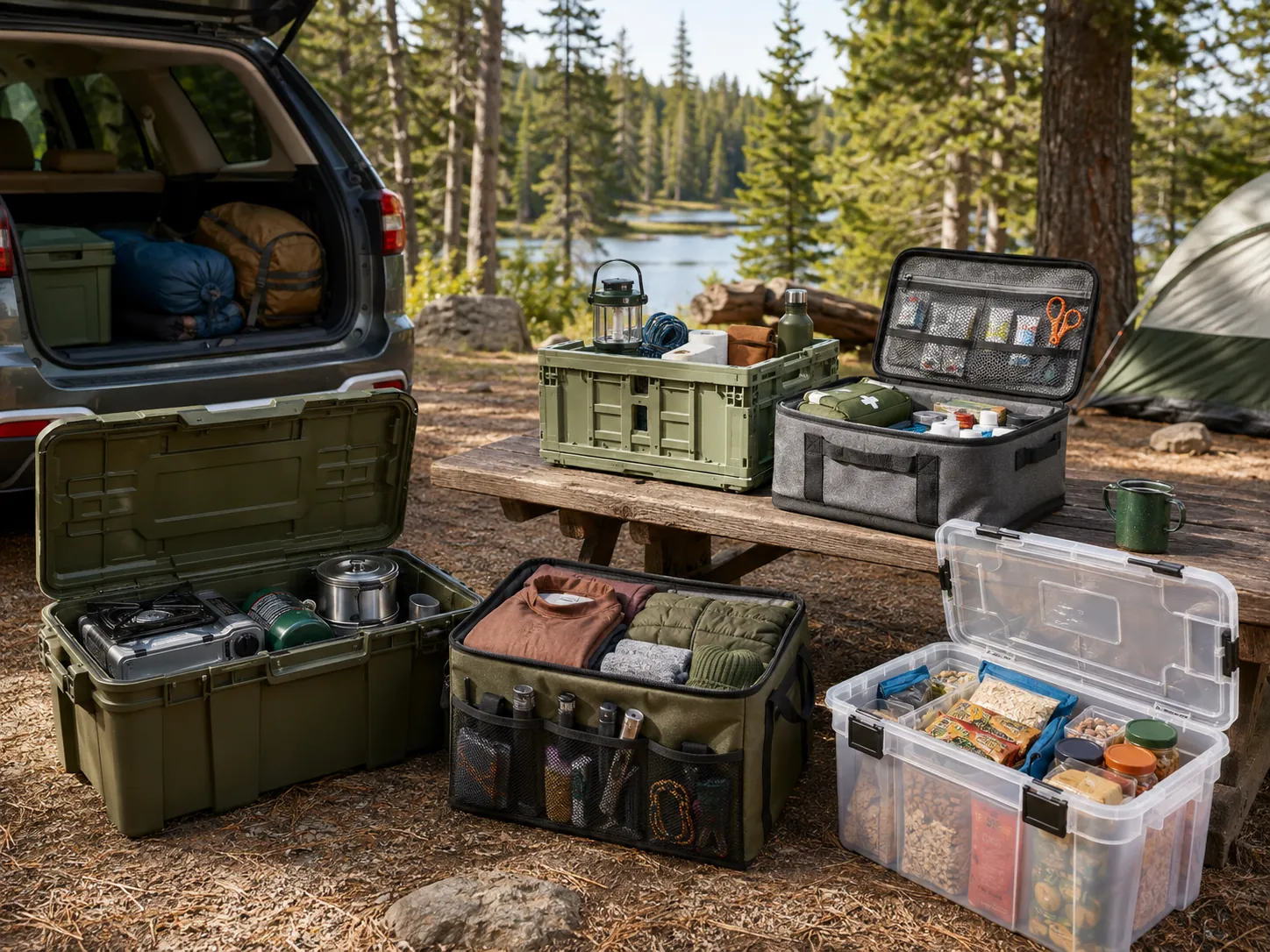
The best camping storage box is not simply the biggest tote that fits in your vehicle. A good box should protect the gear that actually needs protection, stack or collapse efficiently, and still be movable once it is loaded with cookware, tools, lights, and camp supplies.
This 2026 roundup focuses on car camping, basecamp, van, and overlanding storage. We compared sealed hard cases, a collapsible gear box, a large wheeled trunk, a modular overland box, and an affordable gasket-sealed clear tote. We did not mix in small food containers, coolers, or bear canisters because those solve different problems.
YETI LoadOut GoBox 30 is the best camping storage box for most buyers who need serious protection
YETI LoadOut GoBox 30 is our Best Overall pick because the current version combines a manageable 30-liter size with IP65/IP67 dust and water protection, integrated organization, stackability, tie-down points, and a one-handed carry handle. It is expensive and heavy for its capacity, but it protects mixed camp gear better than ordinary totes and is easier to organize than a bare dry box.
If packed size matters more than impact protection, choose the RUX 70L. For bulky family gear, the Plano Sportsman’s Trunk Large gives you 108 quarts plus wheels at a much lower price tier. The Front Runner Wolf Pack Pro is the better modular overland box, while the IRIS USA WeatherPro 62 Qt is the budget choice when you want a gasket seal and clear walls without premium-case construction.
Quick Picks
YETI LoadOut GoBox 30
Best when rain, dust, rough transport, and internal organization matter enough to justify a premium hard case.
RUX 70L
A 70-liter box-shaped soft container that compresses to about 3 inches tall when empty and offers several carry styles.
Plano Sportsman’s Trunk Large
108 quarts, wheels, tie-down points, and stackable geometry for bulky family or group gear—without dry-box pricing.
Front Runner Wolf Pack Pro
Vertical walls and a nesting lid make multiple boxes efficient in an SUV, truck bed, drawer system, or roof-rack setup.
IRIS USA WeatherPro 62 Qt
A clear gasket-sealed tote that makes gear easy to identify and keeps normal camp dust and moisture out for much less money.
Best Camping Storage Boxes Compared
| Pick | Capacity | Protection | Storage behavior | Best for | Amazon |
|---|---|---|---|---|---|
| YETI LoadOut GoBox 30 Best Overall |
30L | IP65 + IP67 | Rigid, stackable; caddy/divider/Pack Attic | Protected kitchen, electronics, first-aid and mixed gear | Check availability on Amazon |
| RUX 70L Best Collapsible |
70L | Waterproof TPU fabric + RF-welded seams; weatherproof system | Box-shaped in use; collapses to ~3 in | Apartment-to-car hauling, sports gear, flexible cargo | Check availability on Amazon |
| Plano Sportsman’s Trunk Large Best Large-Capacity Value |
108 qt | Water-resistant plastic; not a gasketed submersible case | Rigid, stackable, integrated wheels | Bulky family gear, bedding, camp kitchen and general supplies | Check availability on Amazon |
| Front Runner Wolf Pack Pro Best Modular Overlanding |
30.3L published dealer spec | Water- and dust-resistant sealed-lid design | Rigid, vertical-sided, nesting stack | Multiple labeled boxes in vehicle / rack systems | Check availability on Amazon |
| IRIS USA WeatherPro 62 Qt Best Budget Weather-Sealed |
62 qt | Foam gasket / WeatherPro seal; no submersion rating | Rigid, clear, stackable | Protected visible storage inside SUVs, tents and covered camps | Check availability on Amazon |
YETI LoadOut GoBox 30
30L
12.1 lb
IP65 / IP67
Hard case
RUX 70L
70L
~3 in
50 lb
Flexible box
Plano Sportsman’s Trunk Large
108 qt
37.25 × 18 × 14 in
Wheels
Hard trunk
Front Runner Wolf Pack Pro
30.3L
20.1 × 15.7 × 9.1 in
8.1 lb
Stackable
IRIS USA WeatherPro 62 Qt
62 qt
45 lb max
Foam gasket
Clear
The 5 Best Camping Storage Boxes
1. YETI LoadOut GoBox 30 — Wetlands
The premium all-around box for camp gear that really needs protection from dust, water, and rough handling—and for owners willing to carry extra weight to get it.
The GoBox 30 earns Best Overall because it protects camp gear without turning into an enormous expedition case. The 30-liter size works well for a self-contained kitchen module, first-aid and electronics box, camera and power accessories, or a “grab this one first” camp-setup box. The included upper organization also prevents small items from disappearing under bulky gear.
Its protection level is the main reason to pay more. YETI currently specifies both IP65 and IP67: dust and water-jet resistance plus the brand’s stated submersion requirement for the higher rating. That is a very different claim from “weather-resistant” on a normal tote. If you keep expensive electronics, dry clothing, medical supplies, or critical ignition gear in an exposed truck bed or wet campsite, the distinction can matter.
The cost is mass and money. At 12.1 pounds empty, a loaded GoBox 30 gets heavy quickly. It also offers far less volume than the 108-quart Plano. If your box will remain inside a dry SUV and mostly holds inexpensive cookware or bedding, this is more protection than you need.
Pros
- IP65/IP67 dust and water protection
- Integrated caddy/divider/Pack Attic organization
- Stackable body with tie-down points
- 30L size is easier to manage than very large hard trunks
Limitations
- Expensive for a 30-liter box
- 12.1-pound empty weight
- Some owners find the usable size smaller than expected
2. RUX 70L Collapsible Gear Box — Green
The most useful choice when the box has to disappear between trips: a 70-liter upright gear hauler that carries like a tote, duffel, or backpack and compresses to about three inches tall when empty.
The RUX solves the awkward part of normal plastic bins: what to do with them after the trip. When empty, the walls compress and the system packs flat enough to store in an apartment, vehicle drawer, or garage shelf. When loaded, the rim and structural walls let it stand open like a box instead of folding in on itself like a duffel.
It is also easier to carry over distance than most hard bins. RUX supports grab-handle, shoulder/tote and backpack-style configurations, which matters when the parking area is not directly beside the campsite. A 70-liter rigid trunk filled with gear can be miserable to move even if the empty-box specification looks reasonable.
There is one spec-book wrinkle worth knowing: the current RUX product page publishes conflicting empty-weight figures in different sections—5.3 and 6.4 pounds. Rather than pretend one is unquestionably the current production number, we leave weight out of the comparison decision. The verified capacity, dimensions, 50-pound load limit and collapse behavior are the features that should drive the choice.
Pros
- 70L capacity without permanent hard-bin bulk
- Compresses to roughly 3 inches when empty
- Waterproof TPU fabric and RF-welded seams
- Multiple carry configurations
Limitations
- Premium price for a soft-sided storage system
- Does not give the same crush protection as YETI or Front Runner
- Manufacturer page currently contains conflicting empty-weight figures
3. Plano Sportsman’s Trunk Large — Black, 1 Pack
The practical bulk-hauler: 108 quarts, wheels, stackable grooves and tie-down points for campers who need to move bedding, cookware and family gear more than they need a certified dry box.
The Large Sportsman’s Trunk is the opposite of the GoBox 30. Instead of paying for sealing and dense construction, you get a lot of interior space. The long, low-ish 37.25 × 18 × 14-inch exterior also fits common SUV and pickup cargo layouts better than a tall household tote.
Wheels matter at this size. A 108-quart trunk full of cookware, tent accessories, shoes and supplies can become too heavy for comfortable two-handed carrying. Rolling one end across a parking lot or smooth campground surface is much easier, even though the small integrated wheels are not designed for deep sand or rough trails.
Do not upgrade Plano’s claims in your head. Amazon describes the material as water-resistant, and campers often report good protection under normal truck-bed or campsite exposure, but there is no perimeter gasket or IP submersion rating on this model. Put truly water-sensitive gear in dry bags or choose a sealed hard case.
Pros
- Huge 108-quart capacity
- Integrated wheels help with heavy loads
- Stacking grooves and tie-down points suit vehicle transport
- Much lower cost tier than premium dry cases
Limitations
- No gasket or certified submersion protection
- Easy to overload simply because it is so large
- Bulky for compact cars or solo minimalist setups
4. Front Runner Wolf Pack Pro — SBOX031
The best box for building a repeatable vehicle-storage system: compact vertical walls, a secure nesting stack and integration with Front Runner rack, drawer and transit-bag accessories.
The Wolf Pack Pro works best as a system rather than a one-off container. Its near-vertical walls waste less cargo space than deeply tapered household totes, and the base nests into the lid below. That makes it easy to assign permanent roles—kitchen, lighting, recovery tools, hygiene, tent hardware—and load the same boxes in the same order every trip.
Front Runner also sells rack brackets, drawer systems, transit bags and internal organization around this box. You do not need that ecosystem to use it, but it is why the Wolf Pack Pro is more attractive to overlanders than a random plastic tote of similar capacity.
The protection level sits below YETI’s certified IP65/IP67 dry-case claim. Current product descriptions emphasize secure sealing plus water and dust resistance, but we would not treat the Wolf Pack Pro as a guaranteed submersible case. For roof-rack electronics or gear that absolutely cannot get wet, choose protection based on a specific certified rating rather than reputation alone.
Pros
- Efficient vertical-sided cargo shape
- Nesting design makes multiple boxes stack securely
- Impact-resistant polypropylene construction
- Strong ecosystem for racks, drawers and modular vehicle storage
Limitations
- Only about 30 liters despite an 8-pound-class hard-box build
- Not presented here as a certified submersible dry case
- Tight sealing can make the lid harder to open after pressure changes
5. IRIS USA WeatherPro 62 Quart — Clear, Model 110550
The sensible inexpensive choice for covered car camping: a clear 62-quart tote with a perimeter foam gasket, secure latches, stackable lid and a 45-pound recommended load.
IRIS is the right answer when you want better sealing than a basic snap-lid tote but do not need a dry box. The clear shell is especially useful for camping because you can see which bin holds cookware, towels or lighting without opening every lid. That sounds trivial until several nearly identical opaque boxes are stacked in the back of an SUV.
The 62-quart size is also easier to lift than a 108-quart trunk because it naturally limits how much weight you can pack into one container. IRIS currently recommends a 45-pound load, which is already plenty for normal campsite handling.
Do not treat the Amazon “waterproof” metadata as equivalent to YETI’s IP67 certification. IRIS markets this line around a WeatherPro gasket that keeps air and moisture out. For rain under a canopy, dusty vehicle storage and normal damp-ground exposure, that is useful. For roof racks, river crossings or submersion risk, buy a box with an explicit rating for that use.
Pros
- Gasket-sealed lid at a budget-friendly tier
- Clear sides make contents easy to identify
- Stackable and sized well for normal SUV cargo
- 45-pound recommended load
Limitations
- No certified submersion rating
- Less impact-resistant than premium expedition cases
- Current retailer feedback shows recurring shipping-damage complaints
How to Choose a Camping Storage Box
Choose the protection level before the capacity
Start with what happens if the contents get wet or crushed. Clothing inside dry bags and metal cookware can live happily in a simple trunk. Camera equipment, batteries, first-aid supplies and ignition gear deserve better sealing. Paying for an IP-rated hard case makes sense only when the contents or exposure justify it.
Use 30–70L modules when you need to lift boxes often
Large trunks look efficient until they are full. A 108-quart box can hold an enormous amount of gear, but that also makes it easy to create a container one person cannot comfortably lift. Smaller modules let you divide the weight by function and unload only what the campsite needs.
Use a large wheeled trunk for bulky, low-value gear
Sleeping pads, blankets, tent accessories, shoes, games and bulky kitchen equipment do not always need premium sealing. A long wheeled trunk such as the Plano makes sense when volume is the problem and you have enough cargo-floor length to accommodate it.
Choose collapsible storage when empty-bin space is your bottleneck
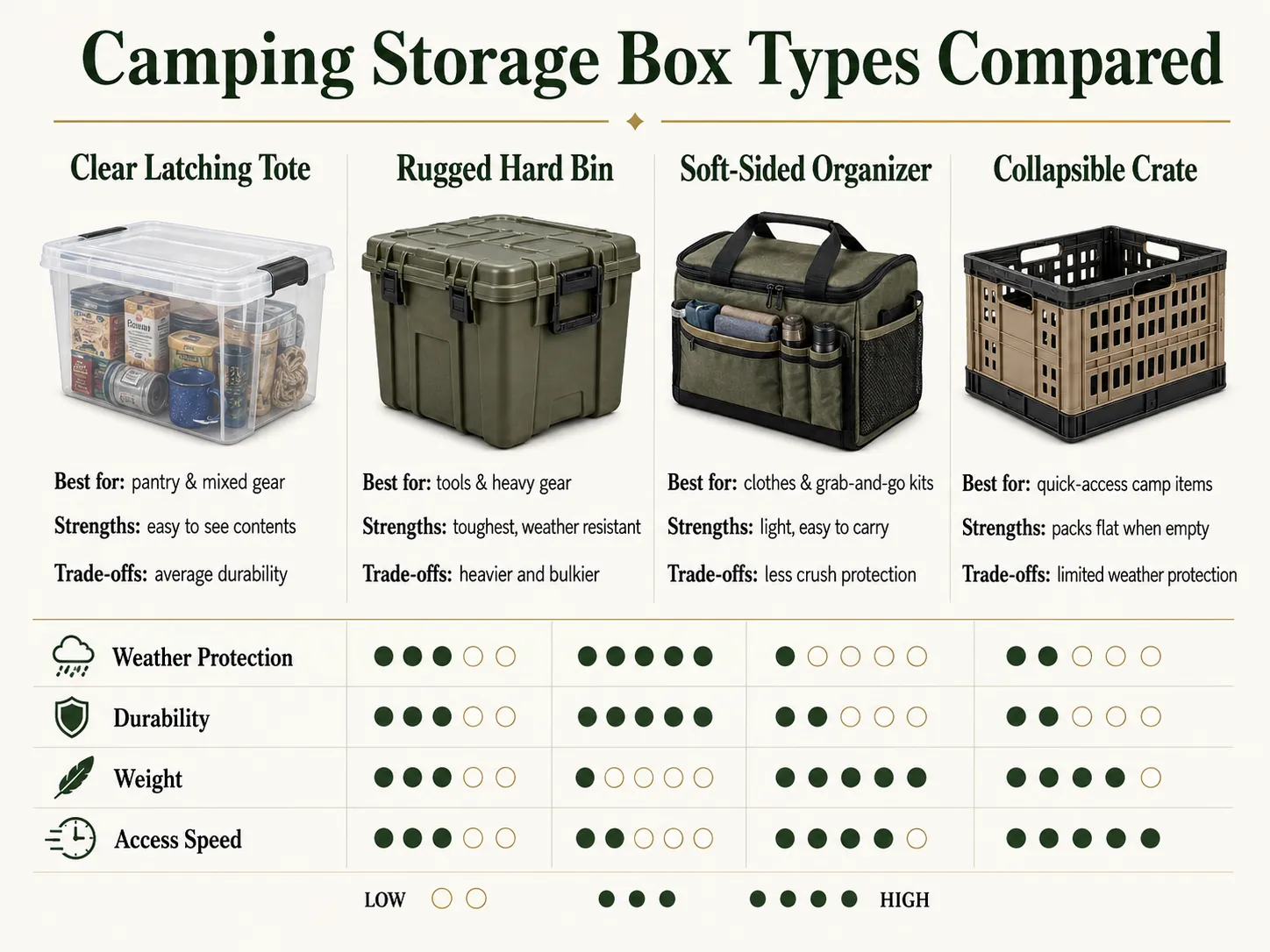
If you live in an apartment, use the same vehicle for daily life, or return from trips with boxes that sit empty most of the week, collapsibility can be worth paying for. The RUX keeps a box-like opening while packed but compresses dramatically when empty. The trade-off is reduced hard-shell crush protection.
Stackability matters only if the boxes actually fit your vehicle
Measure the cargo opening, wheel-well width, shelf height and sleeping-platform clearance before buying a stackable system. A box can stack beautifully in a garage and still waste space in a curved hatchback. Vertical-sided systems such as Wolf Pack Pro are attractive because they minimize taper between boxes.
Clear bins are faster; opaque bins protect privacy and light-sensitive gear
A clear IRIS tote lets you identify contents instantly. Opaque boxes look cleaner, hide expensive gear and block sunlight from the contents. If you use several opaque boxes, add large labels on two sides and the lid so you can identify a box regardless of how it is loaded.
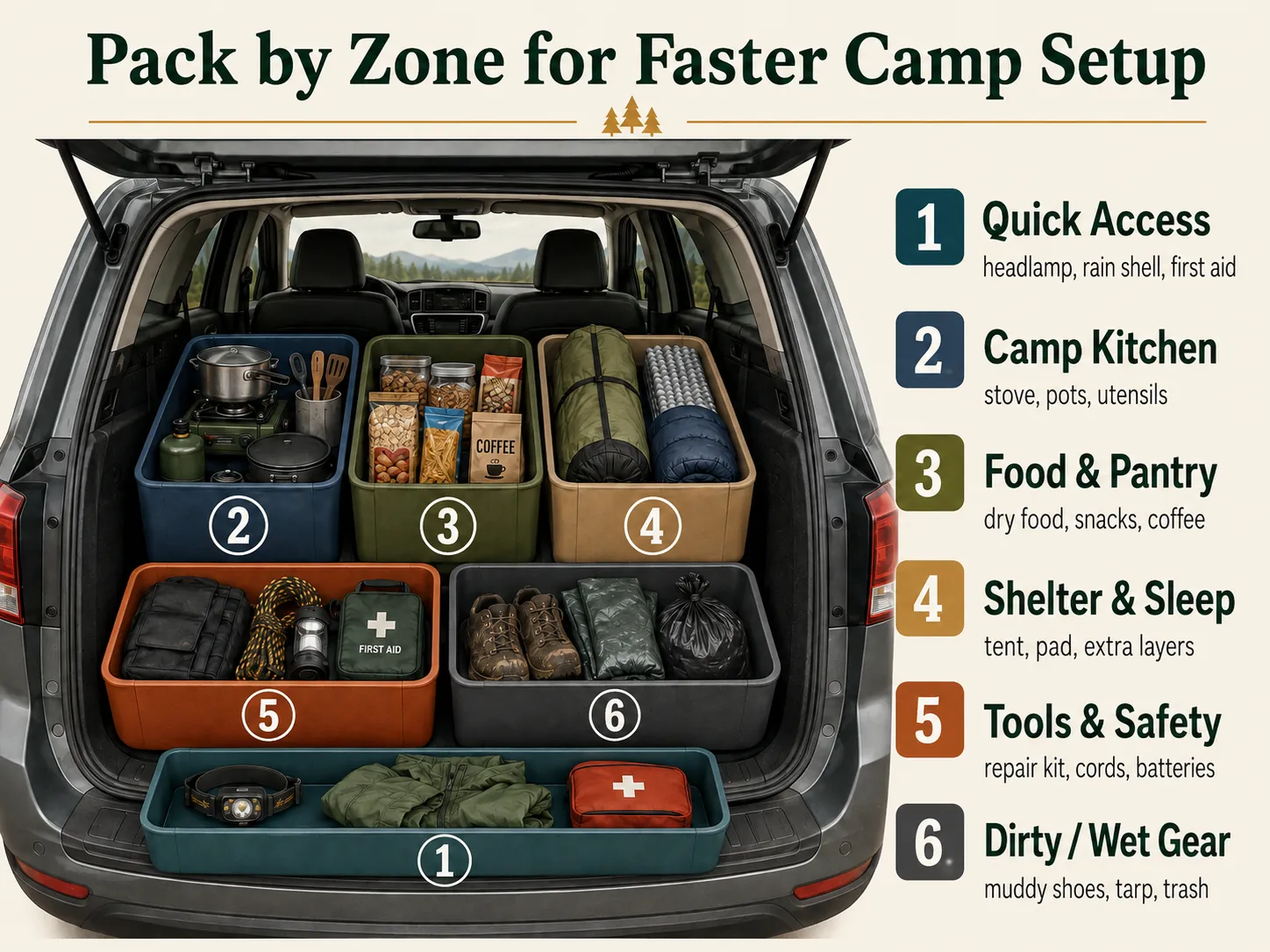
Build boxes by campsite task, not by product category
A useful camp-storage system might be: Kitchen, Shelter & setup, Lighting & power, Hygiene, and Trash / cleanup. That way you unload one box when you start cooking instead of opening a “miscellaneous camping gear” trunk repeatedly. Our collapsible camping trash-can guide covers the cleanup side of that system.
Leave wet gear out of sealed storage until it dries
A good gasket keeps external water out—but it also keeps moisture from wet towels, tents and shoes inside. Vent or dry damp gear before sealing it for the drive home or long-term storage. A weatherproof case is not a drying cabinet.
Tie down hard boxes in moving vehicles
Even a sturdy box becomes a heavy projectile during hard braking. Use the vehicle’s cargo anchors and the box’s tie-down points where available. Stack only as high as the load remains stable and visibility stays acceptable. Overland roof-rack boxes also need attachment hardware appropriate to the rack and box system.
How We Chose These Camping Storage Boxes
This is a research-based Gear & Home roundup, not a claim that we personally drove every box across months of washboard roads. We checked current manufacturer specifications, exact Amazon.com US child listings, 2026 SERP/product landscape, retailer owner feedback, outdoor-community discussions and independent reviews where they added useful context.
Each CTA had to match the precise size, pack count and color/style discussed. We rejected old or ambiguous Amazon children rather than guessing.
Certified IP ratings were separated from ordinary water resistance and gasket/weather-seal claims. We did not upgrade “weather-resistant” into “submersible.”
We compared stackability, wall taper, collapse behavior, wheels and tie-down options because vehicle-space efficiency is a core camping use case.
A storage box is useful only if you can move and access it when full. Capacity was considered alongside handles, carry modes and the risk of overloading very large trunks.
Repeated themes around sealing, durability, latches, shipping damage, organization and portability mattered more than any one review.
The final five cover premium sealed protection, collapsible storage, bulk value, modular overlanding and budget weather-sealed organization instead of ranking near-identical totes.
Camping Storage Box FAQ
What size storage box is best for car camping?
For many campers, 30–70 liters per box is easier to organize and lift than one enormous trunk. A 100-quart-plus trunk makes sense for bulky family gear when you have enough cargo space and can use wheels or two-person lifting. Measure your vehicle first and choose modules based on how you unload camp.
Are camping storage boxes waterproof?
Some are, but the claim varies widely. YETI publishes IP65/IP67 ratings for the GoBox 30. RUX uses waterproof fabric and welded seams in a weatherproof soft-box system. IRIS uses a WeatherPro gasket, while Plano is better treated as water-resistant rather than submersible. Check the exact protection standard instead of assuming every latched box is waterproof.
Are plastic camping boxes bear-resistant?
Ordinary camping totes and gear boxes are generally not approved bear-resistant food containers. Weather seals, latches and hard plastic do not equal wildlife certification. Follow the food-storage rules for the exact park or forest you are visiting and use approved lockers or animal-resistant containers where required.
Is a hard storage box better than a collapsible box?
A hard box is better for impact protection, stable stacking and exposed vehicle storage. A collapsible box is easier to carry and far easier to store when empty. Choose based on what is inside the box and whether empty-container space or loaded-gear protection is the bigger problem.
Do I need wheels on a camping storage trunk?
Wheels become useful on large trunks because high capacity encourages heavy loads. They help on parking lots and firm campground surfaces, but small integrated wheels are less useful on sand, deep gravel or rough trails. For smaller modules, good handles are usually more important than wheels.
Are clear storage bins good for camping?
Clear bins are excellent when fast identification matters: you can see cookware, clothes or lighting without opening the lid. The trade-offs are less privacy for expensive gear and lighter-duty construction on many household-style totes. Clear gasketed bins work best inside vehicles, tents, canopies and other moderately protected locations.
Can I store food in a camping gear box?
You can use a clean box to organize packaged food while you are actively using camp, but ordinary gear boxes do not replace required wildlife-resistant storage. In bear country, food, trash, toiletries and other scented items may need to go into a campground locker, approved bear-resistant container, or other location-specific storage system when unattended.
What is the easiest way to organize multiple camping boxes?
Assign each box one campsite job instead of filling every box with mixed gear. A practical system is Kitchen, Shelter & Setup, Lighting & Power, Hygiene, and Cleanup. Label the lid and at least one side, keep frequently used items near the top, and return each item to the same module after the trip.