
Gear & Home is reader-supported. As an Amazon Associate I earn from qualifying purchases. When you buy through links on our site, we may earn an affiliate commission, at no extra cost to you. Learn more.
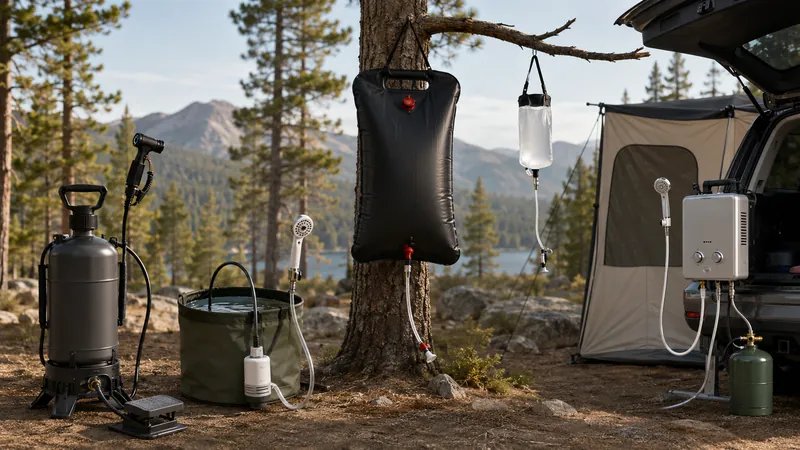
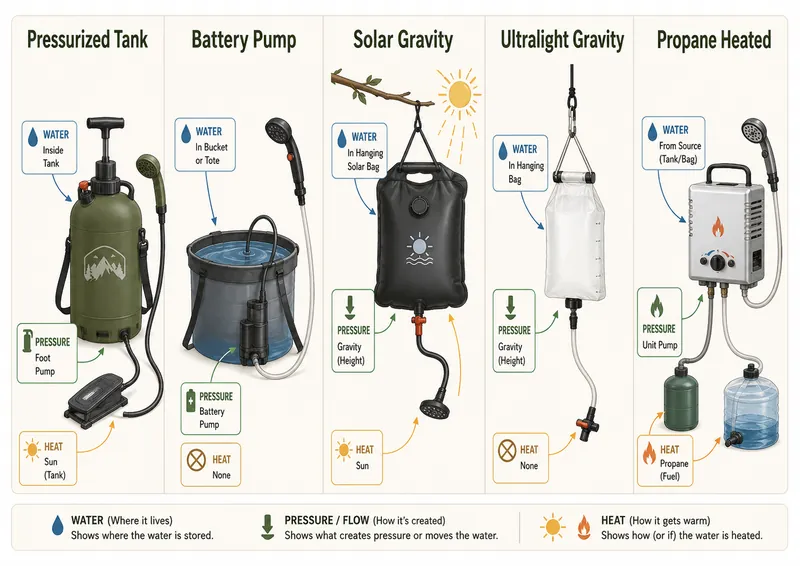
The best portable camping shower depends less on raw “pressure” claims than on the system you actually want to carry: an integrated pressurized tank, a rechargeable pump for a bucket, a solar bag, an ultralight gravity shower, or a propane-heated setup. For most car campers, the NEMO Helio 11L is the best-balanced option because it keeps the water on the ground, builds pressure with a foot pump, and does not depend on a battery.
We compared current manufacturer specifications, exact product variants, recurring owner feedback, and multiple independent review signals. We also verified the Amazon.com US listing and ASIN for every linked pick.
Most battery-powered camping showers, including the Spopal pick below, pump water but do not warm it. If you want genuinely hot water on demand, you are moving into a larger propane-heated system with more setup and safety requirements.
Best portable camping shower for most campers
Choose the NEMO Helio 11L if you want one self-contained shower system for car camping, road trips, rinsing kids or pets, and washing sandy gear. Its 11-liter reservoir stays on the ground while a foot pump creates usable pressure through a 7-foot hose, so you avoid both hoisting a heavy gravity bag and relying on a rechargeable pump.
If you already carry a bucket or water tote, the Spopal 6000mAh gives you a powered shower with less dedicated hardware. The Advanced Elements 5 Gallon Summer Shower is the simpler no-battery solar choice, the Sea to Summit Pocket Shower is the backpacking pick, and the CAMPLUX Nano 3 Max is the upgrade when real hot water matters enough to justify propane and a more complex setup.
Quick Picks
NEMO Helio 11L
Integrated pressurized reservoir with no battery and no heavy bag to hang.
Spopal 6000mAh
A powered pump and shower head for campers who already carry a bucket or water container.
Advanced Elements 5 Gallon Summer Shower
Simple gravity-fed solar heating with no battery, pump, or fuel system.
Sea to Summit Pocket Shower
A 10-liter gravity shower that weighs just 4.2 ounces empty and doubles as a dry sack.
CAMPLUX Nano 3 Max
Actual propane water heating plus a pump for base camps where hot water is the priority.
Portable Camping Showers Compared
The biggest decision is the shower system, not the number of spray settings. These five picks deliberately cover different camp setups instead of ranking five near-identical battery pumps.
| Pick | System | Water setup | Heating | Best for | Main trade-off | Amazon |
|---|---|---|---|---|---|---|
| NEMO Helio 11L Best Overall |
Foot-pump pressurized | Integrated 11L / 2.9-gal reservoir | No built-in heater | Car camping and road trips | Modest pressure; periodic pumping | Check availability on Amazon |
| Spopal 6000mAh Best Value Rechargeable |
Battery pump | Separate bucket or tote | None | Powered rinses on a budget | Needs a separate water container | Check availability on Amazon |
| Advanced Elements 5 Gallon Best Solar / No-Power |
Gravity solar bag | Integrated 5-gal bag | Solar | Sunny campsites and simple setups | Heavy when full; must hang high | Check availability on Amazon |
| Sea to Summit Pocket Shower Best for Backpacking |
Ultralight gravity bag | Integrated 10L bag | No built-in heater | Backpacking and small packed volume | Low gravity pressure; needs a hanging point | Check availability on Amazon |
| CAMPLUX Nano 3 Max Best Heated Upgrade |
Propane heater + pump | Separate water source | Propane | Vehicle base camps and hot showers | Fuel, bulk, setup, and ventilation requirements | Check availability on Amazon |
NEMO Helio 11L
Foot-pump pressurized
11L / 2.9 gal
None built in
Car camping
Spopal 6000mAh
Battery pump
Separate container
None
Budget powered rinses
Advanced Elements 5 Gallon Summer Shower
Gravity solar bag
5 gal
Solar
Sunny campsites
Sea to Summit Pocket Shower
Gravity bag
10L
4.2 oz / 120 g
Backpacking
CAMPLUX Nano 3 Max
Propane heater + pump
Separate source
Propane
Hot-water base camps
NEMO Helio 11L
The best balance of pressure, simplicity, and self-contained water storage for most car campers.
The Helio is the easiest recommendation for a mixed-use camp shower because the major pieces are already integrated. Fill the 11-liter reservoir, pressurize it with the foot pump, and use the 7-foot hose for a quick shower, muddy feet, bikes, dogs, dishes, or sandy beach gear. NEMO lists roughly 5 to 7 minutes of continuous steady pressure from the 11-liter model.
That ground-based design matters more than it sounds. A five-gallon gravity bag becomes awkward to lift and requires a strong overhead anchor. A battery pump works well, but it still needs a bucket or tote and another charged device. The Helio asks you to carry one purpose-built system and avoids both compromises.
Independent reviews and owner discussions consistently point to the same limitation: this is useful camp pressure, not a home shower. The spray is relatively focused, and keeping the reservoir pressurized means giving the foot pump a few presses during use. Drying and storing a soft reservoir also takes more care than tossing a simple pump into a bin.
Pros
- Integrated reservoir, pump, hose, and nozzle
- No battery or overhead hanging point required
- Useful beyond showering for gear, pets, and cleanup
Cons
- Pressure is practical rather than powerful
- Requires periodic foot pumping
- Bulkier than a pump-only or ultralight gravity setup
Spopal 6000mAh Rechargeable Camping Shower
The sensible powered option if a bucket or water tote is already part of your camp kitchen or wash setup.
Spopal makes sense when your camp setup already includes a bucket, collapsible tote, or other clean-water container. Drop the submersible pump into the water and you get a conventional hose-and-shower-head arrangement without lifting a full solar bag. The current 6000mAh variant charges by USB-C and provides high and low water-output modes.
The shower head includes multiple spray patterns, but the more important feature is control at the handle: you can stop the water while soaping up instead of walking back to a hanging bag or pump. That makes a finite water supply easier to manage, especially for hair washing or rinsing more than one person.
The limitation is easy to misunderstand from temperature-display marketing: this model does not heat the water. Its display can show water temperature, but you must start with water that is already warm enough for your needs. A pump system also gives you more separate pieces to keep clean and dry, and some feedback mentions priming or residual-water annoyances rather than the total simplicity of a gravity bag.
Pros
- Powered flow without a heavy hanging reservoir
- Works with water containers you may already carry
- USB-C rechargeable with controls at the shower head
Cons
- Does not heat water
- Requires a separate bucket or tote
- More parts and charging dependence than a gravity bag
Advanced Elements 5 Gallon Summer Shower
A simple solar-heated gravity shower for sunny campsites where you have a strong place to hang it.
The Advanced Elements 5 Gallon Summer Shower is the low-complexity option: fill it, let direct sun warm the water, hang it, and open the shower head. The current SS762 model uses a 5-gallon reservoir and includes a temperature gauge, so you can check the water before getting underneath it.
Its main advantage is that there is very little to fail. No battery has to be charged, no submerged pump has to prime, and no propane connection has to be assembled. For a sunny base camp with trees or a sturdy shower structure, that simplicity is compelling.
The trade-off is physical rather than electronic. Five gallons of water is a lot to lift overhead, so this pick only makes sense when you have a strong, appropriately positioned anchor. Flow also comes from gravity alone; the experience depends on bag height, remaining water, and the small shower outlet rather than pump pressure. Cloud cover and cool weather can also make solar heating too slow or inconsistent for your schedule.
Pros
- No battery, pump, or fuel required
- Solar warming is useful in direct sun
- Large reservoir suits longer rinses or multiple people
Cons
- A full five-gallon bag is difficult to hoist
- Needs a strong, high hanging point
- Gravity flow and solar heating depend on conditions
Sea to Summit Pocket Shower 10L
The backpacking pick when packed weight matters far more than strong pressure or a luxurious shower.
A normal camping shower is hard to justify in a backpack. The Pocket Shower earns its place because it is essentially a compact roll-top water bag with a small shower outlet rather than a pump-and-hose system. Sea to Summit lists a 10-liter capacity, fully taped seams, two D-rings, and 6 meters of cord for hanging.
The manufacturer says the 10-liter bag can provide roughly eight minutes of shower time with the head fully open. In practice, the more backpacker-friendly way to use it is to wet down, close the flow, wash, and rinse. That conserves water and makes the limited gravity pressure less important.
This is not the pick for someone trying to recreate a campground bathhouse. Independent feedback consistently highlights the same two constraints: you need to get the bag high enough for usable flow, and pressure decreases as the bag empties. Its value is that you can carry a genuine rinse setup without turning it into a major weight or volume commitment.
Pros
- Very low empty weight for a 10-liter shower
- Doubles as a roll-top dry sack
- No battery, pump, or fuel system
Cons
- Low gravity pressure compared with pump systems
- Needs a high, secure hanging point
- Not the easiest option for car-camp shower comfort
CAMPLUX Nano 3 Max
The choice for real on-demand hot water when vehicle-supported camping makes the extra fuel, hardware, and setup worthwhile.
The Nano 3 Max belongs in a different class from the first four picks. It combines a portable propane water heater, submersible pump, shower kit, regulator, and adapters into a base-camp hot-water system. If your priority is a genuinely warm shower after cold-weather activities or several days at a vehicle-supported campsite, that capability can be worth the extra equipment.
The current unit uses a 4000mAh built-in battery to power the pump and electronics, while propane provides the heat. CAMPLUX lists a temperature-display range of 50 to 122°F and includes multiple spray modes. More important than those conveniences is the safety distinction: this is a fuel-burning appliance, not just a waterproof shower pump.
Use the heater only in locations permitted by the manufacturer, outdoors or with the required ventilation, and never in an enclosed or poorly ventilated space. Follow the supplied manual for propane connections and operating clearances. If you use a privacy shelter, do not assume the heater itself can safely sit inside it; route the shower setup only as the manufacturer allows.
Pros
- Actual on-demand water heating rather than temperature display only
- Integrated pump-and-heater system for base camp use
- More comfortable for cold-weather or multi-day vehicle camping
Cons
- Requires propane and more setup than other picks
- Heavier and less compact than pump or gravity showers
- Ventilation and fuel-safety requirements limit where it can operate
How to Choose a Portable Camping Shower
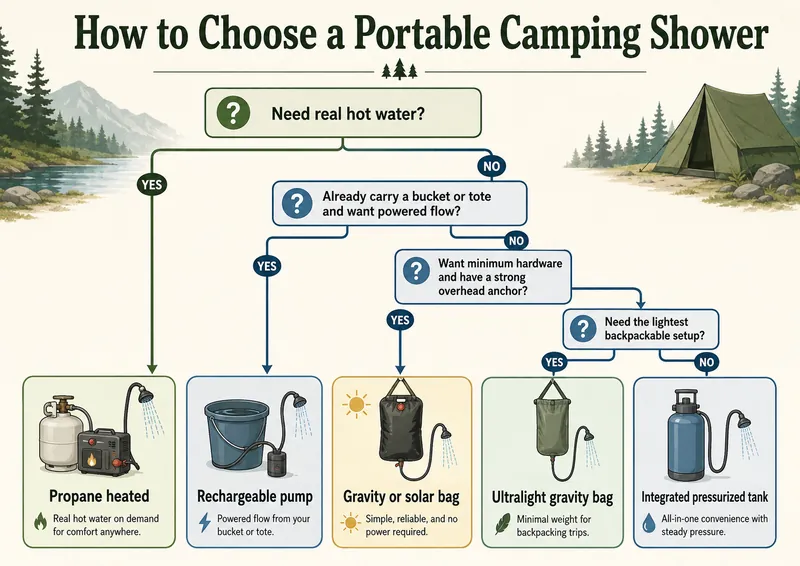
Start with the system that fits your campsite. Once that decision is right, features such as spray patterns and digital displays become secondary.
1. Decide whether you want pressure, heat, or minimum hardware
Pressurized integrated systems such as the NEMO Helio are the easiest all-rounders because the reservoir, pump, and hose travel together. Rechargeable pumps such as the Spopal are more compact if you already carry a bucket or tote. Gravity bags minimize moving parts but trade away pressure and require a secure overhead anchor. Propane systems are the only picks here that create real heat on demand, but they are a base-camp solution rather than a lightweight shower.
2. Do not confuse a temperature display with a heater
A battery pump can tell you that your water is warm without making it warm. If a listing emphasizes a temperature display, verify whether the product has an actual heating element or fuel-fired heater. For most rechargeable camping showers, you still need to warm the water separately or accept the ambient temperature.
3. Think about where the water will live
An integrated reservoir is convenient because it turns the shower into one system, but you carry that dedicated container even when it is empty. A pump-only shower uses space efficiently if your camping setup already includes a clean water tote. Gravity bags combine reservoir and shower, but larger bags become awkward once filled and must be supported overhead.
4. Treat hanging requirements as a real campsite constraint
Solar and gravity showers work best with a sturdy branch, rack, shower enclosure frame, or other safe support above head height. If you camp in open desert, beach lots, or treeless sites, a ground-standing pressurized reservoir or bucket pump is usually easier. Do not suspend a heavy full bag from a weak branch or improvised hook.
5. Build a practical camp hygiene system
A shower is only part of staying comfortable. A fast-drying towel reduces the amount of wet gear you have to pack away; see our guide to the best quick-dry camp towels. For solo trips, our solo camping checklist is a useful second pass for water, hygiene, lighting, and cleanup gear.
6. Keep wash water away from natural water sources
Leave No Trace guidance recommends carrying wash water away from lakes and streams rather than bathing directly in them, and using only small amounts of soap when needed. Check local campground and land-manager rules as well, especially where gray water disposal is regulated. See the Leave No Trace guidance on disposing of waste properly.
How We Chose These Camping Showers
We built the shortlist around distinct buyer scenarios rather than filling a table with near-duplicate products. The final awards are Gear & Home editorial choices based on the current evidence mix.
We checked current manufacturer product pages and matched material specs to the exact variant used in this article.
We looked for recurring strengths and complaints across independent reviews, retailers, and community discussions instead of treating one anecdote as a pattern.
We weighted pressure, water source, heating, hanging requirements, packed burden, setup complexity, and likely camp style.
Every Amazon button is tied to a verified Amazon.com US ASIN for the named model or variant. We do not publish fixed prices, star ratings, or review counts because those change.
Portable Camping Shower FAQ
What type of portable camping shower is best?
For most car campers, an integrated pressurized shower is the easiest all-around system because it combines water storage and pressure without requiring a hanging point or charged pump. A rechargeable pump is better if you already carry a bucket or tote, a gravity bag is simpler and cheaper, and a propane system is the right category only when true hot water justifies the extra hardware.
Do rechargeable camping showers heat the water?
Usually not. Rechargeable shower pumps primarily move water. Some show the water temperature on a display, but that is not the same as heating it. The Spopal 6000mAh in this guide does not heat water; a propane-heated system such as the CAMPLUX Nano 3 Max is a different type of product.
Is a solar shower better than a battery shower?
A solar shower is better when you want the fewest parts and have reliable sun plus a safe overhead hanging point. A battery shower is better when you want powered flow from a bucket or tote and do not want to lift a full water bag. Solar heating also depends on weather, while a battery pump does not create heat at all.
How much water do you need for a camp shower?
It depends on hair length, whether you turn the water off while soaping, and whether the same supply is shared. A 10- to 11-liter system is well suited to a quick wet-wash-rinse routine, while a five-gallon bag gives more margin for longer rinses or multiple users at the cost of much more water weight.
Can you use a camping shower next to a lake or stream?
Do not assume so. Leave No Trace guidance recommends carrying wash water away from lakes and streams rather than bathing directly in them, and local rules may be stricter. Check the rules for the campground, park, forest, or public land where you are staying.
Can a propane camping shower be used inside a shower tent?
Do not assume a privacy shelter is safe for the heater itself. CAMPLUX specifies outdoor or appropriately ventilated use and warns against enclosed or poorly ventilated spaces. Follow the current product manual for heater placement, clearances, propane connections, and ventilation, and keep the fuel-burning unit outside any enclosure unless the manufacturer explicitly permits the setup.