

Gear & Home is reader-supported. As an Amazon Associate I earn from qualifying purchases. When you buy through links on our site, we may earn an affiliate commission, at no extra cost to you. Learn more.
The best camping mattress for couples is the one that gives both sleepers enough room, insulation and pressure relief without taking over the entire tent or car. For most car-camping couples, a thick foam-and-air double is the sweet spot because it feels more stable and mattress-like than a tall household air bed while still packing smaller than a full foam mattress.
For this roundup we kept the category focused on two-person camping mattresses that make sense for tent, vehicle or base-camp use. These are not ultralight backpacking pads. We compared exact current sizes, construction, published insulation data, packed bulk, setup, recurring owner feedback and independent review patterns, then assigned each pick a specific role.
The best camping mattress for most couples
The EXPED MegaMat Duo Queen is our Best Overall pick. Its 80 x 59.8 x 4-inch surface is essentially queen width, the published R-value is 8.1, and the foam-and-air construction gives couples adjustable firmness without the bouncy feel of a tall household air mattress. It is heavy and bulky, but for car camping that trade-off buys a much more bed-like sleep surface.
Choose the Big Agnes Captain Comfort Deluxe 52 x 78 if cold-ground insulation and a slightly narrower footprint matter most. Choose the Lost Horizon Option3 Queen for value, the HEST Dually Long if you want zero inflation and minimal motion transfer, or the Hikenture 79 x 55 when packed size matters more than a published cold-weather rating.
Quick Picks
EXPED MegaMat Duo Queen
Premium car-camping comfort with queen-width space and a published R-value of 8.1.
Big Agnes Captain Comfort Deluxe 52 x 78
Five inches thick, 52 inches wide and R 9.9 in the exact double-wide size.
Lost Horizon Option3 Queen
Full 60-inch queen width, 4.5-inch foam-and-air construction and an included pump.
HEST Dually Long
Two-layer foam with no valves, no pump and very little shared-surface bounce.
Hikenture Double 79 x 55
An air-only double that packs far smaller than the foam-heavy options.
Best Camping Mattresses for Couples Compared
| Pick | Open size | Thickness | Weight | R-value | Construction | Where to check |
|---|---|---|---|---|---|---|
| EXPED MegaMat Duo Queen Best Overall |
80 x 59.8 in | 4 in | 11 lb 14 oz | 8.1 | Self-inflating foam + air | Check availability on Amazon |
| Big Agnes Captain Comfort Deluxe Best for Cold Ground |
78 x 52 in | 5 in | 11 lb 2 oz | 9.9 | Self-inflating foam + air | Check availability on Amazon |
| Lost Horizon Option3 Queen Best Value |
80 x 60 in | 4.5 in | 17.6 lb | Listing claim not used for ranking | Self-inflating foam + air | Check availability on Amazon |
| HEST Dually Long Best No-Inflation |
78 x 50 in | 3.9 to 4 in | 32 lb current HEST spec | No current manufacturer R-value published | Two-layer foam | Check availability on Amazon |
| Hikenture Double Best Compact Double |
79 x 55 in | About 4 in | 3.64 lb exact listing | Not published | Air-only | Check availability on Amazon |
EXPED MegaMat Duo Queen
80 x 59.8 in
4 in
11 lb 14 oz
8.1
Big Agnes Captain Comfort Deluxe
78 x 52 in
5 in
11 lb 2 oz
9.9
Lost Horizon Option3 Queen
80 x 60 in
4.5 in
17.6 lb
Listing claim not used
HEST Dually Long
78 x 50 in
3.9 to 4 in
32 lb
Foam only
Hikenture Double 79 x 55
79 x 55 in
About 4 in
3.64 lb
Not published
The dimensions above are for the exact reference variants linked in this guide. R-value is only shown as a firm comparison metric when we could verify a current published value for that exact product or size. We do not treat an unverified marketplace insulation claim as equivalent to a standardized manufacturer value.
What Matters More for Couples Than for Solo Campers
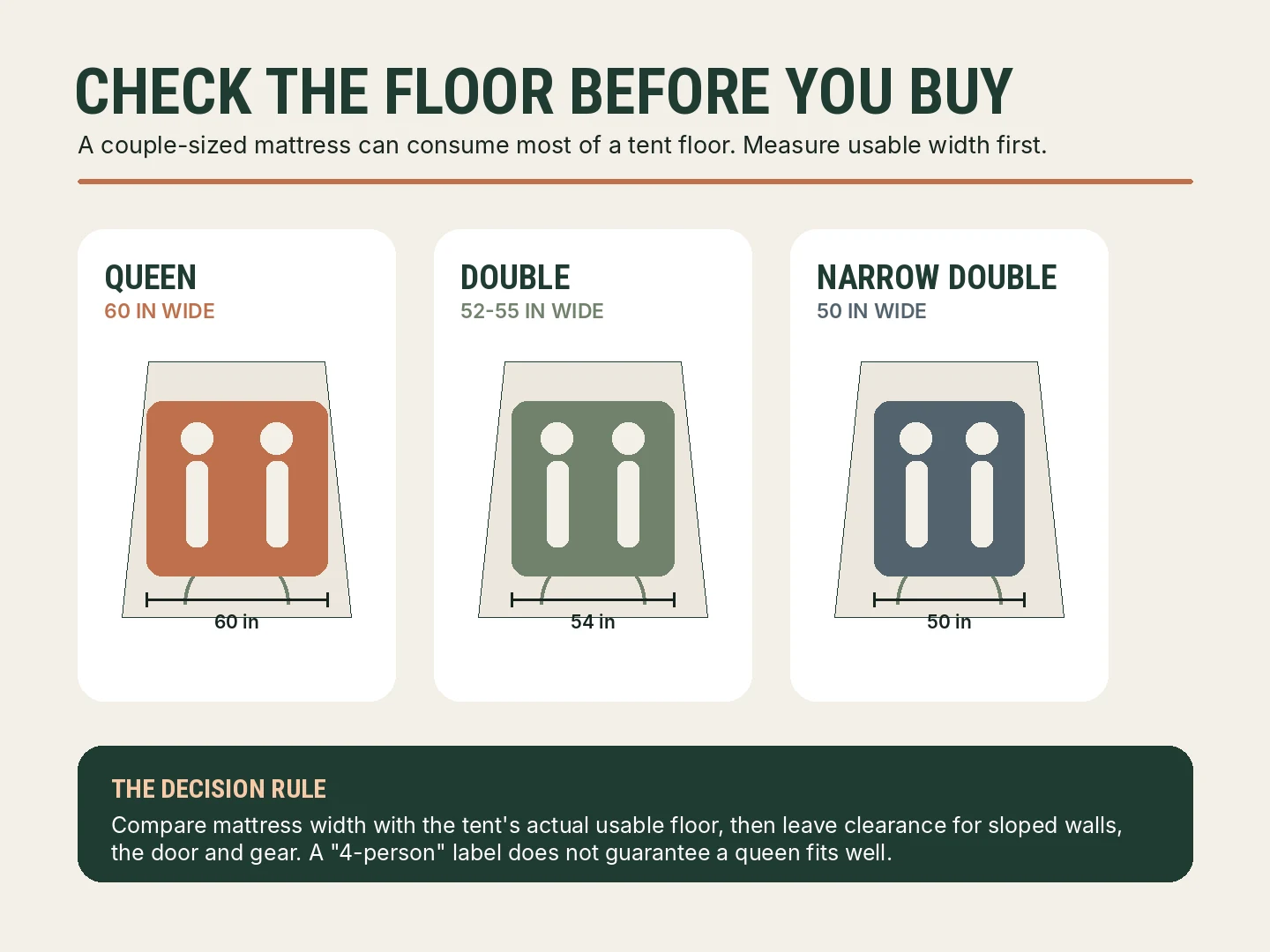
A double pad is not just a wider single pad. Two people create more pressure points, more movement and more opportunities for fit problems. The most important first step is to measure the usable tent floor rather than trusting a capacity label. A 60-inch-wide queen can fill almost the entire interior of many tents, leaving little clearance at sloped walls or the door.
Firmness is also shared. On a foam-and-air mattress, both sleepers live with the same pressure setting. If one person wants a very soft surface and the other wants a firm pad, two singles can be the better sleep system even when a double looks cleaner on paper.
Measure the actual flat sleeping area in inches. A 50- to 55-inch double is often easier to fit around tent walls and gear, while a 60-inch queen gives more elbow room but can crowd the shelter. Fit should be decided before brand.
The 5 Best Camping Mattresses for Couples
EXPED MegaMat Duo Queen
The strongest all-around choice for couples who prioritize bed-like comfort, real queen width and verified ground insulation over packed size.
#1
The MegaMat Duo Queen is the easiest recommendation when the goal is to make tent camping feel less like sleeping on outdoor gear. Its 59.8-inch width is effectively a home queen footprint, and the four-inch foam-and-air core lets you tune firmness after self-inflation. That adjustability matters for couples because overfilling a shared pad can make partner movement more noticeable and create a harder surface than necessary.
The other reason it wins is that the thermal story is clear. EXPED publishes an R-value of 8.1 for the current MegaMat Duo line, so you are not guessing whether the mattress itself is a weak link in a cold-ground sleep system. That does not turn an R-value into a temperature guarantee, but it makes comparison far more useful than marketing terms such as “four season” without a transparent test value.
The downside is storage. The Queen weighs almost 12 pounds and rolls to roughly 31.5 x 11.8 inches. EXPED also recommends storing the mat unrolled with valves open when practical. Couples with small apartments, compact cars or gear closets should account for that ownership footprint, not just campsite comfort.
Pros
- Near-queen 59.8-inch width
- Verified R-value of 8.1
- Adjustable foam-and-air feel
- Current Queen version includes a top-up pump
- Strong independent and owner comfort consensus
Limitations
- Heavy and bulky for anything beyond car camping
- Deflation takes more effort than an air-only pad
- Premium purchase
- Shared firmness still may not suit couples with very different sleep preferences
Big Agnes Captain Comfort Deluxe 52 x 78
A five-inch double-wide foam-and-air pad with an R-value of 9.9 in the exact 52 x 78 size, making it the clearest insulation-first choice here.
#2
The Captain Comfort earns its spot by solving two couple-specific problems at once: cold-ground insulation and motion. The 52-inch width is meaningfully narrower than a queen, which can make tent fit easier, while five inches of thickness gives side sleepers more room before hips and shoulders approach the floor.
Its R-value is also unusually high for a comfort-focused double. The 52 x 78 version is rated R 9.9, while other sizes in the Captain Comfort family have different values. That is why we specify the exact 52 x 78 variant here rather than treating the whole product family as one spec.
There is no magic escape from bulk. At more than 11 pounds and roughly 11 x 27 inches packed, this is still car-camping gear. It is also 8 inches narrower than a queen, so broad-shouldered couples who prize personal space may prefer the EXPED or Lost Horizon even if the Big Agnes fits a tent more efficiently.
Pros
- R 9.9 in the exact double-wide size
- Five inches of cushion
- 52-inch width fits more shelters than a full queen
- Independent testing reports low motion transfer
- Self-inflating with micro-adjustable valves
Limitations
- Still large and heavy
- Less personal width than a 60-inch queen
- Premium category
- Initial self-inflation may still need topping up
Lost Horizon Option3 Queen 4.5-Inch
A full 80 x 60-inch foam-and-air queen that competes on comfort and adjustability while keeping the value proposition stronger than the premium leaders.
#3
The Lost Horizon Option3 is the pick for couples who look at premium self-inflating doubles and decide they want the concept more than the badge. It provides a true 60-inch queen width and a 4.5-inch foam-and-air structure, so the basic sleep experience is closer to the comfort-first models than to a thin air pad.
Recent owner discussions are unusually consistent about one thing: the mattress is not merely a cheap tall air bed. People who have used both Lost Horizon and EXPED often describe the comfort gap as small enough that price and valve preference become deciding factors. That does not establish equal durability, and isolated experiences are not proof of long-term equivalence, but it is a strong enough recurring pattern to make this a serious value option.
We deliberately do not use the marketplace R-value claim in our ranking. The current listing markets a high insulation number, but we did not verify a current standardized manufacturer test for this exact variant. If cold-ground performance is the primary reason you are buying, the Big Agnes and EXPED provide cleaner published insulation data.
Pros
- Full 80 x 60-inch queen footprint
- Thick adjustable foam-and-air construction
- Included pump
- Strong recent owner value and comfort pattern
- Useful alternative to premium self-inflating doubles
Limitations
- 17.6 pounds is very heavy
- Published insulation claim is not used in our ranking
- Long-term track record is less established than EXPED
- Still bulky to transport and store
HEST Dually Long
The simplest sleep surface here: open it, lay it flat and sleep, with no pump, no pressure setting and no air chamber to transfer bounce between partners.
#4
The Dually Long is what to buy when you are tired of thinking about valves. It is a two-layer foam mattress that folds in half. There is no inflation cycle and no need to decide how many PSI feels right. The fold also separates the two halves enough that one sleeper moving does not create the same air-pressure response you get from a shared inflatable chamber.
That simplicity is especially attractive in a rooftop tent, truck platform, van or base-camp setup where the mattress can remain in place. It is much less attractive if you need to move the bed in and out of a compact vehicle every weekend. HEST currently lists the Long at 78 x 50 inches open and 78 x 25 x 8 inches folded, with a 32-pound weight. In practical terms, it barely packs down at all.
HEST does not currently publish an R-value on the product sizing/spec pages we used, so we do not assign it a cold-weather number here even though independent reviews have reported insulation values. For a permanent-ish vehicle sleep platform, the no-air design is the key reason to choose it.
Pros
- No inflation, valves or pump
- Very simple setup and pack-away motion
- Low shared-surface bounce
- 50-inch width works in many vehicle platforms
- Strong comfort reputation
Limitations
- Extremely large when folded
- 32-pound current manufacturer weight
- Not a practical carry-in mattress
- No current manufacturer R-value published on the spec pages used here
Hikenture Double Sleeping Pad 79 x 55
The compact option for couples who need a shared sleeping surface to shrink dramatically for transport and can live without a published R-value.
#5
Every other mattress in this roundup makes a car-camping compromise: lots of foam buys warmth and a more mattress-like feel, but it also creates a large roll. The Hikenture goes the other direction. At about 55 inches wide, it still gives two sleepers a real shared platform, yet its air-only structure can pack to a fraction of the volume.
That makes it a better fit for small cars, tighter storage and campsites where the sleeping setup has to move farther from the vehicle. It is also the only pick here that approaches the weight range where carrying it a meaningful distance is realistic, although 3.64 pounds is still heavy compared with two dedicated backpacking pads.
The trade-off is thermal certainty. Hikenture does not publish an R-value for this current double pad, so we would treat it as a mild-weather choice unless you add verified insulation beneath it or have independent thermal data for the exact revision you own. Do not infer cold-weather performance from thickness alone.
Pros
- Much smaller packed volume than foam-heavy doubles
- About 3.64 pounds for the exact linked variant
- 55-inch width gives couples more room than many narrow doubles
- Pump-sack setup avoids blowing directly into the pad
- Repair kit and stuff sack included
Limitations
- No published R-value
- Air-only feel is less mattress-like than thick foam hybrids
- Shared air chamber can transmit partner movement
- Not our choice for cold ground without additional verified insulation
How to Choose a Camping Mattress for Two
1. Measure the tent floor in inches
Start with actual usable floor width and length, not the tent’s sleeper count. A 60-inch queen may technically fit inside a shelter but still press into sloped walls, block a door or eliminate gear space. The 50- to 55-inch group is often a better compromise when the tent is not oversized.
2. Treat R-value as ground insulation, not a comfort score
A thicker mattress is not automatically warmer. Use a published R-value when cold-ground performance matters, and compare like with like. Our sleeping pad R-value guide explains how thermal resistance works and why the pad is part of the insulation system rather than just cushioning.
3. Decide whether shared firmness is acceptable
One double mattress usually means one pressure setting. That works well when both sleepers like similar firmness. If one person is a side sleeper who wants a softer, thicker surface and the other prefers firm support, two singles can solve the problem more cleanly and provide redundancy if one pad fails.
4. Count packed size as a product spec
For car camping, weight is often less important than volume. A 12-pound mattress that rolls to a manageable cylinder may be easier to live with than a 32-pound foam slab that barely compresses. Think about trunk space, where the mattress will dry after a trip and how you will store it between trips.
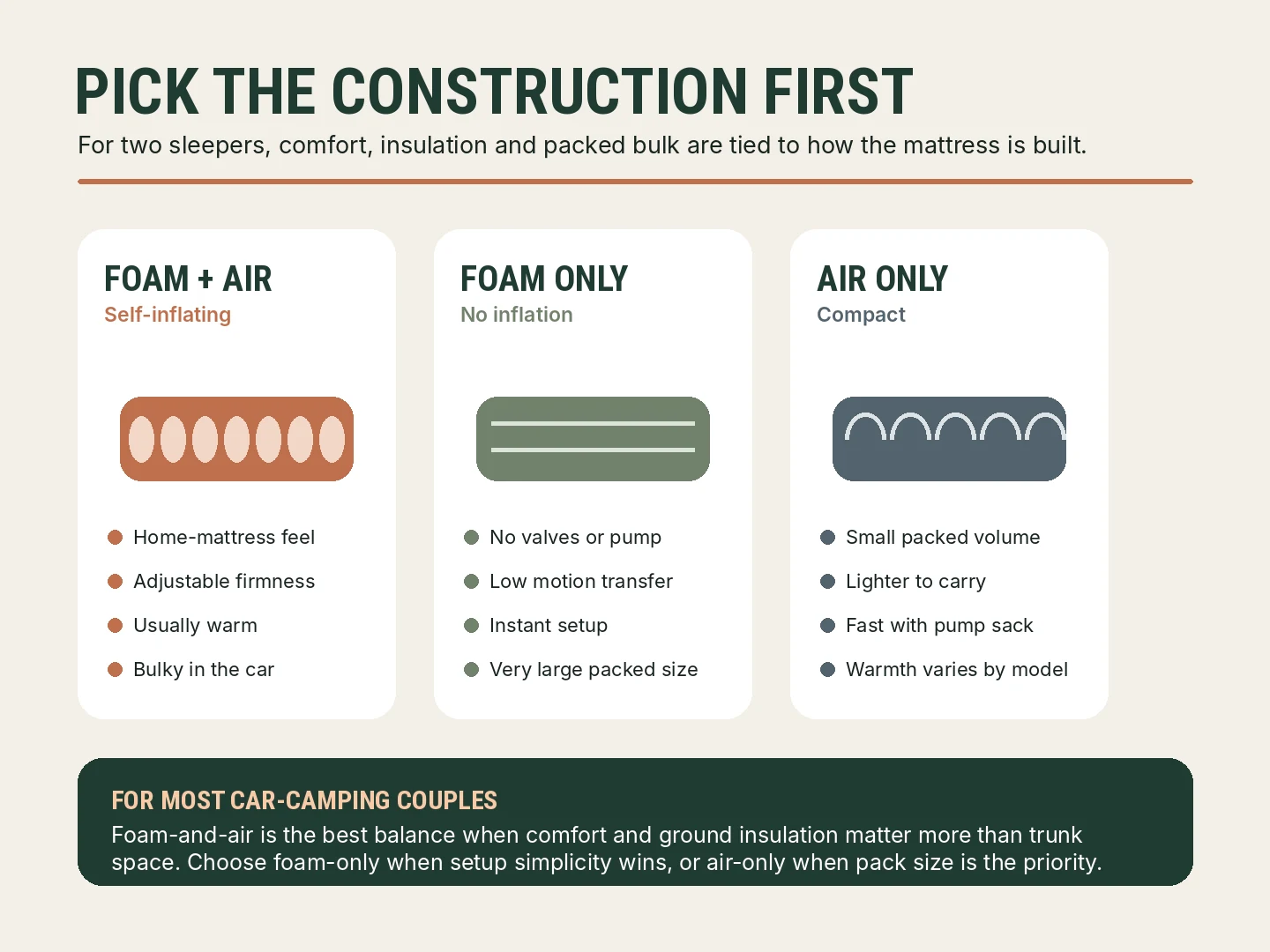
5. Match construction to the trip
Foam + air: best balance of comfort, insulation and adjustable firmness for most car-camping couples. Foam only: best when simplicity and minimal motion transfer matter more than storage. Air only: best when packed volume matters most, but warmth depends heavily on internal insulation and a published R-value.
6. Consider the rest of the sleep system
A mattress does not replace the sleeping bag or quilt, and a warm bag cannot compensate for inadequate ground insulation. If you are building the whole setup from scratch, our complete sleep system guide explains how pads, bags and sleep clothing work together. The products in this roundup are car-camping oriented, but the insulation logic is the same.
How We Chose These Camping Mattresses
We started with the current US search landscape for “best camping mattresses for couples” and separated true two-person camping mattresses from ordinary guest-room air beds, single sleeping pads and vehicle-specific products. We then built the shortlist around five decision roles rather than five near-identical premium pads.
Why the EXPED wins: it has the cleanest combination of near-queen space, verified insulation, adjustable foam-and-air comfort and broad consensus. The Big Agnes is the better insulation-first alternative, Lost Horizon is the value play, HEST removes inflation from the equation, and Hikenture prioritizes packed volume.
Frequently Asked Questions
Is a double camping mattress better than two single pads?
A double mattress is better when you want one continuous sleeping surface, simpler bedding and no gap between pads. Two singles are better when partners prefer different firmness, want easier tent-fit flexibility or want redundancy if one pad leaks.
What size camping mattress is best for two people?
For many couples, 50 to 55 inches wide is the practical middle ground because it gives two sleepers a shared surface without consuming as much tent floor as a 60-inch queen. Couples who prioritize personal space and use a large tent may prefer a full 60-inch queen.
Is a queen camping mattress too large for a tent?
It can be. A 60-inch queen may fit the published floor dimensions but still crowd sloped walls, doors and gear. Measure the tent’s usable flat floor in inches and leave clearance around the mattress before buying.
What R-value should a couples camping mattress have?
There is no single R-value that fits every trip because ground temperature, season and the rest of the sleep system matter. Higher R-values provide more resistance to ground heat loss, so use a published rating and choose enough insulation for the coldest conditions you realistically expect.
Do self-inflating camping mattresses need a pump?
They can expand on their own because the foam draws in air, but a small top-up pump can make final firmness easier and can speed setup. A pump that also removes air is especially useful when packing a thick foam-and-air mattress.
What is the best camping mattress for side sleepers?
Side sleepers usually benefit from enough thickness to keep hips and shoulders from bottoming out plus the ability to fine-tune firmness. In this roundup, the five-inch Big Agnes Captain Comfort offers the most cushion depth, while the EXPED and Lost Horizon provide thick adjustable foam-and-air alternatives.