


Gear & Home is reader-supported. As an Amazon Associate I earn from qualifying purchases. When you buy through links on our site, we may earn an affiliate commission, at no extra cost to you. Learn more.
The best camping cot for car camping is not the lightest cot or the widest cot. It is the one that fits your tent, your vehicle, and the way you actually sleep without turning setup or cargo space into a chore.
For most drive-up campsites, the Coleman Pack-Away Cot is our Best Overall pick. It gives you an 80-inch sleeping surface, a 17-inch bed height, a useful side table, and a mostly fold-open setup without the bulk of the biggest hunting-style cots. The Coleman Trailhead II is the better budget choice, while the TETON Outfitter XXL is the clear fit when length, width, or load capacity matters more than cargo space.
The best camping cot for most car campers
Choose the Coleman Pack-Away if you want the simplest all-around car-camping cot. Its 80-by-32-inch sleeping area suits most adults, the 17-inch height is easier to sit on than a low cot, and the removable side table adds genuinely useful bedside storage.
Choose the Trailhead II to spend less, the TETON Outfitter XXL if you need maximum room and a 600-pound rated capacity, the Kelty Lowdown if cargo volume or tent wall clearance matters, or the Byer of Maine EasyCot if you want a cot that opens in seconds with very little assembly.
Quick Picks
Coleman Pack-Away Cot
Most car campers who want room, height, simple setup, and a side table.
TETON Outfitter XXL
Large tents, tall sleepers, broad shoulders, and high load capacity.
Kelty Lowdown
Small cars, low tent walls, and campers who care about packed volume.
Byer of Maine EasyCot
Drive-up camping where fast fold-open setup matters more than weight.
Best Camping Cots for Car Camping Compared
| Pick | Open size | Weight | Capacity | Best for | Amazon |
|---|---|---|---|---|---|
| Coleman Pack-Away Best Overall |
80 x 44 x 17 in overall 80 x 32 in sleeping area |
19.85 lb | 300 lb | Most drive-up campsites | Check availability |
| Coleman Trailhead II Best Budget |
73 x 35 x 17 in | 21.5 lb | 300 lb | Low-cost full-height cot | Check availability |
| TETON Outfitter XXL Best for Tall and Bigger Campers |
86 x 45 x 19.5 in overall 80 x 35.5 in sleeping surface |
26 lb item weight | 600 lb | Maximum room and support | Check availability |
| Kelty Lowdown Best Compact Cot |
75 x 27.5 x 6.7 in | 4 lb 12 oz | 300 lb | Small cars and tighter tents | Check availability |
| Byer of Maine EasyCot Easiest Setup |
78 x 31 x 18 in | 21 lb | 330 lb | Fast setup and under-cot storage | Check availability |
Coleman Pack-Away
80 x 32 in
19.85 lb
300 lb
17 in
Coleman Trailhead II
73 x 35 x 17 in
21.5 lb
300 lb
Steel
TETON Outfitter XXL
86 x 45 x 19.5 in
26 lb
600 lb
45 x 7.5 x 13 in
Kelty Lowdown
75 x 27.5 x 6.7 in
4 lb 12 oz
300 lb
7 x 17 in
Byer of Maine EasyCot
78 x 31 x 18 in
21 lb
330 lb
Welded steel
Published dimensions are not perfectly comparable across brands. Coleman separates the Pack-Away’s overall width from its 32-inch sleeping area, while TETON publishes both overall dimensions and sleeping-surface dimensions. We use the manufacturer’s current terminology instead of pretending every number measures the same part of the cot.
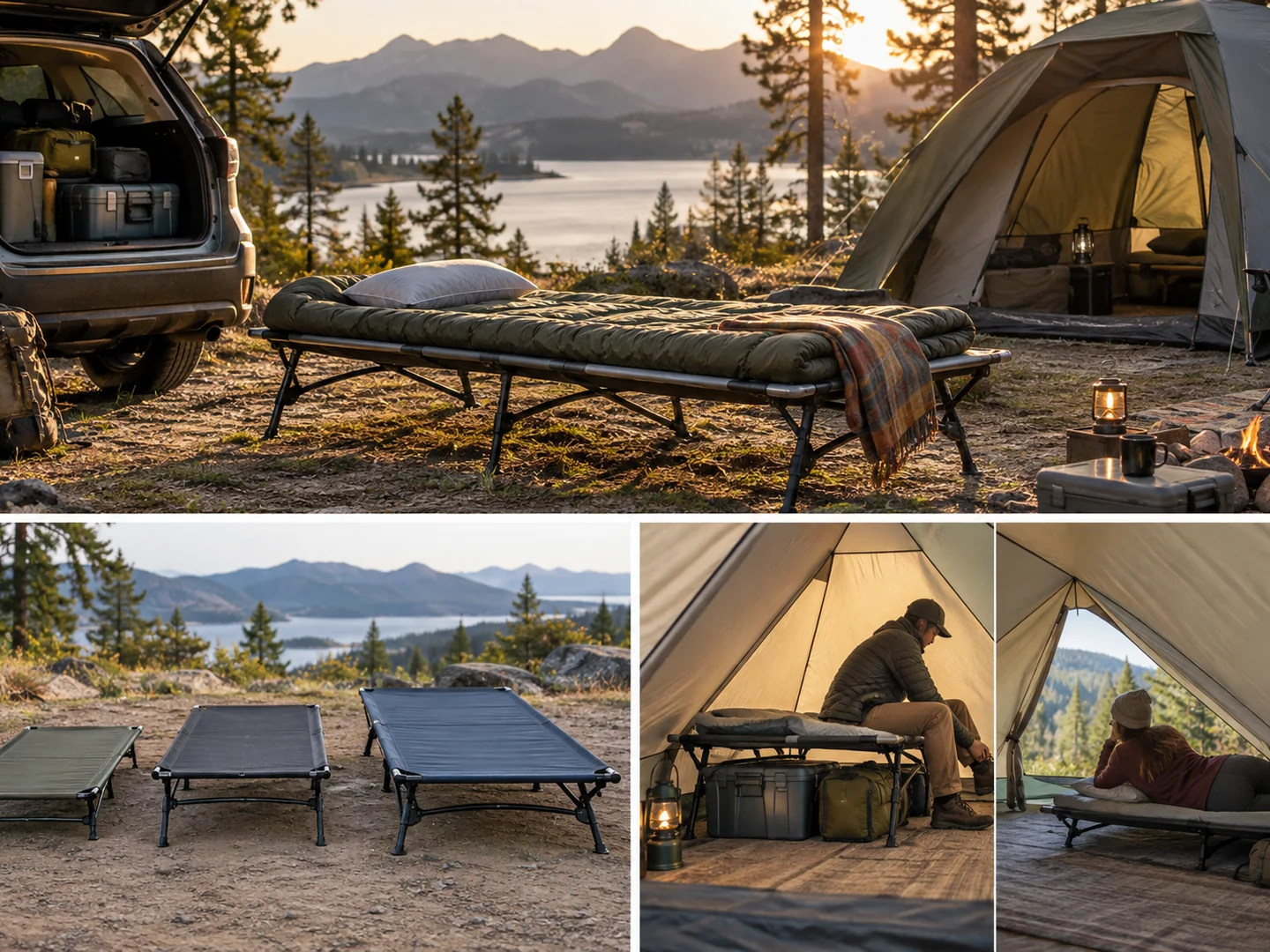
Air moving below an elevated cot can pull heat away from you on cold nights. If temperatures are low, add an insulated sleeping pad or another appropriate insulation layer on top of the cot. Our sleeping-pad R-value guide explains why the pad still matters even when you are off the ground.
The 5 Best Camping Cots for Car Camping
Coleman Pack-Away Cot
The most balanced choice for car campers who want a full-height bed, generous length, useful bedside storage, and a setup that does not require assembling a bag of separate poles.
#1
The Pack-Away earns our top spot because its compromises make sense for the actual car-camping job. At roughly 20 pounds, it is not something you want to carry far, but that barely matters when the cot moves from garage to trunk to a drive-up campsite. What matters more is that it gives an adult a long sleeping surface, keeps you 17 inches off the ground, and does not place a hard end bar directly where your head or feet rest.
The removable side table is more useful than it sounds. A headlamp, glasses, phone, water bottle, and small lantern all need somewhere to live at night. On a bare cot they usually end up under the bed or on the tent floor. Here they stay within reach without adding another piece of camp furniture.
There are two space penalties. First, Coleman lists 44 inches of overall width even though the sleeping area is 32 inches wide, so measure your tent floor before buying. Second, it folds into a chair-bag-like package rather than a compact backpacking bundle. In a sedan packed for a family, that difference can matter.
Pros
- 80-inch sleeping length works for many taller adults
- 17-inch height is easy to sit on and leaves storage space below
- Removable side table with cup holder
- Mostly one-piece fold-open design
Limitations
- Wide overall footprint needs a roomy tent
- Nearly 20 pounds, so it is strictly a short-carry cot
- Leg position should be checked before sitting
- Not the best choice if packed volume is your main constraint
Coleman Trailhead II
A sturdy, inexpensive full-height cot that saves money by keeping the design basic, with one important catch: the final end brace can require real leverage.
#2
If your priority is simply getting off the ground without paying for a premium frame, the Trailhead II is hard to ignore. The steel X-frame supports up to 300 pounds, the 35-inch width is generous for the price class, and the 17-inch height gives you the practical benefits people usually want from a car-camping cot: easier entry and exit plus room underneath for shoes or soft gear.
The setup issue is real enough to change the recommendation. This is not the cot we would buy for someone with limited hand strength or for a camper who hates wrestling with taut fabric. Several owner reports and recent comparison reviews describe using body weight or leverage to connect the last brace, especially when the cot is new.
That annoyance is easier to accept on a budget cot because it happens at camp setup rather than all night. Once the frame is tensioned, the same tight fabric that makes assembly harder also gives the bed a firm, supportive feel.
Pros
- Strong value for a full-size steel cot
- 35-inch width gives more room than many compact cots
- 17-inch height makes getting up easier
- Folds to fit in most car trunks
Limitations
- Final end brace can be difficult to attach
- 21.5 pounds and bulky for anything beyond short carries
- 73-inch length is less suitable for very tall sleepers
- No side table or premium comfort layer
TETON Outfitter XXL Camp Cot
The right answer when normal cots feel cramped or underbuilt, provided you have enough tent floor and vehicle space for an 86-inch-long, 45-inch-wide frame.
#3
The Outfitter XXL is not a slightly larger standard cot. It is a different space commitment. TETON lists an 86-by-45-inch overall footprint and a 19.5-inch height, with a 600-pound rated capacity. That makes it a strong fit for tall campers, heavier sleepers, broad-shouldered side sleepers, or anyone who has felt confined on a narrow military-style cot.
TETON’s pivot arm is the practical detail that keeps this large frame usable. Instead of forcing the tightest crossbar into place by hand, the built-in lever helps tension the final corner. That does not turn a 26-pound cot into a compact system, but it addresses one of the most common frustrations with large tensioned cots.
Before buying, measure the tent, not just the sleeper. Community reports repeatedly note that the XXL can dominate a 4-person tent and may push you toward a 6-person shelter if you also want floor space for gear. Its 45-by-7.5-by-13-inch packed size can also claim a noticeable section of a small crossover or hatchback.
Pros
- 600-pound rated capacity
- Very large footprint and long sleeping surface
- 19.5-inch height makes sitting down and standing up easier
- Pivot arm reduces end-bar wrestling
Limitations
- Requires a genuinely large tent
- 26-pound item weight
- Large packed dimensions compete with other car-camping gear
- Overkill for smaller sleepers who do not need the room
Kelty Lowdown Cot
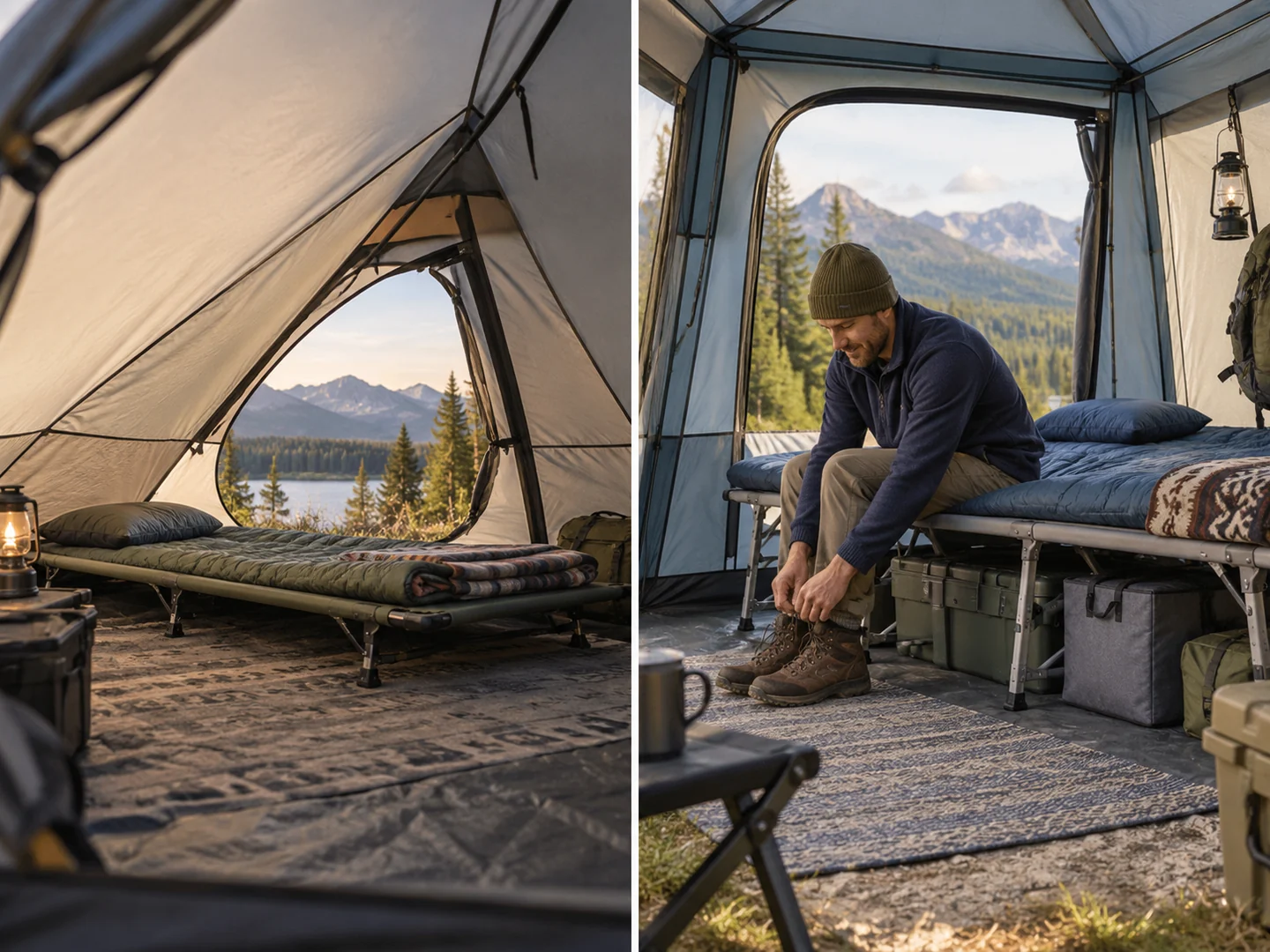
The smart car-camping cot when vehicle space and tent clearance matter more than bed height, with a 7-by-17-inch packed size and a sub-5-pound carry weight.
#4
The Lowdown is the odd one out in this roundup, and that is exactly why it belongs here. Most car-camping cots assume that because a vehicle carries the gear, packed size no longer matters. That is not true when two people, a cooler, a tent, cooking gear, and storage boxes are competing for the same trunk.
Kelty gets the package down to 7 by 17 inches and 4 pounds 12 ounces by using an aluminum frame and a low 6.7-inch platform. That lower profile also helps in tents with sloping walls, where a 17- to 20-inch-high cot can push your sleeping bag into condensation-prone fabric.
The trade is accessibility. A low cot does not give you the chair-like sit height or under-bed storage of the Coleman, TETON, or Byer models. Campers with knee or mobility issues should usually prefer a taller frame even if it weighs more.
Pros
- Very small packed size for the category
- Under 5 pounds but still rated to 300 pounds
- Low profile works better near sloping tent walls
- 27.5-inch width is useful for side sleepers without becoming huge
Limitations
- Low height is harder on knees and reduces storage below
- Multi-piece assembly is slower than fold-open cots
- Some testers report that seating the legs takes force
- Costs more than basic steel car-camping cots
Byer of Maine EasyCot
A straightforward 18-inch-high cot for campers who value near-instant deployment and a stable welded-steel frame more than low weight or a tiny packed package.
#5
Military-style end bars are not the only way to tension a cot. The EasyCot uses an integrated welded-steel leg system that opens from the carry bag with minimal assembly. That makes it especially appealing if you arrive after dark, move camp frequently, or simply dislike the last five minutes of leverage and pinched fingers that some tensioned cots demand.
The 18-inch height is also useful around camp. It is high enough to sit on while pulling on socks or boots, and it creates real volume underneath for duffels, shoes, or soft storage. For car campers who use large cabin-style tents, that can make the whole sleep area feel more organized.
There is no magic in the transport numbers, though. At 21 pounds, this is not a lightweight substitute for the Kelty. It is a convenience-first cot that assumes the vehicle is doing almost all of the carrying.
Pros
- Very fast fold-open setup
- 18-inch height gives good under-bed storage
- 31-inch-wide sleeping surface
- 330-pound rated capacity
Limitations
- 21-pound weight limits it to short carries
- Not especially compact for a crowded vehicle
- No integrated side table
- Costs more than basic steel military-style cots
How to Choose a Camping Cot for Car Camping
1. Measure the tent footprint before comparing comfort
Cot dimensions matter differently from sleeping-pad dimensions because a cot is elevated into the sloping walls of the tent. A frame that technically fits on the floor can still push your sleeping bag or shoulders into wet fabric higher up. Low cots such as the Kelty Lowdown are more forgiving in small dome tents. Tall cots work best in cabin tents and larger shelters with steeper sidewalls.
2. Choose bed height based on mobility and storage
A 17- to 20-inch cot is easier to sit on, easier to stand from, and creates useful storage underneath. A 6- to 8-inch cot is lighter, packs smaller, and fits sloping walls better. If knees or hips make ground-level sleep difficult, height is usually worth more than saving a few pounds.
3. Treat packed size as a vehicle-space problem, not a weight problem
For true car camping, a 20-pound cot can be completely reasonable. The bigger question is whether its packed length and volume still leave room for the tent, cooler, stove, water, chairs, and other bulky gear. If your car is already organized around bins, our guide to camping storage boxes for car camping can help you plan that cargo stack before adding another long bag.
4. Do not confuse a firm cot with a warm sleep system
A taut fabric cot can remove rocks and pressure points, but it has little inherent insulation beneath you. In cool weather, use an insulated pad or other appropriate layer on top. For the broader relationship between bag, pad, and shelter, see our complete sleep-system guide.
5. Decide how much setup friction you will tolerate
Fold-open cots such as the Pack-Away and EasyCot are appealing when you move camp often. Tension-bar designs can be extremely sturdy but may need leverage. Compact aluminum cots save cargo space but require more pieces. None is universally better; the right mechanism is the one you will still be happy to assemble after arriving tired or after dark.
How We Chose These Camping Cots
Gear & Home did not physically test these five cots. We started with the current US search results for car-camping cot queries, then separated backpacking-focused ultralight cots from drive-up models and looked for products that solve meaningfully different buyer problems.
For specifications, we prioritized current manufacturer pages and used current Amazon US listing data to verify exact product identity and variant. We then compared recurring themes across recent professional roundups, owner reviews, and camping-community discussions. A product did not earn an award simply because another publisher gave it one.
Our final matrix emphasized five car-camping factors: usable sleeping space, tent compatibility, setup friction, packed/cargo burden, and support or capacity. That is why this list mixes a nearly 20-pound fold-open Coleman with a sub-5-pound Kelty and a 600-pound-capacity TETON. They are strong choices for different camps, not five versions of the same answer.
FAQ
Are camping cots better than sleeping pads for car camping?
Cots are often better when easy entry, pressure-point relief, or getting off wet and uneven ground matters most. Sleeping pads usually pack smaller and provide clearer insulation ratings. Many comfort-focused car campers use both: a cot for support and elevation, plus an insulated pad for cushioning and cold-weather warmth.
Do you need a sleeping pad on top of a camping cot?
Not always for comfort, but a sleeping pad becomes much more important in cold weather. A cot lifts you into moving air, so insulation below your body still matters. Choose pad insulation for the expected temperature rather than assuming elevation alone will keep you warm.
What cot height is best for a tent?
Choose roughly 17 to 20 inches if you want easy sitting, standing, and under-bed storage in a roomy tent. Choose roughly 6 to 8 inches if your tent has sloping sidewalls, you want lower weight, or cargo space matters more than bed-like height.
Can a cot damage a tent floor?
It can if narrow or sharp feet concentrate weight on thin fabric, especially on hard ground. Clear rocks and sticks, confirm the cot feet are smooth, avoid dragging a loaded cot, and use a footprint or protective floor layer when the tent manufacturer recommends one.
What size tent fits a camping cot?
There is no reliable person-count rule because tent geometry varies. Compare the cot’s full outer footprint with the tent’s floor dimensions, then account for sloping walls and room to enter the bed. Oversized cots such as the TETON Outfitter XXL often need substantially more than the bare floor area shown by the cot dimensions.