
Gear & Home is reader-supported. As an Amazon Associate I earn from qualifying purchases. When you buy through links on our site, we may earn an affiliate commission, at no extra cost to you. Learn more.
Mummy and rectangular sleeping bags solve different problems. A mummy bag uses a tapered cut to reduce the air space your body has to warm and to trim fabric and insulation weight. A rectangular bag gives your shoulders, knees and feet more freedom, usually at the cost of more bulk and lower thermal efficiency for the weight.
Mummy vs rectangular sleeping bag: which is better?
Choose a mummy sleeping bag for backpacking, colder nights or any trip where warmth-to-weight and packed size matter. Choose a rectangular sleeping bag for car camping, mild conditions and sleepers who value room to turn, bend their knees or use the bag open like a blanket.
If you are a restless or side sleeper who still carries your gear, do not jump straight from a mummy to a bulky rectangle. A roomy mummy, semi-rectangular bag or backpacking quilt can preserve much of the packability while giving you more usable space.
Mummy vs Rectangular Sleeping Bags at a Glance
| Decision factor | Mummy bag | Rectangular bag | Who should care most |
|---|---|---|---|
| Warmth efficiency | Better for the same general weight because there is less interior space to heat | More interior air volume and a larger opening can lose heat faster | Cold sleepers, shoulder-season campers, backpackers |
| Freedom to move | More restrictive, especially in narrow performance cuts | More room for knees, feet and position changes | Side sleepers, restless sleepers, comfort-first campers |
| Weight and packed size | Usually lighter and smaller at a comparable warmth target | Usually heavier and bulkier | Anyone carrying the bag in a backpack |
| Head and neck heat control | Often includes a shaped hood and stronger draft-control features | Usually has a broad open top; some models add a hood or draft tube | Campers near or below freezing |
| Warm-weather venting | Varies by zipper design; some do not open fully flat | Often unzips farther and can double as a blanket | Summer and variable-temperature camping |
| Typical sweet spot | Backpacking and cold-weather efficiency | Car camping and roomy comfort | Your transport method is often the easiest tie-breaker |
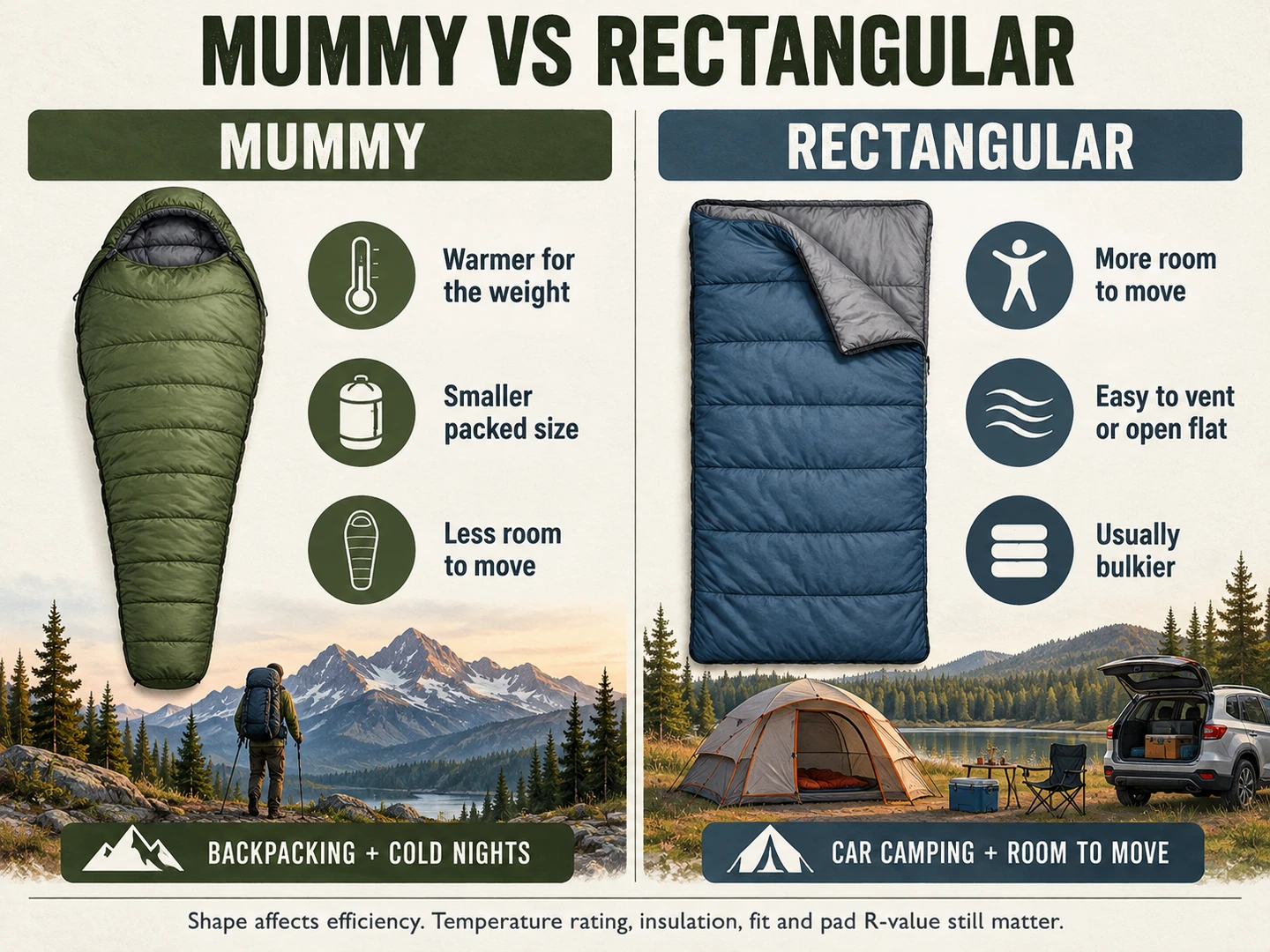
Best for efficiency
More efficient for the weight
More restricted
Usually smaller
Backpacking and colder nights
Best for space
Less efficient for the weight
More room to turn
Usually bulkier
Car camping and mild nights
Shape is only one variable. A well-insulated rectangular bag can be warmer than a lightweight mummy with a milder temperature rating. Compare the exact bag’s tested rating, fit and insulation rather than assuming the silhouette determines the temperature range.
Why Mummy Bags Are Usually Warmer for the Weight
A sleeping bag does not create heat. It traps the heat your body produces. A closer-fitting bag leaves less unused space for your body to warm, and a tapered lower half removes fabric and insulation that would otherwise surround empty space. That is why mummy shapes dominate lightweight backpacking bags.
The advantage becomes more useful as temperatures fall. Many mummy bags also pair their narrow shape with a hood, zipper draft tube and neck collar. Those features can reduce warm-air exchange around the head, neck and zipper. They are separate design features, but they commonly arrive together on performance-oriented mummy bags.
Do not overcorrect by buying the narrowest bag possible. If your shoulders, hips or knees compress the insulation, the bag can lose loft where your body presses against it. A fit that feels comfortably close is more useful than a theoretical efficiency gain from a bag you cannot move in.
Why Rectangular Bags Feel More Comfortable to Many Campers
A rectangle keeps nearly the same width from shoulders to feet. That gives you space to spread your legs, bend a knee and turn inside the bag instead of rotating the whole bag with you. For people who dislike the cocoon feel of a mummy bag, that extra room can matter more than a few saved ounces.
The shape is especially practical when the bag rides in a vehicle. Once you are not carrying the bag for miles, weight and compressed volume become less important. Many rectangular camping bags also unzip far enough to work as a camp blanket, which is useful on warm nights or for lounging around a campsite.
The trade-off is dead space. Your body has to warm more interior air, and a broad top opening can release heat more easily. That does not make rectangular bags “summer only,” but it means you should pay more attention to the exact temperature rating and draft-control design if you camp in cold weather.
What About Side Sleepers and People Who Toss and Turn?
Side sleeping does not automatically mean you need a rectangular bag. The more useful question is whether the bag gives your shoulders, hips and bent knees enough room without compressing the insulation.
Current mummy designs vary widely. Some are narrow tubes built around minimum weight, while others add shoulder and hip room. Community feedback on the same bag can even split between “surprisingly roomy” and “too tight,” which is a reminder that body shape matters as much as the category label.
If a standard mummy feels restrictive, look for a wide mummy, a semi-rectangular or spoon-shaped bag, or a quilt. Those designs sit between the two extremes and can be a better fit for active sleepers who still care about backpacking weight.
Do Not Use Shape as a Substitute for a Temperature Rating
The biggest buying mistake in this comparison is treating “mummy” as a warmth rating. It is not. A bag’s insulation amount, baffle construction, hood and collar design, fit, moisture management and the standard behind its temperature label all matter.
Also remember that the ground is part of the system. Your sleeping bag insulation is compressed under your body, so the sleeping pad provides much of the insulation below you. If you are trying to fix cold nights, check your sleeping pad R-value before assuming a different bag shape will solve the problem.
Backpacking bags often publish ISO comfort and lower-limit figures. Many campground bags use a manufacturer temperature claim instead. A “15°F” mummy and a “30°F” rectangular bag should not be treated as a laboratory-controlled 15-degree head-to-head unless both publish comparable standardized data.
Which Shape Should You Choose?
Choose a mummy sleeping bag if you:
- carry your sleep system in a backpack;
- camp in colder or shoulder-season conditions;
- want the best chance of reducing weight and packed volume;
- like a snug, tucked-in sleeping feel;
- want a shaped hood and stronger draft management.
Choose a rectangular sleeping bag if you:
- mostly car camp or travel where packed bulk is not a major penalty;
- sleep warm or camp mostly in mild conditions;
- feel confined in tapered bags;
- change positions often or like to bend your knees;
- want a bag that can often open flat like a blanket.
Choose something in between if you:
need backpacking efficiency but hate narrow bags. Semi-rectangular and comfort-cut mummy bags deliberately trade a little weight and thermal efficiency for more shoulder, hip or knee room. Quilts go farther by removing the insulated underside and relying on the sleeping pad, which can offer excellent freedom but requires more attention to drafts and pad attachment.
If backpacking is your main use, our best ultralight sleeping bags guide compares current lightweight options. For the bigger picture, see our complete backpacking sleep system guide.
Two Current Examples You Can Check on Amazon
These are representative examples, not an apples-to-apples product shootout. The Sea to Summit Spark 15 shows what a weight-focused mummy design can do. The Coleman Brazos 30°F shows the priorities of a traditional rectangular campground bag. Their temperature labels are not directly comparable because the manufacturers present rating information differently.
Sea to Summit Spark 15, Regular
A technical mummy that makes the shape’s strengths obvious: low weight, small compressed volume and strong warmth-to-weight, with less blanket-like ventilation than a rectangle.
The Spark 15 Regular uses 850+ fill-power goose down, a technical hood and zipper draft tube. Sea to Summit lists the current 15°F Regular at 25.7 ounces and 6.8 liters compressed, with an ISO comfort rating of 28°F and ISO lower rating of 16°F. That is the sort of specification set that explains why backpackers accept a more fitted shape.
Its trade-off is equally representative. A performance mummy does not give you the open, comforter-like feel of a rectangular bag, and ultralight shell fabrics demand more care around rough ground, pets and sharp gear.
Coleman Brazos 30°F, PFAS-Free
A traditional car-camping rectangle that favors simple comfort, full-length space and easy care over backpack-friendly packed volume.
Coleman lists the current Brazos 30°F at 75 by 33 inches for campers up to 5 feet 11 inches, with a zipper draft tube, included stuff sack and the ability to zip two compatible bags together. The current Amazon child listing we verified is the PFAS-Free 30°F variant.
Do not read “rectangular” as “huge.” Some broader owners still report that the 33-inch width feels tight around the shoulders. Shape and actual dimensions both matter, which is why a roomy mummy can sometimes fit a particular sleeper better than a narrow rectangle.
How We Reached This Verdict
Gear & Home does not present this comparison as first-party field testing. We separated category-level shape differences from product-specific claims, then cross-checked current manufacturer guidance, current Amazon US listings, recurring owner feedback, community fit discussions and independent gear reviews.
Frequently Asked Questions
Are mummy sleeping bags warmer than rectangular sleeping bags?
Usually, a mummy shape is more thermally efficient for the weight because it reduces unused interior volume and often includes a fitted hood and stronger draft control. That does not mean every mummy bag is warmer than every rectangular bag. Compare the exact insulation and temperature rating.
Are rectangular sleeping bags better for side sleepers?
They often feel less restrictive because they leave more room around the hips, knees and feet. However, a roomy mummy or semi-rectangular bag can work very well for side sleepers who still need backpacking-friendly weight and packed size.
Can you backpack with a rectangular sleeping bag?
Yes, but it is usually a compromise. Traditional rectangular bags tend to use more material and pack larger, so they make the most sense when comfort matters more than carried weight. For regular backpacking, a roomy mummy, semi-rectangular bag or quilt is usually easier to pack.
Why do backpackers use mummy sleeping bags?
The tapered shape saves material, reduces packed bulk and leaves less interior air to warm. Those advantages align with backpacking priorities, where every ounce and liter of pack volume matters more than it does at a drive-in campsite.
Can a rectangular sleeping bag be warm in cold weather?
Yes. Shape affects efficiency, not the absolute temperature capability of every bag. A heavily insulated rectangular bag can be built for cold conditions, but it may need more insulation and weight to offset the extra interior space and broad opening.
What is a semi-rectangular sleeping bag?
A semi-rectangular bag, sometimes called a modified mummy or barrel shape, sits between the two extremes. It trims some space and weight compared with a full rectangle while giving the sleeper more room than a narrow mummy.
Should I buy a sleeping bag based on the temperature number in its name?
No. Check whether the manufacturer publishes ISO comfort and lower-limit ratings or only a manufacturer claim, then match that data to your sleeping style and expected conditions. Your clothing and sleeping-pad R-value also affect the warmth of the complete system.