
Gear & Home is reader-supported. As an Amazon Associate I earn from qualifying purchases. When you buy through links on our site, we may earn an affiliate commission, at no extra cost to you. Learn more.
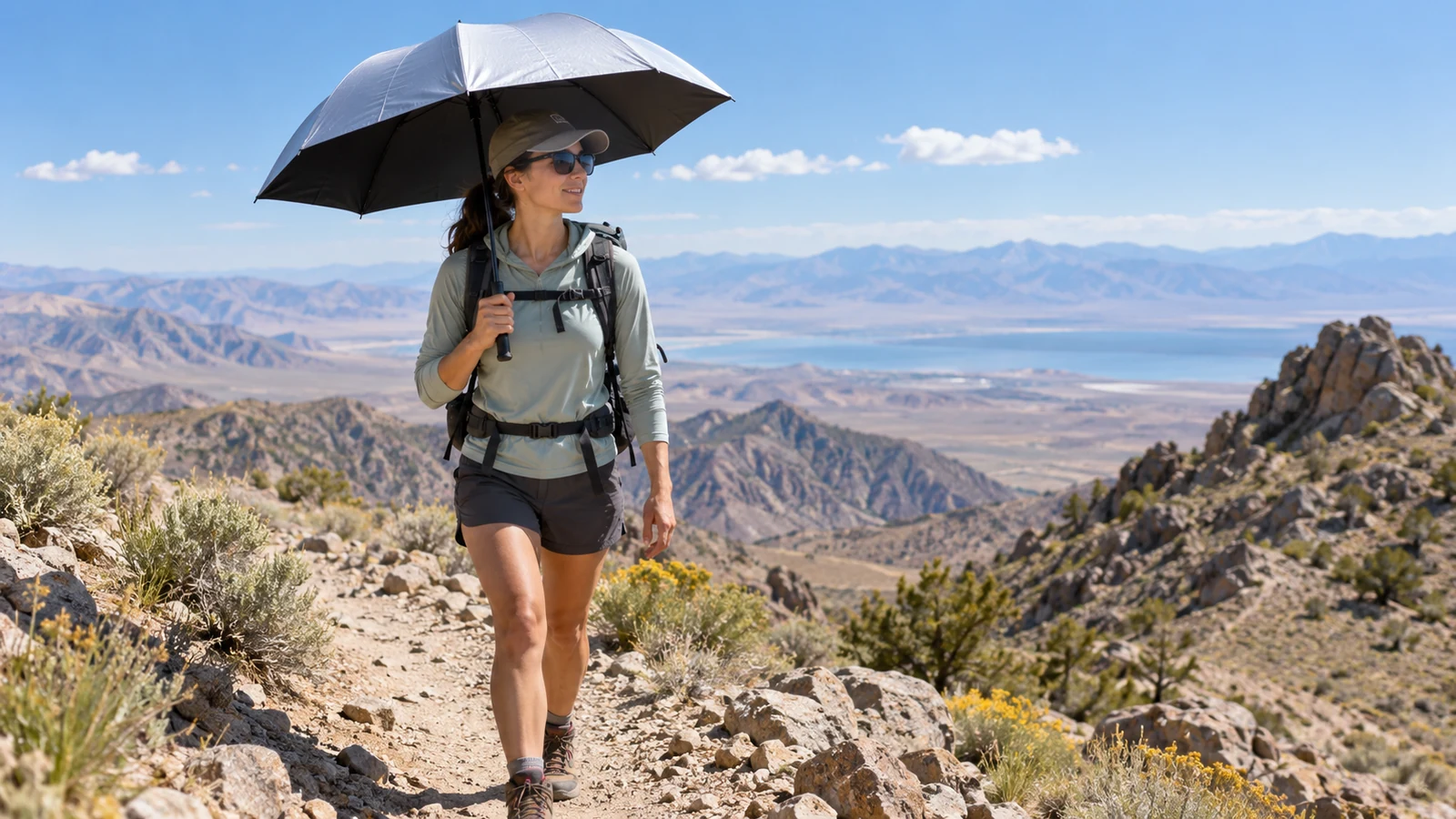
A hiking umbrella earns its pack space when it can handle two jobs that clothing does not combine especially well: portable shade in exposed sun and quick rain coverage without wrapping your upper body in a shell. The tradeoff is wind. The lighter and more collapsible the umbrella, the more carefully you need to choose when to deploy it.
For this guide we kept the category focused on umbrellas that make sense in a hiking pack, not ordinary commuter umbrellas or oversized golf models. The four picks below separate the main decisions clearly: rigid versus folding, reflective shade versus basic UV protection, minimum weight versus frame simplicity, and premium versus budget.
The best hiking umbrella for rain and sun
The Six Moon Designs Silver Shadow Carbon is our Best Overall pick. It weighs 6.8 ounces, opens to 37 inches, carries a UPF 50+ silver-reflective canopy and uses a rigid carbon-fiber shaft and ribs. That combination gives it the best balance here for hikers who want meaningful sun protection and rain coverage without the extra joints of a folding umbrella.
Choose the standard Silver Shadow if value matters more than saving 2.1 ounces. Choose the Silver Shadow Mini if a 10-inch packed length matters more than rigid-shaft simplicity. The G4Free 43-inch Mini is the budget ultralight option for shade and gentle-weather backup, but its own listing warns that the light six-rib structure has limited resistance to wind and rain.
Quick Picks
Six Moon Designs Silver Shadow Carbon
Best balance of 6.8 oz weight, rigid simplicity and reflective UPF 50+ coverage.
Six Moon Designs Silver Shadow
Same 37-inch reflective canopy concept with a heavier fiberglass frame and lower entry cost.
Six Moon Designs Silver Shadow Mini
Folds to 10 inches while keeping a 38-inch open width and 6.8-ounce listed weight.
G4Free 43-inch Mini Travel Umbrella
A 4-ounce, 10-inch folding option for sun and light rain when cost and packability lead.
Best Hiking Umbrellas Compared
| Pick | Listed weight | Packed length | Canopy / open width | Sun protection | Frame | Best for | Amazon |
|---|---|---|---|---|---|---|---|
| Silver Shadow Carbon Best Overall |
6.8 oz / 193 g | 25 in | 37 in open width | UPF 50+, reflective | Carbon fiber | Backpacking in exposed sun and mixed rain | Check availability on Amazon |
| Silver Shadow Best Value |
8.9 oz / 252 g | 25 in | 37 in open width | UPF 50+, reflective | Fiberglass | Hikers who prefer simple construction over minimum weight | Check availability on Amazon |
| Silver Shadow Mini Best Compact |
6.8 oz / 193 g | 10 in | 38 in open width | UPF 50+, reflective | Carbon fiber / aluminum ribs, aluminum shaft | Small packs, travel and bikepacking | Check availability on Amazon |
| G4Free 43-inch Mini Best Budget Ultralight |
4 oz listed | 10 in listed | 43 in listed canopy | UPF 50+ coating | Carbon ribs / aluminum shaft | Low-cost shade and gentle-weather backup | Check availability on Amazon |
Six Moon Designs Silver Shadow Carbon
6.8 oz
25 in
37 in
UPF 50+ reflective
Six Moon Designs Silver Shadow
8.9 oz
25 in
37 in
Fiberglass
Six Moon Designs Silver Shadow Mini
6.8 oz
10 in
38 in
UPF 50+ reflective
G4Free 43-inch Mini Travel Umbrella
4 oz listed
10 in listed
43 in listed
Gentle conditions
Brand measurement methods are not always identical, so the canopy figures above should not be treated as laboratory-equivalent diameters. The useful comparison is the design role: the Silver Shadow models are hiking-specific reflective umbrellas, while the G4Free prioritizes minimum packed weight and size.
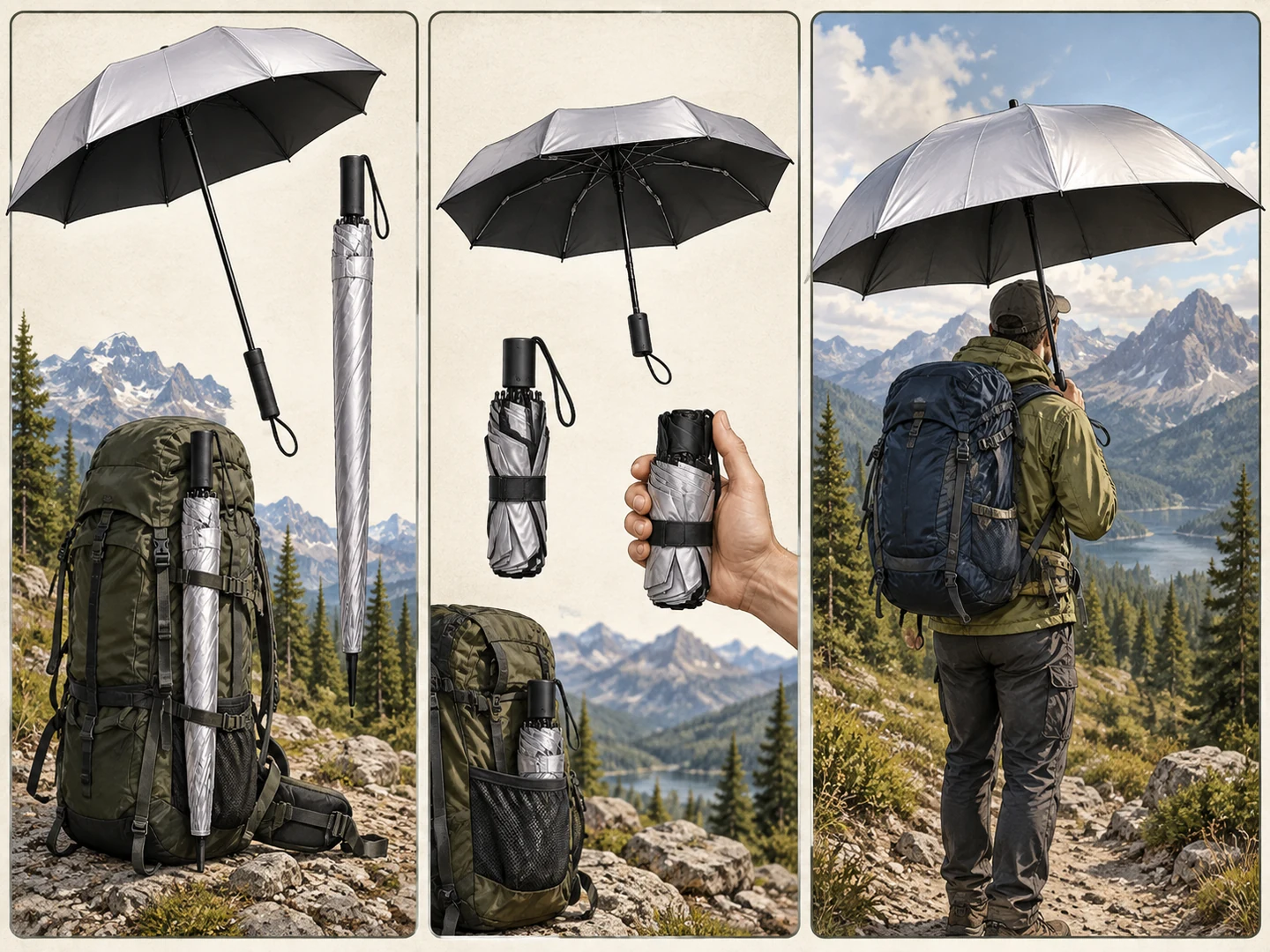
On exposed ridges, in strong gusts, dense brush or technical terrain, a fitted rain jacket is easier to control and leaves both hands available. An umbrella works best as movable shade and ventilation-friendly rain coverage when the trail and wind allow it. If your route is regularly cold and exposed, start with a shell system rather than trying to make an umbrella do every job.
The 4 Best Hiking Umbrellas for Rain and Sun
Six Moon Designs Silver Shadow Carbon
The strongest all-around fit here for hikers who want reflective shade and rain coverage at a low weight without a folding shaft.
#1
The Carbon is the version that makes the Silver Shadow concept easiest to justify in a backpack. It keeps the same 7.5-square-foot listed coverage as the standard model but replaces the fiberglass shaft and ribs with carbon fiber, dropping the listed weight from 8.9 to 6.8 ounces.
The fixed 25-inch shaft is the main trade. It will not disappear inside a small daypack, but it also avoids the telescoping joints and extra deployment steps of a folding umbrella. For backpacking, that is often the better exchange if you strap the umbrella along the outside of the pack.
The reflective silver top and black underside make this a shade-first design as well as a rain umbrella. Six Moon Designs lists UPF 50+ and a 5,000 mm water column for the 210T polyester canopy. Those are useful category signals, but neither should be read as a promise that the umbrella replaces sunscreen, clothing coverage or a storm shell in every condition.
Pros
- 6.8-ounce listed weight with rigid carbon frame
- Reflective UPF 50+ canopy for exposed sun
- 37-inch open width without folding-shaft complexity
- Optional hands-free attachment system available
Limitations
- 25-inch packed length is awkward inside small packs
- Costs more than the fiberglass version
- Umbrella coverage is still sensitive to wind direction
- Hands-free fit depends on pack geometry and positioning
Six Moon Designs Silver Shadow
The sensible choice when you want the same reflective 37-inch coverage concept and prefer to save money rather than 2.1 ounces.
#2
The standard Silver Shadow is not the pick for a spreadsheet that ranks only by ounces. It is 2.1 ounces heavier than the Carbon, and both pack to the same 25-inch length. What it preserves is the part of the design that matters most for sun and rain: the 37-inch silver-reflective canopy with a black underside.
The fiberglass shaft and ribs also keep the construction mechanically simple. That matters because an umbrella can fail at joints and stretchers, not just in the canopy. The standard model avoids a telescoping shaft, so its weight penalty buys a straightforward fixed structure rather than extra features.
For day hikes, occasional backpacking and hikers who do not mind another two ounces, this is the easiest value call in the lineup. The Carbon is better for weight-conscious long-distance use, but the standard Silver Shadow gives up very little in actual shade footprint.
Pros
- Same 37-inch reflective canopy dimensions as the Carbon
- UPF 50+ sun protection and rain-focused coating
- Simple rigid fiberglass construction
- Better value if a 2.1-ounce difference is not important
Limitations
- Heaviest pick in this shortlist at 8.9 ounces
- Still 25 inches long when closed
- Not a hands-free solution unless you add a compatible mount
- Strong gusts can still make an umbrella the wrong tool
Six Moon Designs Silver Shadow Mini
The compact choice when a 10-inch packed length matters enough to justify a telescoping shaft and more moving parts.
#3
The Mini solves the Carbon’s biggest packing annoyance. At 10 inches closed, it is short enough for many side pockets, travel bags and smaller daypacks, yet Six Moon Designs lists a 38-inch open width and the same 7.5-square-foot coverage figure.
That packability is not free. The Mini uses carbon-fiber and aluminum ribs with an aluminum shaft rather than a one-piece carbon structure. More joints mean more deployment steps and more components that can loosen or catch over time. That does not make the Mini fragile by definition, but it changes the durability equation.
The manufacturer currently includes an EVA replacement grip in addition to the compact plastic handle. That can improve comfort and compatibility with the optional hands-free kit, but owner feedback shows that getting any hands-free umbrella positioned correctly depends heavily on the backpack and user.
Pros
- 10-inch packed length is dramatically easier to stow
- Same 6.8-ounce listed weight as the Carbon
- 38-inch open width and UPF 50+ reflective canopy
- Good fit for travel, bikepacking and smaller packs
Limitations
- More moving joints than a fixed-shaft umbrella
- Less direct to deploy than the rigid Silver Shadow models
- Hands-free mounting can require trial and adjustment
- Compactness does not make it a high-wind umbrella
G4Free 43-inch Mini Travel Umbrella
A very light, inexpensive shade and light-rain backup for gentle conditions, not a substitute for a sturdier trekking umbrella when wind matters.
#4
The G4Free belongs here because it is honest about a different use case. It is an ultralight travel umbrella that can cross over into hiking, not a rigid trekking umbrella designed around exposed-trail durability. Its 4-ounce listed weight and 10-inch folded length make it easy to carry as just-in-case shade.
The current Amazon US variant uses a UPF 50+ coated polyester canopy, carbon-fiber ribs and an aluminum shaft. The product listing describes it for light rain and gentle breeze conditions and specifically notes the limits of the six-rib structure. That warning is more useful than a generic windproof claim because it tells you exactly where the low weight comes from.
For a hot, mostly calm day hike or travel-heavy itinerary, that can be a smart trade. For a windy desert ridge or a long route where the umbrella is a core part of your weather system, the Silver Shadow Carbon is the more appropriate category choice.
Pros
- Very low 4-ounce listed weight
- 10-inch folded length fits small bags easily
- UPF 50+ coated canopy
- Lower-cost entry into hiking with an umbrella
Limitations
- Manufacturer limits it to gentle wind and light rain
- Six-rib folding structure gives less wind margin
- Not designed as a dedicated long-distance trekking umbrella
- Canopy measurement method is not directly comparable with SMD open-width figures
How to Choose a Hiking Umbrella
Fixed shaft or folding: decide where the umbrella will ride
A fixed-shaft umbrella is long but simple. The Silver Shadow Carbon and standard Silver Shadow both close to 25 inches, which usually means carrying them in an exterior pack pocket or under compression straps. A folding model is easier to hide inside a pack, but the telescoping shaft and folding ribs add moving parts. If your pack has secure exterior storage, rigid simplicity is usually the better hiking trade. If every item must fit inside a small bag, the Mini is easier to live with.
For sun, look beyond the word “UV”
UPF tells you how much ultraviolet radiation a fabric blocks; it does not tell you everything about how the shade will feel. The Silver Shadow family uses a silver-reflective outer surface with a black underside specifically for sun exposure, while the G4Free uses a coated UPF 50+ fabric in a compact travel design. For long, exposed desert walking, a hiking-specific reflective canopy is the more purpose-built choice.
Wind exposure should decide whether you carry an umbrella at all
Umbrellas create a broad surface for wind to push. A sturdier frame can improve usability, but no lightweight umbrella turns an exposed ridge in strong gusts into an easy environment. If your route is routinely windy, cold or technical, a backpacking rain jacket is the more controllable primary layer. Treat the umbrella as an optional layer for conditions where it makes sense.
Do not compare canopy numbers without checking how brands measure them
One brand may publish open width, another canopy arc, and another overall diameter. A bigger number on a product page is not automatically a bigger usable shadow. More useful questions are whether the canopy covers your head and shoulders, whether the shaft length works with your pack, and whether the umbrella is stable enough for your normal trail conditions.
Hands-free mounting helps, but it is not universal
A hands-free kit can keep both hands available for trekking poles, but the result depends on shoulder-strap shape, sternum-strap position, torso length and the angle needed to block sun or rain. Six Moon Designs sells a compatible mounting kit, yet owner feedback is mixed on how easy it is to dial in. If hands-free use is essential, treat pack compatibility as a fit check rather than an automatic feature.
Build the umbrella into a rain system
An umbrella gives excellent ventilation because it does not seal your torso, but it also leaves parts of the body exposed to wind-driven rain. Warm-weather hikers may pair one with quick-dry clothing or a light wind layer. For colder or sustained rain, combine it with a shell or consider a backpacking rain poncho. If lower-body protection matters, our rain pants guide covers the next part of the system.
How We Chose These Hiking Umbrellas
The current search results are clearly commercial: people searching for the best hiking umbrella are comparing products, not asking for a general explanation of rain gear. Gear & Home does not currently have a competing umbrella roundup, so this page can own that decision without duplicating the rain-jacket or poncho pages.
Manufacturer pages were used for Silver Shadow weights, dimensions, materials, UPF ratings and listed water-column figures. The exact Amazon page was used for the G4Free variant.
Every Amazon CTA in this package maps to a specific Amazon.com US ASIN. The article does not publish a static price, discount, star rating or review count.
Owner reviews, hiking-community discussions and independent roundups were compared for recurring themes such as sun comfort, packed length, folding complexity, wind behavior and hands-free fit.
Awards are based on role separation, not borrowed rankings: overall balance, value, compact packing and budget ultralight use each solve a different buyer problem.
FAQ
What is the best hiking umbrella for rain and sun?
The Six Moon Designs Silver Shadow Carbon is our best overall pick because it combines a 6.8-ounce listed weight, 37-inch open width, reflective UPF 50+ canopy and rigid carbon-fiber frame. The standard Silver Shadow is better value, while the Mini is easier to pack.
Are hiking umbrellas worth carrying?
They can be on exposed, sunny trails and in warm rain because they create portable shade and let air move around your torso. They are less useful in strong wind, dense brush and technical terrain, where a fitted shell is easier to control.
Is a hiking umbrella better than a rain jacket?
Not universally. An umbrella gives much more ventilation and can cover your head and upper body without trapping as much heat, but a rain jacket is more predictable in wind, cold rain, brush and scrambling. Many hikers use an umbrella as an extra option rather than a complete shell replacement.
Do hiking umbrellas work in wind?
They work best in light to moderate wind when you can angle the canopy and the trail gives you room to manage it. Strong or shifting gusts can overpower even a sturdy hiking umbrella. Lightweight folding models generally deserve the most conservative wind expectations.
Is a reflective umbrella better for hiking in the sun?
A reflective outer canopy is purpose-built to reduce incoming solar energy, while a UPF rating describes ultraviolet protection through the fabric. For long exposed hiking, a reflective UPF-rated canopy is a more specialized sun solution than a basic dark rain umbrella.
Should I choose a fixed or folding hiking umbrella?
Choose a fixed shaft if you can carry a 25-inch umbrella outside the pack and want fewer moving parts. Choose a folding model if compact storage matters more. The Silver Shadow Mini folds to 10 inches, but its telescoping construction is more complex than the rigid Carbon or standard Silver Shadow.
Can I use trekking poles with a hiking umbrella?
Yes, but you either need one free hand or a compatible hands-free mount. Mounting success depends on your backpack straps, torso fit and the angle needed for sun or rain, so hands-free compatibility should be checked with your actual pack.