
Gear & Home is reader-supported. As an Amazon Associate I earn from qualifying purchases. When you buy through links on our site, we may earn an affiliate commission, at no extra cost to you. Learn more.
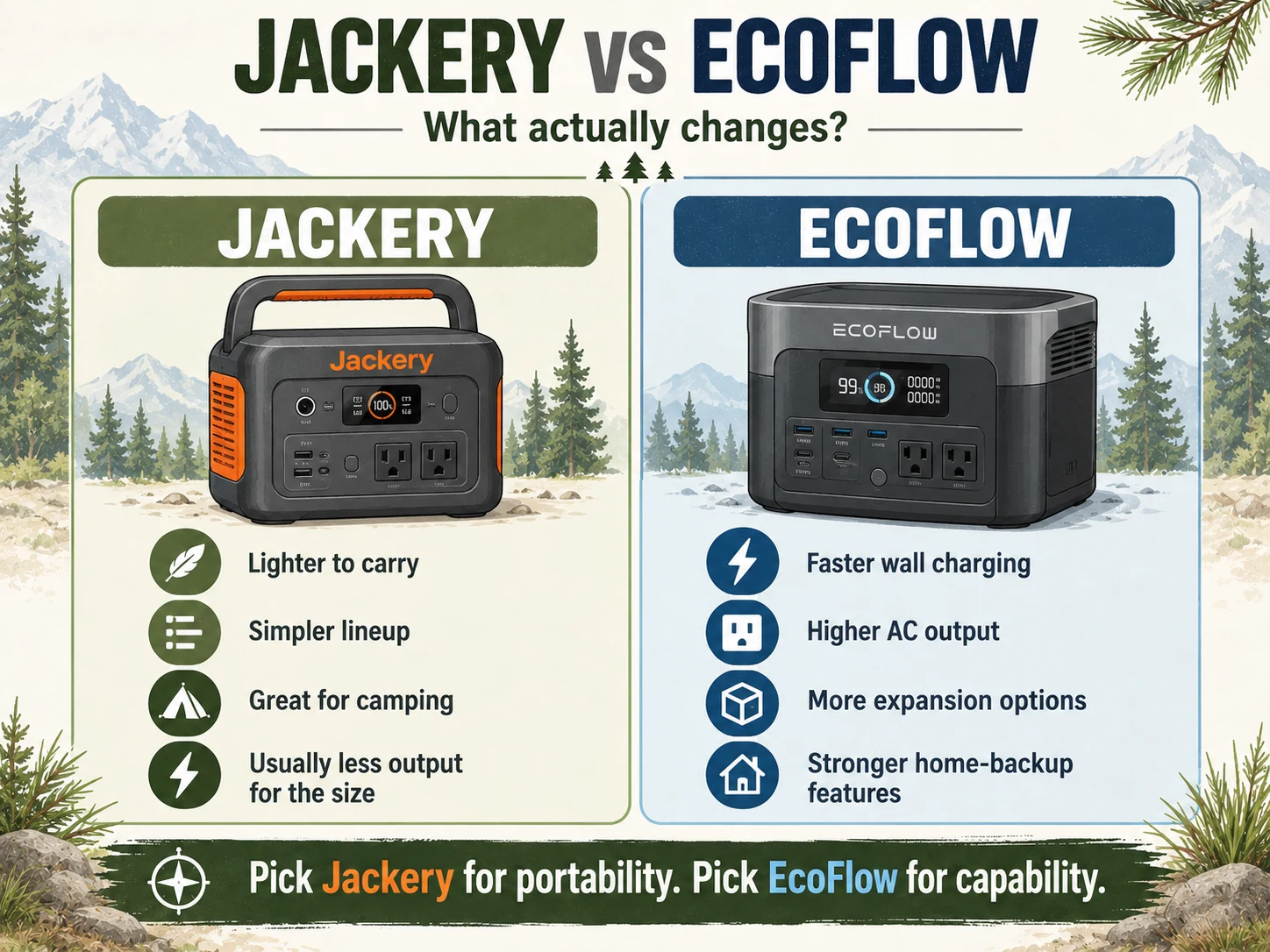
Jackery and EcoFlow now overlap at nearly every useful portable-power size, but they still optimize for different buyers. Jackery’s current v2 stations put a premium on lower carry weight and straightforward operation. EcoFlow pushes harder on inverter output, recharge speed, solar input, expansion and backup features.
EcoFlow is better overall for capability; Jackery is better for portability
Choose EcoFlow if this may become part of a home-backup, RV or higher-demand off-grid system. In the three matched classes below, EcoFlow gives you higher rated AC output, faster wall charging and stronger expansion or smart-backup tools.
Choose Jackery if you will carry the station frequently and your loads fit comfortably inside its inverter limit. The Explorer 300 v2, 1000 v2 and 2000 v2 are all lighter than the EcoFlow models we matched at similar capacity.
The important qualification is that brand alone is not the purchase decision. A 300Wh station and a 2kWh station can wear the same logo while serving completely different jobs. This guide compares current-generation models in three capacity classes, then separates the brand-level differences that actually matter: charging, solar, output, battery life, app control, UPS behavior, expandability, warranty and portability.
Jackery vs EcoFlow at a glance
If you only want the shortest possible answer, start here. These are brand tendencies reflected by the current models compared in this guide, not promises that every product in either catalog behaves the same way.
| Decision area | Jackery | EcoFlow | Who has the edge? |
|---|---|---|---|
| Camping portability | Lighter in all three matched tiers | Heavier in the matched tiers, but with more output | Jackery |
| AC output | 300W / 1,500W / 2,200W | 600W / 1,800W / 3,000W | EcoFlow |
| Wall recharge | Fast, but generally slower in these matched models | About 60 min for RIVER 3 Plus; 56 min for DELTA 3 Plus | EcoFlow |
| Solar input | 100W / 400W / 400W | 220W / 1,000W / 1,000W | EcoFlow |
| Expansion | Limited on the three v2 models compared here | RIVER 3 Plus and DELTA 3 Plus support extra capacity | EcoFlow |
| UPS / backup switching | 10ms on 300 v2; under 20ms on 2000 v2 | Under 10ms on current RIVER 3 Plus and DELTA models here | EcoFlow for backup-first use |
| App dependence | 300 v2 has no app; larger v2 models add app features | App is central to the smart-feature experience | Jackery for simplicity; EcoFlow for control |
| Battery chemistry | LiFePO4 on all three matched current models | LiFePO4 on all three matched current models | Tie |
| Warranty | 3+2 years on these current v2 models when terms are met | 5 years on RIVER 3 Plus and DELTA 3 Plus; DELTA 3 Max Plus is 3+2 with app registration | Read exact model terms |
| Best fit | Camping, frequent carrying, simpler power needs | Home backup, RV, solar-heavy, high-output and expandable systems | Depends on use |
Jackery
EcoFlow
EcoFlow
Jackery
Which Jackery and EcoFlow models should you compare?
Brand comparisons get misleading when one side quietly uses a larger or older station. The fairest way to see the trade-offs is to match current models by stored energy. We use three practical classes: around 300Wh, around 1kWh and around 2kWh.
Small class: Jackery Explorer 300 v2 vs EcoFlow RIVER 3 Plus
Pick the Jackery if carrying weight is the priority. Pick the EcoFlow if AC output matters more. Capacity is nearly identical at 288Wh versus 286Wh, but the design priorities split immediately: Jackery is about 8.2 lb with a 300W inverter, while EcoFlow is 10.4 lb with 600W rated AC output.
Jackery Explorer 300 v2
288Wh, 300W rated output, 8.16 lb, 100W max solar input and 1.5-hour AC charging. It also has a 10ms UPS function, but no app control or extra-battery support.
EcoFlow RIVER 3 Plus
286Wh, 600W rated output, 10.4 lb, 220W solar input, one-hour AC charging, under-10ms UPS and app control. Capacity can also be expanded with compatible extra batteries.
1kWh class: Jackery Explorer 1000 v2 vs EcoFlow DELTA 3 Plus
This is the most useful head-to-head for many campers, van travelers and emergency-backup buyers. Jackery stores slightly more energy and weighs less. EcoFlow supplies more AC power, recharges faster from the wall, accepts much more solar and supports expansion.
Jackery Explorer 1000 v2
1,070Wh, 1,500W rated output, 3,000W surge, 23.8 lb and 400W max solar input. Standard AC charging is about 1.58 hours; its app can enable a one-hour emergency charging mode.
EcoFlow DELTA 3 Plus
1,024Wh, 1,800W rated output, 3,600W surge, about 27.6 lb, 1,000W solar input, 56-minute AC charging and expansion up to 5kWh with compatible batteries.
The practical decision: if 1,500W comfortably covers your fridge, laptop, CPAP, lights and occasional kitchen gear, saving about 3.8 lb is useful. If you expect induction cooking, larger tools, fast solar recovery or future battery expansion, the DELTA 3 Plus gives you more room to grow.
2kWh class: Jackery Explorer 2000 v2 vs EcoFlow DELTA 3 Max Plus
The capacity gap nearly disappears here: 2,042Wh versus 2,048Wh. What changes is the hardware around the battery. Jackery is much easier to move. EcoFlow gives substantially more inverter output and solar input.
Jackery Explorer 2000 v2
2,042Wh, 2,200W rated output, 4,400W surge, about 39.5 lb, 400W max solar input and under-20ms backup switching. The current unit uses LiFePO4 cells rated for 4,000 cycles to 70%+ capacity.
EcoFlow DELTA 3 Max Plus
2,048Wh, 3,000W rated output, 6,000W surge, about 48.7 lb, 1,000W max PV input, under-10ms UPS and Wi-Fi/Bluetooth control. EcoFlow lists a 5-year warranty with the final two years tied to app registration.
If you regularly lift a 2kWh station into a vehicle, the roughly 9 lb difference matters. If the station mostly stays in a garage, van or basecamp, the EcoFlow’s higher AC and solar ceilings are usually more valuable than the weight savings.
Where EcoFlow is better
1. Higher inverter output in the matched models
Rated output decides what the station can run at all. In our matched pairs, EcoFlow moves from 600W to 1,800W to 3,000W, while Jackery moves from 300W to 1,500W to 2,200W. That difference matters more than a small capacity advantage when your appliance draw is close to the inverter limit.
Do not confuse surge or X-Boost marketing with continuous rated output. Temporary overload features can help with some startup loads, but your normal planning number should still be the station’s rated AC output and the actual wattage of the device you intend to run.
2. Faster recharge when access to power is brief
EcoFlow’s current RIVER 3 Plus can recharge from AC in about an hour, and DELTA 3 Plus is rated for 0-100% in 56 minutes. Jackery’s v2 line is no longer slow by older portable-power standards, but the matched 1000 v2 takes about 1.58 hours in its standard AC mode and the 2000 v2 about 1.7 to 2 hours depending on the charging mode and source.
This is a meaningful advantage if you recharge during a short campground-generator window, between outages, at a coffee shop during van travel or whenever an hour of grid access is more realistic than several hours.
3. Much stronger solar intake at larger capacities
The 1kWh and 2kWh EcoFlow models in this comparison accept up to 1,000W of PV input. The matched Jackery 1000 v2 and 2000 v2 top out at 400W. Real solar output varies with weather, panel angle, temperature and controller limits, but the input ceiling still determines how much useful sun the station can accept when conditions are good.
4. Better path to expansion and a smarter backup system
EcoFlow makes more sense when the first purchase may become a larger system. RIVER 3 Plus supports compatible add-on batteries, while DELTA 3 Plus can expand into a multi-kWh setup. EcoFlow also leans heavily into app controls and fast UPS switching. That makes the ecosystem attractive for routers, NAS devices, home-office gear and backup scenarios where the station may remain plugged in and managed rather than simply carried to camp.
Where Jackery is better
1. Weight and portability
This is Jackery’s clearest advantage in the current matched line. Explorer 300 v2 is roughly 2.2 lb lighter than RIVER 3 Plus. Explorer 1000 v2 saves about 3.8 lb versus DELTA 3 Plus. Explorer 2000 v2 saves about 9.2 lb versus DELTA 3 Max Plus.
That may not matter for a station that lives under a workbench. It matters every time you lift one over a tailgate, carry it down a campsite path, move it between an RV and picnic table, or pack and unpack several pieces of heavy gear at once.
2. Simpler camping-first operation
The Explorer 300 v2 is a useful example of Jackery’s simpler end of the spectrum: the current support documentation lists no app control and no expansion-battery support. It is still modern where it counts, with LiFePO4 cells, USB-C, fast AC charging and a 10ms UPS function, but there is less software to configure.
The larger Jackery v2 models do add app connectivity and charging modes, so it would be wrong to call Jackery an app-free brand. The distinction is that EcoFlow generally makes the app and system integration a bigger part of the product proposition.
3. High capacity without 50-pound-class carry weight
At roughly 2kWh, the Explorer 2000 v2 is a particularly strong choice for buyers who need meaningful stored energy but still move the unit frequently. You give up inverter and solar headroom relative to DELTA 3 Max Plus, but 39.5 lb is materially easier to handle than about 48.7 lb.
Battery life: both are LiFePO4, and the cycle numbers are not directly comparable
Older Jackery vs EcoFlow articles often hinge on battery chemistry because older product generations mixed NMC and LiFePO4. That is a poor shortcut for the current models compared here. All six use LiFePO4 cells.
Jackery rates these v2 batteries at 4,000 cycles to at least 70% remaining capacity. EcoFlow rates RIVER 3 Plus at 3,000 cycles to 80%, while the DELTA 3 family is rated around 4,000 cycles to 80%. Those thresholds are different. A raw cycle count to 70% cannot be treated as equivalent to a cycle count to 80%, so we would not name a battery-longevity winner from those numbers alone.
Which is more reliable, Jackery or EcoFlow?
There is not enough defensible evidence for a brand-wide reliability winner. Both brands have large installed bases, long warranties on the current models here and owner reports ranging from trouble-free use to frustrating support or RMA experiences.
The most recurring qualitative difference is complexity. EcoFlow offers more software controls and system features, and owner communities also contain recurring posts about firmware, app connectivity and troubleshooting. Jackery’s simpler models reduce that software surface, although Jackery owners also report support and hardware problems. Neither pattern proves that one brand fails more often across the whole line.
For a high-ticket purchase, buy the exact model you need from a seller with a clear return process, register any warranty extension promptly, and keep the product serial information and purchase record. Reliability is easier to manage when a problem is simple to document and return.
Solar panels: can you use Jackery panels with EcoFlow, or EcoFlow panels with Jackery?
Sometimes, but do not assume plug-and-play compatibility. The station’s input voltage range, current limit, connector and polarity all need to match. Jackery’s current v2 units use DC8020-family inputs, while EcoFlow commonly uses XT60 or XT60i on its solar side.
Jackery states that third-party panels can work when connector size and open-circuit voltage are compatible, but it does not guarantee third-party compatibility. EcoFlow manuals likewise allow compatible solar input within the station’s electrical and port limits. In practice, cross-brand use may require the correct adapter cable and careful verification of voltage and current before connecting anything.
This is also why a Jackery vs EcoFlow solar generator comparison should not focus only on the included panel. A solar generator is simply a power station sold with solar charging hardware. The station’s PV input ceiling and connector rules matter more over the life of the system.
Price and value: do not lock the decision to MSRP
Portable power stations are heavily promoted products. Coupon prices, bundles and panel kits move often enough that a static “price per watt-hour” winner can become wrong without the hardware changing at all.
Use live price as the final tie-breaker, not the first filter. First decide the capacity, output, solar input and carry weight you need. Then compare the current station-only price and the exact panel or extra-battery bundle you would actually buy. A cheaper 1kWh box is poor value if its inverter cannot run your appliance; an expensive expandable system is also poor value if you never plan to expand it.
Which brand should you buy for camping, RV use and home backup?
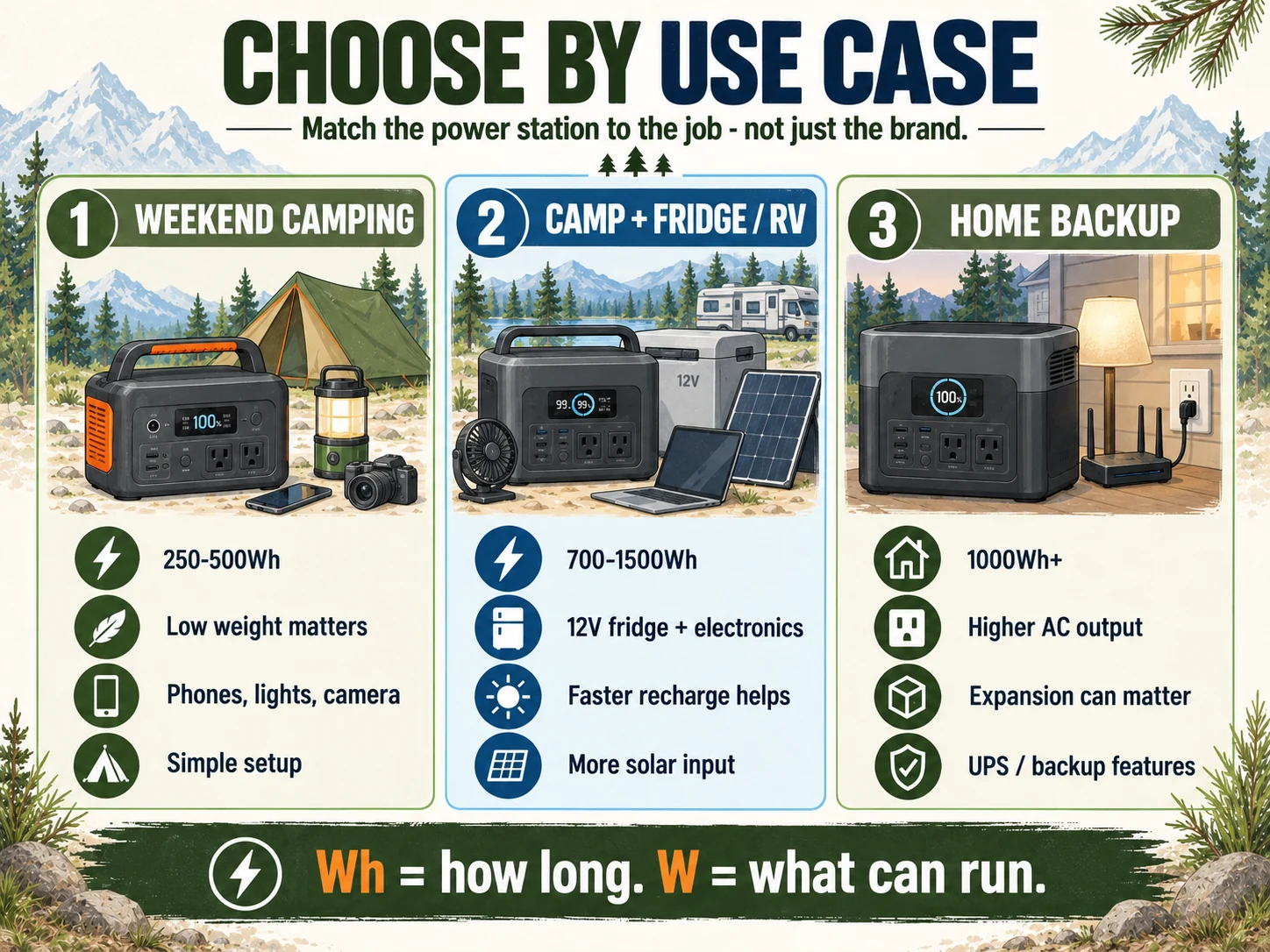
Jackery for carry-first trips
Choose Jackery when you move the station frequently and your appliance list fits its rated output. Choose EcoFlow when campsite cooking or higher-draw gear makes inverter headroom more important than a few pounds.
EcoFlow for systems that may grow
Expansion, faster recharge and higher solar input are strong advantages for a station that lives in a vehicle. Jackery remains attractive if storage space and lifting weight are the hard constraints.
EcoFlow for backup-first use
Higher output, fast UPS switching and expansion make EcoFlow the stronger default here. Verify that your exact critical loads fit the model rather than assuming a portable station can back up an entire home.
Jackery if fewer features are a feature
If the station will sit charged and come out for occasional lights, phones, a router or fridge support, you may value a lighter, simpler box more than a deeper app ecosystem.
What are the main alternatives to Jackery and EcoFlow?
Do not force a two-brand decision if neither model fits. Anker SOLIX is worth considering when you want another strong LiFePO4 ecosystem with modern charging and backup features. BLUETTI competes aggressively on capacity and expansion. Goal Zero remains relevant for buyers already invested in its solar and accessory ecosystem.
The same selection logic applies: compare watt-hours, continuous AC output, solar input, weight, battery chemistry, expansion and warranty on the exact model. Brand reputation should narrow the field, not replace the spec check.
How we compared Jackery and EcoFlow
We compared current US manufacturer specifications, manuals and support documentation, then checked owner discussions and independent reviews for recurring use patterns and complaints. The three model pairs were matched by battery capacity so that a larger battery on one side did not automatically make that brand look better.
FAQ: EcoFlow vs Jackery
Is EcoFlow better than Jackery?
EcoFlow is the better overall choice when you prioritize AC output, fast charging, solar input, expansion and backup features. Jackery is the better fit when lower carry weight and simpler camping-first use matter more.
Is Jackery better than EcoFlow for camping?
Often, yes, if you carry the station frequently and your loads fit the Jackery inverter limit. In the three capacity classes compared here, the current Jackery model is lighter. EcoFlow can still be the better camping choice when you need more AC output or faster solar recovery.
Which is better for home backup, Jackery or EcoFlow?
EcoFlow is the stronger default for backup-first use because the matched DELTA models combine higher rated output, faster UPS switching and better expansion options. Your actual critical-load wattage and required runtime still determine the correct size.
Which charges faster, Jackery or EcoFlow?
EcoFlow wins in the matched current line. RIVER 3 Plus is rated for a one-hour AC charge and DELTA 3 Plus for 56 minutes. Jackery’s v2 models are also fast, but generally take longer in their standard charging modes.
Do Jackery and EcoFlow use LiFePO4 batteries?
All six current models compared in this guide use LiFePO4 batteries: Explorer 300 v2, Explorer 1000 v2, Explorer 2000 v2, RIVER 3 Plus, DELTA 3 Plus and DELTA 3 Max Plus.
Can I use a Jackery solar panel with an EcoFlow power station?
Possibly, but only if the panel voltage and current are within the EcoFlow input limits and you use the correct connector or adapter with the correct polarity. Cross-brand solar should never be assumed to be plug-and-play.
Can I use an EcoFlow solar panel with a Jackery power station?
Possibly, under the same electrical rules. Jackery says compatible third-party panels may work when the connector and open-circuit voltage fit the station, but third-party compatibility is not guaranteed.
Which has the better warranty, EcoFlow or Jackery?
The current models here are broadly in the five-year class, but the terms differ. Jackery lists 3+2 years on these v2 models. EcoFlow lists five years on RIVER 3 Plus and DELTA 3 Plus, while DELTA 3 Max Plus lists three standard years plus two extended years after app registration.
Which brand is more reliable, EcoFlow or Jackery?
There is no defensible brand-wide reliability winner from public evidence. Both have positive long-term owners and support complaints. Choose the exact model on its specifications, warranty and return path rather than assuming the logo predicts failure rate.
What size portable power station do I need?
Add the wattage of devices you may run at the same time to set the minimum inverter output, then estimate daily watt-hours to size battery capacity. A small station is fine for electronics; refrigeration, CPAP, cooking and home-backup loads quickly move buyers into 1kWh or 2kWh classes.