
Gear & Home is reader-supported. As an Amazon Associate I earn from qualifying purchases. When you buy through links on our site, we may earn an affiliate commission, at no extra cost to you. Learn more.
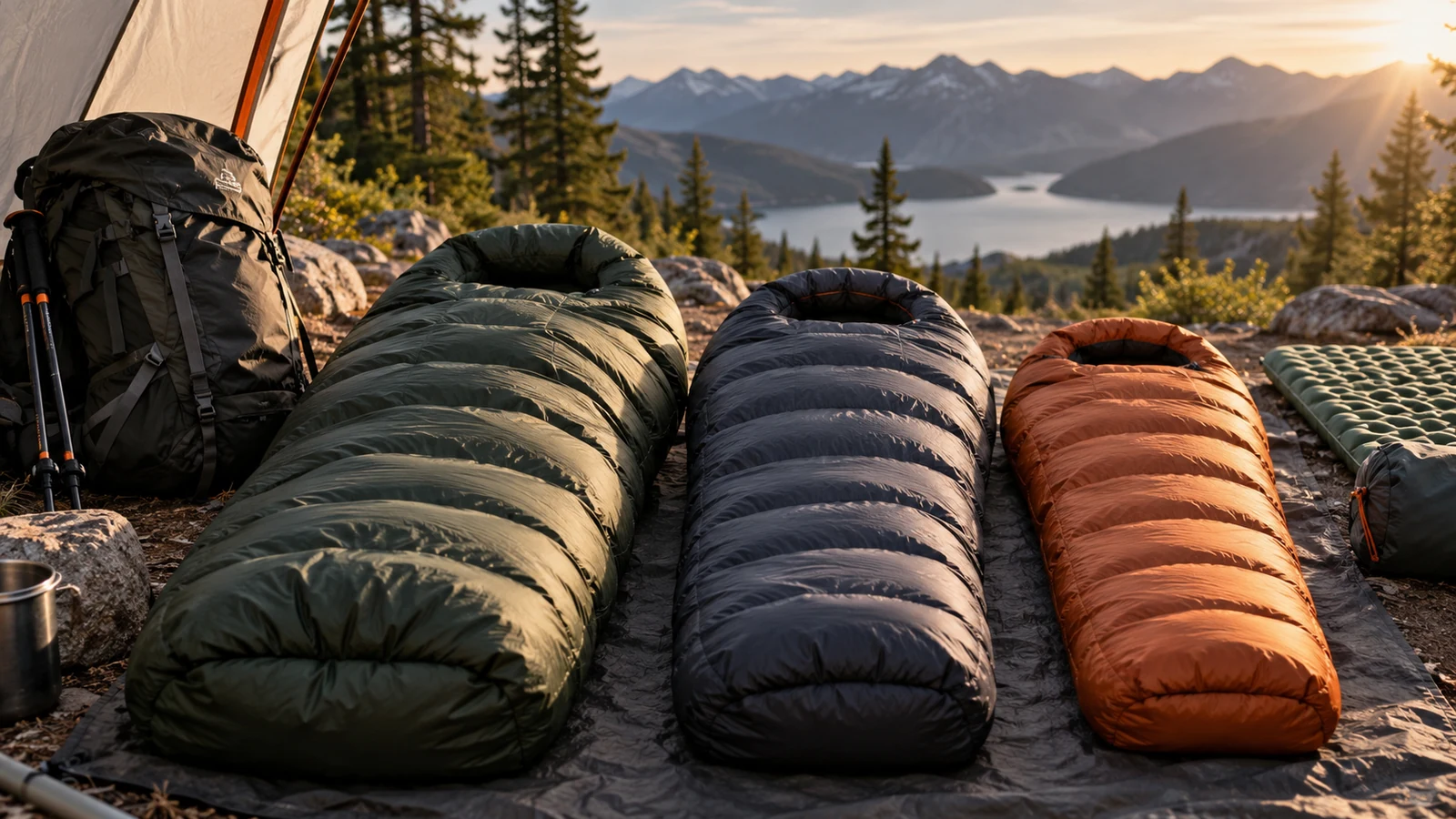
For sleeping bags, 650 vs 800 vs 900 fill power is mainly a trade-off in weight, packed size and cost, not a direct warmth scale. Higher fill power down lofts more per ounce, so a well-designed bag can use less insulation to reach a similar warmth target.
The useful buying rule is simple: choose the temperature rating and fit first, then use fill power to decide how much you want to pay to reduce weight and bulk. A 900-fill bag is not automatically warmer than a 650-fill bag, and a 650-fill bag is not automatically a budget mistake.
650 vs 800 vs 900 fill power: which should you choose?
Choose 650 fill power when value and comfort matter more than minimum pack weight. Choose around 800 fill power for the strongest all-around backpacking balance. Choose 900 fill power when you are deliberately paying more to cut ounces and packed volume from a performance sleep system.
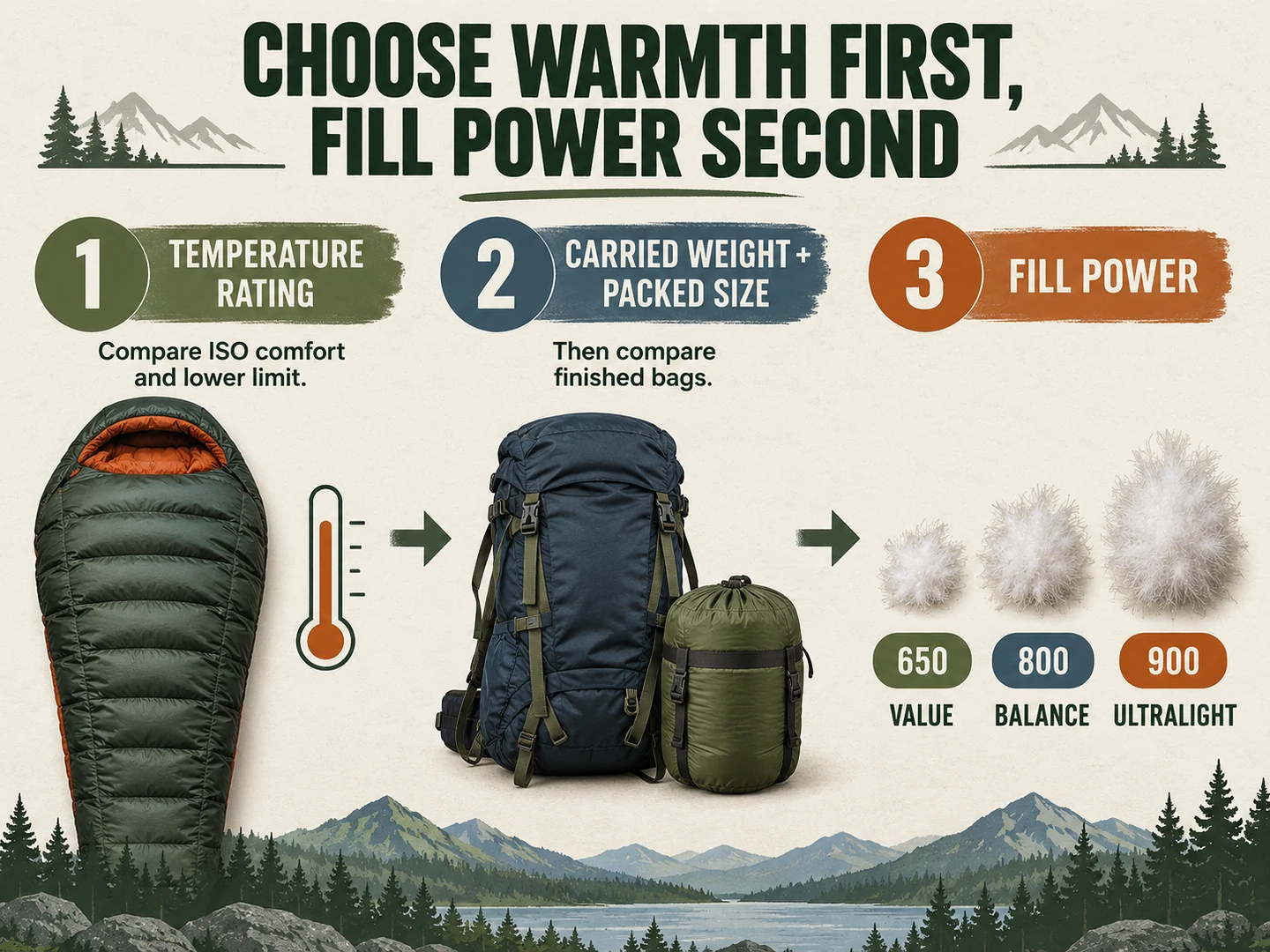
For two bags aimed at the same temperature range, higher fill power can help one bag get lighter and smaller, but shell fabric, bag shape, baffle design, down distribution and total fill weight also matter. Compare the finished bags, not just the number on the hang tag.
What down fill power actually measures
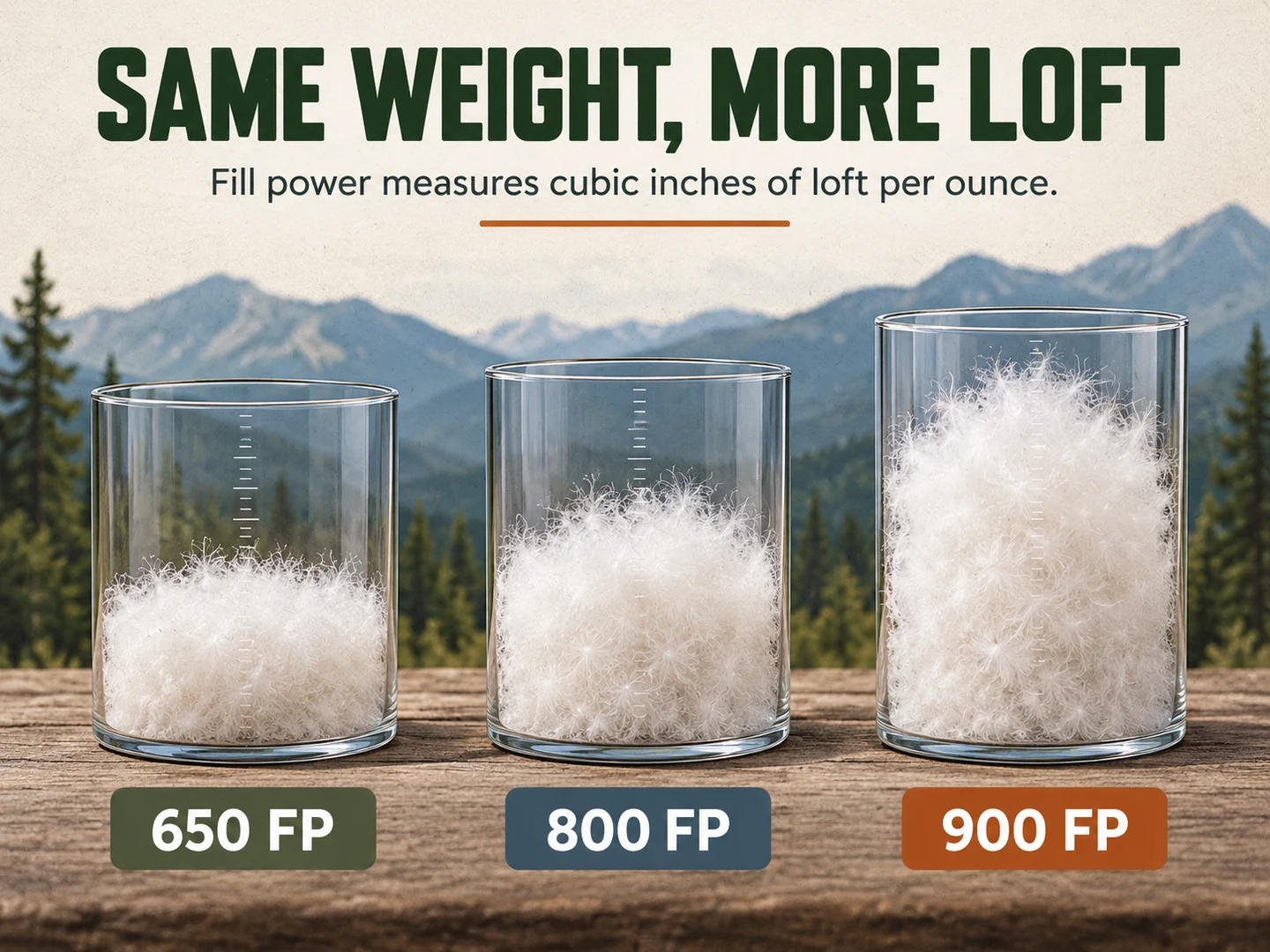
Fill power describes how much volume a given weight of down can loft to under a standardized lab test. In common US terminology, the number corresponds to the cubic inches occupied by one ounce of down. That means one ounce of 900-fill down can loft into more volume than one ounce of 650-fill down.
That makes fill power a useful measure of insulation efficiency by weight and volume. It does not tell you how many ounces of down are inside a sleeping bag, how the down is distributed, how tight the bag fits, or how much heat the complete bag retains.
If you are choosing between sleeping bags, compare standardized ISO or EN comfort and lower-limit figures where they are available. The fill-power number helps explain how efficiently a bag reaches its design target, but the temperature rating is the more useful starting point for warmth.
650 vs 800 vs 900 fill power compared
| Fill power | What it means | Weight and bulk | Cost tendency | Best fit |
|---|---|---|---|---|
| 650 FP | Good down efficiency, but more down is needed for a given loft target | Usually heavier and bulkier than higher-fill alternatives at similar warmth | Lower | Value-focused backpacking, car camping, roomier designs |
| 800 FP | High-efficiency down with a meaningful improvement over 650 | Strong warmth-to-weight and packability without chasing the highest grade | Mid to high | Most weight-conscious backpackers |
| 900 FP | Premium down that produces very high loft per ounce | Best potential for low insulation weight and small packed volume | Highest | Ultralight, fast-and-light and alpine buyers |
650 fill power
Lower cost
More weight and bulk
Budget and comfort-first trips
800 fill power
Strong efficiency
Higher price
General backpacking
900 fill power
Maximum loft per ounce
Premium cost
Ultralight and alpine use
These are decision tiers, not quality verdicts. A well-designed 650-fill sleeping bag can be an excellent choice, while a poorly matched 900-fill bag can still be uncomfortable, too cold for the trip, or needlessly expensive.
How much less down does higher fill power need?
If you hold the target loft constant and ignore every other design variable, the math is straightforward. To create the same nominal loft volume, 800-fill down would need about 81 percent of the down mass required by 650-fill down. That is roughly 19 percent less down. At 900 fill power, the theoretical amount falls to about 72 percent of the 650-fill amount, or roughly 28 percent less.
The jump from 800 to 900 is smaller. For the same theoretical loft target, 900-fill down needs about 11 percent less down than 800-fill down.
A sleeping bag also has a shell, lining, zipper, hood, draft tubes, baffles and other hardware. Shape and fit change how much space must be heated. Manufacturers also distribute down differently. The calculation explains the efficiency advantage of higher fill power, not an exact prediction for two retail sleeping bags.
How to choose fill power for a sleeping bag
Use fill power late in the decision, not first. This order prevents a premium insulation number from distracting you from a bag that is wrong for your actual trip.
1. Start with the temperature rating you actually need
For backpacking sleeping bags, standardized ISO or EN data is the best comparison anchor when both products publish it. Pay attention to whether you are looking at a comfort figure, lower limit or a manufacturer-only rating. A 20F label does not always mean the same thing across brands.
2. Check fit and shape
A narrow mummy bag can save weight and reduce the air your body has to warm, but it can also feel restrictive. A roomier semi-rectangular bag may require more fabric and insulation. If you toss and turn or sleep on your side, a few saved ounces do not help if the cut ruins your sleep.
3. Compare total weight and packed size
These are the outcomes you actually carry. If an 800-fill bag already meets your weight and volume targets, paying for 900 fill may not change your trip enough to matter. If pack volume is a hard constraint, premium down can be valuable even when absolute weight is not.
4. Then compare fill power and fill weight
Fill power tells you insulation efficiency. Fill weight tells you how much down is in the bag. Together they help explain design choices, but neither replaces the complete temperature rating. Manufacturers do not always publish fill weight, so do not reject a bag solely because that number is missing.
5. Decide what each ounce of savings is worth to you
Premium down becomes most rational when the saved weight or volume solves a real problem: a small fastpacking pack, long food carries, steep mileage, airline packing, or an already optimized ultralight setup. For a short walk from the car to camp, 900 fill may be money spent on a benefit you barely use.
When 650 fill power makes sense
650 fill power is a practical choice when your first priority is getting an appropriately warm down sleeping bag without paying the premium attached to the lightest possible build. It is especially sensible for car camping, short backpacking trips, beginners assembling an entire sleep system, and sleepers who prefer roomier bags.
The main compromise is not that 650-fill down is “cold.” The compromise is that a manufacturer generally needs more of it to achieve a given insulation target, so the finished bag can be heavier and harder to compress than a comparable higher-fill design.
That can be a very good trade. If a 650-fill bag fits better, meets the rating you need and stays within your weight budget, there is no rule saying you should upgrade the insulation grade.
When 800 fill power is the backpacking sweet spot
Around 800 fill power is where the efficiency gain becomes substantial without automatically pushing you to the most expensive down grade. That is why 800 and nearby 850-fill constructions are common in serious backpacking bags.
For many hikers, this tier is the easiest recommendation because it supports low total weights and small packed sizes while leaving budget for the parts of a sleep system that may matter more, such as an adequately insulated sleeping pad. If your bag already lands comfortably inside your weight target at 800 fill, moving to 900 should be a deliberate optimization, not a reflex.
When 900 fill power is worth paying for
900 fill power makes the most sense when weight and volume are first-class constraints. Fast-and-light backpackers, thru-hikers, climbers and travelers using small packs can benefit from getting more loft from each ounce of down.
The catch is diminishing returns. The theoretical insulation-mass advantage from 650 to 800 is larger than the step from 800 to 900. By the time you are shopping 900-fill bags, manufacturers often pair the premium insulation with lighter shell fabrics, narrower cuts and pared-back features. Those choices can save additional weight, but they may also reduce roominess, venting options or fabric margin.
A real 20F example: 650 fill vs 900 fill
Two current Therm-a-Rest bags make the trade-off easy to see because both publish a 20F lower-limit rating and 32F comfort rating in Regular. They are not a controlled test, and they are intentionally different designs, but that difference is exactly why buyers should compare whole products instead of assuming fill power acts alone.
| Bag | Fill | Rating | Regular weight | Fill weight | Packed dimensions | Fit direction | Amazon |
|---|---|---|---|---|---|---|---|
| Therm-a-Rest Boost 650 20F | 650-fill hydrophobic duck down | 32F comfort / 20F lower limit | 2 lb 11 oz | 1 lb 7 oz | 12.5 x 7.5 in | Roomy semi-rectangular, 64 in shoulder girth | Check availability on Amazon |
| Therm-a-Rest Hyperion 20F | 900-fill hydrophobic goose down | 32F comfort / 20F lower limit | 1 lb 4 oz | 12.5 oz | 6 x 8 in | Narrow ultralight mummy, 57 in shoulder girth | Check availability on Amazon |
Therm-a-Rest Boost 650 20F
32F comfort / 20F limit
2 lb 11 oz
1 lb 7 oz
Roomy semi-rectangular
Therm-a-Rest Hyperion 20F
32F comfort / 20F limit
1 lb 4 oz
12.5 oz
Narrow ultralight mummy
The Hyperion uses almost half the down fill weight of the Boost and the complete bag weighs less than half as much. But it would be wrong to attribute that entire difference to 900-fill down. The Hyperion also uses 10D fabrics, a much narrower mummy cut and a highly weight-focused design. The Boost uses 20D fabrics and deliberately gives the sleeper far more room.
That design context also matches the broader reviewer pattern. Independent reviews repeatedly describe the Hyperion as exceptionally light and compact but noticeably snug, while current Boost reviews emphasize space and comfort with higher carried weight as the trade-off. The better bag depends on whether you are buying efficiency or room.
Six fill-power mistakes to avoid
1. Assuming 900 fill is always warmer than 650
It is more efficient per ounce. The complete bag can still be warmer, colder or similarly warm depending on fill quantity, construction and rating.
2. Comparing bags with different temperature-rating methods
A standardized comfort rating, standardized lower limit and manufacturer-only label are not interchangeable. Normalize the rating method before you use weight or fill power to decide.
3. Ignoring fill weight
One ounce of 900-fill down lofts more than one ounce of 650-fill down, but the amount of down in the bag still matters. High fill power with very little fill does not create unlimited warmth.
4. Ignoring fit to chase a lighter spec sheet
A narrow mummy bag may be thermally efficient and light, but a sleeper who feels trapped in it may be happier carrying a roomier, heavier bag.
5. Paying for 900 fill when you do not carry the bag far
Premium fill is easiest to justify when ounces and liters matter. Car campers often get more comfort per dollar by prioritizing fit, fabric and features instead.
6. Treating hydrophobic treatment or RDS as another fill-power tier
Hydrophobic treatments address moisture behavior. Responsible Down Standard certification addresses animal-welfare and chain-of-custody requirements. Those are separate buying attributes from the fill-power number.
Which fill power should most people buy?
If you are ready to compare specific lightweight models rather than insulation grades, see our best ultralight sleeping bags for backpacking. That roundup compares finished bags by temperature data, weight, fit and real trade-offs rather than ranking them by fill power alone.
How we built this guide
We treated fill power as a buyer-decision problem, not a product score. The live US search results are dominated by explainers that distinguish fill power from actual warmth, which supports a dedicated decision guide rather than another sleeping-bag roundup.
We cross-checked current guidance from outdoor retailers and down-product manufacturers on what fill power measures and what it does not.
We used current manufacturer data for temperature ratings, fill materials, fill weights, total weights, dimensions and bag shapes.
Independent reviewers, retailer feedback and owner discussions were used to identify recurring fit, weight and packability trade-offs without presenting their testing as ours.
Amazon.com US product identity was checked against exact model and size evidence as late as practical before packaging. Dynamic price, star rating and review count are intentionally omitted.
Frequently asked questions
Is 900 fill power warmer than 650?
Not necessarily. 900-fill down is more efficient per ounce, but the finished sleeping bag’s warmth also depends on how much down it contains, how that down is distributed, the bag shape, baffle construction and the rest of the design. Compare temperature ratings first.
Is 650 fill power good for a sleeping bag?
Yes. 650 fill power can be a good value choice when the bag has the temperature rating and fit you need. The main trade-off is that a 650-fill design generally needs more insulation mass and volume than a higher-fill design aimed at similar warmth.
Is 800 fill power enough for backpacking?
Yes. Around 800 fill power is a strong backpacking tier because it offers high insulation efficiency and good compressibility without always carrying the premium of 900-fill down. The right temperature rating and fit still matter more.
How much lighter is 900 fill than 800 fill?
For an equal theoretical loft target, 900-fill down needs about 11 percent less down mass than 800-fill down. That is not the same as saying a finished 900-fill sleeping bag will be 11 percent lighter, because shell fabric, zipper, baffles, shape and features also contribute to total weight.
What matters more than fill power in a sleeping bag?
Start with the temperature rating and rating method, then check fit, shape, total weight and packed size. Fill power and fill weight help explain insulation efficiency, but they should not override a bag that is better matched to your conditions and body.
Does goose down have higher fill power than duck down?
Either goose or duck down can be sold at useful fill-power levels. Species alone is not a reliable shortcut for performance. Compare the actual certified fill-power number, the amount of down, the complete sleeping-bag specifications and any sourcing or treatment attributes you care about.