

Gear & Home is reader-supported. As an Amazon Associate I earn from qualifying purchases. When you buy through links on our site, we may earn an affiliate commission, at no extra cost to you. Learn more.
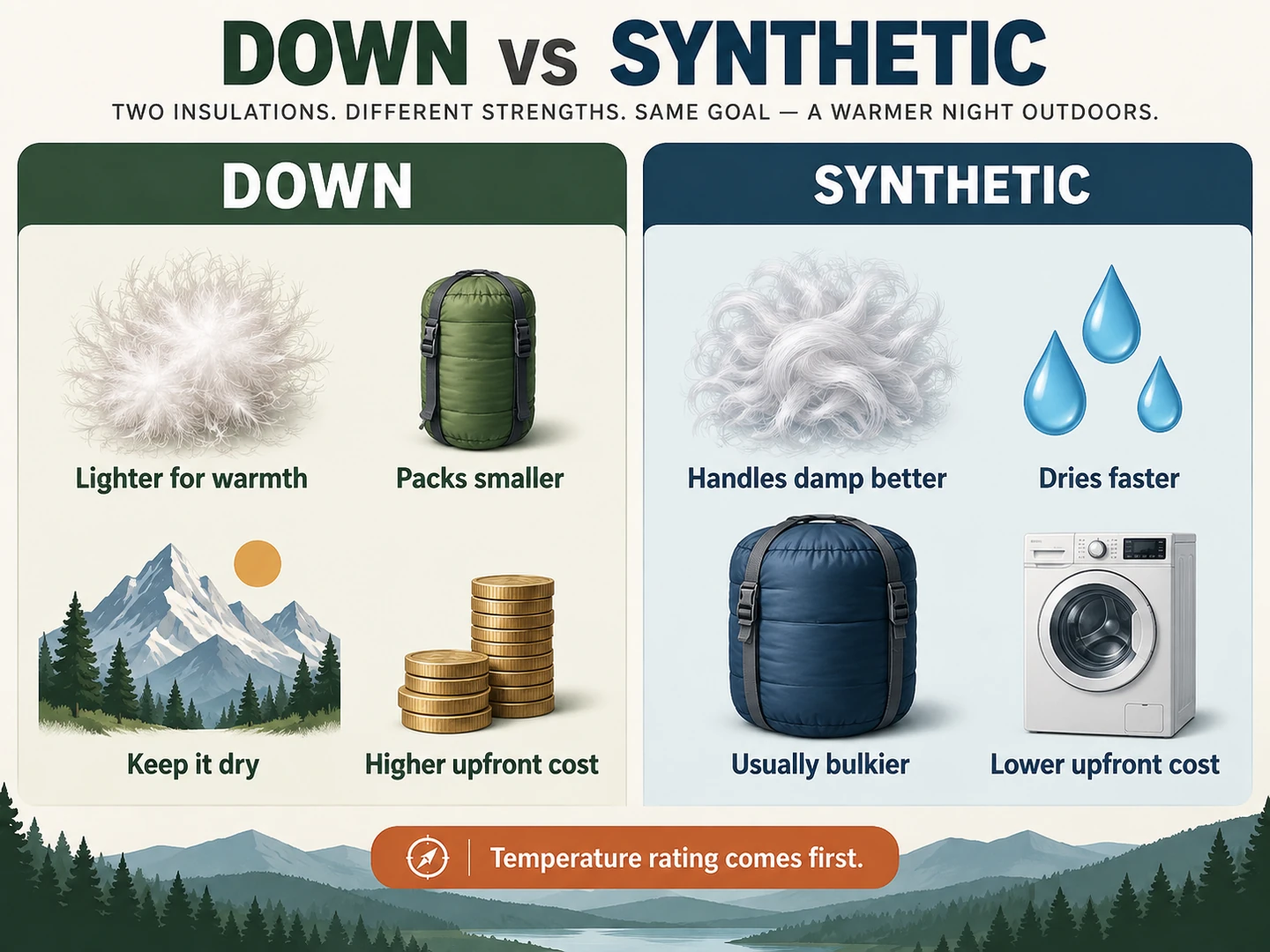
Down and synthetic sleeping bags solve the same problem in different ways. Down usually gives backpackers more warmth for less weight and pack volume. Synthetic insulation usually costs less, dries faster, and keeps more useful loft when damp.
Choose down for packability; choose synthetic for moisture tolerance and value
Down is the better default for most backpackers who can keep their sleep system dry. It is lighter for a given warmth target, compresses smaller, and can retain loft for a long time with proper care. Synthetic is the safer practical choice for persistently damp trips, rougher use, tighter budgets, and car camping where a larger packed size matters less.
Do not choose by insulation alone. First pick the right temperature rating and fit for your expected conditions, then use insulation type to decide how much weight, bulk, moisture tolerance, care, and cost you are willing to trade.
Down vs synthetic sleeping bags at a glance
| Decision factor | Down | Synthetic | Practical edge |
|---|---|---|---|
| Warmth for carried weight | Higher warmth-to-weight potential | Usually needs more fill weight for similar warmth | Down |
| Packed size | Usually compresses much smaller | Usually bulkier | Down |
| Damp conditions | Can lose loft and insulation if saturated | Retains more insulating function when damp and dries faster | Synthetic |
| Drying time | Slower, especially after deep wetting | Faster | Synthetic |
| Long-term loft | Can remain useful for many years with good care | Repeated compression gradually reduces loft | Down |
| Cleaning and care | Needs more careful washing and thorough drying | Generally simpler to wash and dry | Synthetic |
| Upfront cost | Usually higher | Usually lower | Synthetic |
| Animal-free preference | Animal-derived insulation | Polyester-based fill | Synthetic |
Down wins when ounces matter
Down compresses smaller
Synthetic is more forgiving
Synthetic is simpler and usually cheaper
Choose a down sleeping bag if weight and pack space matter most
Down’s main advantage is efficiency. The loft created by down clusters traps a lot of air for relatively little mass, so a well-designed down bag can reach a given warmth target with less carried weight than a comparable synthetic design. Higher fill-power down increases that efficiency further because it creates more loft for a given amount of down.
That does not mean a 900-fill bag is automatically warmer than a 650-fill bag. Fill power describes the loft quality of the down, not the finished bag’s temperature rating. Total fill amount, baffle design, hood and collar construction, fit, shell fabrics, and the rating method all matter.
Choose synthetic if damp-weather forgiveness and price matter more
Synthetic insulation is usually polyester fiber arranged to mimic the air-trapping structure that makes down effective. Its biggest practical advantage is what happens when moisture gets into the insulation. Synthetic fibers do not collapse in the same way as saturated down, so a synthetic bag generally retains more useful loft when damp and dries faster afterward.
That advantage is easy to exaggerate. A soaked synthetic bag is still a bad sleep system. Water adds weight, evaporative cooling can make you colder, and wet fabrics are uncomfortable. Think of synthetic as more forgiving, not waterproof or magically warm when saturated.
Temperature rating matters more than insulation type
A warm synthetic bag is warmer than an under-insulated down bag. That sounds obvious, but the fill label can distract from the number that matters first: a standardized comfort or lower-limit rating when one is available.
ISO and older EN ratings make cross-brand comparisons more useful because the bags are tested under a standardized protocol. The comfort rating is the more conservative reference for a cold sleeper, while the lower-limit rating is intended for a warmer sleeper. A plain marketing label such as “20°F” without a published comfort or limit figure is less precise, so do not assume two bags with the same number provide identical warmth.
Your pad is part of the system too. A sleeping bag’s insulation compresses under your body, which is why ground insulation matters. If you are still building the rest of the kit, use our complete backpacking sleep system guide and our sleeping pad R-value guide alongside this insulation decision.
What happens when down gets wet?
Untreated down depends on loft. When enough water reaches the down clusters, they can clump and collapse, reducing the air space that provides insulation. Drying a thoroughly wet down bag can also take much longer than drying a synthetic one.
Water-resistant shell treatments and hydrophobic down treatments improve resistance to light moisture, condensation, and brief exposure, but they do not make a down sleeping bag waterproof. If a river crossing, leaking shelter, or multi-day rain can saturate your sleep system, synthetic gives you a larger margin for error.
For normal backpacking in mostly dry conditions, the moisture problem is manageable: pack the sleeping bag in a reliable dry bag or waterproof pack liner, keep wet clothing out of the insulation, ventilate the shelter, and air the bag when conditions allow. If you already do those things, down’s packability advantage is often worth the extra care.
Which insulation lasts longer?
Down generally has the better long-term loft potential. With careful washing, complete drying, and uncompressed storage, a quality down bag can remain useful for a long time. Synthetic insulation is resilient in everyday use, but repeated compression gradually damages fiber structure and can reduce loft over time.
Neither type should live permanently crushed in its backpacking stuff sack. After a trip, dry the bag fully and store it loose in a large breathable sack or another space that does not compress the insulation. Follow the manufacturer’s washing instructions instead of treating every fill type the same.
Simple decision rules by trip type
| Scenario | Better starting point | Why | What could change the answer |
|---|---|---|---|
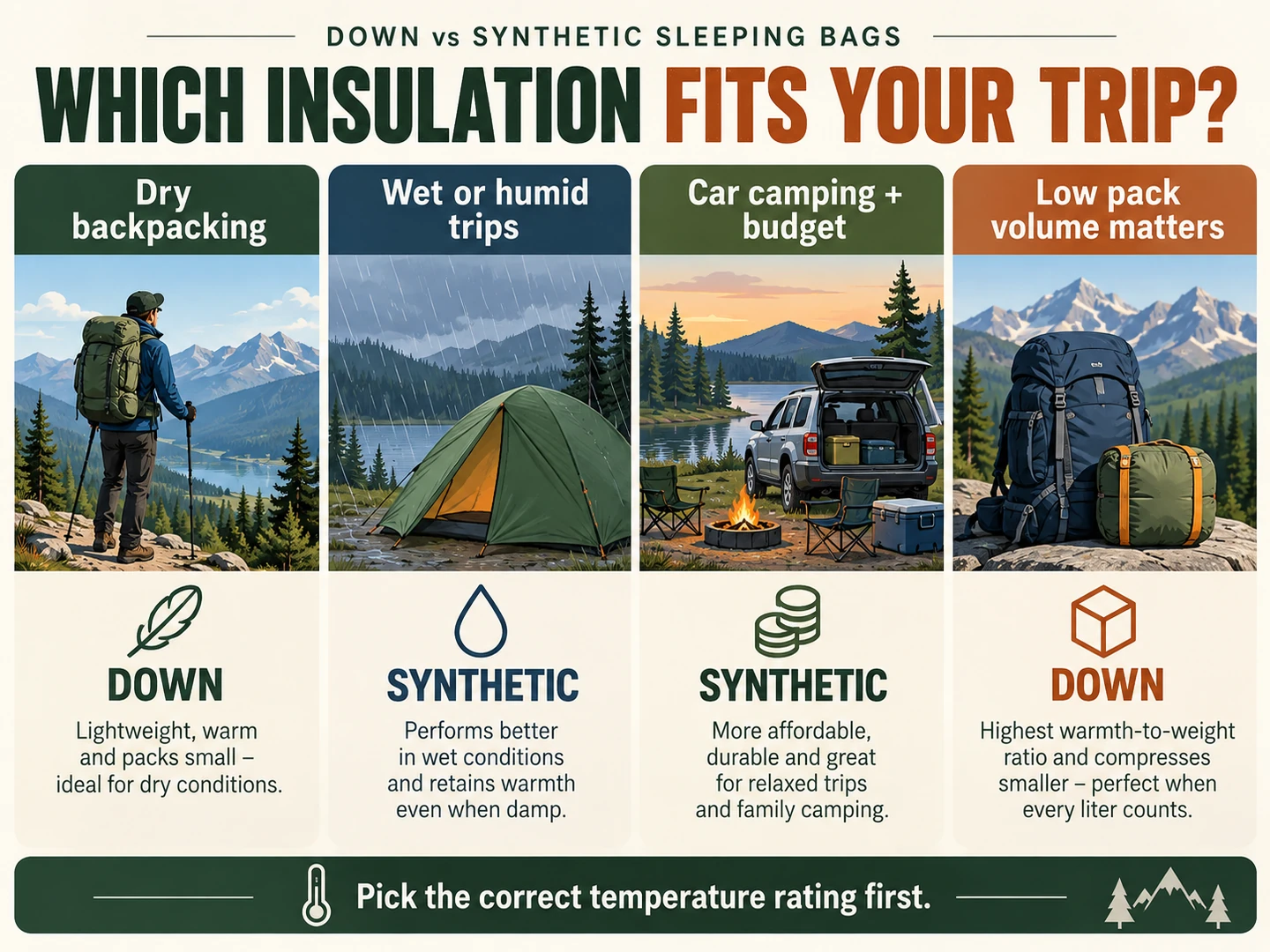
| Three-season backpacking in mostly dry weather | Down | Lower weight and smaller packed size pay off every mile | Synthetic can still make sense if budget is the hard limit |
| Wet, humid, coastal, or paddle trips | Synthetic | More forgiving when the insulation gets damp | Down works if moisture protection is highly reliable |
| Car camping | Synthetic | Weight and bulk matter less, so lower cost has more value | Choose down if storage space is tight or you already own one |
| Ultralight or small-pack travel | Down | Efficiency reduces both weight and volume | Very mild temperatures reduce the size gap |
| Kids, loaner gear, frequent washing | Synthetic | Simpler care and lower replacement cost | Premium needs or very small packing volume can favor down |
| Cold weather with controlled moisture | Down | The weight and bulk gap usually becomes more important as insulation needs rise | Persistent condensation or wet travel can favor synthetic |
Start with down
Carry less weight and use less pack space. Synthetic still works if budget is the main constraint.
Start with synthetic
It is more forgiving when moisture reaches the insulation and generally dries faster.
Synthetic is usually the value choice
The extra bulk matters less when you are not carrying it all day.
Down usually wins
Choose the right temperature rating first, then pay for higher insulation efficiency where it saves meaningful ounces and volume.
Two current examples that make the trade-off concrete
These are not our “best down” and “best synthetic” winners. They are two current versions of the same Kelty Cosmic 20 family, useful because they show how the insulation decision can change weight and packed size without mixing completely unrelated brands.
Both current manufacturer pages use a 20°F product label, but that label alone is not enough to prove identical thermal performance. Treat the numbers below as a size-and-weight illustration, not a controlled warmth comparison.
Kelty Cosmic Down 20
The current Regular/Standard model uses 550-fill down and illustrates why down remains attractive for ordinary backpacking: it is lighter and packs smaller than the synthetic Cosmic 20 example below.
DOWN
Kelty Cosmic Synthetic 20
The current Regular model uses recycled CirroLoft Eco synthetic fill. It gives up pack space and six ounces versus the current Cosmic Down Regular spec, but it offers the moisture and budget advantages that make synthetic attractive.
SYN
Bottom line
For most backpackers, start with down if you can afford it and can reliably keep it dry. The lower weight and smaller packed size are benefits you notice on every trip. Start with synthetic if your trips are persistently damp, your budget is tighter, the bag will be washed or loaned frequently, or you mainly car camp.
If your goal is specifically the lightest practical backpacking setup, the next step is our best ultralight sleeping bags guide. That page compares actual current bags by standardized temperature data, fit, and carried weight instead of treating insulation type as the whole decision.
How we built this comparison
Gear & Home does not assign a winner just because another gear site does. For this page, we separated universal insulation trade-offs from product-specific claims and checked current model identity before adding any Amazon link.
FAQ
Is down or synthetic warmer?
Neither insulation type is automatically warmer. A sleeping bag’s finished temperature performance depends on fill amount, insulation quality, construction, fit, and testing method. Down usually achieves a given warmth target with less weight and pack volume, but compare ISO/EN comfort or lower-limit ratings when available.
Does a synthetic sleeping bag stay warm when wet?
Synthetic insulation generally retains more useful loft when damp and dries faster than down, but a soaked synthetic bag is still colder, heavier, and less comfortable than a dry one. Treat synthetic as more moisture tolerant, not waterproof.
Is hydrophobic down waterproof?
No. Hydrophobic treatments can help down resist light moisture and dry more readily, but enough water can still saturate the insulation and reduce loft. A waterproof pack liner or dry bag remains important when conditions are wet.
Which lasts longer, down or synthetic?
Down generally has better long-term loft retention when it is washed correctly, dried completely, and stored uncompressed. Synthetic fill is easier to care for but can lose loft gradually after repeated compression.
Which is better for backpacking, down or synthetic?
Down is the better default for most backpackers because it usually weighs less and packs smaller for a similar warmth target. Synthetic is the better backpacking choice when persistent moisture, lower cost, or simpler care matters more than minimum weight and volume.