
Gear & Home is reader-supported. As an Amazon Associate I earn from qualifying purchases. When you buy through links on our site, we may earn an affiliate commission, at no extra cost to you. Learn more.
For most hiking, a rain jacket does not need the biggest breathability number on the tag. It needs enough moisture transfer for your normal effort level, plus a way to dump heat when the fabric cannot keep up. As a practical starting point, treat roughly 10,000 to 20,000 g/m²/24h MVTR as the useful middle band for regular hiking when the test method is comparable, and look toward 20,000+ for sustained high-output use. If a brand publishes RET instead, lower is better.
The important catch is that rain-jacket breathability is not a universal scoreboard. Different MVTR test methods can produce different numbers for similar fabrics, warm humid rain reduces the vapor-pressure difference that drives moisture outward, and a saturated face fabric can make a technically breathable shell feel clammy. For hikers, pit zips, side vents, a good base layer, and realistic expectations often matter as much as the lab rating.
How breathable should a hiking rain jacket be?
For steady day hiking, a published MVTR around 10,000 to 20,000 g/m²/24h is a reasonable rough target when you are comparing jackets tested by the same method. Hikers who move fast, climb steeply, or regularly wear a shell in mild temperatures should lean toward 20,000+ and still look for pit zips or large side vents.
If the jacket uses RET, the scale runs the other direction. RET below 6 indicates very low resistance to moisture vapor, 6 to 12 is still highly breathable, 12 to 20 is more moderate, and values above 20 are a poor fit for sustained physical effort.
Rain Jacket Breathability by Hiking Intensity
| Your typical use | Useful MVTR starting point | RET guidance | Ventilation priority | What matters most |
|---|---|---|---|---|
| Low-output walking and cool-weather use | About 5,000 to 10,000 can be workable | Below 20 is preferable | Helpful, not always essential | Weather protection, fit, price |
| Regular hiking on rolling terrain | About 10,000 to 20,000 | Below 12 is a strong target | Strongly recommended | Balance of membrane performance and venting |
| Steep hiking and backpacking climbs | About 20,000+ when comparable | Below 6 to 12 | High priority | Large vents, light layers, easy temperature control |
| Warm, humid, high-output rain | Do not rely on the rating alone | Lower is better, but still limited by conditions | Critical | Mechanical airflow and avoiding overdressing |
Cool-weather walking
About 5K to 10K
Below 20 preferred
Prioritize reliable weather protection and fit. Large vents are useful but not mandatory for everyone.
Regular trail hiking
About 10K to 20K
Below 12 is strong
This is the useful middle ground. Pit zips make the jacket much easier to regulate on climbs.
Steep climbs and fast hiking
About 20K+
Below 6 to 12
Look beyond the membrane number. Large vents and a light base layer matter more as effort rises.
Warm, humid rain
Not enough by itself
Critical
Even highly breathable waterproof fabrics can feel clammy when the outside air is already warm and humid.
These are decision bands, not promises of comfort. MVTR values are most useful when the same laboratory method is used. If two brands do not state the method, avoid treating a 20,000 figure from one as precisely twice as breathable as a 10,000 figure from another.
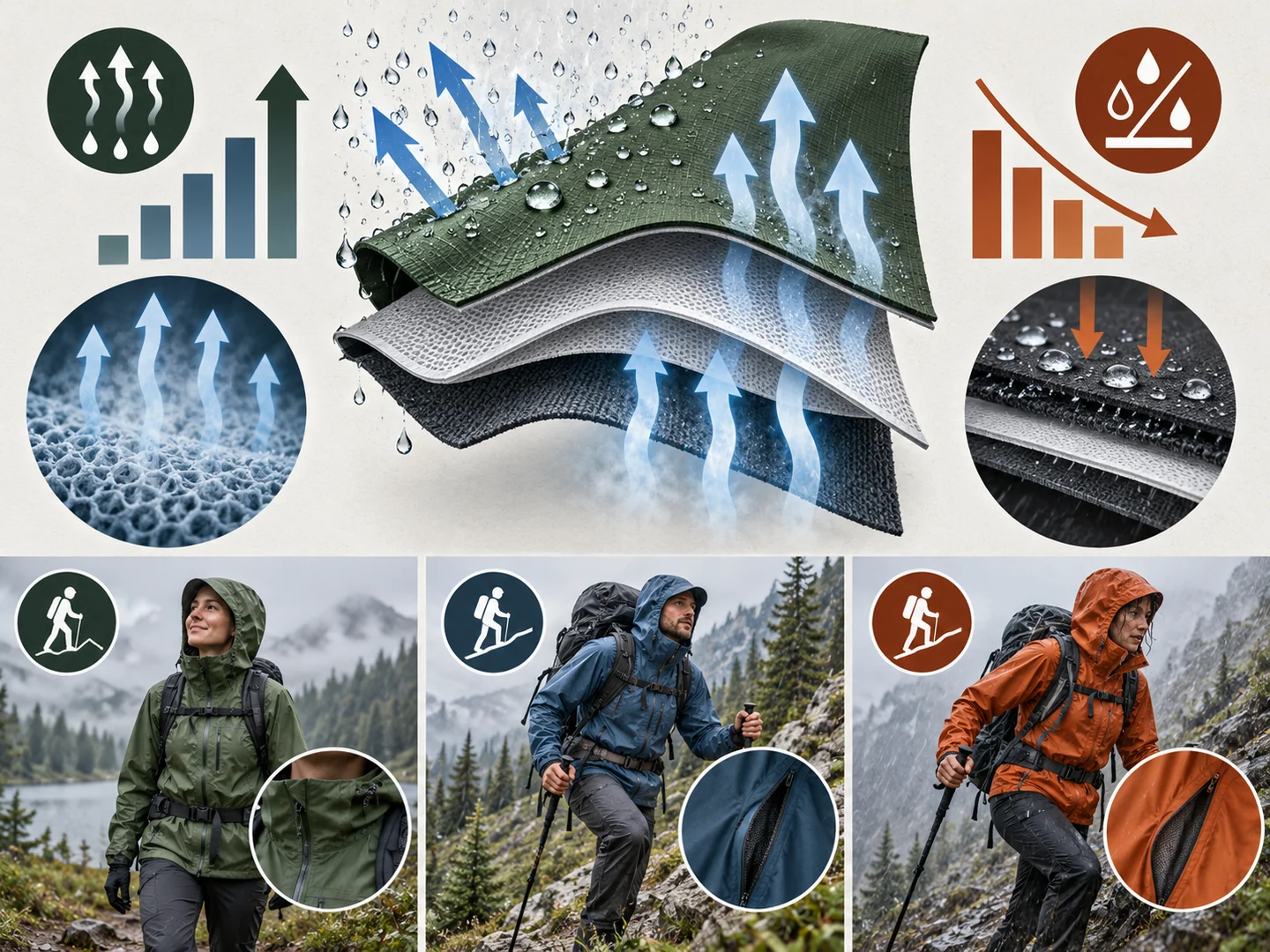
MVTR vs RET: Read the Number in the Right Direction
MVTR: higher usually means more vapor can pass
MVTR stands for moisture vapor transmission rate. It is commonly expressed as grams of water vapor that pass through one square meter of fabric over 24 hours. A higher result generally indicates greater moisture transfer in that specific test.
The problem is comparability. Multiple MVTR methods exist, and the same fabric can score differently depending on the test setup. That makes MVTR best for understanding a brand’s own performance tiers or comparing products where the test method is known, rather than building a universal ranking across every manufacturer.
RET: lower means less resistance to vapor
RET measures resistance to evaporative heat transfer. The lower the resistance, the easier it is for moisture vapor to escape. RET testing is commonly associated with ISO 11092, which makes the direction of the scale much easier to read: lower is better.
An RET of 5 is more breathable than an RET of 15. With MVTR, the higher figure is normally the more breathable result within the same test method.
What if the brand publishes no breathability number?
That is not automatically a reason to reject the jacket. Some strong hiking shells are sold without a simple MVTR or RET figure. In that case, compare construction, ventilation, face fabric, intended activity, current manufacturer description, and independent evidence rather than inventing precision the brand does not publish.
Why a Highly Breathable Rain Jacket Can Still Feel Wet Inside
Waterproof-breathable fabric does not function like a fan. It moves moisture vapor through a material, and that process depends on the difference between conditions inside and outside the shell. A steep uphill hike can generate moisture faster than even a good membrane can move it.
Warm and humid weather reduces the advantage
Vapor moves most effectively when the air inside your jacket is warmer and more humid than the air outside. In cold, relatively dry conditions, that gradient can be favorable. In warm rain with high outside humidity, the difference shrinks, so passive moisture transfer becomes less effective exactly when you may be sweating hardest.
A wet face fabric can choke real-world performance
Most modern rain shells use a durable water-repellent treatment on the outer fabric. Its job is to make water bead and roll away so the face fabric does not stay saturated. When the outer layer wets out, the membrane may still block liquid water, but the jacket can feel colder, heavier, and less breathable.
This is why cleaning and restoring the water-repellent finish can improve comfort even when the waterproof membrane itself is still intact. Follow the exact care instructions for your jacket rather than applying a generic treatment blindly.
Your backpack creates a local breathability problem
Shoulder straps and the back panel press fabric against clothing and reduce airflow. Those high-contact zones are often where hikers first notice sweat accumulation. A membrane rating cannot remove the mechanical effect of a loaded pack sitting against your shell.
Your layers can trap moisture before it reaches the shell
A cotton shirt, thick midlayer, or too-warm insulation can hold sweat inside the system. For active hiking in rain, a wicking base layer and conservative insulation often improve comfort more than spending heavily to move from one already-decent membrane rating to another.
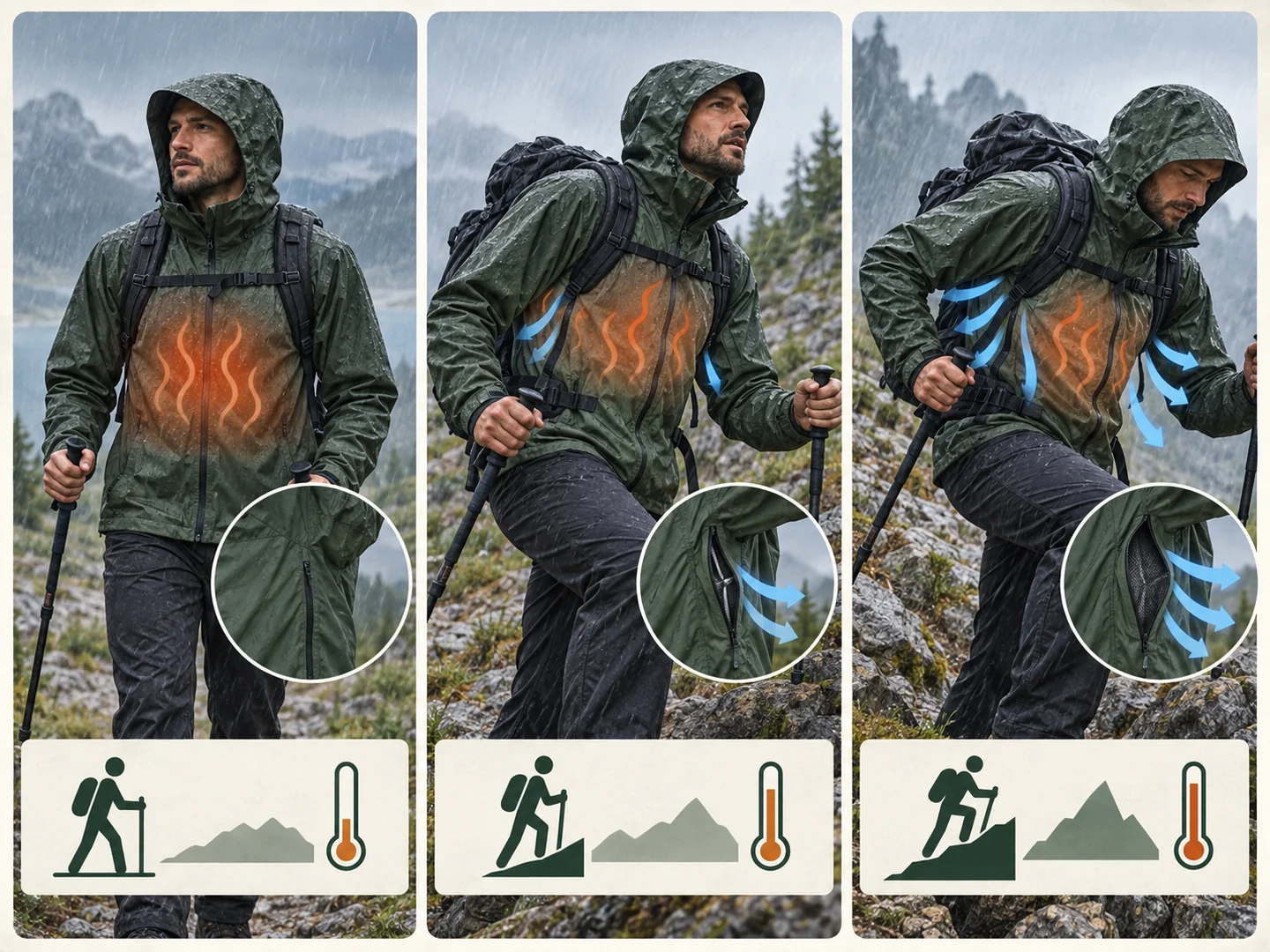
Why Pit Zips Matter So Much for Hiking
Mechanical ventilation bypasses the membrane. Open a pit zip or long side vent and warm humid air can leave directly instead of waiting to diffuse through the fabric. That is especially valuable on climbs, under a backpack, and in mild rain where fully opening the front zipper would expose your torso.
For regular hiking, the most useful ventilation features are:
- Pit zips: the easiest way to dump heat while keeping the front of the jacket mostly closed.
- Hem-to-bicep side zips: larger openings that can move much more air and also improve access under a pack belt.
- Two-way front zippers: useful for opening the lower torso while keeping upper-body coverage.
- Mesh-backed pockets: sometimes provide additional venting when the pocket design allows airflow.
- Adjustable cuffs and hem: less dramatic, but useful for changing how much air enters and leaves.
If you hike hard, a jacket with a respectable membrane and excellent venting is often a better tool than a theoretically more breathable jacket that is difficult to open up.
Two Practical Rain Jacket Examples
This is a decision guide, not a rain-jacket roundup, so the two models below are here to show how the buying logic translates into real products. They are not presented as universal winners.
Marmot PreCip Eco
Marmot’s current PreCip Eco uses waterproof-breathable NanoPro fabric, fully taped seams, and pit zips. The key lesson is not a published breathability score: it is that a mainstream hiking shell can combine basic waterproof construction with direct underarm ventilation.
Outdoor Research Foray 3L
The Foray 3L uses a three-layer AscentShell Dry construction and Outdoor Research’s TorsoFlo vents, which unzip from the hem toward the bicep. It is a useful example of a design that treats mechanical airflow as a core hiking feature rather than an afterthought.
Choose Breathability by the Hiking You Actually Do
Day hiking in cool, rainy weather
You do not need to chase an extreme lab rating if your pace is moderate and the outside air is cool. Prioritize a comfortable fit, reliable waterproof construction, and at least some ventilation. A 10,000 to 20,000 MVTR class shell can be entirely reasonable when the figure is comparable.
Backpacking with repeated climbs
Breathability matters more because you may wear the shell for longer while carrying a pack. Look for a higher-performance membrane, but make pit zips or large side vents part of the requirement. The pack itself reduces airflow at the back and shoulders.
Fast hiking and trail-focused high output
Here, 20,000+ MVTR or very low RET can be useful signals, but no waterproof shell will feel like an open wind shirt when you are climbing hard. If the route allows it, managing pace and opening vents early is more effective than waiting until your base layer is already soaked.
Warm and humid climates
This is where shoppers most often overestimate what a membrane can do. High outside humidity reduces passive vapor transfer, so ventilation, a light base layer, and avoiding unnecessary insulation become critical. In warm storms, a backpacking rain poncho can also make sense for hikers who value airflow more than wind stability and close-fitting protection.
Cold, exposed, wind-driven rain
Weather protection moves back up the priority list. You still want breathability, but opening huge vents may not be desirable in cold wind. A more protective three-layer shell with controllable vents can be easier to manage than an ultralight emergency jacket.
Do Not Trade Away the Waterproofing You Actually Need
Breathability is only half of the rain-shell decision. A hiking jacket still needs a waterproof membrane or coating, sealed seams, a functional hood, and enough coverage for your conditions. Chasing a softer or more air-permeable shell is not useful if it stops matching the weather you hike in.
The practical rule is to use waterproofness as a protection floor and breathability as a comfort and exertion decision. Our rain jacket guide covers the wider product choice, while the ultralight rain systems guide shows how ventilation and carried weight change in short summer storms.
Rain Jacket Breathability Buying Checklist
- Check which metric is published. Higher is generally better for MVTR; lower is better for RET.
- Do not compare unrelated MVTR numbers as if they use one universal test.
- For regular hiking, use about 10,000 to 20,000 MVTR as a rough middle band when methods are comparable.
- For sustained high output, look toward 20,000+ or low RET, then verify ventilation.
- Prefer pit zips or large side vents if you sweat heavily or climb often.
- Check whether pockets and vents still work with your backpack hip belt.
- Keep the face fabric clean and maintain its water-repellent finish according to the manufacturer.
- Use a wicking base layer and avoid overdressing under the shell.
- Expect every waterproof shell to have limits in warm, humid rain.
How We Built This Decision Guide
We checked the current US search results for rain-jacket breathability, then separated this page from the neighboring waterproof-rating intent. The search landscape supports a dedicated breathability decision page because users need help interpreting MVTR, RET, ventilation, wet-out, humidity, and effort level rather than another product roundup.
RET guidance is grounded in ISO 11092-based evaporative-resistance explanations, while MVTR is treated as a family of methods rather than one universal cross-brand score.
Recommendations are framed by effort level, temperature, humidity, backpack contact, and mechanical ventilation instead of one headline number.
The Amazon examples were verified against current Amazon US titles and current manufacturer model pages.
This page stays focused on breathability. Waterproof-rating thresholds and broad best-jacket selection belong on separate supporting pages.
FAQ
Is 10,000 breathability good for a rain jacket?
An MVTR around 10,000 g/m²/24h can be adequate for lower-output use and steady hiking in cooler conditions. It is less convincing for sustained steep climbs or warm-weather hiking. Treat the figure as a rough band and check the test method and ventilation features.
Is 20,000 breathability good for hiking?
Yes, a 20,000-class MVTR is commonly in the range aimed at more active use. It can be a useful target for regular or high-output hiking, but it does not guarantee comfort. Test methods vary, and pit zips can matter more when you are generating sweat faster than the membrane can move it.
What is a good RET rating for a hiking rain jacket?
Lower RET is better. As a practical guide, below 6 is highly breathable, 6 to 12 is still very breathable, 12 to 20 is more moderate, and above 20 is a weak choice for sustained physical effort.
Are pit zips more important than breathability ratings?
For many hikers, pit zips are at least as important because they provide direct mechanical airflow. A membrane can only move moisture so fast, while opening a vent can immediately release warm humid air during a climb.
Why do I sweat inside a breathable waterproof jacket?
Your body can produce moisture faster than the fabric can move it. Warm humid weather, a saturated face fabric, a backpack pressing against the shell, heavy midlayers, and high exertion all reduce real-world comfort.
Does a higher waterproof rating mean lower breathability?
Not automatically. Waterproofness and breathability are different measurements, and modern membranes are engineered to balance both. In practice, fabric technology, construction, face-fabric condition, and ventilation matter more than assuming one number always rises when the other falls.
Should I choose MVTR or RET when comparing jackets?
Use whichever reliable metric the manufacturer publishes, but read it correctly. Higher MVTR generally indicates more vapor transfer within the same method, while lower RET indicates less resistance. RET can be easier to interpret when reported from standardized ISO 11092 testing.