

Gear & Home is reader-supported. As an Amazon Associate I earn from qualifying purchases. When you buy through links on our site, we may earn an affiliate commission, at no extra cost to you. Learn more.
A rain jacket can be genuinely waterproof and still leave you damp inside. The usual explanations are sweat and condensation, a face fabric that has wetted out, or rain entering through openings such as the cuffs and neck. A true fabric, seam or zipper leak is possible, but it is better to diagnose the pattern before you reproof or replace the jacket.
Wet inside does not automatically mean leaking
Broad dampness across your chest, back or arms that gets worse while climbing is more consistent with sweat and condensation. A dark, saturated outer face points toward wet-out and reduced breathability. Water that repeatedly appears at one seam, zipper or damaged spot is more suspicious for a real leak.
Start by cooling down and venting the jacket, then check whether rain is still beading on the outside. Clean the shell before assuming the DWR is gone, reproof only when the care instructions support it, and inspect localized wet spots for damage.
First, diagnose what kind of wetness you have
The fastest way to troubleshoot a wet rain jacket is to look at where the moisture appears, what you were doing when it appeared, and what the outside fabric looks like. Those clues separate four different problems that need different fixes.
A useful clue is whether the problem changes when your output changes. If you slow down, remove an insulating layer and open available vents, then the inside gets noticeably drier, your own moisture load was probably a major part of the problem. If one fixed spot stays wet even during low effort, investigate that spot instead.
Why a waterproof jacket can feel wet inside
Your body produces heat and moisture while you hike. A waterproof-breathable shell can move some water vapor outward, but it does not have unlimited moisture-transfer capacity. During hard exertion, your body can create moisture faster than the fabric can move it.
Cold rain makes the problem easier to notice. Warm, humid air inside the jacket meets a colder inner surface and some of that moisture can condense into liquid water. Once sweat has condensed, it is no longer vapor waiting to pass through the shell. It is simply water on the inside.
Warm and humid rain can also be difficult because there is less difference between conditions inside and outside the jacket. That weakens the driving force for moisture transfer. This is why a jacket that feels comfortable during a cool walk can feel much clammier during a steep climb in mild rain.
A waterproof-breathable shell is a compromise: it keeps liquid rain out while allowing some moisture vapor to escape. Mechanical ventilation, pace and layering still matter, especially in humid weather or during high-output hiking.
Wetting out is not the same as the membrane leaking
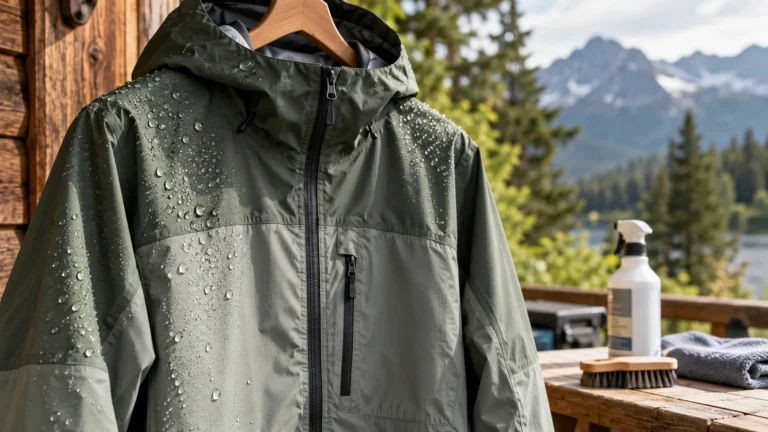
Most waterproof-breathable rain shells use a durable water repellent finish, usually called DWR, on the outer face fabric. When that finish is working well, rain beads and rolls away. As DWR performance drops, or as the surface becomes contaminated with dirt and body oils, the face fabric can start absorbing water instead.
That is called wet-out. The exterior can turn darker and feel saturated. A functioning waterproof membrane underneath may still stop liquid water from crossing the shell, but the soaked face fabric can reduce effective breathability and make the jacket feel colder and clammy. That combination is easy to mistake for a leak.
A healthy DWR helps delay wet-out, but it is not an endless shield against sustained rain. The practical question is whether the jacket still beads reasonably well after proper cleaning and whatever DWR-reactivation process the manufacturer specifies.
Do a simple beading check
On a clean, dry jacket, sprinkle or spray a little clean water on several areas of the face fabric. If the water beads and rolls away, the surface repellency is still doing useful work. If large areas immediately darken and absorb water, the DWR may need cleaning, reactivation or renewal according to the garment maker’s care instructions.
What to do on the trail when the inside feels wet
- Reduce heat before you add more protection. Slow your pace for a few minutes and remove an unnecessary insulating layer if conditions allow. Less heat production usually means less sweat to manage.
- Use mechanical ventilation. Open pit zips, chest vents or the main zipper as much as the rain and wind safely allow. Loosen cuffs when practical. Venting can move warm moist air faster than the fabric alone.
- Keep openings from funneling rain inside. Check the hood, collar, cuffs, hem and front zipper. Water running down your hands or neck can make a good shell seem defective.
- Notice the moisture pattern. Broad dampness suggests condensation. A fixed wet patch is a better reason to inspect a seam, zipper, tear or delaminated area later.
There is no field treatment that turns a saturated face fabric instantly dry while rain keeps hitting it. The immediate goal is to manage heat and ventilation, then clean and evaluate the jacket properly once you are home.
At home: clean first, then decide whether to reproof
Dirt, skin oils and residue can interfere with water repellency, so a jacket that looks like it needs new DWR may simply need the correct wash. Start with the garment’s care label and the manufacturer’s current instructions. Close zippers and hook-and-loop fasteners as directed, use the recommended cycle and cleaner, and avoid products the jacket maker warns against.
Some waterproof-shell manufacturers use controlled heat to reactivate an existing DWR after washing, while other garments have different limits. Do not copy a generic dryer or ironing routine onto every shell. The care label for your exact jacket wins.
If the clean jacket still absorbs water instead of beading, then a compatible DWR treatment may be appropriate. Spray-on and wash-in treatments are not interchangeable for every construction. For example, a spray-on product can be useful when you want the treatment concentrated on the outer face instead of an internal wicking liner.
Two relevant maintenance options
These are not automatic prescriptions. They are current Amazon examples for the two most common maintenance steps discussed above. Confirm that your jacket manufacturer allows the product type before using it.
Nikwax Tech Wash, 300 ml
Designed for waterproof outerwear cleaning and for reviving existing water repellency without using a conventional laundry detergent. A sensible first step when dirt or residue may be contributing to wet-out.
Nikwax TX.Direct Spray-On, 300 ml
Designed to add exterior water repellency to breathable waterproof clothing. Nikwax specifically positions the spray-on version for garments with wicking liners, where treating the outer face is useful.
When the jacket may actually be leaking
Condensation and wet-out are common, but real failures happen. The strongest clue is localized, repeatable water entry rather than a general clammy feeling.
- Lifted or peeling seam tape: water may track through stitch lines once the interior tape is no longer sealed.
- Punctures and abrasion: a small hole can create a very specific wet patch.
- Delamination: bubbling, peeling or separation between laminate layers can indicate structural failure that surface DWR will not fix.
- Zipper or pocket leakage: inspect the exact wet area and the zipper construction rather than blaming the entire fabric.
- Persistent fixed wet spot after proper care: if the same area gets wet during low-output use after cleaning and DWR maintenance, contact the manufacturer about repair or warranty options.
Do not keep adding DWR to a damaged laminate or failed seam and expect it to solve the underlying problem. DWR treats surface repellency. It does not repair holes, detached seam tape or delamination.
Common troubleshooting mistakes
What often makes the diagnosis worse
- Assuming any wet lining proves the membrane leaked
- Reproofing a dirty jacket without cleaning it first
- Wearing too much insulation under the shell while climbing
- Closing every vent because it is raining lightly
- Using fabric softener or another treatment the care label prohibits
- Applying more DWR to a seam, tear or delamination problem
What gives you better evidence
- Compare broad dampness with one fixed wet spot
- Check whether the face fabric still beads
- See whether venting and lower effort reduce moisture
- Clean the shell before judging DWR performance
- Inspect tape, zippers and worn panels under good light
- Use brand-specific care and repair instructions
When replacing the jacket makes sense
A clammy hike by itself is not a good reason to replace a rain shell. Start with ventilation, layering and care. Replacement becomes more reasonable when the laminate is delaminating, seam repairs are no longer practical, the shell has repeated localized leaks, or the design consistently lacks the ventilation you need for your climate and activity.
If you need a different shell rather than a maintenance fix, our backpacking rain jacket guide compares current jacket options by use case. If your biggest issue is heat buildup in warm weather and you can accept less wind control and a looser shape, a backpacking rain poncho can be another way to get more mechanical airflow.
How we built this troubleshooting guide
This article is a research-based diagnosis guide, not a claim that Gear & Home personally used your jacket. We cross-checked current care and rainwear guidance from GORE-TEX, Arc’teryx, REI and Nikwax, then compared recurring owner discussions about condensation, wet-out and localized leaks. Manufacturer instructions for your exact jacket take priority over any general maintenance rule.
FAQ
Does a wet rain jacket lining mean the jacket is leaking?
No. Broad dampness can come from sweat and condensation even when the waterproof barrier is still stopping rain. A leak is more suspicious when water repeatedly appears at one seam, zipper, damaged area or other fixed point.
Why does a GORE-TEX jacket feel wet inside?
The inside can feel wet when your body produces moisture faster than the shell can move vapor outward, especially during hard effort or humid rain. If the outer face fabric wets out, effective breathability can also drop. That does not automatically mean liquid rain crossed the GORE-TEX membrane.
Does wet-out mean my rain jacket is no longer waterproof?
Not necessarily. Wet-out describes the outer face fabric becoming saturated after it stops shedding water effectively. A functioning waterproof membrane underneath can still block liquid water, but the saturated face can reduce breathability and make the jacket feel cold and clammy.
Should I reproof my jacket every time it feels wet inside?
No. First diagnose condensation versus a localized leak, then clean the jacket according to its care instructions. Reproofing is more appropriate when the clean face fabric still does not bead and the manufacturer recommends renewing the DWR.
Do pit zips actually help with condensation?
Yes, when conditions let you use them. Pit zips and other vents provide mechanical airflow that can dump warm, moist air before as much sweat condenses inside the shell. They do not repair a leak, but they can reduce moisture buildup during high-output hiking.
How can I tell condensation from a real rain-jacket leak?
Condensation is usually spread over a broader area and tracks your exertion level. A real leak is more likely to be localized and repeatable at the same seam, zipper, hole or damaged panel, including during relatively low-output use.