
Gear & Home is reader-supported. As an Amazon Associate I earn from qualifying purchases. When you buy through links on our site, we may earn an affiliate commission, at no extra cost to you. Learn more.
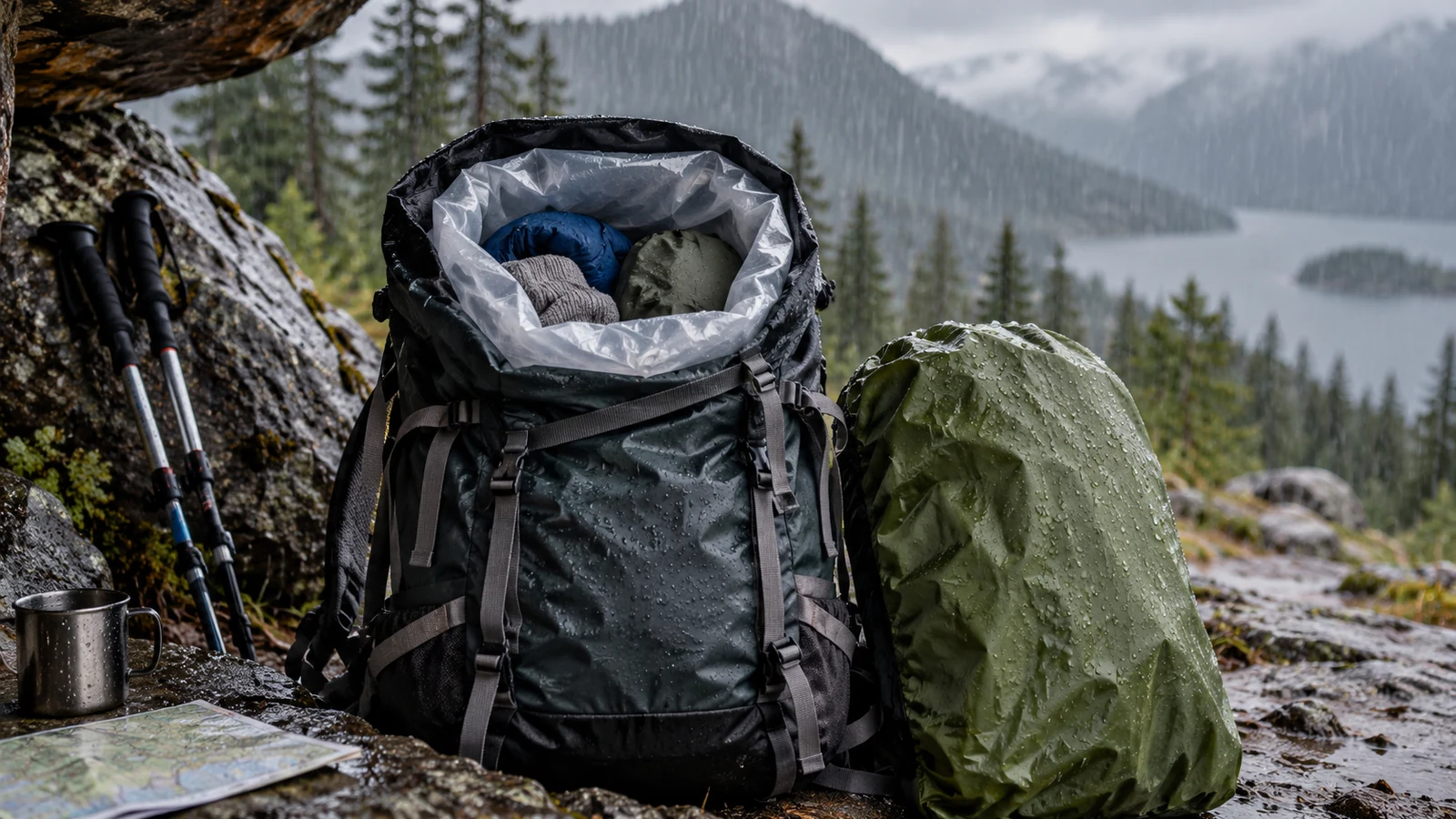
If your priority is keeping a sleeping bag, spare clothes and electronics dry inside a backpack, a pack liner is the stronger baseline. A rain cover is better at keeping the pack shell and some exterior pockets from getting soaked, but it cannot seal the harness side of the backpack.
Pack liner vs rain cover: choose the liner if you can carry only one
For protecting critical gear inside the main compartment, choose a pack liner. It creates the protective boundary around the contents rather than around the outside of the pack, so rain reaching the back panel, seams or pack fabric does not automatically reach your insulation.
Choose a rain cover when your second priority is keeping the backpack itself drier. Covers can reduce direct rain on the shell, lid and covered exterior pockets, which matters more with packs that absorb water or carry important gear outside the lined main compartment.
For prolonged cold rain, a wet climate, or a conventional padded pack that holds water, using a liner plus a cover is reasonable. Treat the liner as the primary protection for critical contents and the cover as secondary protection for the pack.
Pack Liner vs Backpack Rain Cover: Decision Table
| Decision | Pack liner | Rain cover | Better choice |
|---|---|---|---|
| Keep sleeping gear and spare clothes dry | Protects contents inside the lined main compartment | Reduces direct rain but leaves the harness side open | Pack liner |
| Keep the pack shell from soaking up water | Does not protect the exterior | Shields much of the shell from direct rain | Rain cover |
| Protect exterior pockets and lid | Only items placed inside the liner are protected | Can shield covered pockets and lid, depending on fit | Rain cover |
| Handle wind, brush and snags | Sits inside the pack and is less exposed | External fabric can shift, snag or fit poorly | Pack liner |
| Protect critical gear in sustained rain | Still protects the contents if the pack exterior becomes wet, assuming the liner is intact and closed | Helpful secondary barrier, but not a sealed enclosure | Pack liner |
| Keep both contents and pack shell as dry as practical | Protects contents | Protects much of the exterior | Use both |
Pack liner wins
Protects main-compartment contents
Back panel remains exposed
Rain cover wins
Pack exterior still gets wet
Reduces direct rain on shell
Pack liner is less exposed
Protected inside the pack
Fit and retention matter
Use both when pack wet-out matters
Pack liner
Rain cover
The key distinction is simple: a liner protects what is inside the protected boundary, while a cover protects much of what is outside it. That is why a liner is usually the safer single choice when insulation and dry sleep clothes matter more than the condition of the pack fabric.
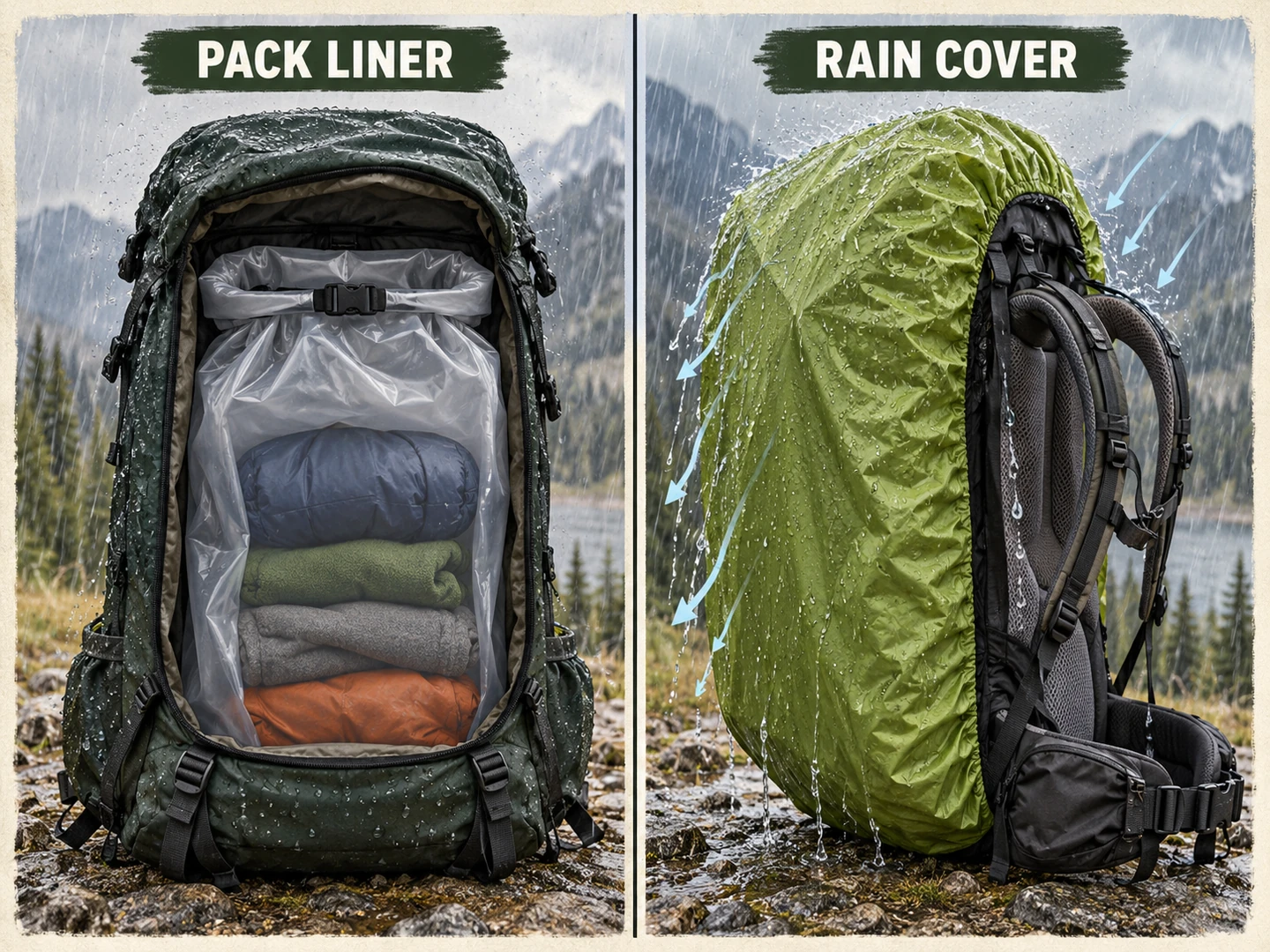
Why a Pack Liner Usually Keeps Critical Gear Drier
A backpack rain cover cannot close the side pressed against your back because the shoulder straps and hipbelt have to remain usable. Rain can still reach the back panel, run along the harness area, or work into seams and openings if the cover shifts. A liner avoids that geometry problem by protecting the contents from inside the pack.
This is also the recurring pattern in backpacking discussions: hikers who use both systems commonly describe the liner as the dependable layer for sleeping gear, with the cover used mainly to reduce how wet the pack itself becomes. That does not make every liner fail-proof. A puncture, an open top, or wet gear placed inside the liner can still compromise the system.
If you already know you want a liner and need a lightweight setup, sizing and packing workflow, see our ultralight pack liners and dry storage guide.
Where a Backpack Rain Cover Is Better
A cover solves a different problem: it reduces how much rain lands directly on the pack body. That can keep fabric, lid pockets and covered external storage drier, which may reduce water absorption and make a soaked pack less unpleasant to handle at camp.
Current owner feedback on dedicated Osprey covers shows the trade-off clearly. Many users report good performance in heavy rain and secure fit when the size is right, while negative feedback tends to cluster around sizing, coverage and concern about an external cover shifting or snagging. In other words, a good rain cover can work very well within its design limits, but it is still not a sealed bag around the entire backpack.
When It Makes Sense to Use Both
Using both is not automatically overkill. The combination makes the most sense when the consequences of wet gear are high and the penalty of a wet pack is also meaningful.
- Cold, sustained rain: keep insulation inside a closed liner while the cover reduces direct rain on the pack body.
- Conventional padded backpacks: a cover can reduce water absorbed by foam, fabric and external compartments.
- Long trips in wet climates: the liner protects critical contents while the cover can make repeated wet camp transitions less messy.
- Important gear outside the main compartment: a cover can help shield pockets the liner cannot reach, although truly critical items should still have their own waterproof bag.
A liner is the better boundary for internal gear, but a typical backpack liner is not the same thing as a certified submersible dry bag. Before deep water crossings, protect insulation, electronics and documents with an appropriate secondary waterproof bag and keep closures fully sealed.
For a broader hot-weather system that combines pack protection with what you wear, see our ultralight rain systems for summer thunderstorms.
Two Current Product Examples
These are not category winners. They are two current products from the same brand that make the liner-versus-cover trade-off easy to see, and both exact Amazon US variants were verified before publication.
Osprey Ultralight Pack Liner Medium
A purpose-built 58-liter liner for 50 to 70 liter packs, with a roll-top closure and waterproof-coated fabric and seams.
Osprey shapes this liner for rectangular packing and specifies waterproof-coated fabric and seams. Current retailer feedback is limited but consistently highlights easy sealing, smooth fit inside larger packs and convenience over an improvised bag. The main practical trade-off is value: some owners explicitly note that a heavy-duty plastic bag can perform the same basic liner role for less money.
Pros
- Protective layer sits around the contents
- Roll-top closure is easy to inspect and reseal
- Purpose-built shape fits the pack interior more neatly than many improvised liners
Cons
- Does nothing to keep the pack shell dry
- Costs more than simple disposable liner options
- Current manufacturer availability can vary, so check the exact listing before buying
Osprey Ultralight Raincover Medium
A taped-seam external cover for 30 to 50 liter packs that reduces direct rain on the pack body without pretending to seal the harness side.
Osprey uses a drawcord and taped seams, and the cover packs into itself. Retailer reviews repeatedly praise easy deployment and successful use in heavy rain when sizing is correct. The recurring complaints are more about fit and coverage than the fabric itself: a cover that is too loose, too tight or loaded over bulky external gear is less dependable.
Pros
- Reduces direct rain on the pack shell and covered pockets
- Taped seams and drawcord address the main external-cover requirements
- Packs into itself for storage
Cons
- Harness side of the pack remains open
- Correct sizing matters, especially with external gear attached
- External covers are more exposed to wind, brush and snags than an internal liner
Alternatives to a Dedicated Pack Liner or Rain Cover
Heavy-duty plastic or compactor-bag liner
This is the budget and ultralight-style alternative to a purpose-built liner. It protects the main-compartment contents using the same inside-the-pack logic, but durability and closure quality depend on the bag. Our pack liner and dry storage guide covers sizing, packing and failure points in more detail.
Individual dry bags
Dry bags are useful when only a few items absolutely must stay dry or when you want compartment-level organization. The trade-off is more individual closures and potentially more total material than a single liner.
Pack-covering poncho
A poncho that extends over both the hiker and the pack reduces the exposed-back-panel problem of a conventional rain cover. It can be a very efficient system in warm weather, but wind control and snagging still matter. Compare current options in our best rain ponchos for backpacking guide.
Water-resistant or seam-taped backpack
Low-absorption waterproof-style fabrics can reduce how much water the pack body takes on, but fabric choice alone does not prove the whole backpack is waterproof. Seams, zippers and closures still determine whether water can enter. For critical insulation, a separate liner or dry bag remains cheap redundancy.
How We Reached This Verdict
We checked the current US results for direct liner-versus-cover queries and confirmed that a standalone comparison intent exists separately from our pack-liner buying guide.
Construction, size ranges, fabric and listed weights for the two product examples were taken from current Osprey US product pages.
Retailer reviews were used to identify recurring real-world themes such as fit, ease of use, cover retention and the value trade-off between a dedicated liner and a simple bag.
Multiple backpacking discussions were checked for repeated long-term patterns, especially the open-back limitation of covers and the common use of a liner as the primary dry-gear layer.
The exact Medium Black child-ASIN was checked for each Osprey example on Amazon US. No ASIN was inferred from a parent listing or another size.
Gear & Home did not physically test these items. The verdict is an editorial synthesis of current specifications and recurring evidence.
FAQ
Is a pack liner better than a backpack rain cover?
For keeping critical gear inside the main compartment dry, usually yes. A liner protects the contents from inside the pack, while a rain cover leaves the harness side open. A cover is better at keeping the pack shell itself drier.
Do I need both a pack liner and a rain cover?
Not always. A liner alone is a strong minimalist setup when dry insulation is the priority. Add a cover for sustained rain, water-absorbing packs, important exterior pockets, or when carrying a soaked backpack would be a significant nuisance.
Will a pack liner keep gear dry if the backpack falls in water?
Do not assume it will. A typical pack liner is not automatically certified for submersion. For deep crossings or boating, put critical insulation, electronics and documents in an appropriate sealed dry bag even if you also use a liner.
Does a rain cover keep the back panel dry?
No conventional rain cover can fully enclose the harness side while you are wearing the pack. Rain can still reach the back panel, shoulder-strap area and any exposed openings.
Can I use a trash compactor bag as a pack liner?
Yes. Heavy-duty unscented compactor bags are a common low-cost liner option. Inspect them for punctures, keep sharp gear away from the plastic, and close the top so water cannot run directly inside.
Do I still need a liner with a waterproof backpack?
It depends on the pack construction and the consequences of a leak. Waterproof fabric alone does not guarantee that seams, zippers and closures are sealed, so many hikers still use a light liner or dry bag for sleeping insulation and other critical items.
How do I choose the right liner or rain-cover size?
Use the current manufacturer fit range for your loaded pack, not the word Medium or Large by itself. Size labels are not interchangeable. For example, Osprey’s current Medium pack liner is intended for 50 to 70 liter packs, while its Medium rain cover is intended for 30 to 50 liter packs.