
Gear & Home is reader-supported. As an Amazon Associate I earn from qualifying purchases. When you buy through links on our site, we may earn an affiliate commission, at no extra cost to you. Learn more.
A hiking rain jacket does not need the biggest waterproof number on the tag. It needs enough waterproofing for your exposure, plus sealed seams, a useful hood, good ventilation and a face fabric that still sheds water.
Short answer
For most hikers, 10,000 to 15,000 mm is a sensible shopping band – when the brand publishes a hydrostatic-head rating
For ordinary three-season hiking, a published rating around 10,000 to 15,000 mm gives a useful margin for real trail rain. If you regularly hike for hours in steady rain, carry a heavier pack, travel above treeline or cannot easily retreat, moving toward 15,000 to 20,000 mm or more is reasonable.
But the number is not a universal score. Rainwear brands do not all use one agreed test protocol or one agreed definition of “waterproof,” so a 20,000 mm jacket from Brand A is not automatically twice as protective as a 10,000 mm jacket from Brand B. A reputable shell with fully sealed seams and no published mm figure can still be an excellent hiking jacket.
What a waterproof rating actually measures
The millimeter figure is usually a hydrostatic-head or water-column result. In simple terms, a fabric sample is exposed to increasing water pressure until water begins to pass through. A 10,000 mm result means the material resisted pressure equivalent to a 10-meter column of water under that test method.
That sounds like a clean way to rank jackets, but there is an important catch: the rainwear industry does not use one universal performance scale across every brand. Test methods, conditioning, sample age and pass criteria can differ. REI, for example, describes 3 psi, or about 2,109 mm, as its rainproof threshold, while brands such as Patagonia use much higher internal benchmarks as part of durability testing. Patagonia’s H2No process starts waterproofness testing at 20,000 mm and then requires fabric to maintain a 10,000 mm rating after its abrasion and wet-flex durability cycle.
The figure is most useful when comparing products from the same brand or when a manufacturer clearly explains its test. For cross-brand shopping, pair the number with seam sealing, construction, hood design, ventilation and intended use.
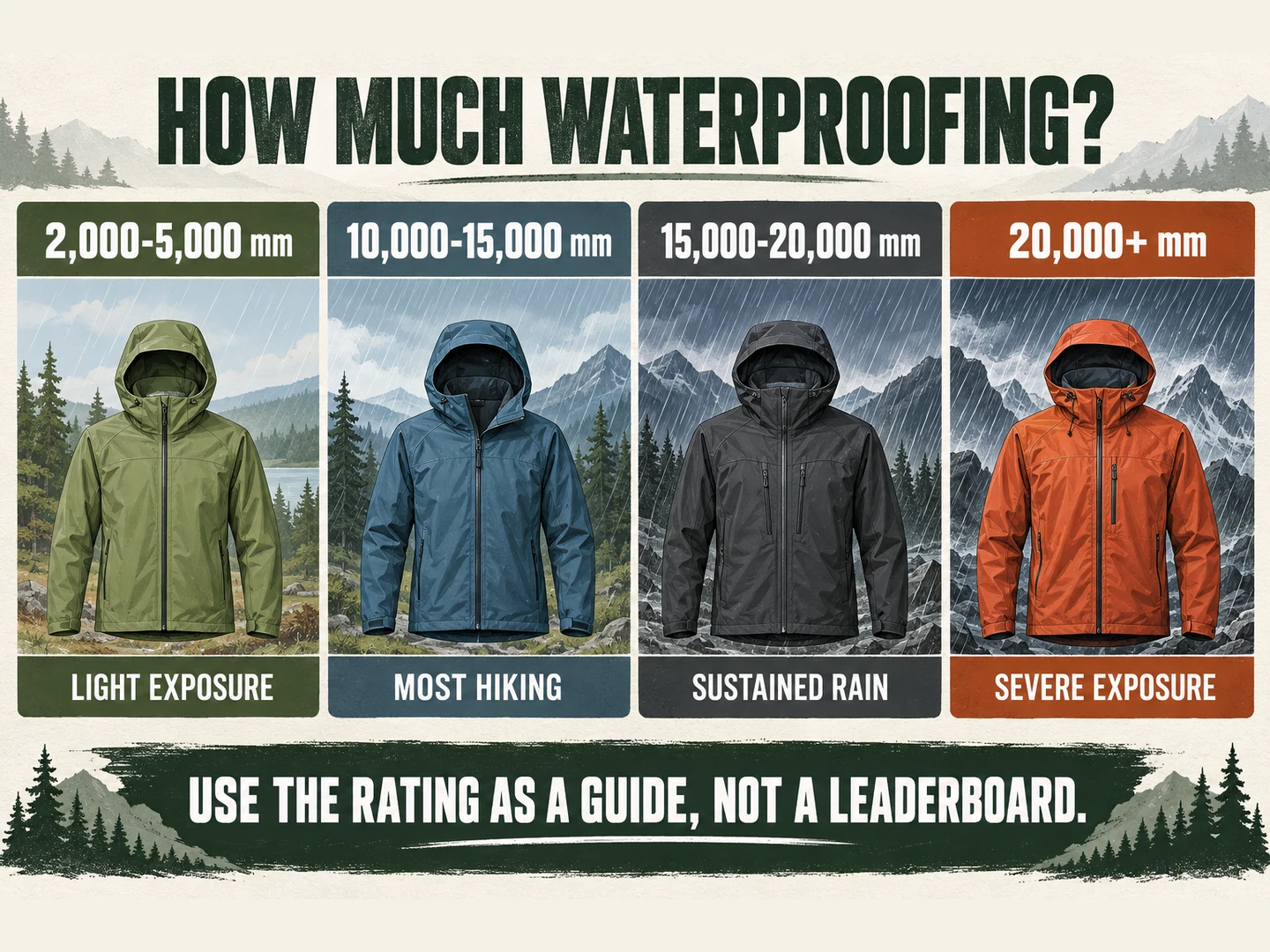
How much waterproofing do you need for hiking?
The bands below are practical buying guidance, not an industry certification. They intentionally leave some margin for long exposure, wind, pressure from shoulder straps and the fact that a finished jacket has seams, zippers and openings that a fabric swatch does not.
| Published waterproof rating | Best fit | What to check before buying |
|---|---|---|
| About 2,000 to 5,000 mm | Short walks, emergency shells, light or intermittent rain | Fully sealed seams matter. Treat this as limited-margin protection for hiking rather than an all-day storm target. |
| About 10,000 to 15,000 mm | Most three-season day hikes and general backpacking | A useful all-around band if the jacket is fully seam sealed and the hood, cuffs and hem close well. |
| About 15,000 to 20,000 mm | Frequent sustained rain, exposed routes, longer trips, heavier packs | Look for ventilation and durable construction so the extra weather margin does not become a sweat problem. |
| 20,000 mm and above | Severe exposure, alpine use, repeated wet-weather trips, high-consequence conditions | Do not pay for the number alone. Construction quality, long-term durability and fit can matter more than another jump in the lab rating. |
| No published mm figure | Potentially any of the above, depending on the shell | Check the manufacturer’s waterproof standard, full seam sealing, construction and intended use. Missing mm data does not mean “not waterproof.” |
Short exposure, light rain
Sealed seams
Most three-season hiking
Whole-jacket design
Sustained rain and exposure
Ventilation and durability
High-consequence wet weather
Do not shop by number alone
Depends on the shell
Brand standard and seam sealing
Decathlon’s current hiking guidance illustrates why the use case matters: it positions a 5,000 mm shell for short outings, around 15,000 mm for moderate showers and a 25,000 mm 3-layer shell for longer wet-weather hiking. Those are useful examples from one brand, not universal thresholds for every manufacturer.
The fabric rating is only one part of staying dry
1. Fully sealed seams are non-negotiable for a real hiking rain shell
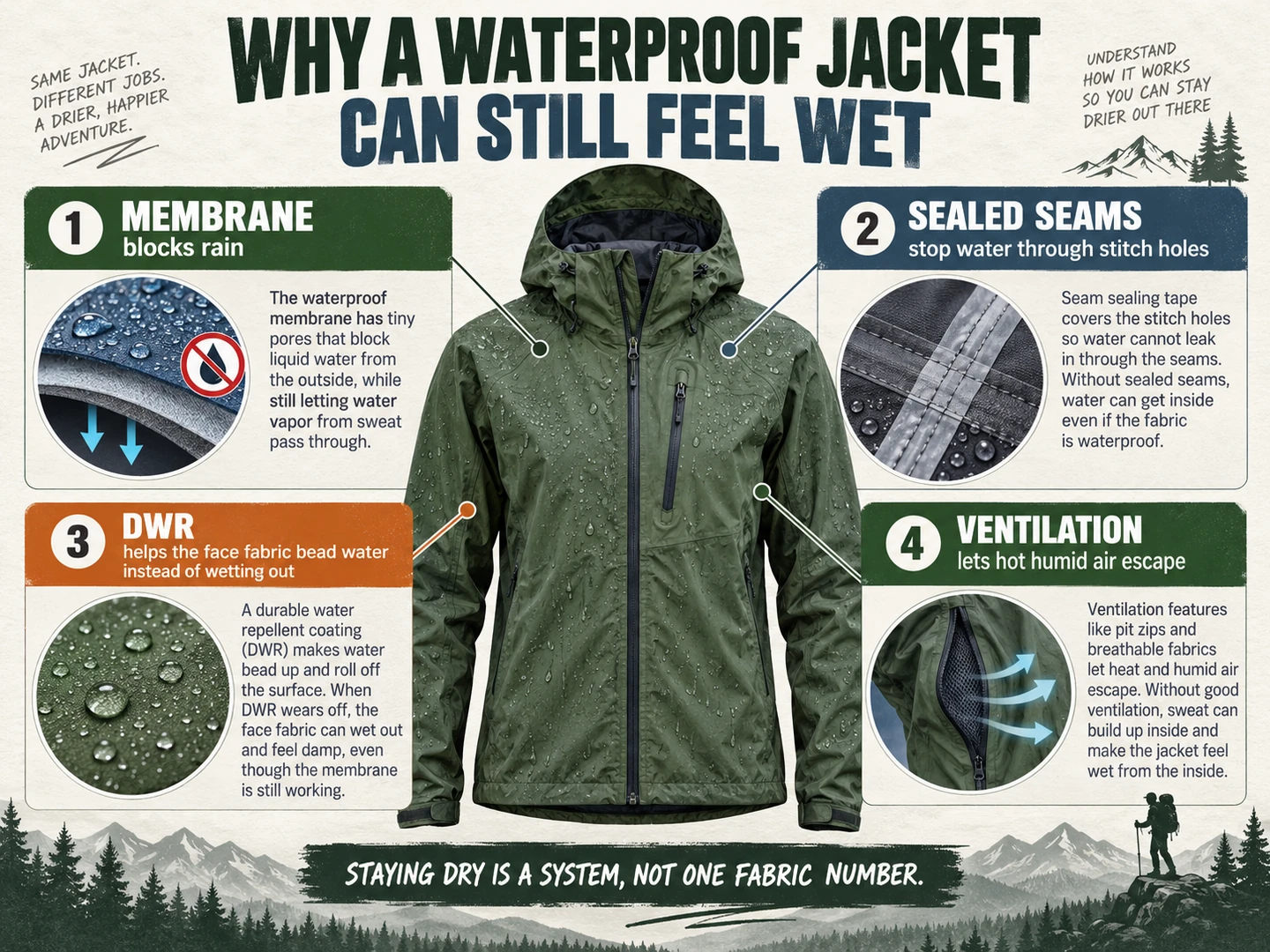
Needle holes can turn waterproof fabric into a leaky garment. For sustained hiking rain, look for language such as fully seam sealed or fully taped seams. “Critical seams sealed” can be adequate for lighter use, but it leaves more uncertainty if you expect hours of rain.
2. A useful hood can matter more than another 5,000 mm on the spec sheet
A hiking hood should move with your head, tighten without blocking peripheral vision and seal reasonably around the face. A loose hood that dumps water down the collar makes an impressive fabric rating irrelevant. If you wear a climbing helmet, confirm helmet compatibility rather than assuming a large hood is automatically better.
3. Cuffs, hem and front zipper are controlled leak paths
Rain runs down sleeves, blows under hems and pools around openings. Adjustable cuffs and a drawcord hem help close those paths. Water-resistant zippers reduce ingress, but zipper construction varies, so check whether the main zipper uses a storm flap or a protected waterproof design.
4. Backpack pressure changes the problem
Shoulder straps and a hip belt press wet fabric against your clothing for long periods. That pressure, plus abrasion and reduced airflow, is one reason backpackers benefit from more weather margin and durable face fabrics than someone carrying no pack on a short neighborhood walk.
Why a very waterproof jacket can still leave you wet inside
A waterproof membrane blocks rain, but it cannot repeal physiology. During hard uphill hiking, your body can produce moisture faster than a shell can move vapor through the fabric. In warm, humid rain, the temperature and humidity gradient that helps vapor escape is also weaker.
That means a clammy base layer is not proof that the membrane leaked. It may be sweat, condensation or a face fabric that has wetted out and slowed vapor transfer.
2-layer, 2.5-layer or 3-layer: which construction makes sense?
Layer count describes how the waterproof membrane or coating is protected, not how many separate jackets you are wearing.
| Construction | Typical strengths | Typical trade-offs | Good hiking use |
|---|---|---|---|
| 2-layer | Comfortable liner, straightforward everyday design | Often bulkier because the inner liner hangs separately | Day hiking, travel and general outdoor use |
| 2.5-layer | Light, compact and often more affordable | Can feel clammy against bare skin and may give up durability or comfort versus a robust 3-layer shell | Backpacking, emergency shells, weight-conscious three-season use |
| 3-layer | Membrane protected between face and inner fabrics, usually built for repeated performance use | Usually higher cost, and some models are heavier or stiffer | Frequent hiking in bad weather, long trips, alpine and high-use shells |
Comfort and everyday versatility
Day hiking and travel
Light and compact
Backpacking and backup shells
Durability and repeated wet use
Frequent storms and exposed trips
Do not assume every 3-layer jacket is automatically more waterproof than every 2.5-layer jacket. The construction tells you how the shell is built; the membrane, seam treatment, design and quality control still determine the final garment.
Choose the jacket by the trip, not by the biggest number
Fair-weather day hikes with a shell carried “just in case”
Prioritize low weight, easy packing and enough real waterproof construction to handle a surprise shower. A lighter 2.5-layer shell can make more sense than a heavy expedition shell that stays home because it is unpleasant to carry.
Typical three-season hiking and backpacking
This is where a published 10,000 to 15,000 mm rating is a useful starting band. Pair it with full seam sealing, an adjustable hood and at least one effective ventilation option. If a reputable brand does not publish a hydrostatic figure, judge the shell by its waterproof standard and intended activity instead.
Wet climates and multi-day trips
Move durability and ventilation higher on the list. Repeated hours in rain, damp camps and pack abrasion reward a stronger shell. A 15,000 to 20,000 mm or higher published rating can provide useful margin, but a proven 3-layer construction, good hood and pit zips may matter more than the final digit.
Exposed alpine routes or cold conditions where getting soaked has consequences
Choose the complete system conservatively. A robust 3-layer shell, secure hood, full seam sealing and dependable closures are more important than shaving ounces. Pair the jacket with proper lower-body protection such as rain pants for backpacking, and keep critical insulation protected from moisture inside the pack.
Two useful Amazon reference points
This is a decision guide, not a full jacket roundup, so the examples below are intentionally limited. They show two different parts of the waterproofing decision: buying a complete seam-sealed shell and maintaining the DWR on a shell you already own.
Columbia Watertight II
Columbia’s current Watertight II is a useful reminder that a credible rain shell does not need a public mm figure. Columbia specifies a 2-layer Omni-Tech waterproof-breathable construction, full seam sealing, an adjustable storm hood, adjustable cuffs, drawcord hem and self-packing design.
Nikwax TX.Direct Wash-In Waterproofing
If the shell’s face fabric has stopped beading water but the membrane is still sound, restoring water repellency can be more sensible than replacing the jacket. The current Amazon US listing for Nikwax TX.Direct Wash-In describes it as a wash-in treatment intended to add water repellency and revive breathability in waterproof clothing. Nikwax instructs users to clean items before waterproofing, so follow the garment label and the treatment instructions for your exact shell.
For a broader model-by-model shortlist, use our best rain jackets for backpacking guide. That page is where product comparison belongs; this page stays focused on deciding how much waterproofing you actually need.
DWR, wetting out and membrane failure are three different things
The face fabric on most waterproof-breathable jackets has a durable water repellent finish, or DWR. Its job is to make droplets bead and roll away so the outer fabric does not become saturated. The waterproof membrane underneath is the part that actually blocks liquid water.
When DWR performance fades, the face fabric can darken and soak up water. The shell may feel cold and clammy, and breathability can drop, even while the membrane is still preventing rain from passing through. That condition is called wetting out.
Clean the jacket according to the manufacturer instructions first. Dirt, body oils and sunscreen can degrade DWR performance. If water still will not bead after correct cleaning and any manufacturer-approved heat reactivation, then consider a compatible reproofing treatment. A peeling membrane, extensive delamination or failing seam tape is a different problem and may justify repair or replacement.
Five mistakes to avoid when buying a hiking rain jacket
- Comparing mm ratings as if every brand used the same test. They do not.
- Ignoring seam sealing. Waterproof fabric does not rescue an incompletely sealed garment in sustained rain.
- Buying too much shell for the trip. A heavy storm shell is not useful if you stop carrying it on ordinary hikes.
- Equating clamminess with leaking. Sweat, condensation and wetting out can all make the inside feel damp.
- Forgetting the rest of the rain system. Water can run off the jacket onto your legs, into boots or down an unprotected pack. Depending on conditions, consider a backpacking rain poncho, rain pants or other protection that matches the trip.
How we set these decision ranges
We treated hydrostatic-head figures as context rather than a universal ranking. The ranges above reconcile current manufacturer guidance with the broader reality that rainwear brands do not share one single pass/fail standard.
Current REI guidance explains hydrostatic testing and warns that cross-brand spec comparisons are unreliable.
Current Decathlon guidance places 5,000, 15,000 and 25,000 mm shells into progressively more demanding hiking scenarios.
Patagonia’s current H2No standard tests at 20,000 mm and then requires 10,000 mm after its durability cycle.
We weighted seam sealing, hood and closure design, ventilation, construction and DWR condition alongside any published fabric number.
FAQ
Is 10,000 mm waterproof enough for hiking?
For many three-season hikes, 10,000 mm is a sensible published starting point if the jacket is fully seam sealed and well designed. It is not a universal minimum, because brands use different test methods and some excellent shells do not publish a hydrostatic-head figure at all.
Is 20,000 mm waterproofing overkill?
Not necessarily. It can be useful for long exposure, wet climates, alpine routes and repeated storm use. But a higher number does not automatically make a jacket better for you. Ventilation, durability, hood design, fit and seam sealing may have a larger effect on real hiking comfort.
What does a 10,000 mm waterproof rating mean?
It generally means the tested fabric resisted pressure from a 10,000 mm water column before leakage under that test method. Because brands do not all test and condition fabrics identically, use the figure as a comparison clue rather than a universal score.
Does a higher waterproof rating mean lower breathability?
Not automatically. Waterproofness and breathability are separate performance characteristics, and both depend on membrane technology, construction and test method. During hard hiking, mechanical ventilation such as pit zips can matter more than small differences in lab breathability figures.
Why does my waterproof jacket feel wet inside?
The cause can be sweat, condensation, wetting out of the face fabric or an actual leak. Check whether water is entering at seams or openings, whether the outer fabric has stopped beading and whether the dampness appears mainly during high exertion before assuming the membrane has failed.
Can I restore a rain jacket that has stopped beading water?
Often, yes. Start by washing and drying it exactly as the manufacturer recommends, because dirt and body oils can reduce DWR performance. If beading does not return, a compatible DWR treatment may help. Reproofing will not repair delamination, damaged membrane material or failed seam tape.