
Gear & Home is reader-supported. As an Amazon Associate I earn from qualifying purchases. When you buy through links on our site, we may earn an affiliate commission, at no extra cost to you. Learn more.
Backpacking rain pants have to solve a harder problem than everyday rainwear. They need to block wind-driven rain, fit over hiking layers, go on quickly when the weather turns, survive pack and trail abrasion, and still be light enough that you will actually carry them. A 2.5-ounce thru-hiking shell and a 13-ounce three-layer pant can both be excellent choices – but for very different trips.
For most hikers, the best rain pants are not simply the lightest pair. The right choice depends on how often you expect to wear them, how much abrasion your route creates, whether you hike in trail runners or boots, and how much ventilation you need while climbing. If you are still building the upper half of your storm system, compare our best rain jackets for backpacking and best backpacking rain ponchos.
Quick answer: the best backpacking rain pants
Patagonia Torrentshell 3L is our best all-around pick if you expect to actually hike in your rain pants, not just carry them. Its 50-denier three-layer shell, useful pockets, and cuff-to-thigh zips trade some pack weight for a broader wet-weather range. If minimizing carried weight matters more, the Outdoor Research Helium UL is the better backpacking-first choice at a listed 5.75 ounces. Dedicated ultralight hikers should also look closely at the Zpacks Vertice and Rab Phantom.
How we chose these rain pants
This is a research-led buying guide, not a claim that Gear & Home has completed controlled long-term field testing on every model below. We verified current manufacturer specifications and availability, then compared each design around the factors that matter most for backpacking: listed weight, waterproof construction, face-fabric durability, seam sealing, zipper length, packability, fit over footwear, ventilation options, and whether the design makes more sense as emergency protection or as clothing you can wear for hours.
We deliberately do not assign fake 9.4/10-style scores. A three-ounce shell should not lose points simply because it lacks the durability of a 13-ounce storm pant, and a heavy three-layer shell should not lose because it is heavier than a race-oriented emergency layer. Instead, each recommendation is tied to a specific use case and its tradeoffs are stated directly.
Product specifications and Amazon availability were rechecked on August 11, 2026. Marketplace inventory, sizes, colors, and sellers can change; recheck the exact variant before ordering. Read more about how Gear & Home researches gear.
Backpacking rain pants comparison
Weights below are manufacturers’ listed weights for the named men’s models/configurations. Weight can vary by size. Waterproof and breathability numbers from different brands are not directly interchangeable because test methods and constructions differ.
Best Overall
50D, 3-layer H2No
Best Lightweight
15D, 2.75-layer Dermizax
Best Thru-Hiking Minimalist
Vertice waterproof-breathable fabric
Best Specialized Ultralight
7D Pertex Shield 2.5L; 20k/20k
Best for Mobility
50D DrySpell 2.5L stretch
Best Value/Performance Balance
50D Pertex Shield 2.5L; 20k/20k
Best Full-Zip Value
2.5-layer HydroWall; full side zips
Best for Sustained Bad Weather
40D AscentShell Dry 3L
Best Budget Pick
Omni-Tech; fully seam sealed
1. Patagonia Torrentshell 3L Rain Pants – Best Overall
The Torrentshell 3L is our best all-around recommendation because it behaves like actual bad-weather clothing rather than emergency packaging. Its 50-denier three-layer shell is heavier than ultralight options, but the extra structure makes more sense when rain is expected for hours, not minutes. Cuff-to-thigh two-way zips improve boot clearance and ventilation, while two hand pockets make the pants more livable around camp and during travel.
Verified specifications
- Listed weight: 11.8 oz / 335 g
- 50D three-layer H2No Performance Standard shell
- Two-way side zips from cuffs to thighs
- Two handwarmer pockets
- Regular inseam: 32.5 in; 30 in version also available
- Fabric, membrane, and DWR made without intentionally added PFAS
Why it made the list
For backpackers who actually expect wet weather, a three-layer shell is easier to justify than an ultralight 2.5-layer pant. The 50D face fabric gives more abrasion margin around wet brush, campsites, and pack contact, while the long side zips let you vent before condensation becomes the main problem.
Tradeoffs
The weight is real: this is more than twice the listed weight of the Helium UL and far heavier than the Zpacks or Rab Phantom. It is a poor choice if your rain pants spend 98 percent of every trip compressed in a pack.
Pros
- Three-layer construction suits sustained wear
- 50D face fabric offers useful abrasion margin
- Long two-way zips aid ventilation and footwear access
- Two useful hand pockets
Cons
- Heavy for an emergency-only layer
- Larger packed volume than ultralight pants
- Side zips stop at the thigh rather than fully separating
Best fit: Backpackers in wet climates, shoulder-season hikers, and anyone who expects to spend meaningful time walking in rain pants.
Skip it if: You mostly hike in dry climates and want the smallest possible contingency layer.
2. Outdoor Research Helium UL Pant – Best Lightweight Pick
The Helium UL is the backpacking sweet spot for hikers who want real waterproof construction without carrying a half-pound-plus shell. At a listed 5.75 ounces, it undercuts full-featured rain pants dramatically while retaining fully taped seams, ankle zips, a 15D ripstop shell, and a pocket that doubles as a stuff sack.
Verified specifications
- Listed weight: 5.75 oz / 163 g
- Toray Dermizax 2.75-layer construction
- 15D ripstop nylon shell
- Fully seam taped
- Ankle zippers, elastic cuffs, and lace loops
- Back pocket doubles as stuff sack
Why it made the list
For ordinary three-season backpacking, the Helium UL preserves the features that matter most while staying light enough to carry routinely. It is less specialized than a two- or three-ounce racing shell and much easier to justify in a lightweight pack than a 12- or 13-ounce storm pant.
Tradeoffs
A 15D shell still needs deliberate handling. It is not the pant we would choose for repeated brush, trail work, frequent scrambling against rock, or daily professional use. Ankle zips also provide less boot access and ventilation than thigh- or full-length designs.
Pros
- Excellent protection-to-weight balance
- Very compact self-stowing design
- Fully taped waterproof construction
- Ankle zips improve footwear clearance
Cons
- Thin shell requires care
- Less ventilation than long-zip pants
- Less convenient over bulky boots
Best fit: Lightweight three-season backpackers who carry rain pants as dependable storm insurance.
Skip it if: Your trip involves sustained rain, abrasive terrain, or frequent changes over large boots.
3. Zpacks Vertice Rain Pants – Best for Minimalist Thru-Hiking
Zpacks targets hikers who count ounces across an entire long-distance kit, and the Vertice pants reflect that priority. The men’s version is listed at just 2.5 ounces, packs down extremely small, uses an adjustable waist, and is sized to fit over hiking pants. There are no long zippers, pockets, or heavy hardware competing with the core job of providing ultralight rain protection.
Verified specifications
- Listed weight: 2.5 oz / 72 g
- Vertice waterproof-breathable fabric
- Adjustable shock-cord waist
- Designed to fit over hiking pants
- PFAS-free DWR
- Rolls into a very small package without a separate stuff sack
Why it made the list
A backpacking-specific roundup would be incomplete without a true thru-hiking option. The Vertice makes sense when pack weight is a system-level priority and the user accepts a minimalist feature set in exchange for exceptionally low carried weight.
Tradeoffs
Minimalism removes conveniences. There are no long side zips to vent aggressively or simplify changes over bulky boots, and ultralight fabrics deserve more care around rough vegetation and rock.
Pros
- Extremely low listed weight
- Tiny packed size
- Simple over-pants sizing and adjustable waist
- PFAS-free DWR
Cons
- No side zips for ventilation
- No pockets
- Minimalist construction is not intended to mimic a heavier storm shell
Best fit: Thru-hikers, ultralight backpackers, and experienced hikers who treat rain pants as part of a tightly optimized clothing system.
Skip it if: You want maximum convenience over boots or a tougher pant for frequent off-trail use.
4. Rab Phantom Waterproof Pants – Best Specialized Ultralight
The Phantom is a three-ounce specialist built around 7D Pertex Shield 2.5-layer fabric. It is aimed at fast, light movement and makes the most sense when waterproof pants are mandatory backup equipment rather than something you expect to grind through brush every weekend.
Verified specifications
- Listed weight: 3 oz / 84 g in size M
- 7D Pertex Shield 2.5-layer fabric
- Hydrostatic head: 20,000 mm
- MVTR: 20,000 g/m²/24 hr
- Slim fit with articulated knees
- Adjustable lower-leg hem
Why it made the list
Rab publishes both waterproof and moisture-vapor figures, and the overall package is exceptionally light. For fastpacking, mountain running, or maintained-trail backpacking where every ounce is deliberate, the Phantom has a clear reason to exist.
Tradeoffs
The 7D shell offers less abrasion margin than mainstream rainwear, and the minimalist pull-on design gives up the long side zips that make heavier pants easier to ventilate and change over boots.
Pros
- Only 3 oz listed weight
- Published 20k/20k fabric figures
- Very compact
- Articulated cut for fast movement
Cons
- Very light 7D fabric
- Limited mechanical ventilation
- Slim cut is less forgiving for bulky layering
Best fit: Fastpackers, trail runners, and experienced ultralight hikers on maintained routes.
Skip it if: You want one rain pant for rough trails, repeated use, and large boots.
5. Mountain Hardwear Stretch Ozonic Rain Pant – Best for Mobility and Quiet Fabric
Not everyone wants a rain pant that feels stiff and noisy. The Stretch Ozonic uses a 50D stretch ripstop 2.5-layer fabric and is designed for backpacking and hiking, with four-way stretch and three-quarter side zips. At 9.3 ounces, it sits between emergency shells and heavier three-layer pants.
Verified specifications
- Listed weight: 9.3 oz / 264 g
- 50D DrySpell 2.5-layer stretch ripstop
- 100% recycled polyester shell fabric
- Three-quarter side zips
- Elastic waistband with snap closure, fly, and drawcord
- Front zippered pocket
Why it made the list
Mobility matters on steep trail, high steps, and scrambling approaches. The Ozonic’s stretch construction gives it a different value proposition from crinkly minimalist shells while remaining reasonably light and packable for a fully featured hiking pant.
Tradeoffs
The extra comfort and stretch come with more weight and a higher level of construction complexity than minimalist rain pants. It is not the choice for hikers whose only metric is ounces carried.
Pros
- Four-way stretch improves freedom of movement
- 50D face fabric is more substantial than ultralight shells
- Three-quarter zips improve venting and on/off
- Useful pocket and conventional waistband
Cons
- Heavier than lightweight emergency shells
- 2.5-layer rather than three-layer construction
- More features than ounce-counters need
Best fit: Backpackers who value mobility, softer hand feel, and easier transitions more than minimum possible weight.
Skip it if: Your rain pants almost never leave the pack.
6. Rab Downpour Waterproof Pants – Best Value/Performance Balance
The Downpour is a practical middle-ground shell: 50D face fabric, a listed 9.3-ounce weight, published 20k/20k waterproof/breathability figures, and three-quarter zips that make the pants much easier to pull over footwear than minimalist designs.
Verified specifications
- Listed weight: 9.3 oz / 262.5 g in size M
- 50D Pertex Shield 2.5-layer fabric
- Hydrostatic head: 20,000 mm
- MVTR: 20,000 g/m²/24 hr
- Three-quarter side zips
- Regular fit and PFAS-free fabric/product statement
Why it made the list
This is the kind of rain pant that makes sense for hikers who expect to deploy their shell several times per trip but do not need a full three-layer build. The 50D fabric and long zips make it more practical than emergency pants without pushing weight into the heaviest part of the category.
Tradeoffs
Like other 2.5-layer pants, the interior can feel less pleasant during long, humid wear than a three-layer shell. Three-quarter zips also stop short of the complete step-in convenience of full side zippers.
Pros
- Useful 50D durability-to-weight balance
- Three-quarter zips aid ventilation and boot clearance
- Published 20k/20k specifications
- Multiple length options
Cons
- Heavier than ultralight shells
- 2.5-layer interior may feel clammy in sustained humidity
- Not fully separating
Best fit: Weekend and multi-day hikers who want a conventional, serviceable shell without jumping to a heavier three-layer pant.
Skip it if: Your priority is either absolute minimum weight or maximum storm durability.
7. REI Co-op Rainier Rain Pants – Best Full-Zip Value
The current Rainier prioritizes transition speed and fit flexibility. Full-length outseam zippers make the pants easier to put on over footwear and double as large vents, while short, regular, and tall inseam options reduce the common problem of excess rain-shell fabric bunching around the ankle.
Verified specifications
- Listed weight: 12 oz
- 2.5-layer HydroWall recycled waterproof/breathable membrane
- Full-length outseam zippers
- Fully sealed seams
- Short/regular/tall inseams: 28.5 / 31 / 34 in
- Zippered hand pockets and articulated knees
Why it made the list
Full-length zips solve a real trail problem: getting waterproof pants on after the rain has already started without removing muddy footwear. They also create far more mechanical ventilation than short ankle zips.
Tradeoffs
At 12 ounces, the Rainier is not a lightweight contingency layer. The added zipper hardware increases weight and gives the design more snag points than minimalist pants.
Pros
- Full-length zips simplify changes over footwear
- Three inseam options improve fit
- Large mechanical ventilation range
- Useful pockets and articulated knees
Cons
- Heavy for ultralight backpacking
- Bulkier packed size
- 2.5-layer construction at roughly three-layer-pant weight
Best fit: Hikers using boots, people who value easy on/off, and buyers who need more inseam choice.
Skip it if: Your footwear is low-profile and you rarely deploy rain pants.
8. Outdoor Research Foray 3L Rain Pant – Best for Sustained Bad Weather
The Foray 3L is the heavy-duty choice in this backpacking list. Outdoor Research combines a 40D three-layer AscentShell Dry fabric with mechanical stretch, fully taped seams, YKK Aquaguard zippers, articulated knees, a gusseted crotch, and three-quarter side zips. The result is a much more protective design than an emergency shell, but at a listed 13.58 ounces it belongs on trips where the weather justifies the weight.
Verified specifications
- Listed weight: 13.58 oz / 385 g
- 40D three-layer AscentShell Dry recycled nylon
- Fully seam taped
- Three-quarter side zippers
- Back pocket doubles as stuff sack
- Articulated knees and gusseted crotch
Why it made the list
Some backpacking trips are not fair-weather trips with a rain layer in reserve. If you are heading into a persistently wet region or expect repeated exposure, the extra structure, mobility features, and three-layer construction can be worth carrying.
Tradeoffs
The Foray is the heaviest pant in this guide. Outdoor Research also currently states that this item contains PFAS and cannot be shipped to California, New York, or Colorado, so availability depends on destination.
Pros
- Three-layer construction for prolonged use
- 40D shell with mechanical stretch
- Strong mobility and zipper feature set
- Self-stowing pocket
Cons
- Heaviest option here
- Overkill for occasional summer showers
- Current manufacturer shipping restrictions in several states
Best fit: Backpackers heading into wet climates, repeated storms, or trips where rain pants are expected to be worn rather than carried.
Skip it if: Your main goal is to reduce base weight.
9. Columbia Rebel Roamer II Pants – Best Budget Pick
The Rebel Roamer II is the straightforward budget option: waterproof-breathable Omni-Tech construction, full seam sealing, an adjustable elastic waist, adjustable cuffs, and multiple inseam choices. It deliberately skips the long side zips and ultralight fabric story of more technical backpacking shells.
Verified specifications
- Omni-Tech waterproof-breathable construction
- Fully seam sealed
- Drawcord-adjustable elastic waist
- Adjustable cuffs
- 30 / 32 / 34 in short, regular, and long inseams
- 100% nylon shell
Why it made the list
Not every hiker needs a specialized ultralight shell. If cost matters more than ounces and you mainly need straightforward waterproof over-pants for hiking, the Rebel Roamer II covers the basics without pretending to be a thru-hiking race garment.
Tradeoffs
Columbia does not list a garment weight on the current product page, so we will not invent one. The absence of side zips also means less ventilation and more hassle over larger footwear than the Rab Downpour, Rainier, or Foray.
Pros
- Simple fully seam-sealed construction
- Multiple inseam choices
- Adjustable waist and cuffs
- Clear budget-oriented use case
Cons
- No published garment weight on current official page
- No long side zips
- Less backpacking-specific than premium ultralight picks
Best fit: Budget-focused hikers who want straightforward waterproof over-pants and do not prioritize pack weight.
Skip it if: You need fast changes over boots, maximum ventilation, or a carefully optimized ultralight kit.
How to choose rain pants for backpacking
1. Decide whether the pants are emergency gear or daily clothing
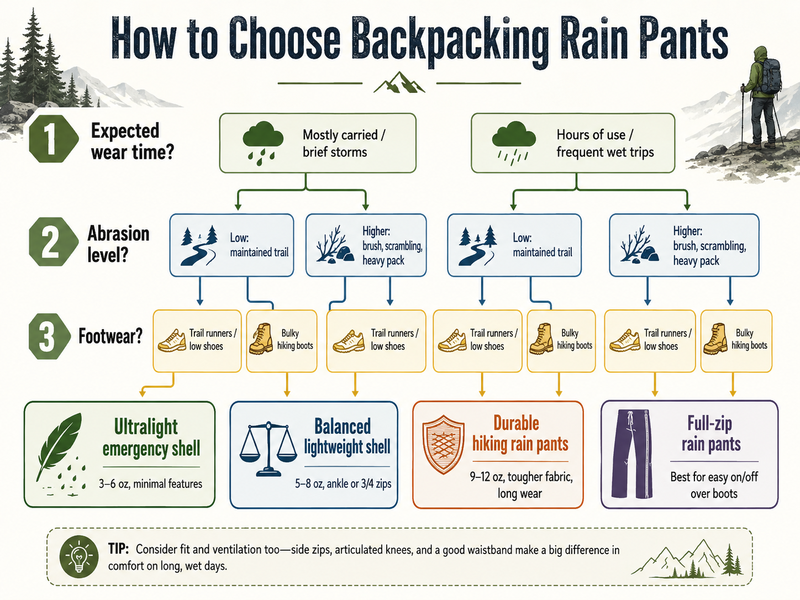
This is the biggest decision. If rain pants live in the bottom of your pack on mostly dry trips, every unnecessary ounce is carried all day for a short period of use. That favors models such as the Helium UL, Vertice, and Phantom. If your route has a real chance of hours or days in rain, a tougher three-layer shell or a well-vented midweight pant becomes much easier to justify.
2. Treat denier as context, not a universal durability score
Face-fabric denier helps explain why a 7D racing shell and a 50D hiking shell feel like different tools, but denier alone does not tell you membrane quality, weave strength, seam construction, or real-world longevity. Use it as one signal. Wet brush, pack contact, rock, and repeated kneeling all increase abrasion.
3. Match zipper length to your footwear
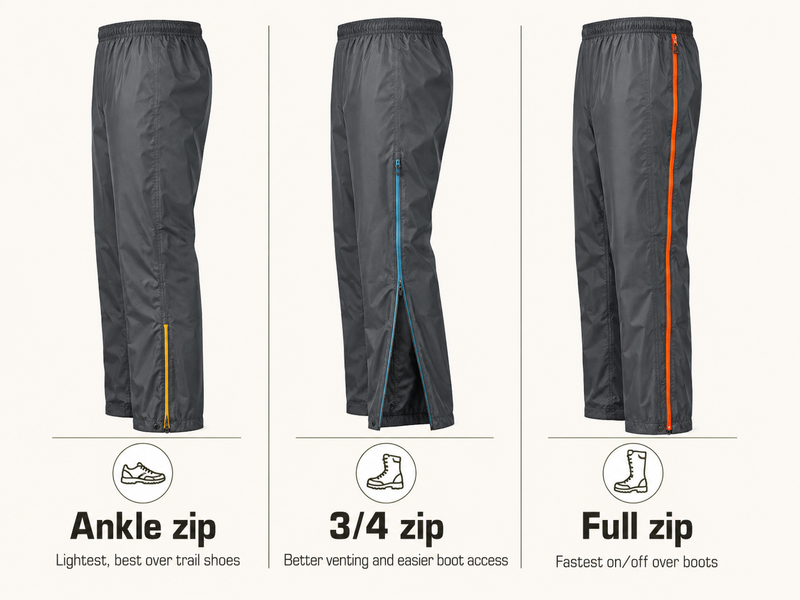
Short ankle zips are usually enough for trail shoes and some low hiking footwear. Three-quarter zips make boot transitions easier and add useful ventilation. Full-length zips are the easiest option when you want to step into the pants without removing footwear. Test the exact combination at home before a remote trip.
4. Do not confuse waterproof with sweat-proof
All waterproof shells restrict vapor movement compared with open hiking fabric. If you are climbing hard, moisture inside the pants can be sweat or condensation rather than membrane failure. Long side zips, lighter base layers, pacing, and early ventilation can matter more than small differences between lab figures.
5. Check the whole lower-body system
Put your rain pants on over the actual hiking pants or base layer you plan to wear. Check knee mobility, waistband security beneath a hipbelt, hem overlap, boot clearance, and whether you can reach the pockets you actually need. If waterproof shells are not the main need, compare our best quick-dry pants for backpacking. For foot protection, see our guide to waterproof hiking socks.
Which rain pants should you choose for your trip?
Mostly dry three-season backpacking
Outdoor Research Helium UL is the easiest recommendation. It keeps carried weight low without moving all the way into an extreme two- or three-ounce shell.
Long-distance thru-hike with an ultralight kit
Zpacks Vertice makes sense when ounces saved across the entire system matter more than long zippers and pockets. Rab Phantom is another extremely light option, especially for fast movement and maintained routes.
Wet climate or repeated shoulder-season storms
Patagonia Torrentshell 3L is the more balanced choice for sustained wear. Move to the Outdoor Research Foray 3L when maximum protection and a more technical feature set justify another weight penalty.
Boots and frequent layer changes
REI Rainier is the most convenient design here because its full-length zips minimize the need to remove footwear. The Rab Downpour and Mountain Hardwear Stretch Ozonic offer lighter three-quarter-zip compromises.
Budget matters more than base weight
Columbia Rebel Roamer II keeps the design simple and fully seam sealed. You give up long zips and a published ultralight weight, but the core rain-shell function remains clear.
Rain-pant care and weather-protection limits
A durable water-repellent finish helps water bead on the face fabric, but DWR is not the waterproof membrane itself. Dirt, body oils, and worn surface treatment can make fabric wet out sooner and reduce comfort. Follow the exact manufacturer’s wash and drying instructions instead of assuming every waterproof shell needs the same detergent, heat, or reproofing treatment.
Inspect cuffs, seam tape, and zipper sliders before remote trips. Carry a repair product that is compatible with the fabric. None of these pants should be treated as protective equipment for wildfire, chemical exposure, or work around open flame.
Finally, keep your shell accessible. A rain pant buried below your sleep system is far less useful when a squall arrives. Our backpack packing guide explains how to keep weather layers reachable without turning the outside of the pack into clutter.
Frequently asked questions
Do backpackers really need rain pants?
They are most valuable in cold rain, wind, exposed terrain, and trips where staying wet for a long time would create a real safety or comfort problem. In warm and sheltered conditions, some hikers prefer quick-dry pants or a rain kilt. Temperature, storm duration, wind, terrain, and bailout options matter more than a universal yes-or-no rule.
How much should backpacking rain pants weigh?
There is no single ideal weight. Roughly 2.5–6 ounces covers minimalist and lightweight emergency-oriented pants, while many more durable or feature-rich hiking shells land around 9–14 ounces. Choose the lightest design that still fits your expected wear time, abrasion, footwear, and ventilation needs.
Can rain pants go over hiking boots?
Some can. Full-length and three-quarter zippers are the safest designs for larger footwear. Ankle zips may work with trail runners and lower-volume boots. Always test the exact boot, gaiter, and rain-pant combination before the trip.
Are 3-layer rain pants better than 2.5-layer pants?
Not automatically. Three-layer construction usually makes more sense for repeated or extended wear, but it generally costs more weight and bulk. A lighter 2.5- or 2.75-layer pant can be the better backpacking choice when it will spend most of the trip packed.
Why do I feel wet inside waterproof rain pants?
Perspiration and condensation are common causes, especially on climbs. Ventilate early, reduce unnecessary insulation, and consider pace and temperature before assuming the waterproof membrane has failed. Face-fabric wet-out can also reduce comfort even when the membrane is still blocking external water.
What is the difference between waterproof pants and water-resistant hiking pants?
Waterproof rain pants use a waterproof construction with sealed seams to block sustained external water. Water-resistant hiking pants are generally more breathable and comfortable in dry conditions but are not substitutes for a true rain shell in prolonged rain.