
Gear & Home is reader-supported. As an Amazon Associate I earn from qualifying purchases. When you buy through links on our site, we may earn an affiliate commission, at no extra cost to you. Learn more.
Category: Info Guide
Focus: Sleeping pads
Time to Read: 18 minutes
Ever woken up at 3 AM in your tent, teeth chattering despite your expensive sleeping bag? The culprit probably wasn’t your bag at all—it was the cold ground sucking heat from your body through an under-insulated sleeping pad.
Here’s the problem: Most beginners focus entirely on sleeping bag temperature ratings while ignoring their pad’s insulation. The result? You could have a -20°F sleeping bag but still freeze in 40°F weather if your sleeping pad’s R-value is too low. The cold ground is relentless, and without proper insulation beneath you, no sleeping bag can keep you warm.
This guide will decode the sleeping pad R-value system so you can choose the right insulation for your adventures. We’ve tested dozens of pads in temperatures from muggy summer nights to sub-zero winter camps, and we’ll share exactly what R-value you need for different conditions—plus the surprising factors that affect how warm you’ll actually sleep.
Quick Answer ✓
R-value measures your sleeping pad’s thermal resistance—higher numbers mean better insulation from cold ground. For summer camping, aim for R-value 1-2.5. Three-season adventurers need R-value 2.5-4. Winter camping demands R-value 4.5 or higher.
Key Takeaways:
- R-values are now standardized (ASTM F3340), making comparisons accurate across brands
- You lose more heat to the ground than to air—pad insulation matters more than you think
- R-values are additive: stack pads to boost warmth for cold conditions
- Cold sleepers should add 1-1.5 to recommended R-values
Learn more about complete sleep systems in our Complete Backpacking Sleep System Guide.
Table of Contents
What Is R-Value? The Science Behind the Number
R-value measures thermal resistance—essentially, how well your sleeping pad resists heat flow from your warm body to the cold ground. The “R” stands for resistance, and it’s the same metric used in home insulation.
In the outdoor world, sleeping pad R-values typically range from 1.0 (minimal insulation, summer use only) to 8.0 or higher (extreme cold weather protection). Each point increase represents significantly better insulation.
The ASTM F3340 Standard: Why It Matters
Before 2020, R-value testing wasn’t standardized. Different brands used different methods, making comparisons unreliable. One company’s “R-3” might perform like another’s “R-2.”
The outdoor industry adopted the ASTM F3340-18 standard, which provides consistent testing conditions across all manufacturers. Now when you see an R-value rating, you can trust it’s been measured the same way regardless of brand.
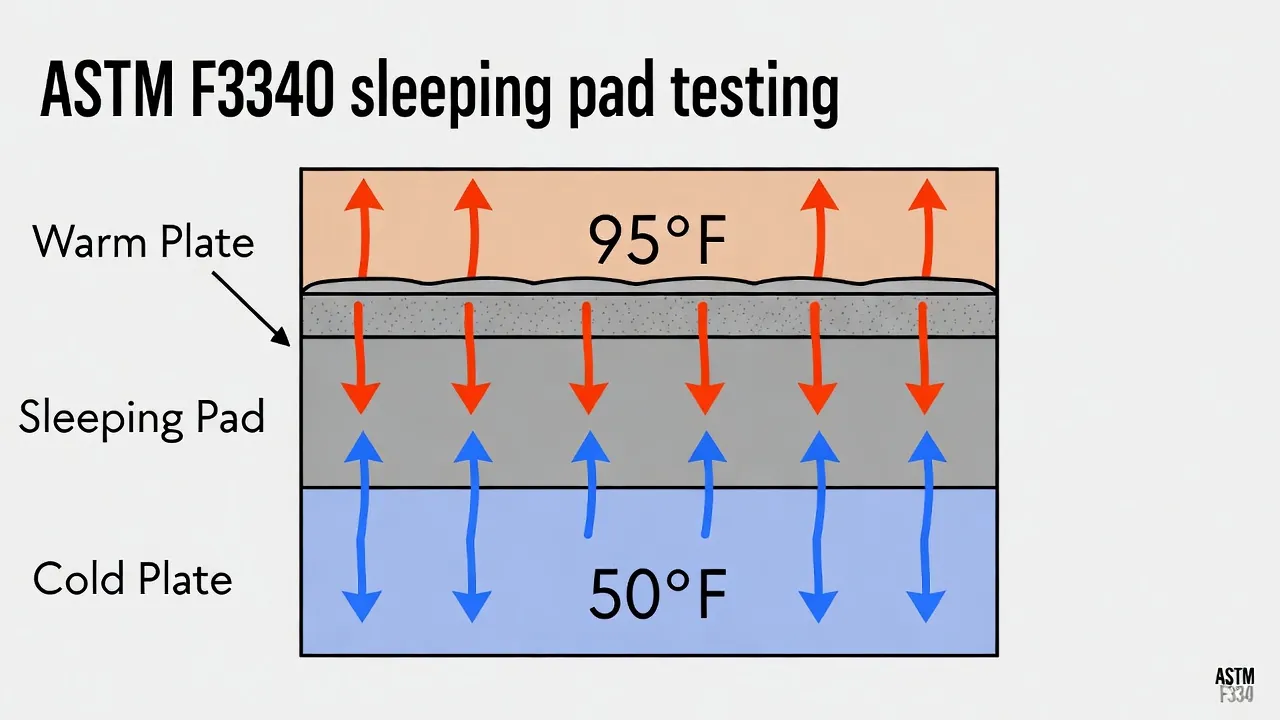
What the test measures: A sleeping pad is placed between a warm plate (95°F, simulating your body) and a cold plate (50°F, simulating cold ground). The test measures how much heat flows through the pad. Better insulation means less heat transfer and a higher R-value.
How R-Value Relates to Temperature
R-value doesn’t directly translate to a specific temperature rating—it measures insulation resistance, not comfort zones. Your actual warmth depends on multiple factors: your sleeping bag, clothing, metabolism, whether you’re a hot or cold sleeper, ground conditions, and more.
That said, the outdoor community has developed general guidelines connecting R-values to temperature ranges based on years of field experience.
R-Value Chart: What You Need for Different Conditions
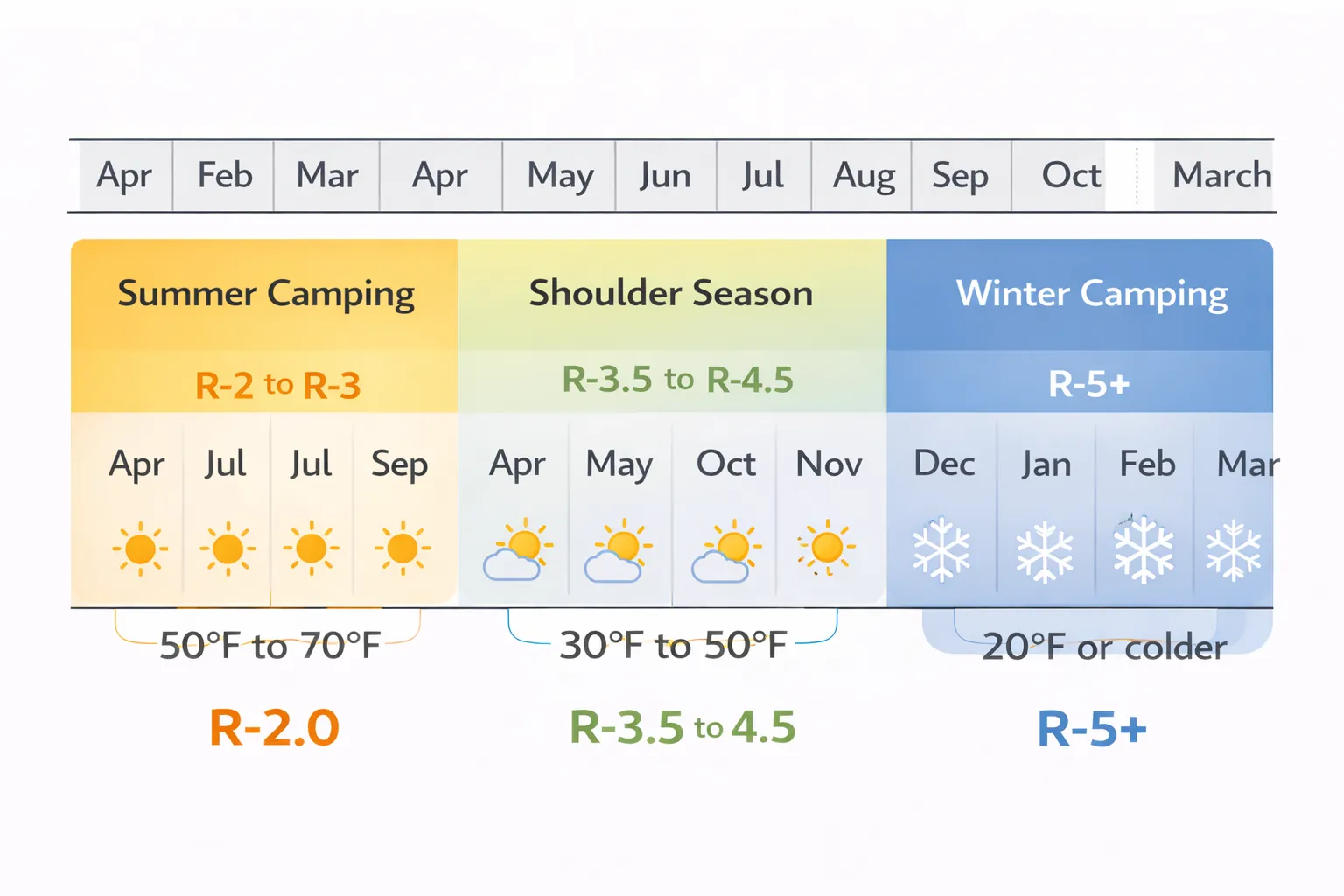
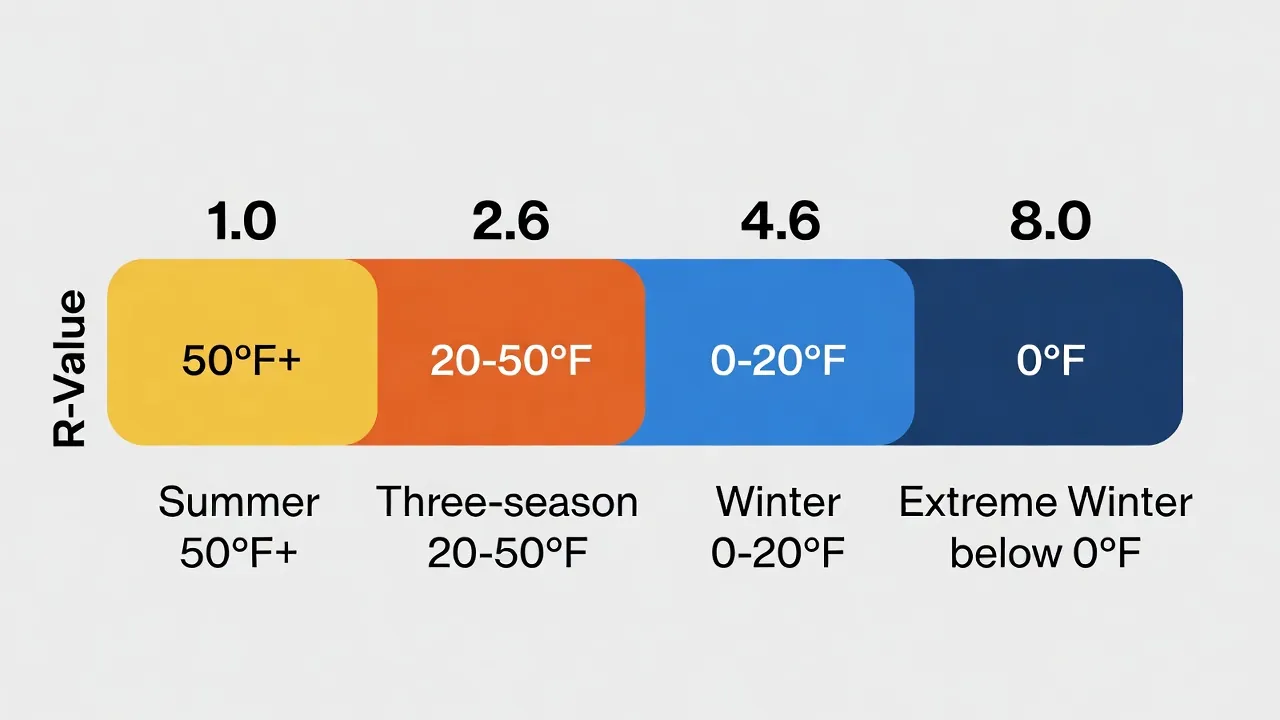
Use this chart as your starting point for selecting sleeping pad insulation. Remember: these are guidelines for average sleepers. We’ll discuss adjustments for cold and hot sleepers below.
| R-Value Range | Temperature Range | Season | Best For |
|---|---|---|---|
| 1.0 – 2.0 | 50°F and above | Summer | Warm weather car camping, tropical backpacking, indoor use |
| 2.1 – 3.5 | 35°F – 50°F | Late spring to early fall | Summer backpacking, shoulder season camping |
| 3.6 – 4.5 | 20°F – 35°F | Three-season | Most backpacking trips, alpine camping, cool weather |
| 4.6 – 6.0 | 0°F – 20°F | Cold weather | Late fall, winter camping, high elevation, cold climates |
| 6.1+ | Below 0°F | Extreme winter | Mountaineering, arctic conditions, serious winter camping |
Real-World Temperature Testing Insights
In our field testing across Montana’s Beartooth Wilderness, we learned that ground conditions dramatically affect these numbers. During a September trip with overnight lows around 28°F, testers using R-3.5 pads reported being “just comfortable” on forest duff but “uncomfortably cold” when camping on rocky alpine terrain just 1,000 feet higher.
The lesson: these temperature ranges assume reasonably insulated ground (forest soil, meadow grass). Sleeping on snow, ice, or cold rock subtracts at least 10-15°F from the comfort range. When winter camping on snow, we recommend adding at least 1.0 to your target R-value.
How to Choose Your Sleeping Pad R-Value
Selecting the right R-value requires honest assessment of three key factors: where you camp, when you camp, and how you sleep.
Step 1: Identify Your Coldest Camping Conditions
Don’t choose based on average conditions—select for the coldest nights you’ll encounter. If you mostly camp in summer but plan one spring trip where lows might hit 30°F, choose for that 30°F scenario.
Pro tip: Check historical weather data for your camping areas. Sites like Weather Underground show historical temperatures for specific dates and locations. We look at the record low for our target camping month, then add 10°F as a safety buffer.
Step 2: Assess Your Sleep Temperature
This is the factor most beginners ignore. People have genuinely different metabolic rates and insulation needs.
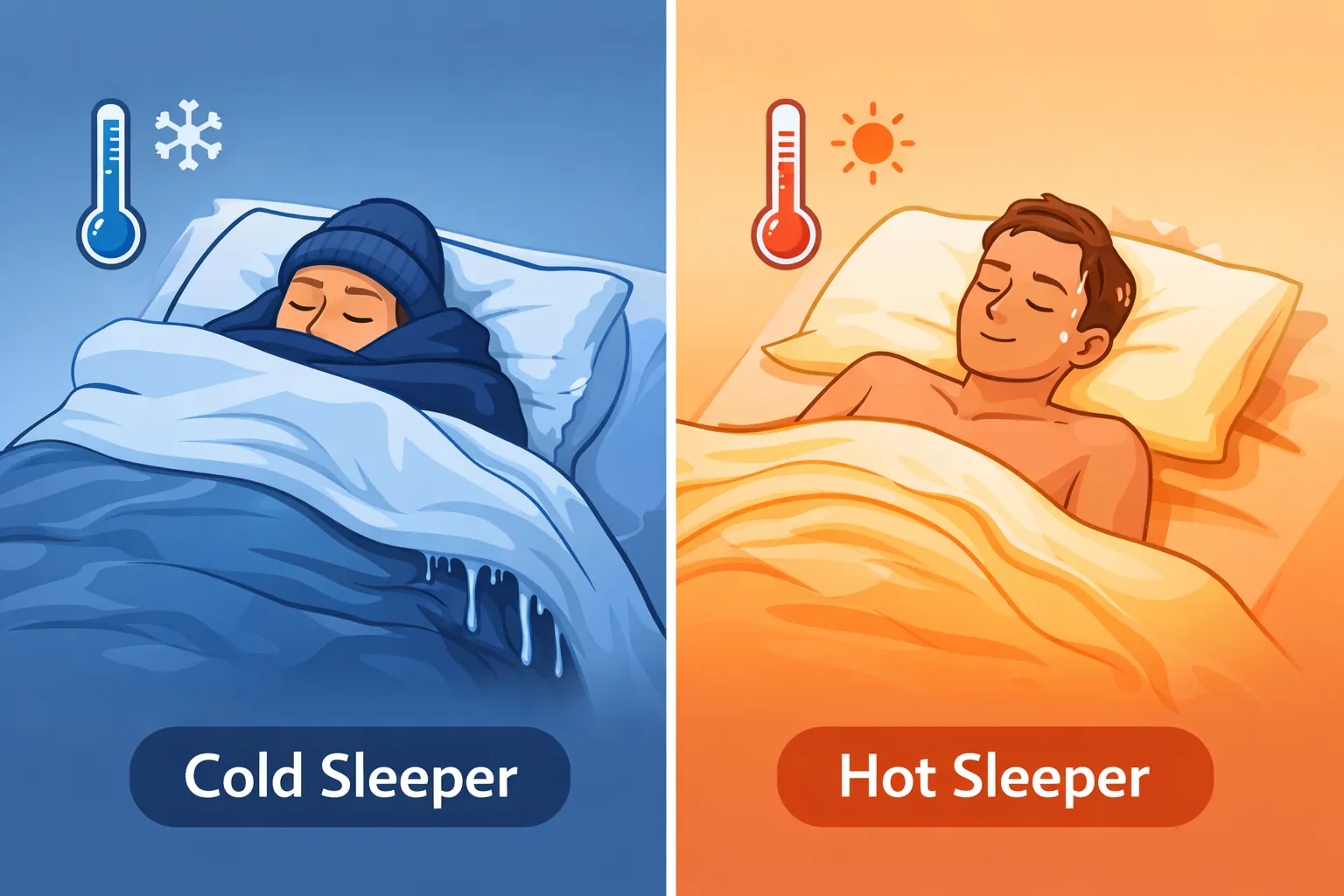
You’re likely a cold sleeper if you:
- Feel cold while others are comfortable at home
- Sleep with extra blankets year-round
- Have poor circulation or cold hands/feet
- Are petite or have low body fat
- Are female (women generally require slightly higher R-values due to metabolic differences)
You’re likely a hot sleeper if you:
- Often overheat at night
- Prefer minimal bedding
- Have higher body mass or muscle
- Run warm throughout the day
R-value adjustments:
- Cold sleepers: Add 1.0-1.5 to recommended R-value
- Hot sleepers: Subtract 0.5-1.0 (but don’t go below R-2.5 for three-season use)
Step 3: Consider Your Camping Style
Different camping scenarios demand different approaches to insulation.
Backpackers: Balance warmth with weight. A 3-season backpacker in the Rockies might choose R-4.0 (around 16-20 oz) rather than R-5.0 (24-28 oz) and compensate with warmer clothing and a better sleeping bag.
Car campers: Weight doesn’t matter. Choose 0.5-1.0 higher R-value than you think you need for maximum comfort. You can also easily double up pads for cold nights.
Bikepacking/fastpacking: Every ounce counts. Choose the minimum R-value for your conditions and layer with a foam pad if you encounter unexpected cold.
Our R-Value Recommendations by Use Case
Summer Weekend Warrior
- Target R-Value: 2.0-3.0
- Camping Season: June-September, elevations below 8,000 ft
- Why: Covers most summer trips with a safety margin for cool mountain nights
What to look for: Lightweight inflatable pads with R-values in the 2.5-3.5 range. These provide adequate warmth for summer conditions while keeping pack weight down.
Three-Season Backpacker
- Target R-Value: 4.0-4.5
- Camping Season: April-October, all elevations
- Why: Handles spring snow camping and fall cold snaps
What to look for: Insulated inflatable pads with synthetic fill or down insulation. Look for models that balance warmth with reasonable weight (15-20 oz for regular length).
Winter Camper
- Target R-Value: 5.5-7.0+
- Camping Season: Year-round, especially Nov-March
- Why: Essential for sleeping on snow; prevents dangerous heat loss
Recommended approach: Stack an inflatable (R-4 to R-5) over a foam pad (R-2) for reliability and maximum insulation. This provides redundancy if your inflatable fails and gives you combined R-6.5 to R-7.0 protection.
6 Factors That Affect Your Actual Warmth
R-value is just one piece of the puzzle. Here’s what else determines whether you’ll sleep warm.
1. Ground Surface Type
The surface beneath your tent dramatically affects heat loss. Snow and ice are excellent insulators. Rock and frozen ground are thermal sinks that pull heat away aggressively.
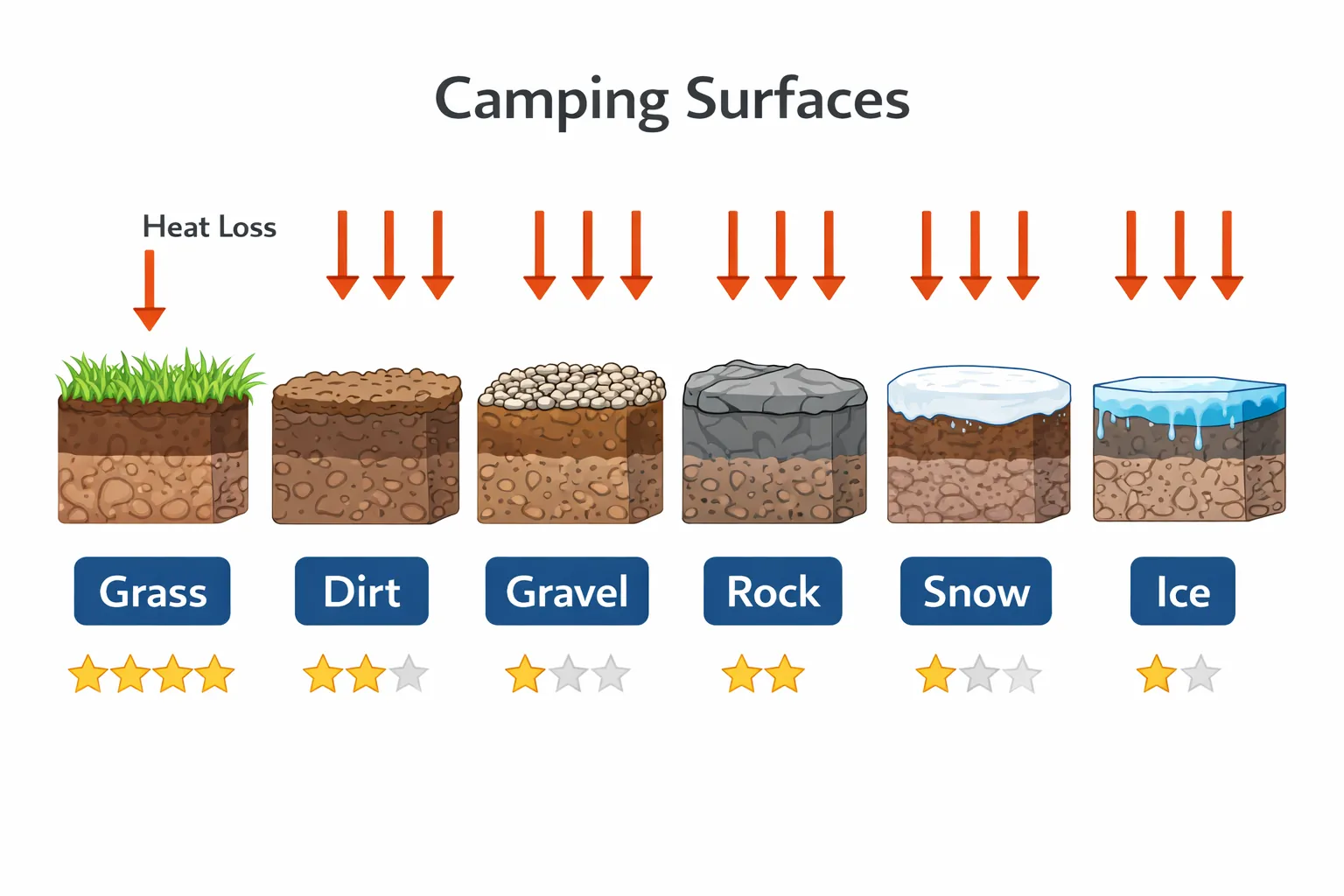
Heat loss comparison (same R-4 pad, 25°F ambient temperature):
- Forest duff/grass: comfortable
- Packed dirt: slightly cool
- Gravel/rocky: noticeably cold
- Large flat rock: very cold
- Powder snow: comfortable
- Compacted snow/ice: cold
2. Your Sleeping Bag’s Lower Limit
Your sleeping pad and bag work as a system. An R-3 pad with a 15°F bag will keep you warmer than an R-3 pad with a 35°F bag in the same conditions.
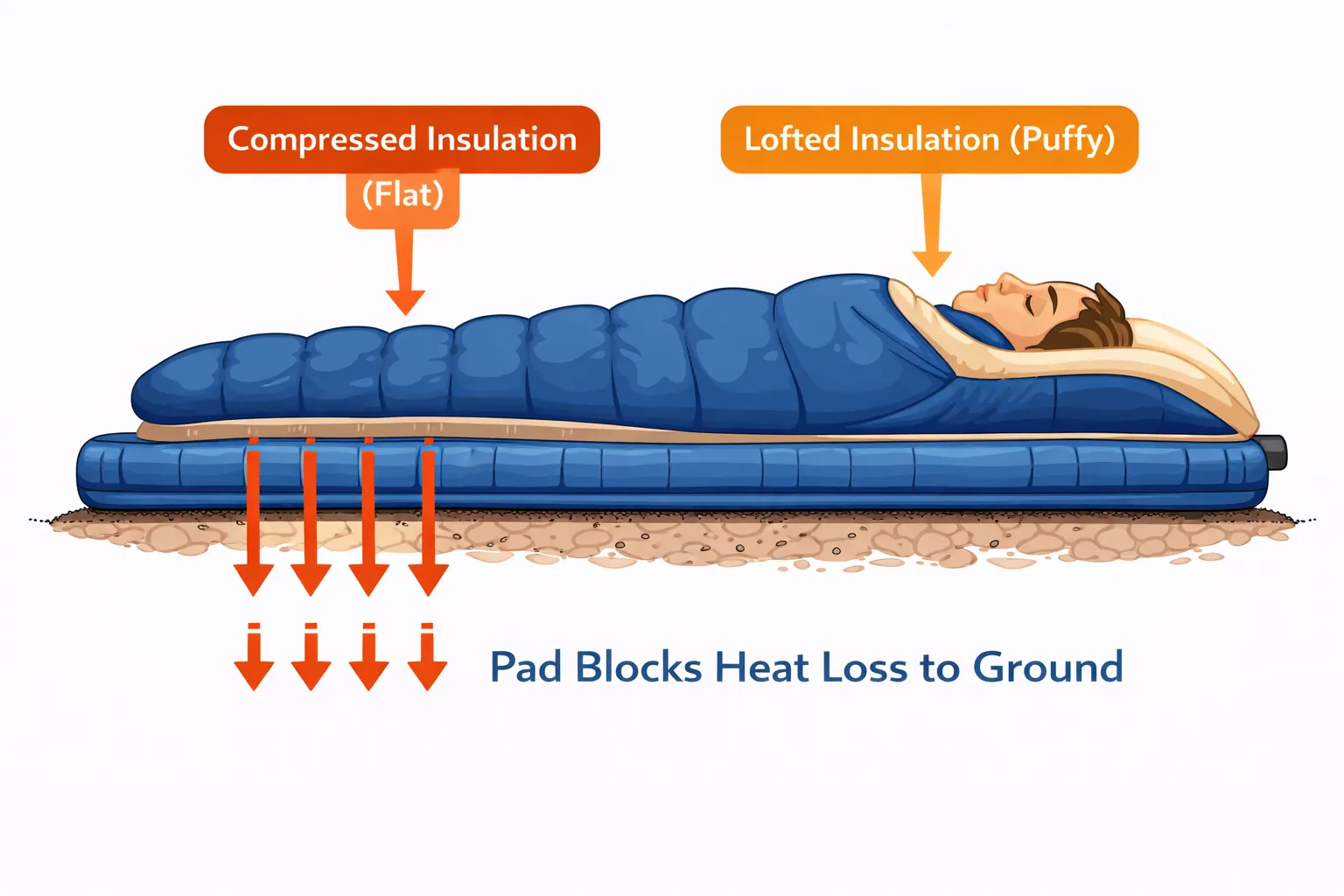
Sleeping bag manufacturers assume you’re using an adequately insulated pad when they rate their bags. The EN/ISO testing standard uses a pad with R-value 5.38. If your pad’s R-value is insufficient, your bag can’t perform to its rating.
3. Sleep Position
Side sleepers have less body contact with the pad, creating air gaps where warm air escapes. They typically need 0.5-1.0 higher R-value than back or stomach sleepers for the same warmth.
We’ve noticed side sleepers also appreciate thicker pads (3+ inches) for comfort, which usually correlates with higher R-values anyway.
4. Clothing and Shelter
Wearing a puffy jacket, insulated pants, or warm socks in your bag adds significant warmth—roughly equivalent to 0.5-1.0 R-value increase or 10-15°F comfort boost.
Similarly, your shelter matters. A 4-season tent with low ventilation stays 5-10°F warmer than a minimalist tarp. The more protected from wind, the warmer you’ll sleep.
5. Pad Inflation Level
Under-inflated pads compress more under your weight, reducing insulation effectiveness. Over-inflation creates a firm surface where you roll off the pad or compress it fully anyway.
For maximum warmth, inflate so the pad barely deforms when you lie down. You should sink slightly but not “bottom out” where you feel the ground.
6. Individual Variables
Age, fitness, hydration, food intake, and fatigue all affect your thermal regulation. A well-fed, hydrated hiker in their 20s will sleep warmer than a dehydrated, exhausted 50-year-old, even with identical gear.
During a Colorado winter trip, our team noticed that testers who ate a hot dinner and snacks before bed reported being significantly warmer overnight than those who skipped evening meals—despite using the same sleeping systems.
Stacking Sleeping Pads: Doubling Up for Winter
Here’s one of the best-kept secrets in cold weather camping: R-values are additive when you stack pads. This opens up flexible solutions for different conditions.
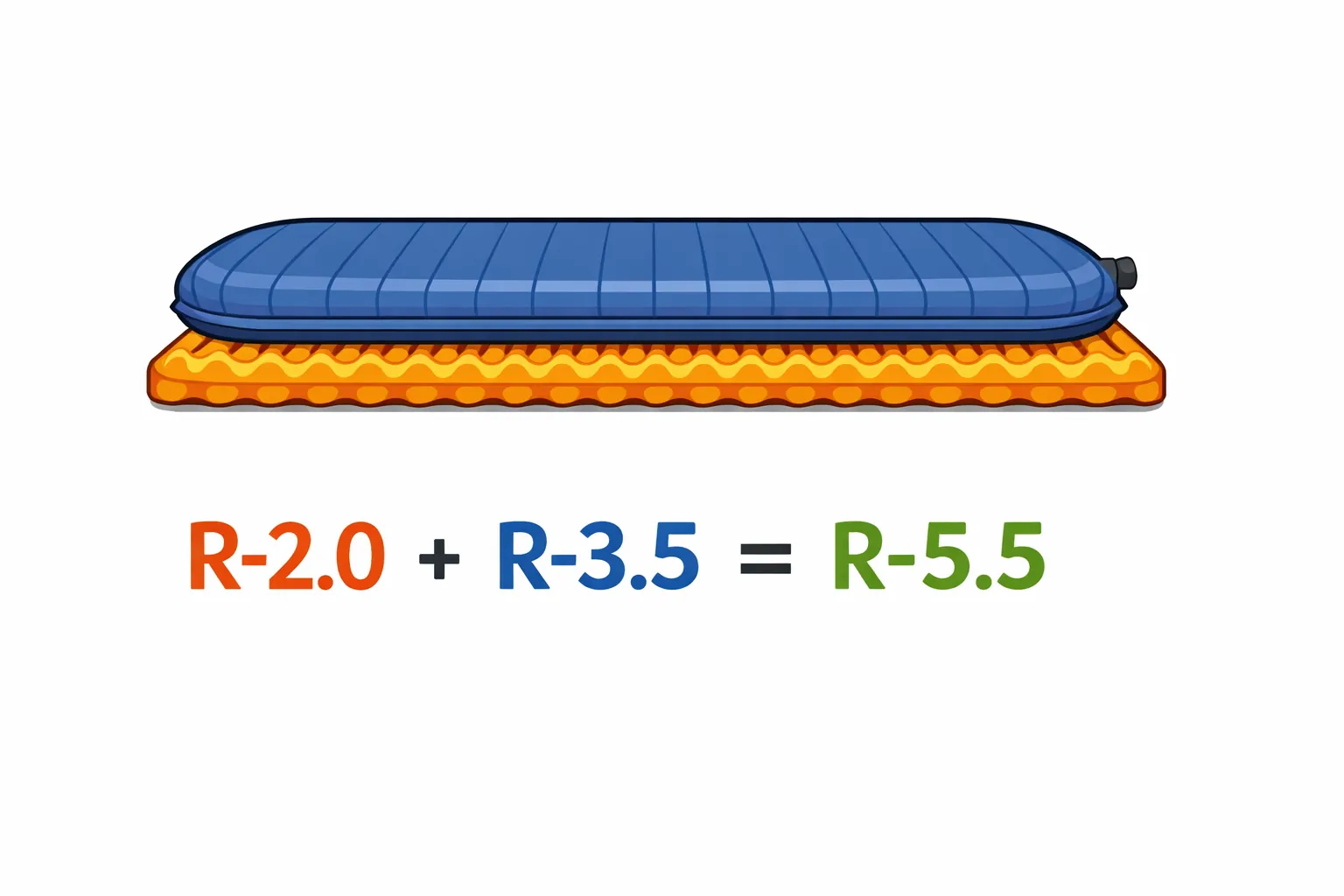
The Math of Stacking
Place one pad directly on top of another, and their R-values combine:
- Foam pad (R-2.0) + Inflatable (R-3.5) = R-5.5 total system
- Two R-2.6 foam pads = R-5.2 combined
- Budget inflatable (R-1.5) + closed-cell foam (R-2.3) = R-3.8
Why Stack Instead of Buying One High-R Pad?
Redundancy: If your inflatable develops a leak in the backcountry, you still have the foam pad for insulation rather than sleeping directly on frozen ground.
Flexibility: Use the inflatable alone for summer, add the foam pad for shoulder season, and stack both for winter. Three season capability from two pads.
Cost: Two moderate pads often cost less than one extreme cold pad. Foam pads are especially affordable ($30-60).
Durability: The bottom foam pad protects your expensive inflatable from punctures.
Practical Stacking Combinations
Budget Winter Setup (R-6.0): Closed-cell foam pad (R-2.6, around $50) underneath a mid-range insulated inflatable (R-4.4, around $80) gives you R-7.0 total for approximately $130.
Ultralight Winter Setup (R-6.3): Lightweight foam pad (R-2.0, around $55, 14.5 oz) underneath a premium ultralight inflatable (R-4.5, around $210, 15 oz) totals R-6.5 at just 29.5 oz combined weight.
Expedition Setup (R-9.3): Basic foam pad (R-2.0, around $35) underneath a high-performance winter inflatable (R-7.3, around $260) gives you R-9.3 for serious arctic and alpine missions.
Stacking Tips
- Always put the foam pad on the bottom for puncture protection
- Match pad lengths—a short foam pad under a long inflatable creates cold spots
- In survival situations, you can even stack two inflatables (though foam is more practical)
- Use a fitted sheet or quilt to prevent the top pad from sliding off
5 Common R-Value Misconceptions
Myth 1: “Thicker Pads Are Always Warmer”
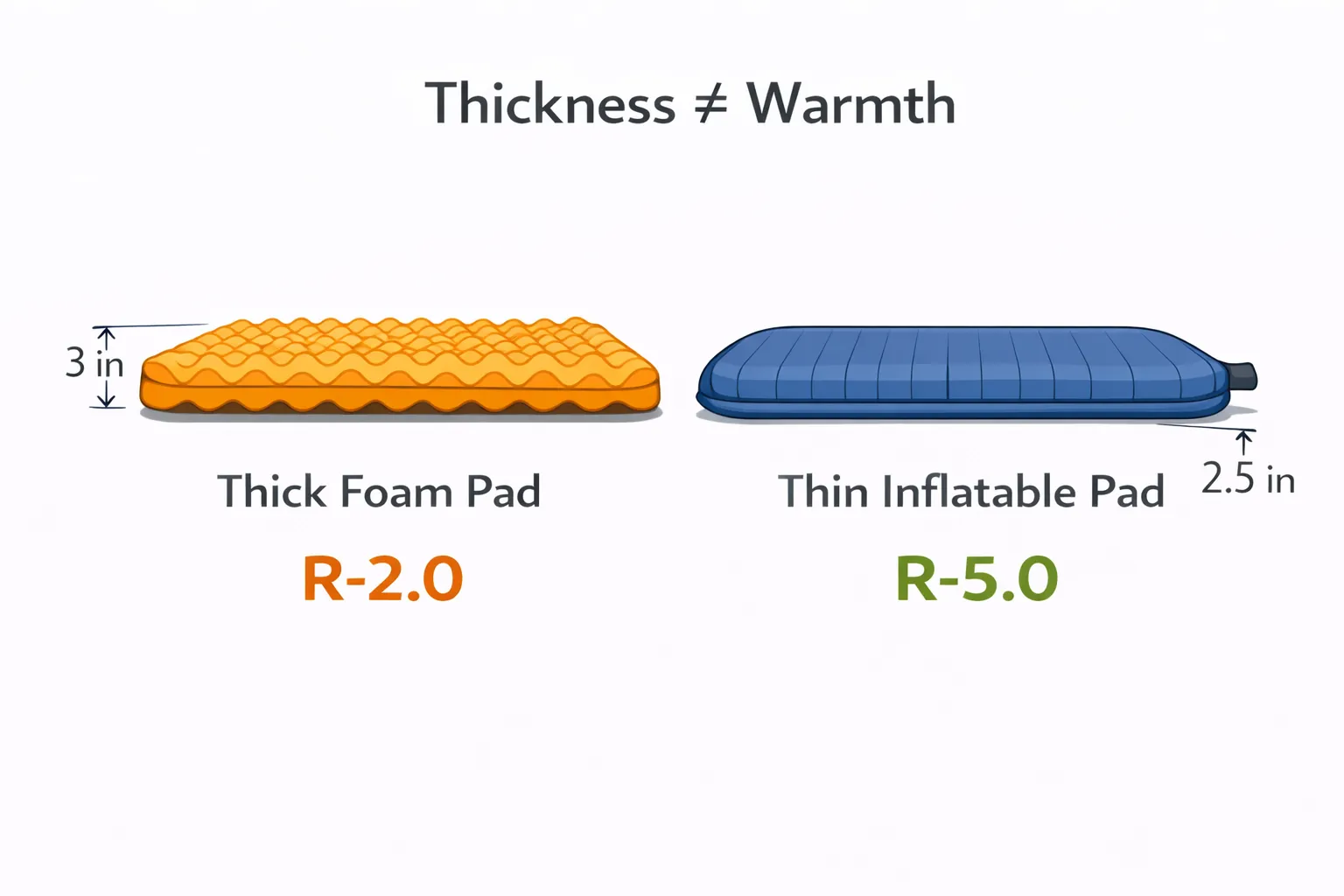
Reality: Thickness provides comfort (cushioning), not necessarily insulation. A 3-inch foam pad might have R-2.0, while a 2.5-inch insulated inflatable could have R-5.0. Materials and construction determine R-value far more than thickness.
Myth 2: “I Don’t Need High R-Value Because I Have a Warm Sleeping Bag”
Reality: Your bag’s insulation compresses to near-zero under your body weight. All insulation must come from your pad on the ground side. A 0°F bag over an R-2 pad will leave you freezing at 30°F.
Myth 3: “R-Values Are Just Marketing Numbers”
Reality: Before ASTM F3340 (2020), this was partially true. Now R-values are scientifically measured and standardized. They’re as reliable as your sleeping bag’s temperature rating—maybe more so.
Myth 4: “More Expensive Pads Have Higher R-Values”
Reality: Price often reflects weight, packed size, and comfort features, not just warmth. A $180 ultralight summer pad (R-2.5, 12 oz) costs more than a $65 winter foam pad (R-5.0, 26 oz) but provides less insulation.
Myth 5: “R-Value Doesn’t Matter for Car Camping”
Reality: You’ll still freeze on cold ground without adequate insulation, whether you drove there or hiked. Car camping actually offers the perfect opportunity to use high-R pads or stacked pads since weight isn’t a concern.
Frequently Asked Questions
What does R-value mean for sleeping pads?
R-value measures a sleeping pad’s thermal resistance or insulation capability. The number quantifies how well the pad prevents heat from your body escaping to the cold ground. Higher R-values indicate better insulation. The scale typically ranges from 1.0 (summer use only) to 8.0+ (extreme winter conditions). The measurement is standardized under ASTM F3340, making comparisons between brands accurate and reliable.
What R-value do I need for my sleeping pad?
For summer camping in temperatures above 50°F, an R-value of 1.0-2.5 is sufficient. Three-season camping (spring through fall, 20-50°F) requires R-value 2.5-4.5. Winter camping below 20°F demands R-value 4.5 or higher, with serious winter campers using R-6 to R-8. Cold sleepers should add 1-1.5 points to these recommendations, while hot sleepers can subtract 0.5-1.0 points.
Can I stack sleeping pads to increase R-value?
Yes, R-values are additive when you stack pads. If you place a foam pad with R-2.0 underneath an inflatable pad with R-3.5, your total system provides R-5.5 of insulation. This is an excellent strategy for winter camping, providing redundancy if one pad fails and allowing you to use lighter pads individually during warmer seasons. Always place the foam pad on bottom for puncture protection.
Is R-value the same as temperature rating?
No, R-value and temperature rating measure different things. R-value is a standardized measurement of insulation resistance, while temperature ratings are estimates of comfort zones that vary by manufacturer. R-value is now tested using the consistent ASTM F3340 standard, making it reliable across brands. Your actual warmth depends on your sleeping bag, clothing, metabolism, ground surface, and whether you’re a hot or cold sleeper—R-value is just one part of the equation.
Does sleeping pad thickness affect R-value?
Not necessarily. Thickness primarily affects comfort by providing cushioning, not insulation. A thick 3-inch foam pad might only have R-2.0, while a thinner 2.5-inch insulated inflatable could offer R-5.0 or higher. Materials and construction methods—such as reflective barriers, synthetic insulation, or down fill—determine R-value much more than thickness alone. Choose thickness for comfort and R-value for warmth.
How accurate are ASTM R-value ratings?
ASTM F3340 ratings are highly accurate and consistent for comparing pads across brands. The test uses controlled conditions (warm plate at 95°F, cold plate at 50°F) to measure heat flow. However, real-world performance depends on factors the test doesn’t account for: ground surface type, your sleeping bag quality, clothing worn, elevation, and personal metabolism. Treat ASTM R-values as reliable comparisons between products rather than absolute guarantees of warmth at specific temperatures.
Why do some cheap pads have high R-values?
Foam pads achieve high R-values (R-2 to R-3) inexpensively because closed-cell foam is naturally insulating and requires no complex construction. Budget inflatable pads may use synthetic insulation or reflective layers to boost R-value affordably, though they often sacrifice features like weight, packed size, or durability. A $40 foam pad can legitimately offer similar insulation to a $180 inflatable—you’re paying more for packability, comfort, and convenience, not just warmth.
Do I need different R-values for summer and winter?
Most campers benefit from owning two pads or using a stacking system. A lightweight R-2.5 to R-3.5 pad handles summer perfectly while keeping pack weight down. For winter, either upgrade to a dedicated R-5+ pad or add a foam pad beneath your summer inflatable to boost the combined R-value. The versatility of stacking two moderate pads often proves more practical and economical than buying separate summer and winter pads.
Final Recommendations: Choosing Your Perfect R-Value
Understanding sleeping pad R-value transforms you from someone guessing at gear to someone making informed decisions. The difference between a miserable night and restorative sleep often comes down to this single number.
Your Action Plan
Before buying your next sleeping pad, follow these steps:
- Identify your coldest camping scenario using historical weather data
- Determine if you’re a cold or hot sleeper and adjust R-value accordingly
- Decide on weight vs. warmth priorities based on your camping style
- Consider stacking two pads for maximum versatility and redundancy
- Match your pad to your sleeping bag for a complete sleep system
Don’t Forget the Rest of Your Sleep System
Your sleeping pad is only one component of staying warm. Pair it with the right gear:
- Choose a sleeping bag appropriate for your coldest expected conditions
- Add a proper pillow for better sleep quality and neck support
- Consider a sleeping bag liner for an extra 10-15°F of warmth
- Layer strategically with insulated clothing inside your bag when temps drop
The right R-value means the difference between enduring the outdoors and genuinely enjoying it. Now that you understand thermal resistance, you can sleep confidently in any condition you’re prepared to face.